SB 79 Thread #2, part 1: Big Open Legal Questions
I will cover:
1) general principles for construing SB 79;
2) CEQA;
3) demolitions
1/
I will cover:
1) general principles for construing SB 79;
2) CEQA;
3) demolitions
1/
https://twitter.com/CSElmendorf/status/1966910007141867675
Start w/ general principles. Will judges interpret SB 79 w/ strong thumb on scale in favor of housing?
No.
Two of CA's big housing laws explicitly instruct judges to construe them broadly (Density Bonus Law, Housing Accountability Act). SB 79 does not.
/2
No.
Two of CA's big housing laws explicitly instruct judges to construe them broadly (Density Bonus Law, Housing Accountability Act). SB 79 does not.
/2
That SB 79 passed w/ incredibly narrow margins, after all manner of compromises, also warrants cautious interpretation.
@DBRodriguez5 & Weingast's great paper, "The Positive Political Theory of Legislative History," should be required reading for judges in SB 79 cases.
/3
@DBRodriguez5 & Weingast's great paper, "The Positive Political Theory of Legislative History," should be required reading for judges in SB 79 cases.
/3

Building on earlier work by Posner & others, Rodriguez & Weingast argue that judges should try to identify enforce the "terms of the deal" when big bills get whittled through committee processes.
/4
/4
If judges just construed the statute in line w/ their conception of public interest (rather than trying to give effect to leg compromises), legislators would have less incentive to work on hard problems & those who oppose controversial bills would be more obstructionist.
/5
/5
In sum, we shouldn't expect or even hope that judges will save the good parts of SB 79 from the bad.
The most we can reasonably hope is that judges will defer to @California_HCD (which Leg put in charge of implementation) when text & leg history of SB 79 is unclear.
/6
The most we can reasonably hope is that judges will defer to @California_HCD (which Leg put in charge of implementation) when text & leg history of SB 79 is unclear.
/6

That's enough preliminaries, now to the specific issues.
Issue #1: CEQA.
Can SB 79 projects use @BuffyWicks's awesome "plain bagel" CEQA exemption for infill housing, enacted via trailer bill AB 130 last summer?
/8
Issue #1: CEQA.
Can SB 79 projects use @BuffyWicks's awesome "plain bagel" CEQA exemption for infill housing, enacted via trailer bill AB 130 last summer?
/8
I *think* SB 79 projects will be AB 130 eligible, but it's a bit tricky.
AB 130 (like previous, weaker CEQA exemptions) requires projects to comply w/ applicable gen. plan & zoning standards. But SB 79 requires cities to waive standards. Is that disqualifying under AB 130?
/9
AB 130 (like previous, weaker CEQA exemptions) requires projects to comply w/ applicable gen. plan & zoning standards. But SB 79 requires cities to waive standards. Is that disqualifying under AB 130?
/9


In last year's builder's remedy bill (AB 1893), the Leg resolved the analogous question by "deeming" locally-noncompliant projects to be complaint for all purposes of state law.
SB 79 doesn't include such language.
/10
SB 79 doesn't include such language.
/10

Rather, in same paragraph where it declares projects to be "consistent" w/ local standards *for purposes of the HAA*, SB 79 says that it does not require ministerial approval or otherwise "modify" the requirements of CEQA.
A court could point to this paragraph,...
/11
A court could point to this paragraph,...
/11
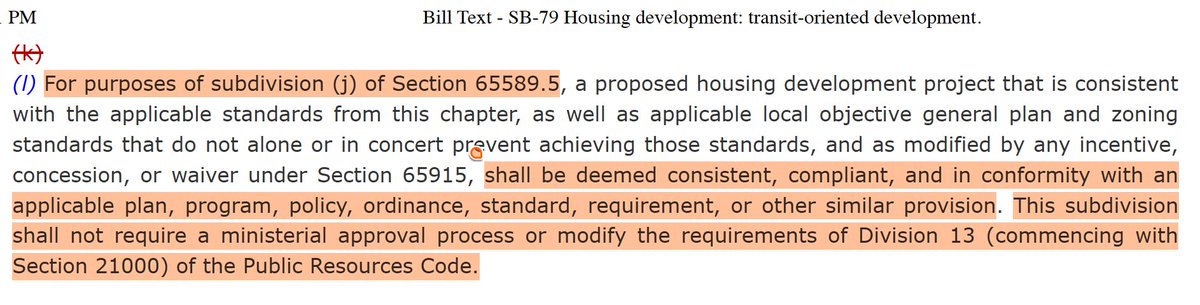
contrast the text of SB 79 w/ text of AB 1893, and say, "Sorry, SB 79 projects aren't CEQA exempt."
Or, a court could say that AB 130 only requires compliance w/ "applicable" standards, that preempted standards aren't "applicable," so SB 79 projects qualify for AB 130.
/12
Or, a court could say that AB 130 only requires compliance w/ "applicable" standards, that preempted standards aren't "applicable," so SB 79 projects qualify for AB 130.
/12
Ultimately, I think the vast majority of SB 79 projects will become AB 130 eligible through cities' enactment of "local implementation ordinances" per GC 65912.160 & 65912.161.
The enactment of these ordinances is expressly CEQA-exempt.
/13
The enactment of these ordinances is expressly CEQA-exempt.
/13
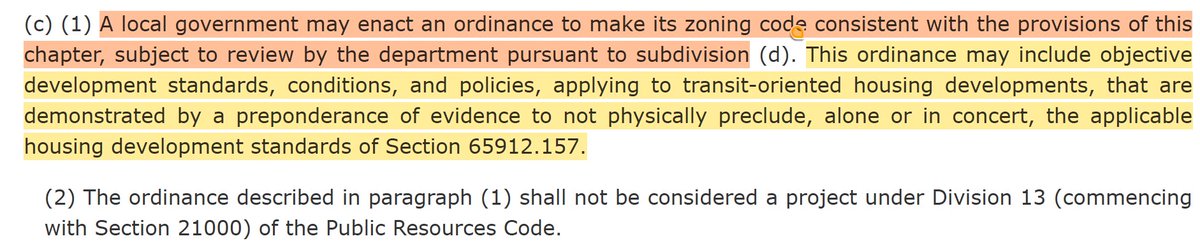
And once a local-implementation ordinance exists, a project that conforms to it will clearly be AB 130-eligible, as the project will comply with the local general plan & zoning standards that are applicable per local law.
/14
/14
In fact, a one-sentence ordinance stating, "Our city will comply with SB 79, granting waivers from any local development standard that 'physically precludes' a qualifying project or that is otherwise preempted by SB 79" would suffice to make SB 79 projects AB 130-eligible.
/15
/15
Given that reality, and given that the Leg expressly exempted SB 79 implementation ordinances from CEQA, a court might say it's just common sense that that SB 79 projects are AB-130 eligible whether or not a city has adopted an implementing ordinance.
/16
/16
Issue #2: Demolitions
An SB 79 project "shall comply with any applicable local demolition and antidisplacement standards...."
Could city negate SB 79 by barring, say, any "substantial alteration" of "any existing structure," even parking lots?
/17
An SB 79 project "shall comply with any applicable local demolition and antidisplacement standards...."
Could city negate SB 79 by barring, say, any "substantial alteration" of "any existing structure," even parking lots?
/17

Potentially, but there are a few checks:
- the demo ordinance can't apply just to SB 79 projects (but that's a mixed blessing, b/c it could incentivize city to restrict demolitions more broadly!)
- the demo standard can't be subjective, or else HAA will vitiate it
/18
- the demo ordinance can't apply just to SB 79 projects (but that's a mixed blessing, b/c it could incentivize city to restrict demolitions more broadly!)
- the demo standard can't be subjective, or else HAA will vitiate it
/18
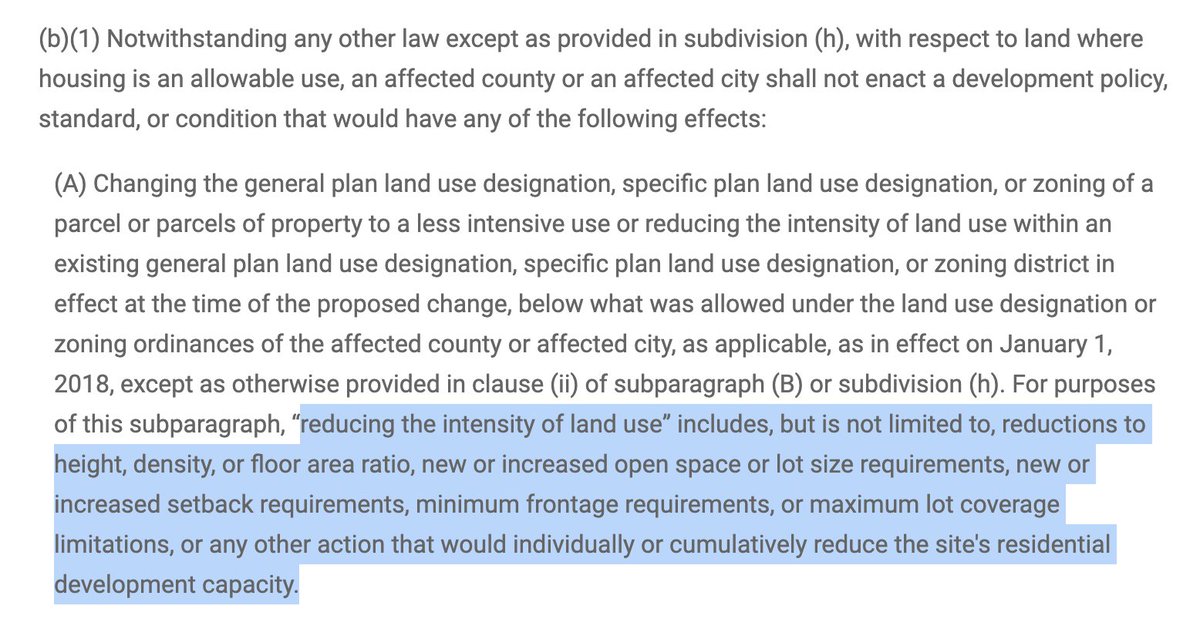
- it's *possible* that the demo ordinance would violate the "no backsliding" proviso of the Housing Crisis Act, which says cities can't make their land-use rules more restrictive than the year-2018 baseline. See GC 66300.
/19
/19
The text of GC 66300 is broad enough to nail demo controls ("any other action that would individually or cumulatively reduce the site's residential development capacity").
But the textual examples may support a narrower interp. (limits on building up, not tearing down).
/20
But the textual examples may support a narrower interp. (limits on building up, not tearing down).
/20
Another, more practical consideration: cities that restrict demos would have to grant wild waivers for front-yard and rear-yard towers, since developers are entitled to the SB 79 heights & floor-area ratios insofar as they can achieve it consistent w/ city's demo controls.
/21
/21
Finally, @California_HCD could curtail demo controls through its review of local implementation plans & its guidelines for counting SB 79 capacity for purposes of RHNA. More on this in a future 🧵 on "advice for HCD."
/22
/22
Part 2 of this 🧵 will address three more legal issues:
4) SB 79 in cities whose implementation ordinance may be unlawful;
5) waivers & reductions in local standards under SB 79;
6) transit-agency zoning
Stay tuned.
/end
4) SB 79 in cities whose implementation ordinance may be unlawful;
5) waivers & reductions in local standards under SB 79;
6) transit-agency zoning
Stay tuned.
/end
@threadreaderapp unroll
@threadreaderapp unroll
• • •
Missing some Tweet in this thread? You can try to
force a refresh