Abdel Abdellaoui Profile picture
Sep 16, 2025 9 tweets 4 min read Read on X
The largest study on late life virginity, based on > 400k individuals, out now in @PNASNews

Open access link:

Shoutout to shared first author @laurawesseldijk ❤️

Thread below 👇🏽 pnas.org/doi/10.1073/pn…Image
Sex is central to human wellbeing.

~1% of people never have sex. While some people simply don’t want sex, for others, no partner can mean loneliness, lower wellbeing, or even economic disadvantage.

No sex is also interesting for genetics as it is an evolutionary “dead end”. Image
Sexless individuals reported:
- More loneliness, nervousness, unhappiness
- Fewer close relationships & social connections
- Less alcohol & drug use

Patterns differed by sex: for men, physical strength, income, and social connection mattered more. Image
Where you live matters too.

Men in regions with fewer women were more likely to be sexless.

Sexlessness was also more common in regions with higher income inequality. Image
Image
Thousands of genetic variants with very tiny effects together explain ~15% of variation. The genetic correlation between men and women is .56.

Ancient DNA shows an allele significantly associated with sexlessness declined over 12,000 years, consistent with natural selection. Image
Genes linked to sexlessness overlap with genes associated with:
- Higher education & IQ
- Less substance use
- Higher autism & anorexia risk
- Lower ADHD, anxiety, depression & PTSD risk Image
Sexlessness is relevant to wellbeing and evolution. But it’s also a complex behavioral trait: its genetic associations trace back to many other traits and environments.

The associations we find are correlational and likely to be culture-specific, so more research is needed. Image
Many thanks to my co–first author @laurawesseldijk (🥰), co–last authors Brendan Zietsch & Karin Verweij, and all other co-authors ❤️

Check out the paper here: pnas.org/doi/10.1073/pn…
@laurawesseldijk Brendan Zietsch wrote a good and accessible summary of our paper here: theconversation.com/1-of-people-do…

• • •

Missing some Tweet in this thread? You can try to force a refresh

 

Keep Current with Abdel Abdellaoui

Abdel Abdellaoui Profile picture

Stay in touch and get notified when new unrolls are available from this author!

Read all threads

This Thread may be Removed Anytime!

PDF

Twitter may remove this content at anytime! Save it as PDF for later use!

Try unrolling a thread yourself!

how to unroll video
  1. Follow @ThreadReaderApp to mention us!

  2. From a Twitter thread mention us with a keyword "unroll"
@threadreaderapp unroll

Practice here first or read more on our help page!

More from @dr_appie

Jun 21, 2025
Studying the genetics of intelligence measures can help us understand the neurobiology of cognition and neurodevelopmental conditions 🧬🧠

We estimated missing intelligence test scores in @uk_biobank to reduce bias and boost power.

Preprint:

Thread 👇 medrxiv.org/content/10.110…Image
For additional context, we’ve written a lay summary and FAQ that explain the study and how the results can and can’t be used or interpreted: medrxiv.org/content/medrxi…Image
~40% of UK Biobank participants (N~170k) never completed the fluid intelligence test, limiting power of previous GWASs and introducing bias. We addressed this by imputing missing scores using a wide range of correlated measurements, including health, behavior, and SES outcomes. Image
Read 9 tweets
Mar 26, 2025
In every civilization, people end up sorted into levels of socio-economic status (SES). We explore the history, present, and future of scientific research on the complicated relationship between SES and DNA in @NatureHumBehav 💰🧬🎓

Link:

Thread below 👇🏽 rdcu.be/efacKImage
This thread summarizes our key findings, but Twitter's format necessitates some simplification and jargon. For a more comprehensive and nuanced understanding of this complex topic, I encourage reading the full paper, which we've written to be accessible to a wider audience.
We begin with a historical overview of SES itself. Most hunter-gatherers were relatively egalitarian. With the Neolithic shift ~12,000 years ago, societies grew larger and more stratified—SES began shaping lives, and over time, potentially genomes. Image
Read 17 tweets
Aug 22, 2022
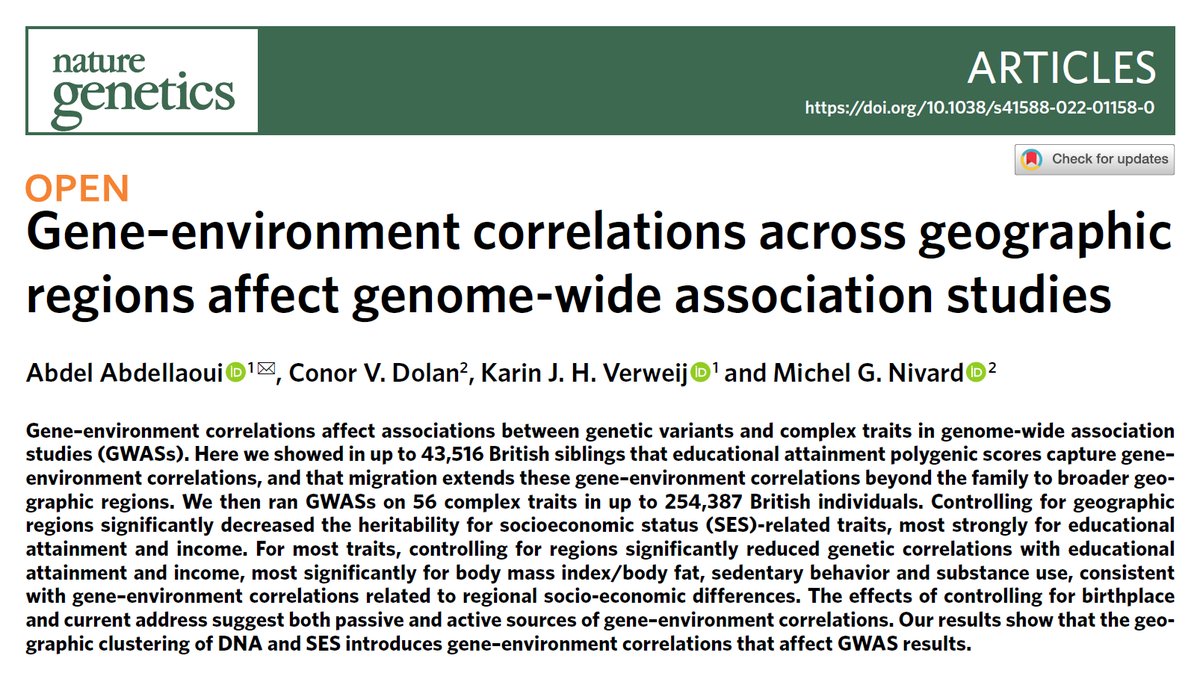
We tend to reward people with certain genetic propensities with better environments (higher SES 💰). This results in gene-environment correlations that make society more unequal and further complicate studying human genetics.

Out now in @NatureGenet: nature.com/articles/s4158…
🧵👇🏽 Image
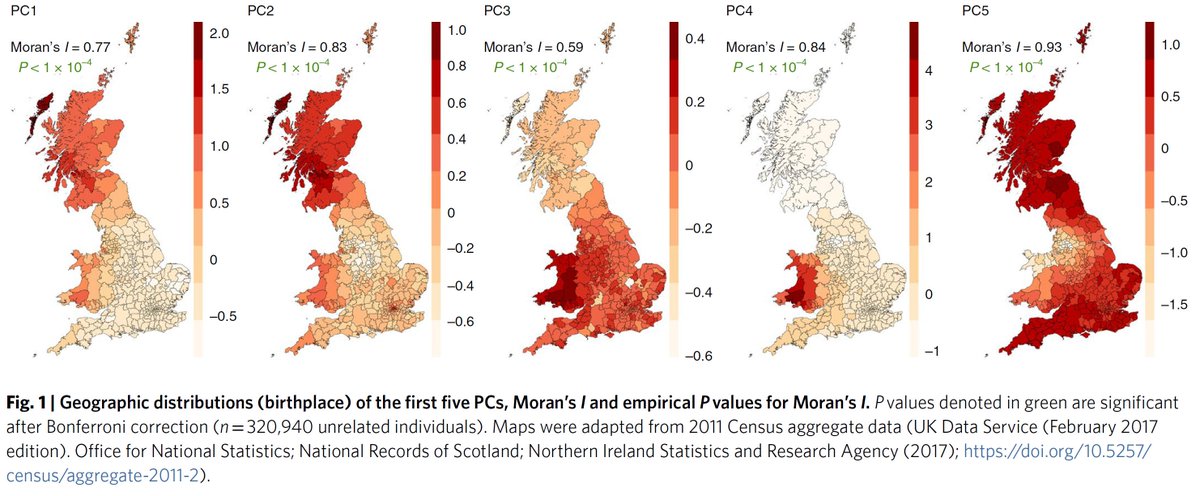
Genes associated with complex traits are not distributed randomly across geographic regions. Especially genes associated with education show regional differences in line with SES, at least in part due to migration. More on that in this older thread:
Here, we first showed in ~43k adult siblings that polygenic scores for educational attainment capture gene-environment correlations (rGE) on both a family-level and a regional level. We saw evidence for passive rGE (family you're born into) and active rGE (region you migrate to). Image
Read 11 tweets
Oct 21, 2019
Our study on the geographic distribution of human DNA in Great Britain is out in @NatureHumBehav.

You can download a general summary and FAQ document here: scribd.com/document/43055…

The article is here: nature.com/articles/s4156…

And a thread explaining the main findings below 👇🏾
@NatureHumBehav We looked at the geographic clustering of ancestry differences and complex trait variation. As expected, ancestry differences show very strong geographic clustering and very nice geographic patterns, many roughly separating Wales, England, and Scotland. 2/15
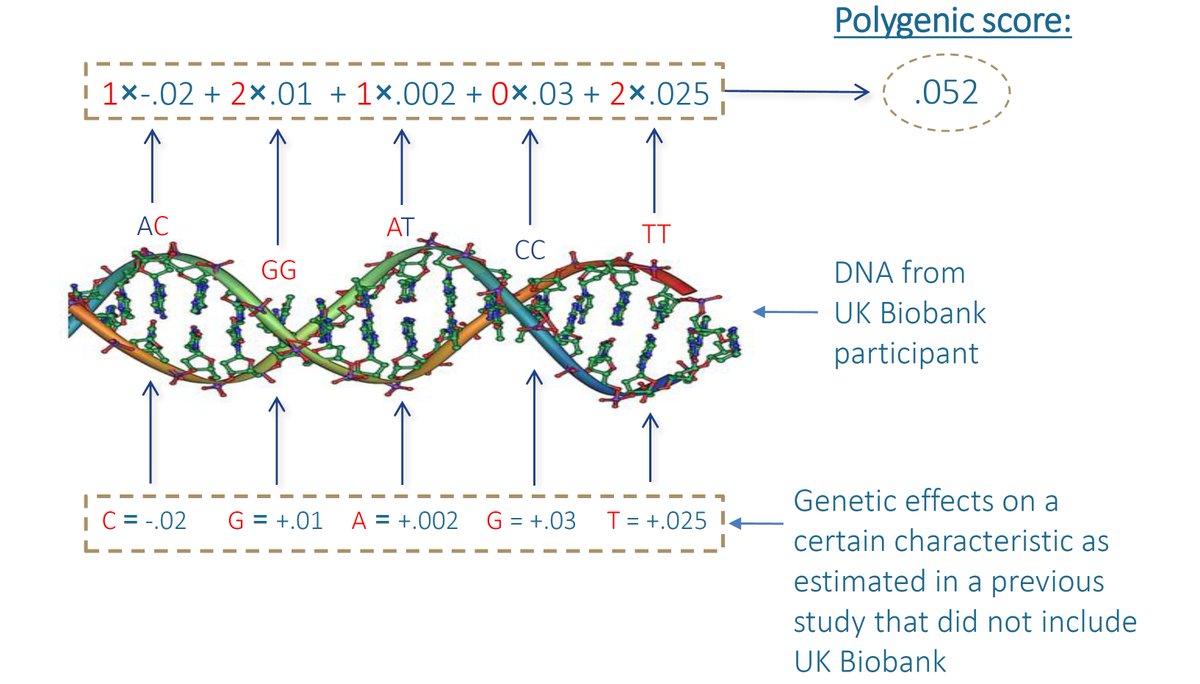
@NatureHumBehav Then we looked at geographic clustering of polygenic scores, measures that are predictive for complex traits and based on measured DNA. Below a figure of how we construct polygenic scores for UK Biobank subjects using genetic effects estimated from external studies. 3/15
Read 15 tweets

Did Thread Reader help you today?

Support us! We are indie developers!


This site is made by just two indie developers on a laptop doing marketing, support and development! Read more about the story.

Become a Premium Member ($3/month or $30/year) and get exclusive features!

Become Premium

Don't want to be a Premium member but still want to support us?

Make a small donation by buying us coffee ($5) or help with server cost ($10)

Donate via Paypal

Or Donate anonymously using crypto!

Ethereum

0xfe58350B80634f60Fa6Dc149a72b4DFbc17D341E copy

Bitcoin

3ATGMxNzCUFzxpMCHL5sWSt4DVtS8UqXpi copy

Thank you for your support!

Follow Us!

:(