SB 79 Thread #2.2: More legal issues.
This one covers:
4. SB 79 in cities whose implementation ordinance may be unlawful;
5. waivers & reductions in local standards under SB 79;
6. transit-agency zoning
/2
This one covers:
4. SB 79 in cities whose implementation ordinance may be unlawful;
5. waivers & reductions in local standards under SB 79;
6. transit-agency zoning
/2
https://twitter.com/CSElmendorf/status/1966910007141867675
Issue #4: How will project entitlement work if city has passed an SB 79 implementing ordinance that may be unlawful, i.e., not "substantially compliant" w/ SB 79?
Can developer proceed under SB 79 directly, at least if HCD hasn't approved the implementing ordinance?
/3
Can developer proceed under SB 79 directly, at least if HCD hasn't approved the implementing ordinance?
/3
Context: An SB 79 ordinance may withdraw certain sites (those w/ historical resources, or exposed to sea level rise or wildlife risk), & reallocate heights/densities among others.
Like a housing element, such ordinances face HCD review for "substantial compliance."
/4
Like a housing element, such ordinances face HCD review for "substantial compliance."
/4
If city lacks an implementing ordinance, then developers can propose SB 79 projects & demand waiver of any local standards that "physically precludes" their project at SB 79 scale.
But once city passes a compliant implementing ordinance, developers only get what it allows.
/5
But once city passes a compliant implementing ordinance, developers only get what it allows.
/5
This will no doubt result in cases where a city says its ordinance is compliant, but HCD says it is not.
Probably some developers will then propose projects that SB 79 would allow if the ordinance were void, and city will deny the project, treating ordinance as valid.
/6
Probably some developers will then propose projects that SB 79 would allow if the ordinance were void, and city will deny the project, treating ordinance as valid.
/6
The legal uncertainty -- is the implementing ordinance valid, void, or invalid only in part? -- may deter many developers from proposing projects at all.
/7
/7
In 2024, the Legislature solved the analogous issue in the context of the Housing Element Law by declaring that a housing element is not "substantially compliant" for purposes of the builder's remedy until HCD says that it is.
/8
/8
The analogous SB 79 move would be to say, "Projects may be submitted directly under SB 79 until HCD has determined that the local implementing ordinance, if any, is substantially compliant."
It could be argued that this is the negative implication of GC 65912.161(d).
/9
It could be argued that this is the negative implication of GC 65912.161(d).
/9

But a judge could also say, "Well, SB 79 expressly allows cities to adopt local implementation plans over HCD's objection, and if the city was right that its plan substantially complies w/ SB 79, developers should have complied w/ city's plan all along."
/10
/10

For the 7th housing element cycle & beyond, there's a stronger argument that a local implementation plan has no legal effect until approved by HCD as part of city's housing element or otherwise.
But the statutory text is a hard to parse (see screenshot),...
/11
But the statutory text is a hard to parse (see screenshot),...
/11
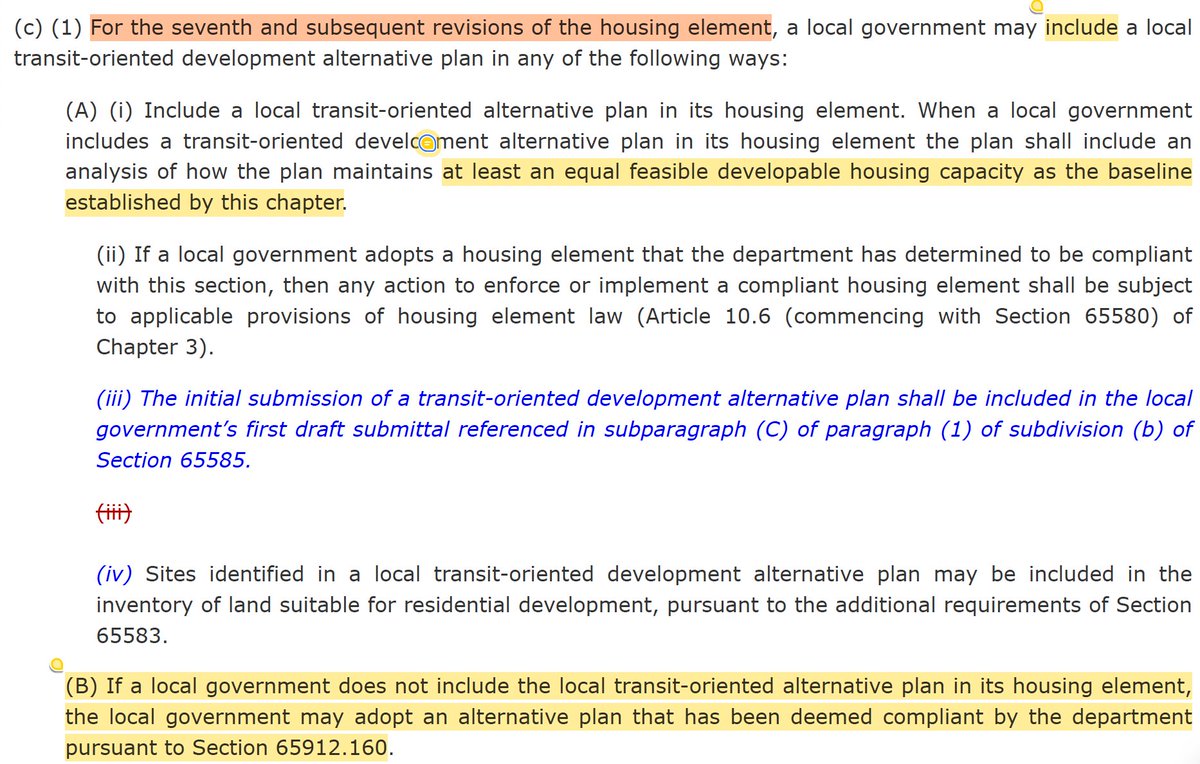
and a court reading SB 79 narrowly might resolve the legal doubts in favor of letting cities continue to adopt & rely on local-implementation ordinances that HCD has not approved.
In sum, there's no clear answer. Leg should fix this next year.
/12
In sum, there's no clear answer. Leg should fix this next year.
/12
https://x.com/CSElmendorf/status/1967357905445040223
Issue #5: SB 79 waivers & reductions of development standards.
In cities w/o a local implementation ordinance, it's clear that SB 79 requires waivers of development standards that "physically preclude" projects of the allowable height/density/FAR.
/13
In cities w/o a local implementation ordinance, it's clear that SB 79 requires waivers of development standards that "physically preclude" projects of the allowable height/density/FAR.
/13
It's likely that courts will rely on State Density Bonus Law caselaw to flesh out this requirement, as SDBL also requires waivers of dev. standards that "physically preclude" a project at the allowed density.
The two statutes are "in pari materia," a judge would say.
/14
The two statutes are "in pari materia," a judge would say.
/14
SDBL caselaw is generous on waivers: it entitles the developer not just to waivers that would enable some hypothetical, alternative project at the allowed density, but to waivers that allow a project *with all of the amenities* that the developer wishes to provide.
/15
/15
In practice, this generally means that the city must grant waivers to accommodate the actual, specific project that the developer wants to build.
/16
/16
To be sure, a court could construe the waiver provision of SB 79 more narrowly than that of SDBL, contrasting SDBL's "construe broadly" proviso w/ lack of such a provision in SB 79.
/17
/17
https://x.com/CSElmendorf/status/1967357912847650839

But my best guess is that courts will follow SDBL, both b/c that's easier than inventing a new body of waiver doctrine, & b/c SB 79 waivers will operate in practice as kind of a penalty default in jx that do not have a substantially compliant "local flexibility plan."
/18
/18
Another key question is whether cities must waive development standards that render a project *economically* infeasible to develop, w/o physically precluding it.
This is arguably implied by the provision in the screenshot, ...
/19
This is arguably implied by the provision in the screenshot, ...
/19

which allows cities to apply IZ standards -- which are economic, not physical restrictions -- that do not "prevent achieving" a project of the allowed height & FAR.
/20
/20
Yet b/c SB 79 has no "thou shall not render a project infeasible" clause (contra subd. (d) of the HAA), & b/c SB 79 is likely to be interpreted cautiously, I'd be very surprised if courts held that it impliedly limits IZ & other cost-elevating development standards.
/21
/21
Last topic: transit-agency zoning.
SB 79 lets transit agencies write their own zoning for agency-owned parcels.
Municipal zoning also applies to these parcels, but only insofar as it's "consistent" w/ transit agency's standards.
/22
SB 79 lets transit agencies write their own zoning for agency-owned parcels.
Municipal zoning also applies to these parcels, but only insofar as it's "consistent" w/ transit agency's standards.
/22

If transit agency writes a "least-cost zoning" code that entitles developers to choose the least expensive way of achieving certain minimal design objectives, would that preempt a city's design standards insofar as achieving the city's would be more expensive?
/23
/23
I'm not sure.
Clearly the point of giving the transit-agency the authority to zone is to make it more feasible for agency to develop & profit from its sites.
OTOH, the "cautious construction of SB 79" principle militates in favor of the city.
/24
Clearly the point of giving the transit-agency the authority to zone is to make it more feasible for agency to develop & profit from its sites.
OTOH, the "cautious construction of SB 79" principle militates in favor of the city.
/24
That's it from me on the Big Legal Questions I saw initially. (I'm sure many more will come to light.)
Note: my SB 79 Big Legal Qs 🧵s have not addressed questions about scope of @California_HCD's authority, which I'll cover that in my "advice to HCD" 🧵. Coming soon!
/end
Note: my SB 79 Big Legal Qs 🧵s have not addressed questions about scope of @California_HCD's authority, which I'll cover that in my "advice to HCD" 🧵. Coming soon!
/end
@threadreaderapp unroll
• • •
Missing some Tweet in this thread? You can try to
force a refresh