It's pretty to easy to see how utterly debased the @CSIRO modelling underpinnning the economic claims regarding the 2035 targets is.
They assume the whole world is committed to Paris targets, ie. Net Zero. They don't have any baseline where that doesn't happen. 1/
That's right, they derive a "global carbon price" commensurate with the world hitting net-zero targets. And apply it to Australia.
(Without saying anywhere in the document what that price is!) 2/
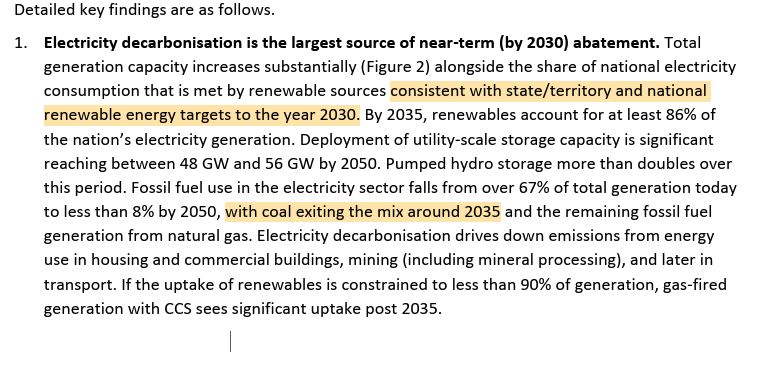
And that price seems to be enough for us to OVERSHOOT the 2030 targets! The Labor plan says we need 82% renewable energy by 2030. Not even Ross Garnaut thinks that's possible.
But CSIRO models us beating that, in all scenarios!
This is absurd. 3/
Yep, this document pays hommage to the utterly implausible state and federal targets... And the nonsense about coal being gone in 2035, despite the coal plant owners not indicating/intending that at all. 4/
And then... off with the fairies.
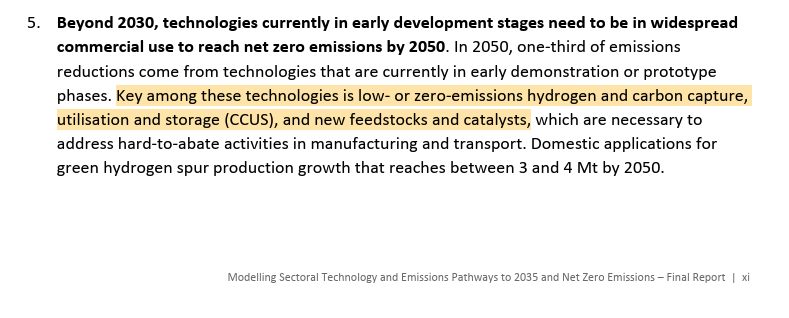
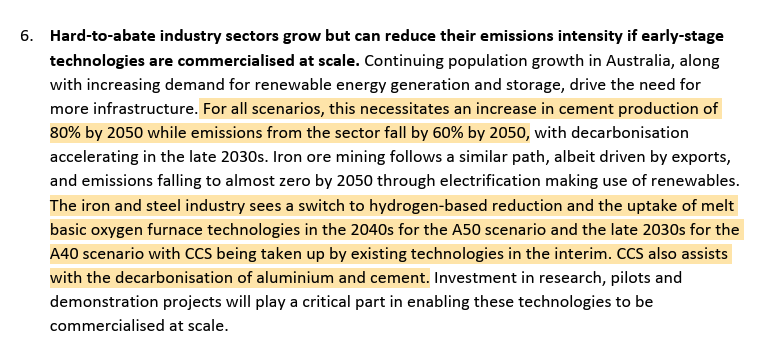
"one third of emissions reductions come from technologies that are currently in early demonstration or prototype phases."
Including all the ones that that have been stuck there for decades, like green hydrogen and carbon capture!! 5/
No, they weren't typos.
We're going to almost halve cement emissions whilst almost doubling the amount we produce.
What did Darryl Kerrigan say? "Tell 'im he's dreaming."
Steel and aluminium are all green too. 6/
This is galling stuff... the most shameless "assume a can-opener" type assumptions that would make economists blush, adopted by our leading scientific institution.
Withheld from the day of announcements. 7/7
• • •
Missing some Tweet in this thread? You can try to
force a refresh

Some boffins on LkdIn are scratching their heads over this.
I have a theory. Helluva storyif true.
TLDR: Pure chaos.
Originating over 2000km away on the border between South Australia and Vic.
Tell me where I'm wrong. 1/
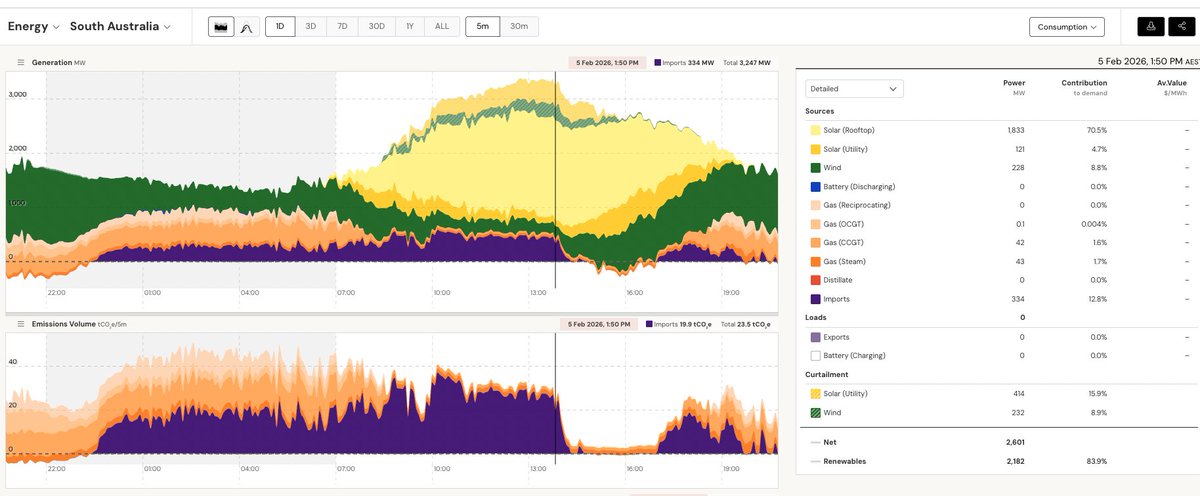
At 1:50pm, SA is soaked in rooftop solar. They're curtailing excess wind and grid solar. Prices are consistently negative, and dip here to -$200. They run a slither of gas for system security, but weirdly, they're importing nearly 400MW throughout from Victoria. 2/
Victoria is still running a firm bed of brown coal, and while prices are low, they're positive. Wind isn't strong negligible renewable curtailment. But electricity has been flowing across to SA, racking up small bills, which with a price dip to -200 in SA, a limit is hit. 3/
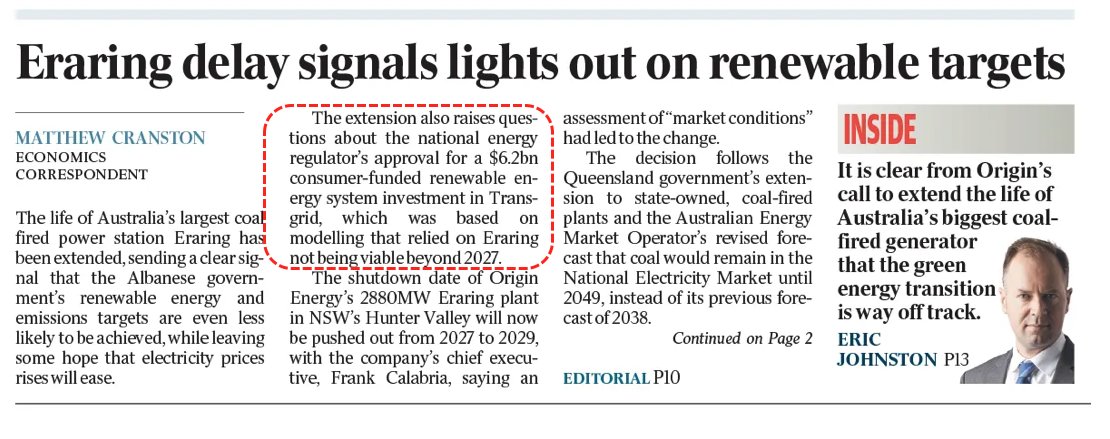
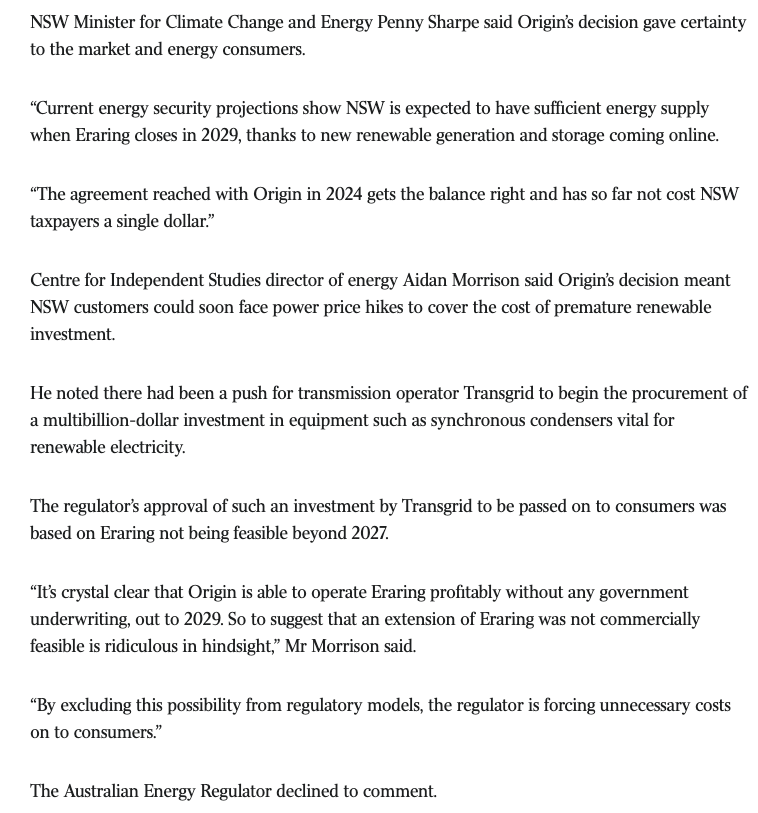
Yesterday, Origin announced they would extend Eraring. No new subsidies. Their own commercial decision.
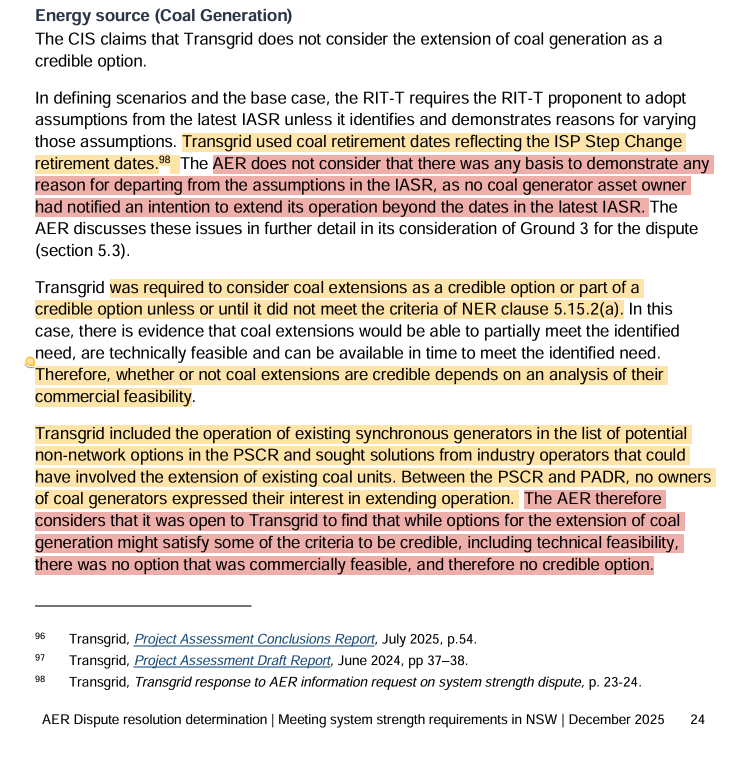
On 23 December @aergovau, quashed a dispute lodged by @cisoz in a regulatory process, on the basis that extending Eraring beyond 2027 was not "commercially feasible".
As a result, Transgrid has got in-principle access to ~6bn dollars of funding to procure system security services currently provided (at little or no cost) by coal plants, like Eraring.
NSW consumers will have to pay for that.
And all the modelling they used to justify their schedule of rapidly procuring synchronous condensers and grid-forming batteries is based around Eraring closing in 2027.
The essence of one of our main grounds of dispute was that they should consider the possibility that coal would be extended. That might be a lower-cost way of meeting the need?
Impossible, argues Transgrid. Apparently, since no coal power station had knocked down their door to express an interest in remaining open, it was safely discarded as being commercially infeasible.
Nevermind the fact that contemplating paying generators extra to modify their plant, or run their plant for extended hours, was very much the purpose of this whole application, and heavily relied upon for gas in the proposed solutions.
Nevermind the fact that Origin had secured an agreement with the NSW government that gave them the option to operate up to 2029, when NSW only offered underwriting to 2027. In Transgrid and AER's eyes, that doesn't demonstrate interest.
And the Regulator, who should be looking out for consumer interests by testing and challenging proponent assumptions, is just fine with all this.
Today, we can see this for what it is.
This is gaslighting, perhaps more brazen than ever seen before.
Our instincts, supported by every scrap of evidence one could hope to find digest (company profits, deals with NSW, energy prices, capture prices, previous closure dates etc etc) suggested it was commercially feasible to extend.
And yet the authorities, even when challenged, forbade such a contention. "no credible option".
And we now have exactly what they said was not credible come to pass. Consumers have a right to be furious. 1/
This story was briefly mentioned in today's Australian. But it requires a little more.
I've been following Transgrid's regulatory pogress to get funding for system security for some time. Their PADR document showed how critical the need was.
Blackouts destroying the NSW economy, literally. 3/
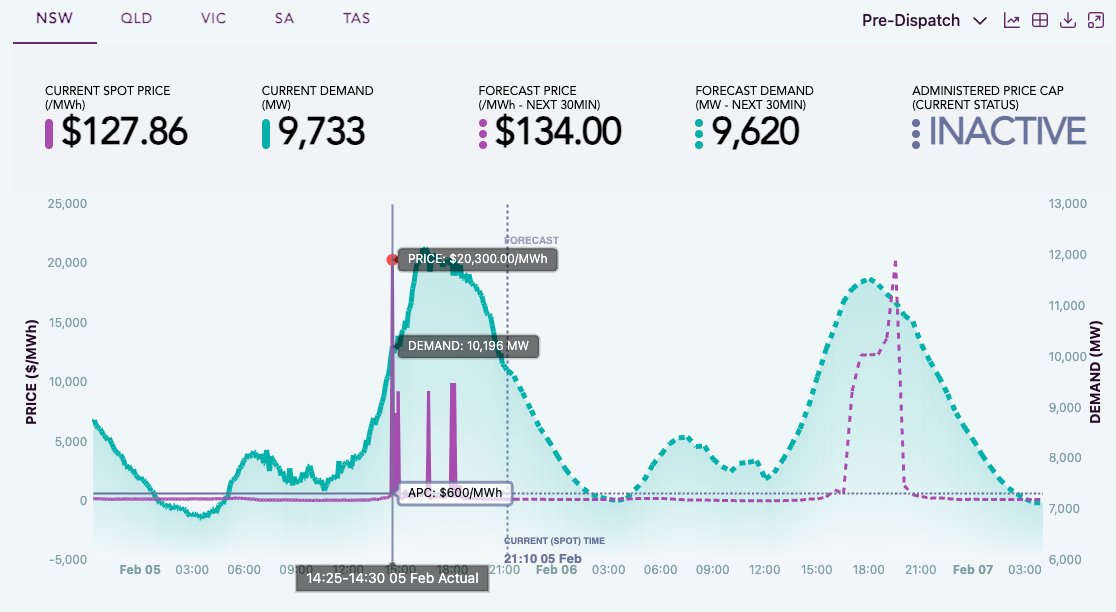
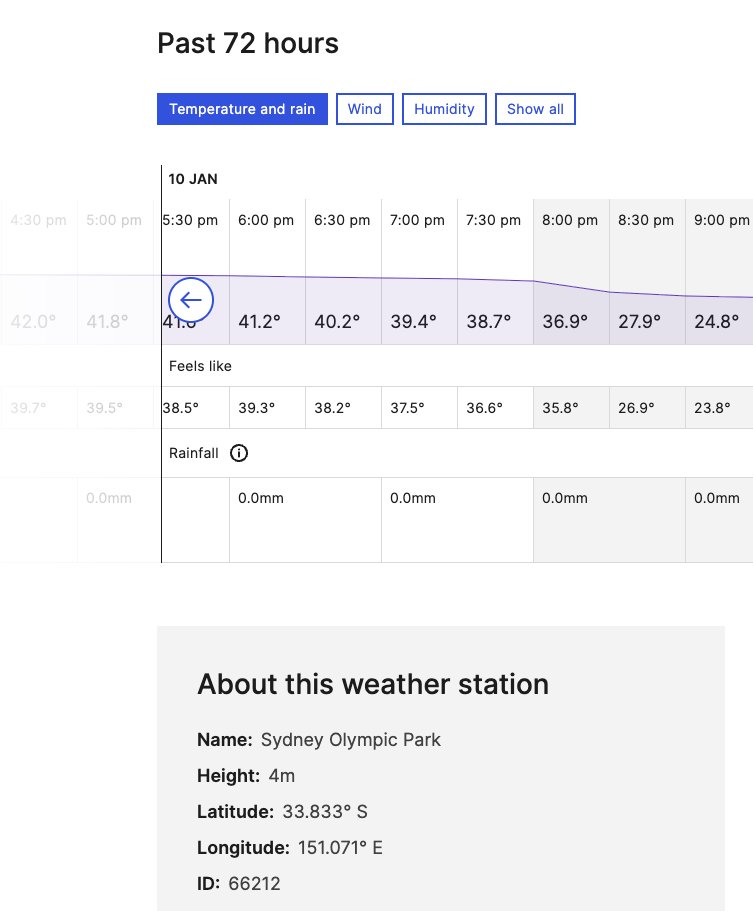
Saturday was very hot in Sydney, over 40 degrees for much of the day.
And as the sun set, it was still hot.
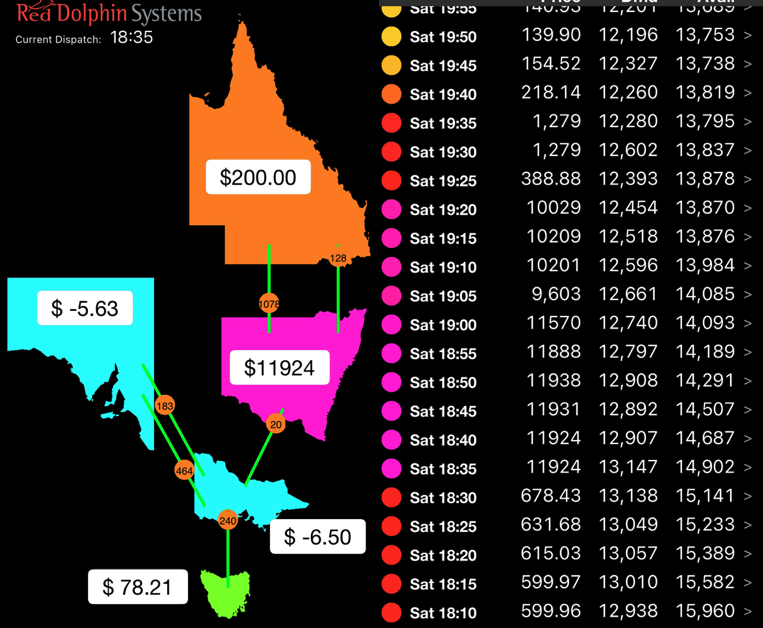
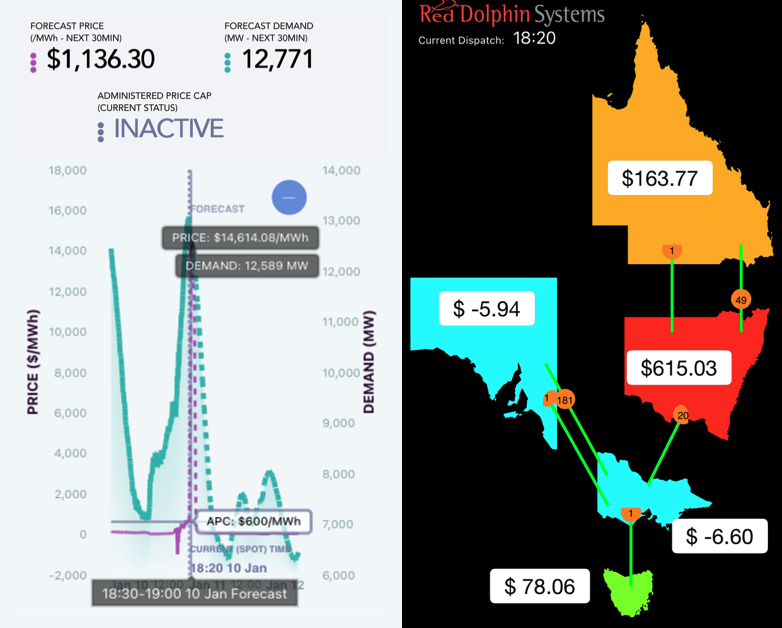
Prices spiked to over $10,000/MWh, and stayed there for nearly an hour.
A short thread on what really happened, and what it means for the renewables transition. 1/
Now it's worth noting that at 6:20pm, this spike was still forecast. But it wasn't forecast to endure for 10 price intervals. As it happened, the peak grid demand was slowly falling (middle column in post above), but not as fast as that available (right column) was. 2/
In the middle of Sydney (Olympic Park) it was still over 40 degrees at 6:30pm. People wouldn't have been turning down their air conditioning much.
Later on that evening, around 8pm, the temperature would drop 12 degrees in an hour. Wind picked up. Still no clouds.
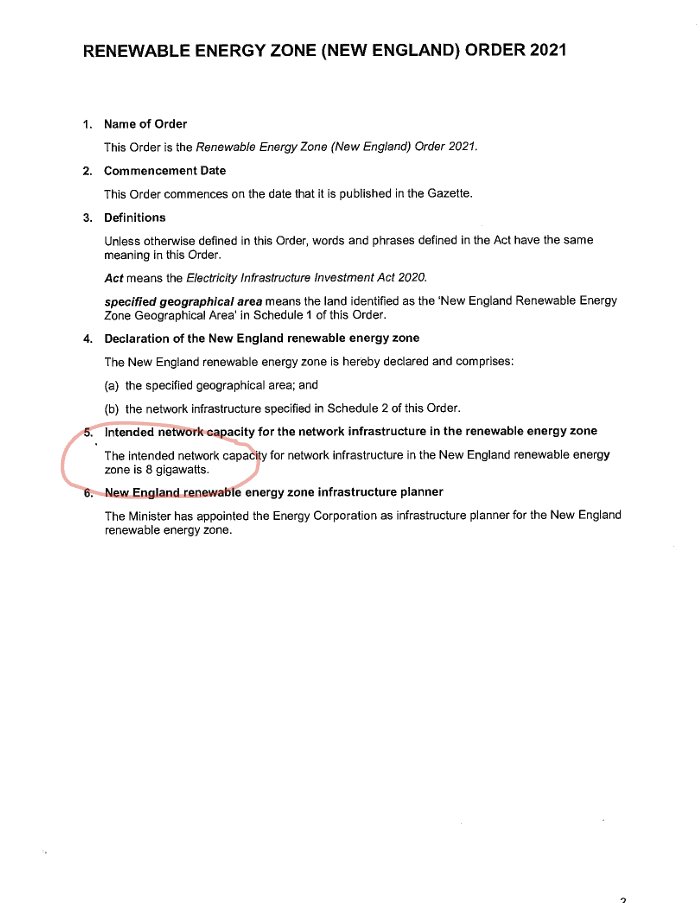
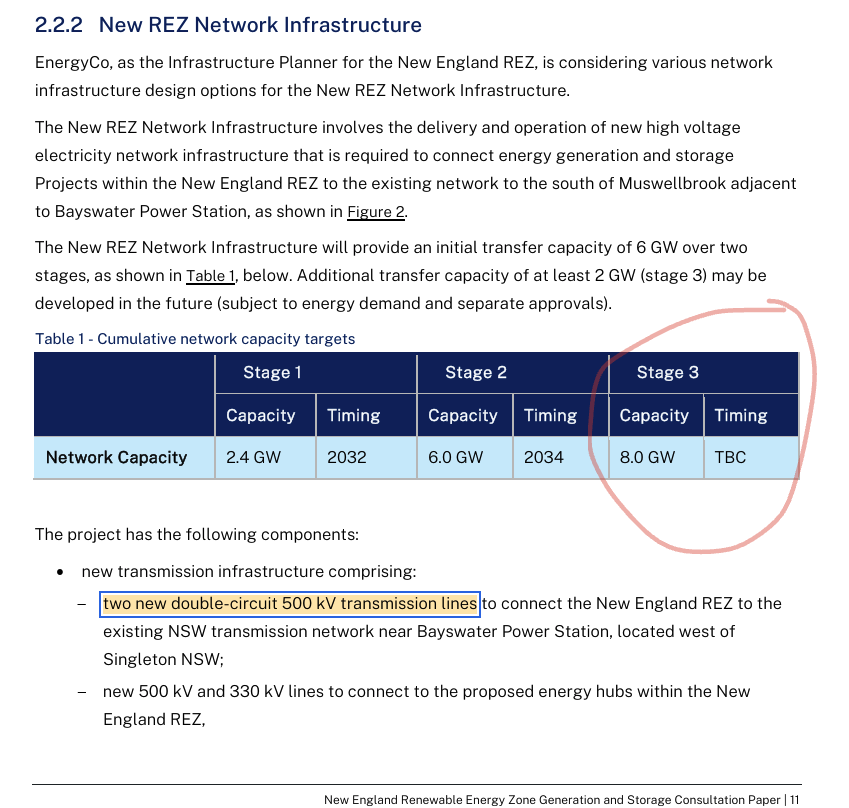
But a consultation paper that was released just in August, on the generation and storage, outlines reaching 8GW in three separated stages.
The third doesn't have timing allocated? (Will it ever happen?)
And they mention two double-circuit 500KV lines. 2/
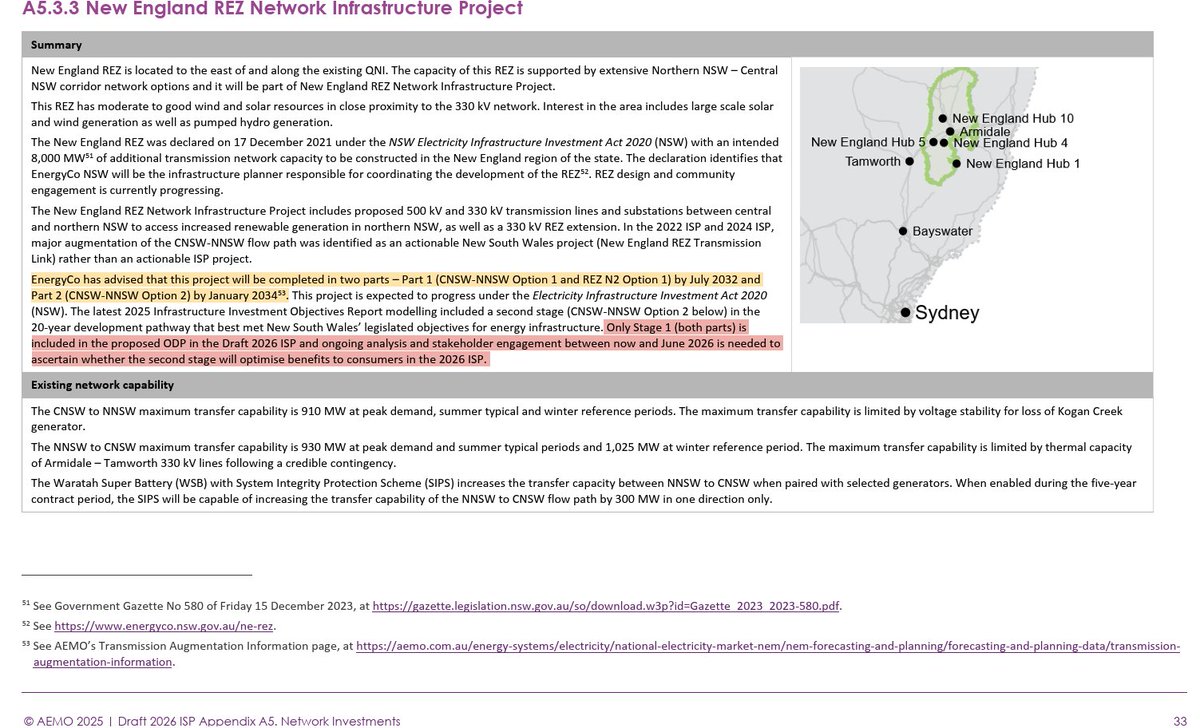
And the Draft ISP confirms this. They seem to roll the first two 'Stages' that EnergyCo has into one 'Stage' with two 'Parts', delivered in 2032 and 2034.
But AEMO says they're not sure "whether the second stage will optimise benefits to consumers in the 2026 ISP." 3/
This is bad. Last Thursday, the NSW government made it crystal clear that they're entirely reliant on AEMO for assessing the need for Sydney Ring South.
Clean buck-pass. No sign of comprehension, let alone responsibility. 1/
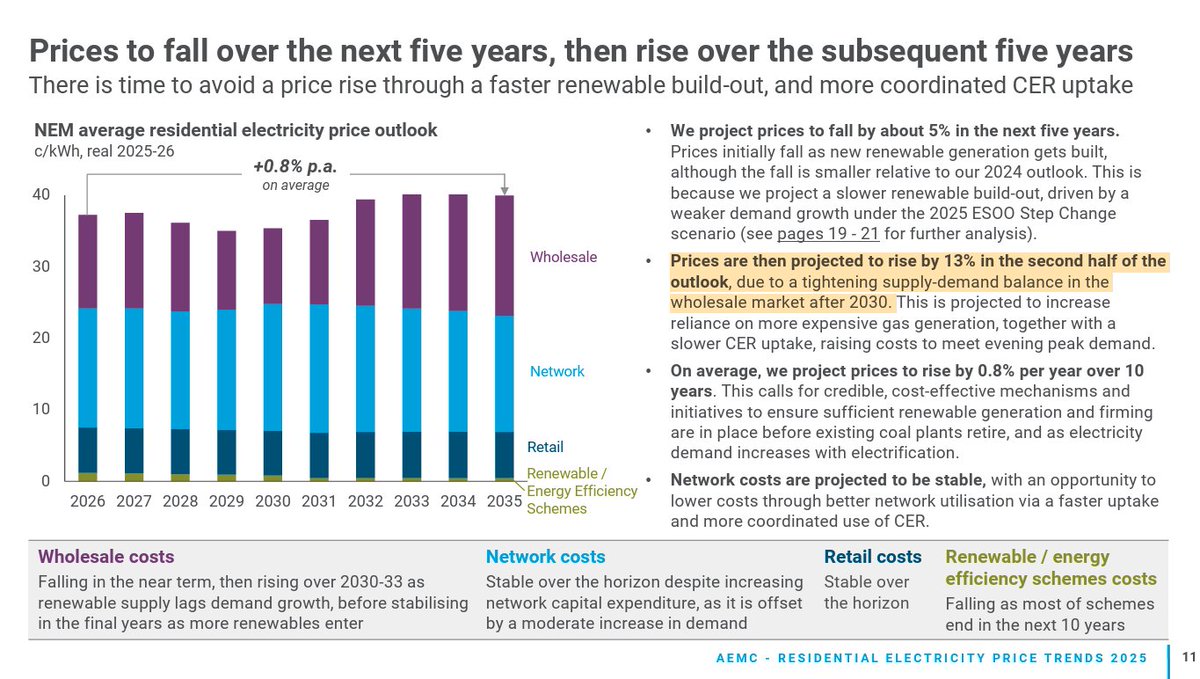
The headline this year: prices go up in the medium term under current policy. That's a reversal from last year.
And yet the prescription is for more renewables, and faster electrification.
What gives? Isn't that what we're doing, that seems not to be working?
The explanation for that contradiction took some teasing out. I think it's scandalous.
AEMC's capacity expansion model builds less renewables than last year, and ends up with a tighter wholesale market, because the demand outlook has changed.
And they've lied about how the demand outlook has changed. They've said it was a reduction in electrification demand. Their sources (ESOO) contradict that.
What they really mean is not a reduction in electrification demand, but a reduction in electric fudge-factors they've relied upon in the past to cram renewables into the model without it exploding. Namely "coordinated" consumer storage (batteries you buy, but let the grid control), as well as flexible hydrogen.
And an increase data centre demand, which is flat and inflexible, the complete opposite of how they assumed hydrogen demand would work.
So this report should be admitting a collision of reality with earlier unrealistic assumptions.
Something like "with real-world demand, renewables don't work so great", followed up with calls for more firm capacity to match more realistic demand profiles.
But instead they double-down on their earlier optimism, and just call for the fudge-factors they previously relied upon to be rushed back in, blaming the lack of renewables in their model (which is the symptom of a problem, not the cause of it) for pushing prices up.
This is really incredible. They've inverted the chain of causality that actually flows through their model.
Such a blatant misdirect in the conclusions of the analysis that they've done (some of which, in parts, they made genuine and respectable efforts to improve on over previous versions, and I was tempted to commend) is just appalling. 1/
Let's start with the conclusion.
They've revised the predicted prices upwards, significantly, throughout the period.
We now have overall price increases.
As a veteran of watching CSIRO adjust its reports year on year, this is... unsurprising, but foreboding. 2/
The next page is clear that it's "updated demand, new entrants" that causes most of the pain in the wholesale upgrade.
And it's clear that it's the lower demand that "lead to a smaller buildout".
And the lower reserve margin, from this pushes up prices. 4/