The specificity matters. Claude adjusts its knowledge retrieval based on expertise depth.
Generic roles = generic outputs. Specific roles = specialist-level responses.
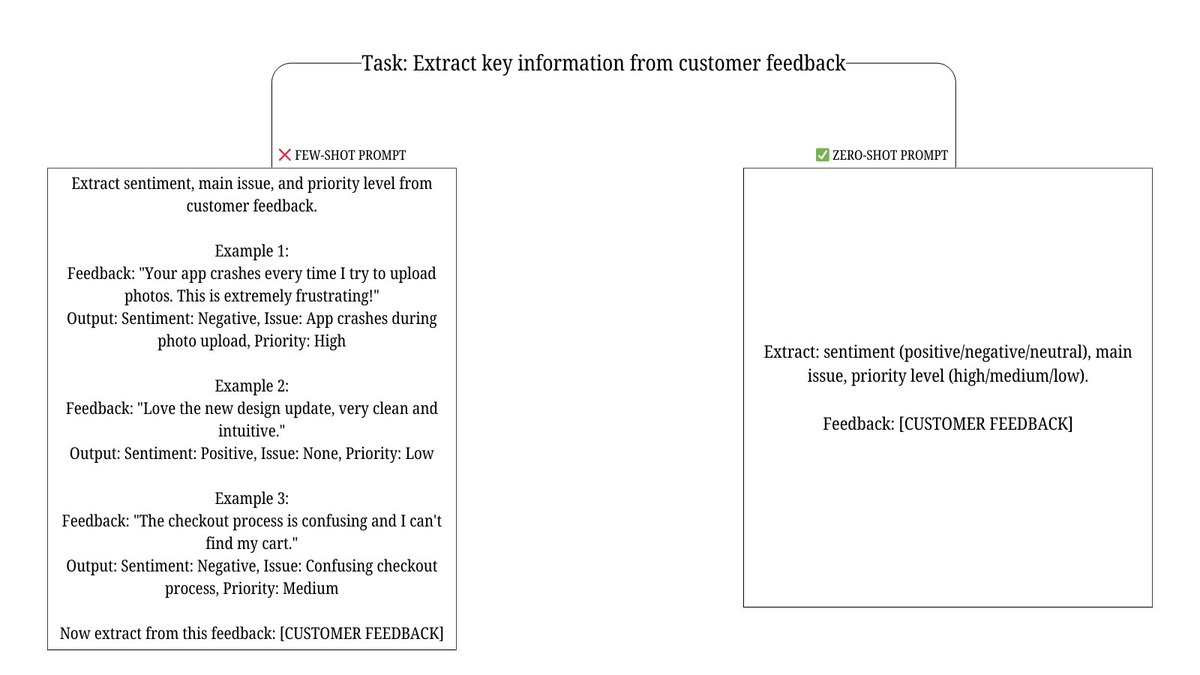
Fourth pattern: examples are structured as complete documents, not fragments.
Most people do this:
Example: The cat sat on the mat.
Anthropic does this:
Translate "The cat sat on the mat" to French
- "The cat" = "Le chat"
- "sat" = past tense of "s'asseoir" = "s'est assis"
- "on the mat" = "sur le tapis"
This shows Claude the complete reasoning path, not just input/output pairs.
Few-shot prompting jumps from ~60% to ~85% effectiveness with this structure.
Fifth discovery: they use thinking tags for complex reasoning.
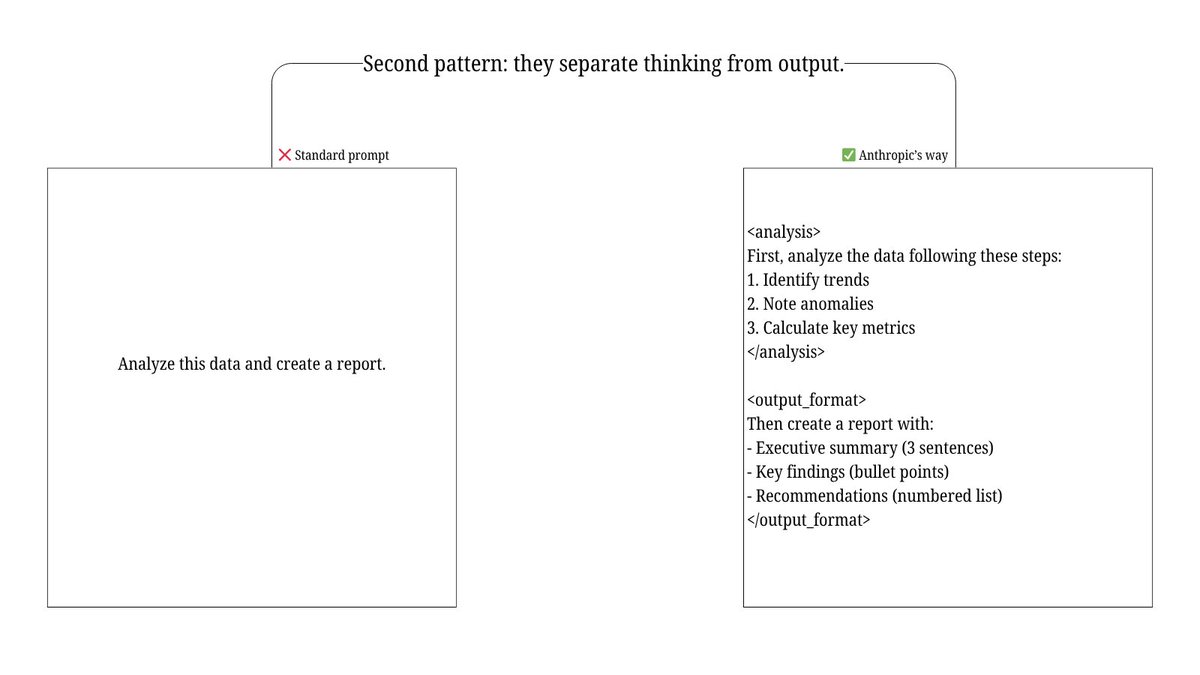
When the task requires multi-step logic, Anthropic explicitly asks Claude to show its work.
Before answering, wrap your reasoning in tags.
Include:
- Assumptions you're making
- Alternative interpretations considered
- Potential edge cases
- Confidence level in your conclusion
Then provide your final answer in tags.
This is basically Chain-of-Thought, but formalized into the prompt structure.
For reasoning tasks (math, logic, analysis), this improved accuracy by 34% in my tests.
Sixth technique: constraint specification using negative examples.
Don't just say what you want. Say what you don't want.
Standard approach:
Write a professional email.
Anthropic's method:
Write a professional email that:
- Is concise (under 150 words)
- Has a clear call-to-action
- Uses active voice
Do NOT:
- Use corporate jargon ("synergy," "leverage," "circle back")
- Include multiple requests in one email
- End with "let me know if you have questions"
The negative constraints are just as important as positive ones.
Claude learns boundaries, not just targets.
Seventh pattern: output format specification at surgical precision.
Anthropic doesn't say "give me a summary." They define exact structure.
Provide your response as:
[Title: Max 8 words]
Key Insight: [One sentence, under 20 words]
Analysis:
- Point 1: [Evidence]
- Point 2: [Evidence]
- Point 3: [Evidence]
Recommendation: [One specific action item]
Confidence: [Low/Medium/High] because [brief reason]
This eliminates 90% of formatting inconsistency.
You get exactly what you ask for, every single time.
Eighth technique: they use document tags for multi-file context.
When working with multiple sources, Anthropic wraps each in document tags.
Compare Q3 and Q4 performance. Reference documents by index.
This prevents Claude from mixing up sources or hallucinating attribution.
It can cite exactly: "According to document 1..."
Ninth discovery: error handling is built into prompts.
Anthropic anticipates edge cases and tells Claude how to handle them.
If the input data is:
- Incomplete: State what's missing and make reasonable assumptions
- Contradictory: Identify the contradiction and ask for clarification
- Outside your knowledge: Say "I don't have reliable information about X" (never make up facts)
- Ambiguous: Interpret both ways and note the ambiguity
This prevents hallucination and creates graceful failure modes.
Claude admits limitations instead of confidently bullshitting.
Tenth pattern: they use prefilled assistant responses.
This is the most underrated technique in the entire library.
Instead of just sending a prompt, Anthropic starts Claude's response.
API structure:
Then they post the same recycled motivational garbage.
I've been using AI to write posts that sound more human than most humans.
10 prompts I use in Claude that got me 50K followers in 6 months:
1. Create a high-performing LinkedIn post
“You are a top-performing LinkedIn ghostwriter.
Write a single post (max 300 words) on [topic] that provides insight, tells a short story, and ends with a strong takeaway or CTA.”
2. Turn tweets into full LinkedIn posts
“Expand this tweet into a high-performing LinkedIn post.
Keep the tone professional but conversational. Add more depth, examples, and a clear lesson.”
→ [Paste tweet]