James L. Nuzzo, PhD Profile picture
Oct 9, 2025 1 tweets 1 min read Read on X
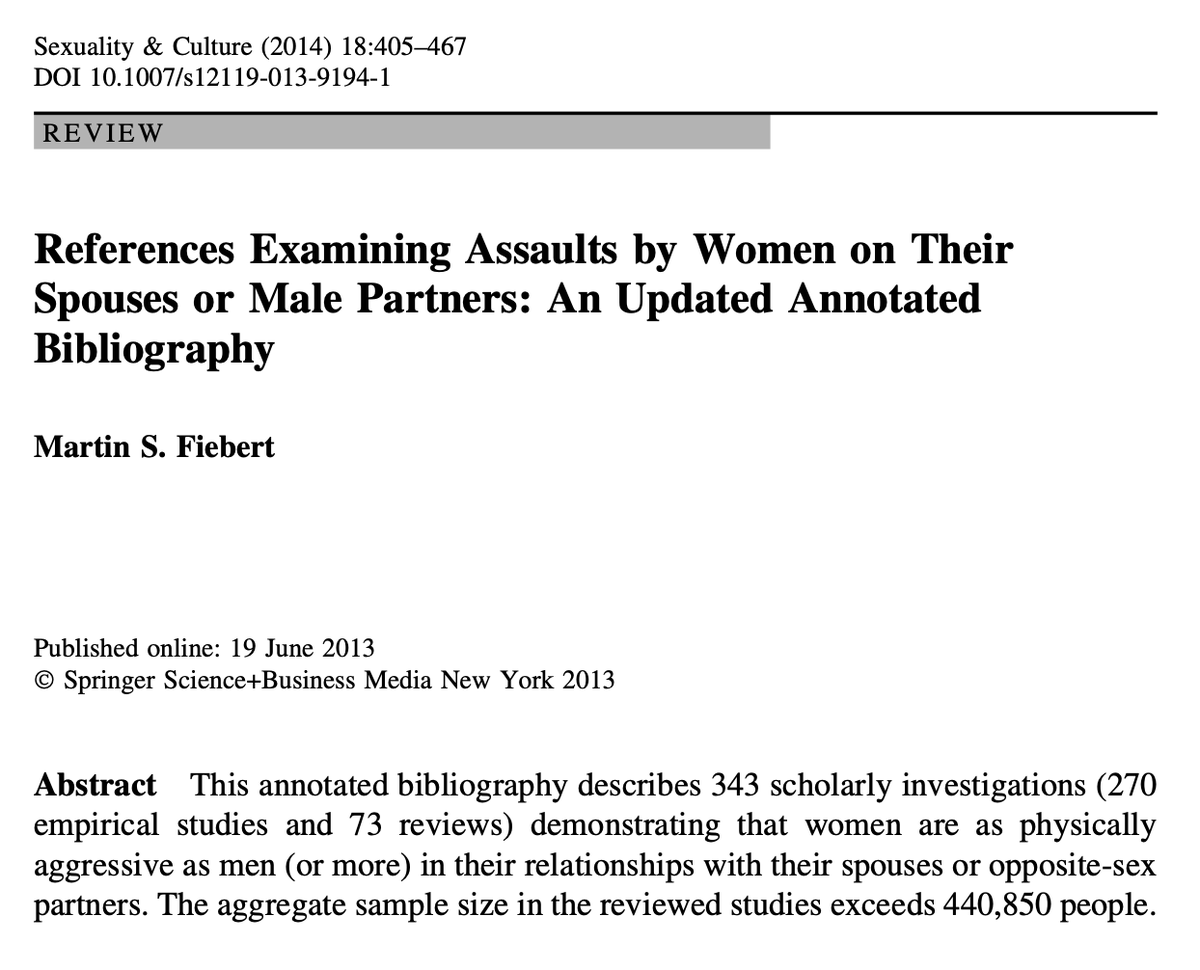
"This annotated bibliography describes 343 scholarly investigations...demonstrating that women are as physically aggressive as men (or more) in their relationships with their spouses or opposite-sex partners." Image

• • •

Missing some Tweet in this thread? You can try to force a refresh

 

Keep Current with James L. Nuzzo, PhD

James L. Nuzzo, PhD Profile picture

Stay in touch and get notified when new unrolls are available from this author!

Read all threads

This Thread may be Removed Anytime!

PDF

Twitter may remove this content at anytime! Save it as PDF for later use!

Try unrolling a thread yourself!

how to unroll video
  1. Follow @ThreadReaderApp to mention us!

  2. From a Twitter thread mention us with a keyword "unroll"
@threadreaderapp unroll

Practice here first or read more on our help page!

More from @JamesLNuzzo

Apr 6
1/4. Building off my previous posts on MIT and Caltech, here are the data for Georgia Tech. In recent years, Georgia Tech has begun to admit a greater percentage of its female applicants than it has its male applicants, resulting in a female:male admissions preference ratio that now stands at about 1.6.Image
2/4. Georgia Tech receives about 2-2.5 times as many applications from potential male than female students. Image
3/4. In recent years, whereas the number of females admitted to Georgia Tech has grown with the increased numbers of female applicants, the number of males admitted to Georgia Tech has not grown with the increased number of males applicants, resulting in a higher female:male admissions preference ratio in recent years compared to previous years.Image
Read 4 tweets
Apr 7, 2025
🧵NEW: Our latest paper is a meta-analysis of sex differences in upper- and lower-limb strength in kids aged 5-17 years old (3,497 boys; 3,137 girls).

Before, during, and after puberty, boys are stronger than girls on average. The sex difference in muscle strength is ~10% in 5–10-year-olds and increases to ∼40% in 14–17-year-olds. Throughout development, the sex difference in strength tends to be more pronounced in upper- than lower-limb muscles.

Co-author: @MatheusdPintoImage
2/5. All 299 effect sizes in the analysis. Positive effect sizes to the right of the dashed vertical zero line represent when the group of boys was stronger than the group of girls. Negative effect sizes to the left of the dashed vertical zero line represent when the groups of girls were stronger than the group of boys.Image
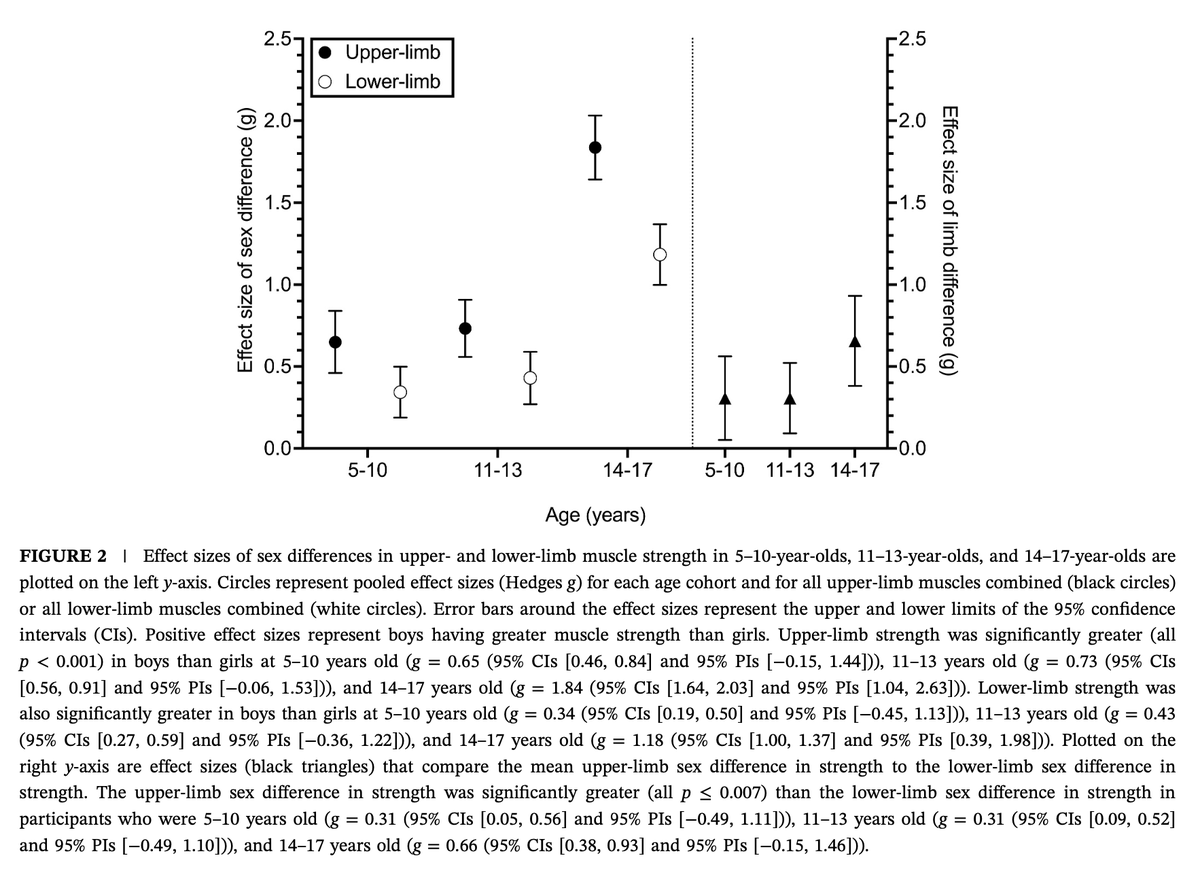
3/5. Effect sizes of sex differences in upper‐ and lower‐limb muscle strength in 5–10‐year‐olds, 11–13‐year‐olds, and 14–17‐year‐olds. Positive effect sizes represent boys having greater muscle strength than girls.

Boys are stronger than girls at all ages. The sex difference in strength tends to be greater in upper- than lower-limb muscles.Image
Read 5 tweets

Did Thread Reader help you today?

Support us! We are indie developers!


This site is made by just two indie developers on a laptop doing marketing, support and development! Read more about the story.

Become a Premium Member ($3/month or $30/year) and get exclusive features!

Become Premium

Don't want to be a Premium member but still want to support us?

Make a small donation by buying us coffee ($5) or help with server cost ($10)

Donate via Paypal

Or Donate anonymously using crypto!

Ethereum

0xfe58350B80634f60Fa6Dc149a72b4DFbc17D341E copy

Bitcoin

3ATGMxNzCUFzxpMCHL5sWSt4DVtS8UqXpi copy

Thank you for your support!

Follow Us!

:(