Under this bill, new tenants will be able to challenge their rent at a tribunal within six months of moving in. This means tribunals will be able to control all market rents, not just rent rises within a tenancy. This is straightforward rent control across the entire market.
The pretext of the bill is that tribunals will have to refer to market rates to determine if rent rises are ‘too high’.
But this is circular: all market rents, including new tenancies, will be set under rent tribunals’ jurisdiction. There will be no ‘market rate’ to refer to.
I’d previously thought that this bill was bad, but survivable. Now I realise that it controls rents *between* tenancies as well as within them, I believe that it is bringing first-generation rent controls to the English rental market. This could be very, very bad.
• • •
Missing some Tweet in this thread? You can try to
force a refresh

In 1995, Western European productivity was 95% of the US's. By 2023, it was 80%.
Western European GDP per capita is $63,000 per year, adjusted for PPP; the United States's is $86,000. In just the last 13 years, the gap has grown by 8.6 percentage points.
In 2015, 52 of the world's top 100 companies by market cap were American & 28 were European. Now, the American total is 58—Europe has just 18 of the top 100 companies.
And Europe's largest company, the enterprise software provider SAP, is smaller by market cap than Home Depot.
- Prehistoric psychopaths
- The steam networks of NYC
- Urbanism with Chinese characteristics
- How we may conquer menopause
- The Hanseatic League's rise and fall
- The pineapple: the king of fruits
And more!
The Hanseatic League was a coalition of merchant cities that grew to dominate trade in Europe and even fought and won wars.
The League's rise and fall is a story of building and holding together a coalition, and of how technology shapes war & economics.
At 'peak pineapple', British aristocrats would pay the equivalent of $16,000 for a single one. Poor Londoners would pay for a single morsel to taste it.
NEW: How Labour's plan to push through strategic projects like data centres and prisons can be made to work, by letting the local authorities affected retain 100% of their business rates bills.
We have a chronic problem with blocking projects that are nationally important but locally inconvenient.
Weak growth, housing shortages, crime, high energy costs, droughts and transport congestion are all downstream of this problem.
Labour plan to decide on these projects at the national level to overcome local opposition.
That's good, but won't solve the problem – the Aquind Interconnector, equivalent to a new nuclear power station, was still blocked this way because of strong local opposition.
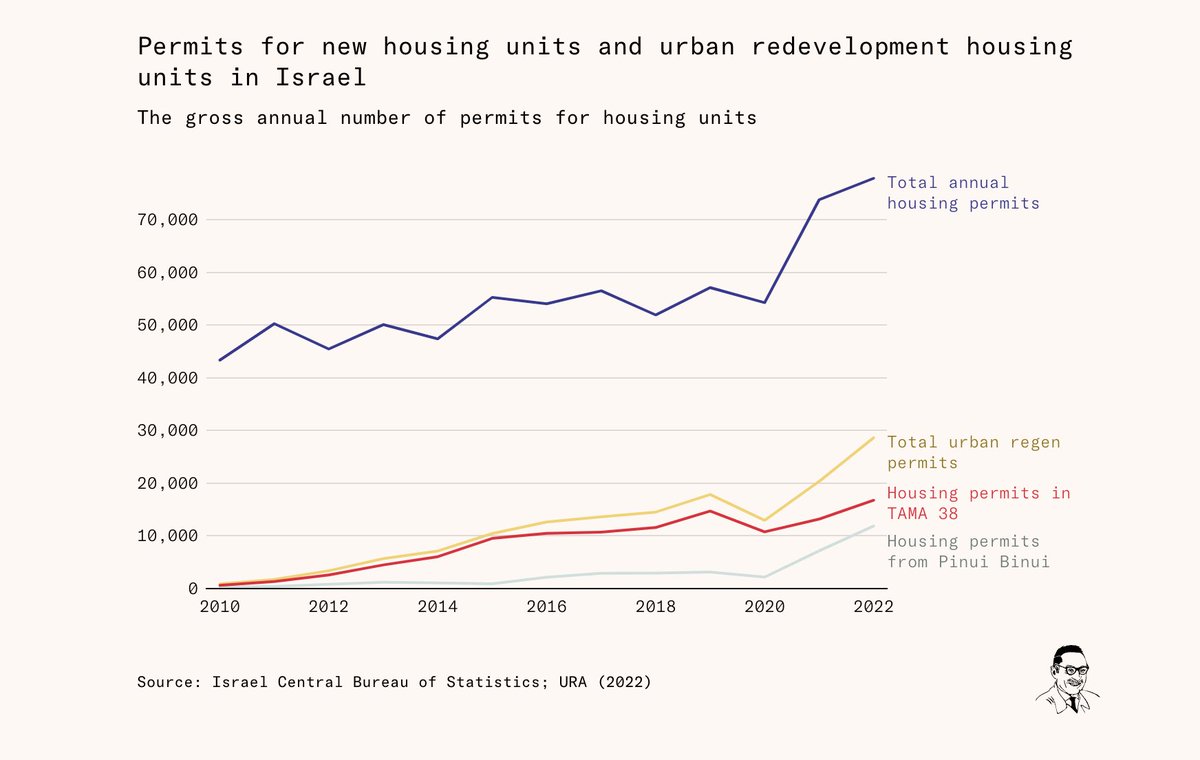
Here's what I learned reading about Israel's policies that give apartment owners the right to vote to redevelop their buildings into taller, denser developments with more units. 🧵
In buildings built before 1980, homeowners can vote on proposals to tear down their older, dilapidated buildings and replace them with new ones. They get newer, bigger, apartments.
Here's the clever bit: the project is paid for with new apartments added to their buildings/plots.
That means that the regeneration can make existing homeowners better off AND deliver more homes.
These policies accounted for 2% of new homes built in 2010. Today, they account for *37%* of new homebuilding, and a whopping 50% of new homes built in Tel Aviv.
The most likely explanation for this is that the public is self-interested, and understands that a policy that incentivises capital-owners to consume their wealth or put it into distortionary avoidance schemes hurts them in the long-run.
Why does the public oppose randomly expropriating the property of people richer than them and 98% tax rates on millionaires? It must be their keen sense of fair play.
Even though people are usually pretty bad at guesstimating facts and figures about the economy, they're almost spot-on at guessing which taxes raise the most and least amounts of money.