
🚨UKHSA - Dr Shona Aurara
The system of control in schools was not effective for an airborne virus.
CVF's questions from @AdamWagner1 KC
NB/ There was a HUGE amount of content - our amazing team are working on prioritising the best clips for you actively!
1/
The system of control in schools was not effective for an airborne virus.
CVF's questions from @AdamWagner1 KC
NB/ There was a HUGE amount of content - our amazing team are working on prioritising the best clips for you actively!
1/
Adam had to work hard today to try to hold UKSHA to account!
2/
2/
AW "By reducing the isolation period [to 3 days], as well as restricting testing unless advised by a healthcare professional, that meant that infectious children were likely to be returning to classrooms?"
SA "Infectious period... viral shedding... balance of risk..."
3/
SA "Infectious period... viral shedding... balance of risk..."
3/
AW "Don't you agree that by reducing the period to 3 days and reducing the need for testing you are going to make it more likely that infectious children are going to be in the classrooms?"
SA "...Population immunity... Vaccine programme"
4/
SA "...Population immunity... Vaccine programme"
4/
AW "Was any assessment made of the disproportionate impact that that shortened isolation period and restricted testing would have on CV children and children in CV family members?"
5/
5/
RAPID REVIEW
Main lesson is to improve evidence generation.
Rapid evaluation into a response:
- Sleeper study cells / protocols
- Rapid adaptive trials for simulateous testing of NPIs
CTI "What is needed [in plain language] to plug the gap?"
6/
Main lesson is to improve evidence generation.
Rapid evaluation into a response:
- Sleeper study cells / protocols
- Rapid adaptive trials for simulateous testing of NPIs
CTI "What is needed [in plain language] to plug the gap?"
6/
SA "...set up studies ...design frameworks... studies and develop protocols... use peacetime more effectively..."
7/
7/
Airborne Risks in Schools
CTI "Ask more generally, whether plans to make schools safer should focus on pathogens which are transmitted through the air?"
8/
CTI "Ask more generally, whether plans to make schools safer should focus on pathogens which are transmitted through the air?"
8/
SA "Five out of the six pandemics that have occurred since the 20th century have been respiratory or airborne."
"It would certainly make sense to start with prioritising that."
9/
"It would certainly make sense to start with prioritising that."
9/
Prof Sir Chis Whitty explained that even illnesses that are not airborne still have risks for children.
10/
10/
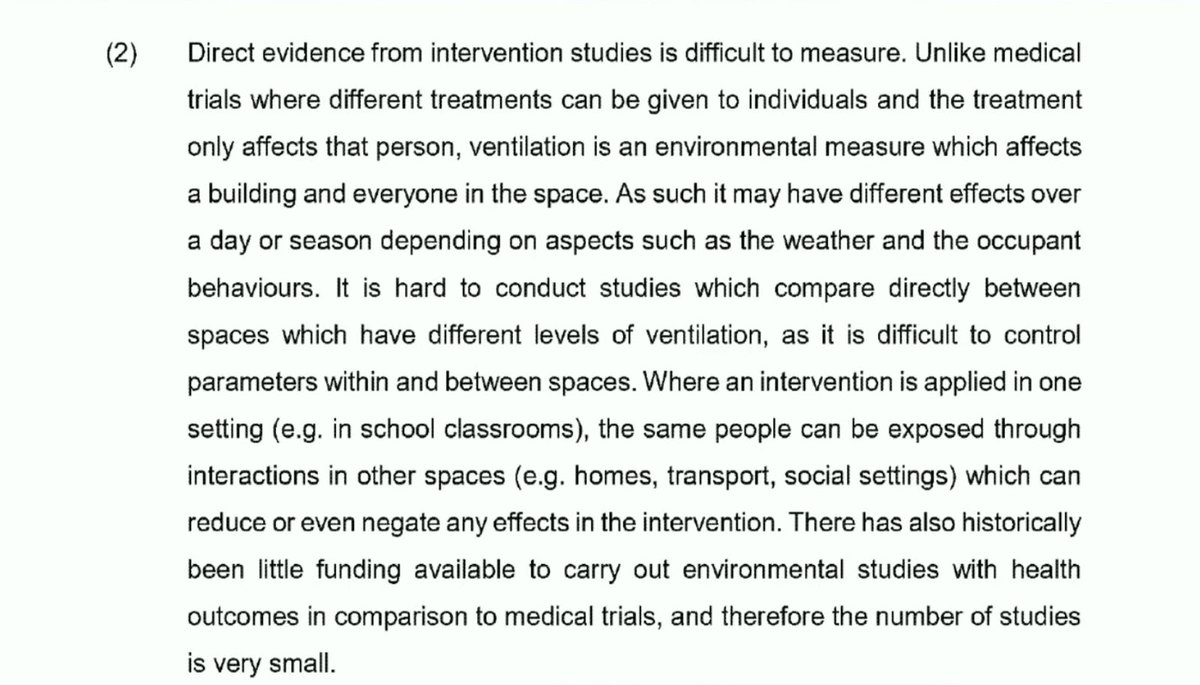
Whitty says that evidence that ventilation or air cleaning reduces transmission is described as ‘very limited’ - mainly because infection data is hard to obtain.
Reducing airborne pathogens by 50% may not cut infection by 50% if exposure still exceeds the infectious dose.
11/
Reducing airborne pathogens by 50% may not cut infection by 50% if exposure still exceeds the infectious dose.
11/

He thinks that it is hard to measure. People won't just stay in one location and different spaces have different risks.
Clean air protects everyone in a room, not just one person, which makes trials difficult.
___
However, it does not mean the science is weak!
12/
Clean air protects everyone in a room, not just one person, which makes trials difficult.
___
However, it does not mean the science is weak!
12/
To be continued...
Prof Cath Noakes has explained:
For trial to evaluate air cleaning technology, if children travel by bus - so it is difficult to work out the benefit from air cleaning.
13/
For trial to evaluate air cleaning technology, if children travel by bus - so it is difficult to work out the benefit from air cleaning.
13/
CTI "Noakes' view is that there is growing evidence that indicates that enabling better ventilation and indoor air quality does have a positive effect on children..."
"Should more be done to improve ventilation and air quality in education settings?"
14/
"Should more be done to improve ventilation and air quality in education settings?"
14/
SA "That isn't a decision for UKHSA to make."
15/
15/
Indoor air quality matters for a whole range of issues:
Infectious disease transmission
Concentration / wellbeing
Thermal quality (hot / cold)
New study "CHILLI" (?)
16/
Infectious disease transmission
Concentration / wellbeing
Thermal quality (hot / cold)
New study "CHILLI" (?)
16/
Limited resources in schools.
Need good new build standards.
Challenge is around retrofitting.
17/
Need good new build standards.
Challenge is around retrofitting.
17/
Guidance to schools on ventilation weren't provided by PHE. They were referred to guidance for businesses.
CTI "Would you agree that ventilation guidance specific to schools ought to have been given by PHE during the pandemic?"
18/
CTI "Would you agree that ventilation guidance specific to schools ought to have been given by PHE during the pandemic?"
18/
SA "There was a stronger focus on 'droplet spread' and a and less so on 'aerosol spread'.
And therefore a stronger focus on [droplet] measures."
DfE guidance should have addressed this as the evidence emerged.
19/
And therefore a stronger focus on [droplet] measures."
DfE guidance should have addressed this as the evidence emerged.
19/
Noakes' recommendations:
More effective monitoring with long-term data collection across public building, supporting building the evidence base for environmental impacts on health.
20/
More effective monitoring with long-term data collection across public building, supporting building the evidence base for environmental impacts on health.
20/
On the need for long-term data collection on environmental impacts on health:
SA "It wouldn't necessarily be us [UKSHA] to spearhead, we would certainly be there to support."
21/
SA "It wouldn't necessarily be us [UKSHA] to spearhead, we would certainly be there to support."
21/
DfE are taking a leadership role:
CO2 monitors
Awaiting publication of Bradford study [ClassACT]
Academic institutions, Engineers (building expertise) and UKSHA in a supporting role.
"DfE absolutely critical"
22/
CO2 monitors
Awaiting publication of Bradford study [ClassACT]
Academic institutions, Engineers (building expertise) and UKSHA in a supporting role.
"DfE absolutely critical"
22/
PART 2/
Tweet 23 clips go missing... so skipping this one...
⚠️23/
Tweet 23 clips go missing... so skipping this one...
⚠️23/
Guidance for CV/CEV children and young people:
School attendance
24/
School attendance
24/
March 2020 - PHE Shielding Guidance (12 week)
May 2020 - DfE Guidance CV & Immunocompromised C&YP: Julia Kinnerberg (DfE) said PHE assisted.
25/
May 2020 - DfE Guidance CV & Immunocompromised C&YP: Julia Kinnerberg (DfE) said PHE assisted.
25/
"Vulnerable children and young people who have a social worker attendance is expected unless the child or household is shielding or clinically vulnerable."
26/
26/
"It is giving parents, and other adults with responsible for that child... permission... to weigh competing interests, including health vulnerabilities in deciding whether attendance is appropriate for those children."
27/
27/
RCPCH and the NHSE removed the category CV children stating "the middle ground group was not meaningful as applied to children".
Children were either "CEV" or "not at significantly increased risk".
28/
Children were either "CEV" or "not at significantly increased risk".
28/
CTI "Can you help us with why the DfE guidance referred to 'clinically vulnerable' children, whereas it seems... in early May this category was made obsolete as regards to children?"
29/
29/
10 June 2020 - Shielding update
Asthma, Diabetes, Epilepsy, Kidney Disease
Can return to school if it opens...
⚠️NONE OF WHICH AS A GROUP WERE SHIELDED
(aside from severely immunosuppressed asthmatics)
30/
Asthma, Diabetes, Epilepsy, Kidney Disease
Can return to school if it opens...
⚠️NONE OF WHICH AS A GROUP WERE SHIELDED
(aside from severely immunosuppressed asthmatics)
30/
How do you even answer this question...
THEY WEREN'T SHIELDED!
31/
THEY WEREN'T SHIELDED!
31/
CVF understood that CEV were downgraded to CV in September 2021 - CV wasn't removed.
32/
32/
Guidance from DHSA and PHE:
Children should no longer be classified as CEV
"Recent clinical studies have shown children and young people are at very low risk of serious illness if they catch Covid-19."
33/
Children should no longer be classified as CEV
"Recent clinical studies have shown children and young people are at very low risk of serious illness if they catch Covid-19."
33/
"Children and young people under 18 are no longer considered to be CEV.... A small number of children and young people will have been advised to isolate or reduced their social contacts... due to their general risk of infection rather than because of the pandemic."
34/
34/
SA "Beginning to be a move away from CEV.... vaccines... treatments."
NB/ Most children weren't vaccinated. Antiviral treatments weren't generally available to children because they weren't approved for them!
35/
NB/ Most children weren't vaccinated. Antiviral treatments weren't generally available to children because they weren't approved for them!
35/
"NEW NORMAL"
Small group of severely immunosuppressed children.
e.g. Those undergoing chemotherapy who are at risk from any infectious disease.
36/
Small group of severely immunosuppressed children.
e.g. Those undergoing chemotherapy who are at risk from any infectious disease.
36/
Evidence from @lara_wong from CVF regarding the "Green Book" which has criteria for clinically vulnerable children.
There is some confusion about children being classed as CV when it comes to vaccines but not schools.
37/
There is some confusion about children being classed as CV when it comes to vaccines but not schools.
37/
@lara_wong SA: "Vaccine prioritisations... are recommended by JCVI... UKHSA are a member.
They [look at] how effective a vaccine would be at either reducing transmission or *preventing a severe outcome* "
38/
They [look at] how effective a vaccine would be at either reducing transmission or *preventing a severe outcome* "
38/
@lara_wong SA "That might be different in a school setting"
- The risk of *severe outcomes* from might be different in a school setting?
"What are the mitigations if they are in school to keep them safe and protected."
- Haven't we already established they were the wrong mitigations?
39/
- The risk of *severe outcomes* from might be different in a school setting?
"What are the mitigations if they are in school to keep them safe and protected."
- Haven't we already established they were the wrong mitigations?
39/
@lara_wong 🤯
• • •
Missing some Tweet in this thread? You can try to
force a refresh




