“Ethereum alignment” isn’t about substance (i.e., who actually provides the most value to the ecosystem), it’s about creating the most convenient narrative for ETH
Your protocol can drive an immense amount of value to the Ethereum ecosystem over a number of years, but if it doesn’t elevate ETH to a privileged position and you instead accrue value to your own token, you might as well be a competitor
You’re supposed to sacrifice your protocol’s own utility and value accrual all in the name of pumping someone’s ETH bags
That’s why an subsidized infrastructure yield farm for restaked ETH that has delivered little to no real tangible value for users is considered more “Ethereum aligned” than a protocol who data products enabled the rise of Ethereum DeFi and scaled it into the hundreds of billions safely
It’s a toxic cycle where even the most aligned are somehow considered not aligned enough, and get bullied the most until they are bled dry or pivot
Only way to win is to not play the alignment politics game in the first place
Sandeep’s comment sums it up well:
>When Polymarket wins big, it’s “Ethereum,” but Polygon itself is not Ethereum. Mind-boggling.
The reason why @Coinbase Commerce doesn’t support self-custody $BTC baselayer payments is simple
UXTO chains like Bitcoin lack the programmability necessary to meet the requirements of most merchants
1) Merchants don’t want to be exposed to crypto price volatility risk
Ethereum and EVM chains solve this by being able to programmatically covert whatever crypto token is used as payment into a stablecoin like $USDC, when can then be optionally redeemed for $USD and sent to the merchant’s bank account
UXTO-based chains like $BTC lack the native programmability to convert their native asset into stablecoins onchain, so a custodial solution is required
2) Merchants don’t want to deal with manual burden of resolving incorrect payments (eg: underpayment)
Ethereum and EVM chains solve this by being to programmatically reject payment with incorrect payment amounts
This is literally a single line of code in a smart contract (require payment amount == invoice amount, otherwise revert)
UXTO-based chains like $BTC lack the native programmability to revert payments based on amount, so a custodial solution is required
—
Net result is that Coinbase made a calculated decision that the overhead/friction/cost of supporting baselayer $BTC payments was simply not worth it
Payment processing for self-custodial wallets is challenging, it’s not nearly as a simple as just giving a customer an address to pay into, they will fuck it up, it needs to be idiot-proofed
Can lightning fix this for $BTC? Possibility, but there’s a great deal of friction today in terms of managing inbound/outbound liquidity and channel rebalancing
Lightning also means you can support one additional asset, $BTC, while integrating with EVM chains means you can accept hundreds to thousands of crypto-assets (including stablecoins and $WBTC) and get paid directly into your bank account programmatically if you desire
That said, I hope Lightning improves enough to make it a realistic option for merchants to leverage
Additional context/commentary from the Coinbase Commerce team themselves about UXTO payment support:
Obligatory thread of some of my unfiltered thoughts and predictions regarding the major crypto trends this year
🧵
• Bitcoin as a Dominant Asset Class
The catalysts for $BTC are clear; a dozen or so spot ETFs a week from approval, halving in April, multiple interest rate cuts, and fiat money printer brrrrr
Initial ETF inflows won’t be as massive as expected but will ramp up over the year
$BTC spot ETF Issuers will battle over management fees (sub 40bps fees), advertising will be strong (Super Bowl ads), and a lawsuit with the SEC over allowing in-kind issuance/redemption vs just cash
$ETH ETF will be next and then no ETFs for other tokens this year (2025 tho…)
1. Risk of staking ETH 2. Risk of liquid staking ETH 3. Risk of restaking ETH 4. Risk of liquid restaking ETH
You’re not only exposed to slashing and smart contract bug risk at each tier, but risks that only appear when composing protocols
Hell, why not take this further
Deposit your liquid restaking token into an AMM DEX, get an LP token back in return, and then deposit that LP token into a money market as collateral so you can borrow even more ETH to liquid restake
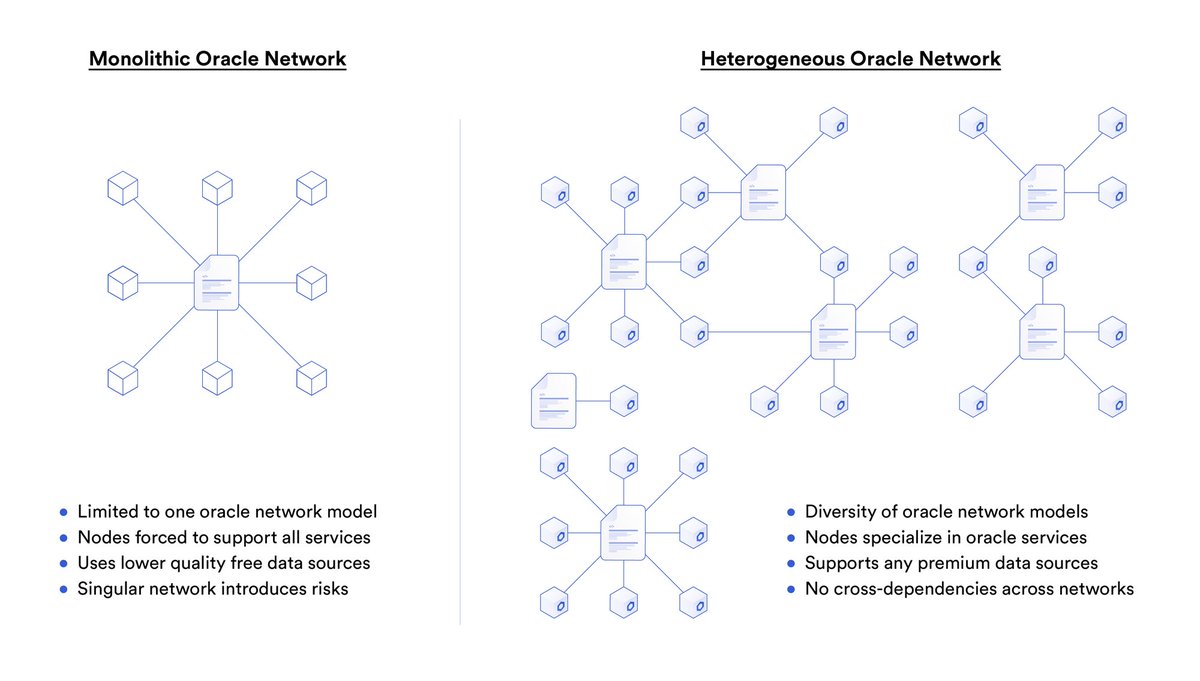
What started as a single ETH/USD Price Feed has since expanded into a fully-featured platform of services
There are now 1,000+ #Chainlink oracle networks that span external data, offchain compute, and cross-chain interoperability
A thread 🧵
Oracles connect blockchains to external systems, enabling them to execute based on inputs/outputs from the real world
Before chainlink, oracles were highly centralized and insecure, with frequent oracle attacks resulting in exploits and loss of funds
garbage in -> garbage out
Chainlink solved this problem through the creation of decentralized oracle networks (DONs), backed by strong cryptoeconomic incentives and high quality node operators