California, home of the world's 4th largest economy & several of its top econ departments, has spent 50 years "planning for housing need" w/o availing itself of economic expertise.
The game is up, courtesy of the S.F. city economist. My op-ed in today's @sfchronicle ⤵️.
🧵/22
The game is up, courtesy of the S.F. city economist. My op-ed in today's @sfchronicle ⤵️.
🧵/22

What happened?
Every 8 years, CA cities must adopt a plan, called a "housing element," that shows how they'll accommodate their fair share of regionally needed housing.
/2
Every 8 years, CA cities must adopt a plan, called a "housing element," that shows how they'll accommodate their fair share of regionally needed housing.
/2
In June 2020, after some back-and-forth w/ regional "council of governments" (but no input from economists) @California_HCD announced the current target for the Bay Area.
/3
abag.ca.gov/sites/default/…
/3
abag.ca.gov/sites/default/…
The regional council, @ABAGSFBayArea, then convened a committee to devise a formula for allocating the regional target among the 100+ Bay Area municipalities.
/4
/4
The committee had no data on the market or political feasibility of putting new housing in this or that community.
One member told me off the record, "We were given two instructions: minimize GHG emissions & make rich suburbs zone for affordable multifamily housing."
/5
One member told me off the record, "We were given two instructions: minimize GHG emissions & make rich suburbs zone for affordable multifamily housing."
/5
"When I pointed out that the two goals work at cross purposes," he continued, "the ABAG staff just shrugged."
Eventually ABAG landed on a formula.
The final allocation, adopted in Dec. of 2021, assigned ~82,000 housing units to San Francisco.
/6
abag.ca.gov/sites/default/…
Eventually ABAG landed on a formula.
The final allocation, adopted in Dec. of 2021, assigned ~82,000 housing units to San Francisco.
/6
abag.ca.gov/sites/default/…
That's a big number! To produce 82,000 new units over 8 years, San Francisco would need to triple the annualized rate of housing production it has realized over the last couple of decades.
It would have to build like Seattle, not like Peskinville.
/7
It would have to build like Seattle, not like Peskinville.
/7
State law gave San Francisco a little over a year (from the release of the final allocation) to enact a plan for how to do it.
/8
/8
S.F. planners responded w/ magical thinking about "pipeline" of entitled (but mostly stalled, b/c infeasible or needing massive infrastructure) projects to whittle the 82,000-unit target down to 36,000 units that would be accommodated w/ upzoning.
/9
/9
https://x.com/CSElmendorf/status/1508086769874472961
The state housing agency, HCD, blessed the plan, I think b/c it committed the city to "reasonably account...using an analytical model" for sites' likelihood of development, and in part b/c it included a mid-cycle circuit breaker.
The supes passed the plan in Dec. 2022.
/10
The supes passed the plan in Dec. 2022.
/10
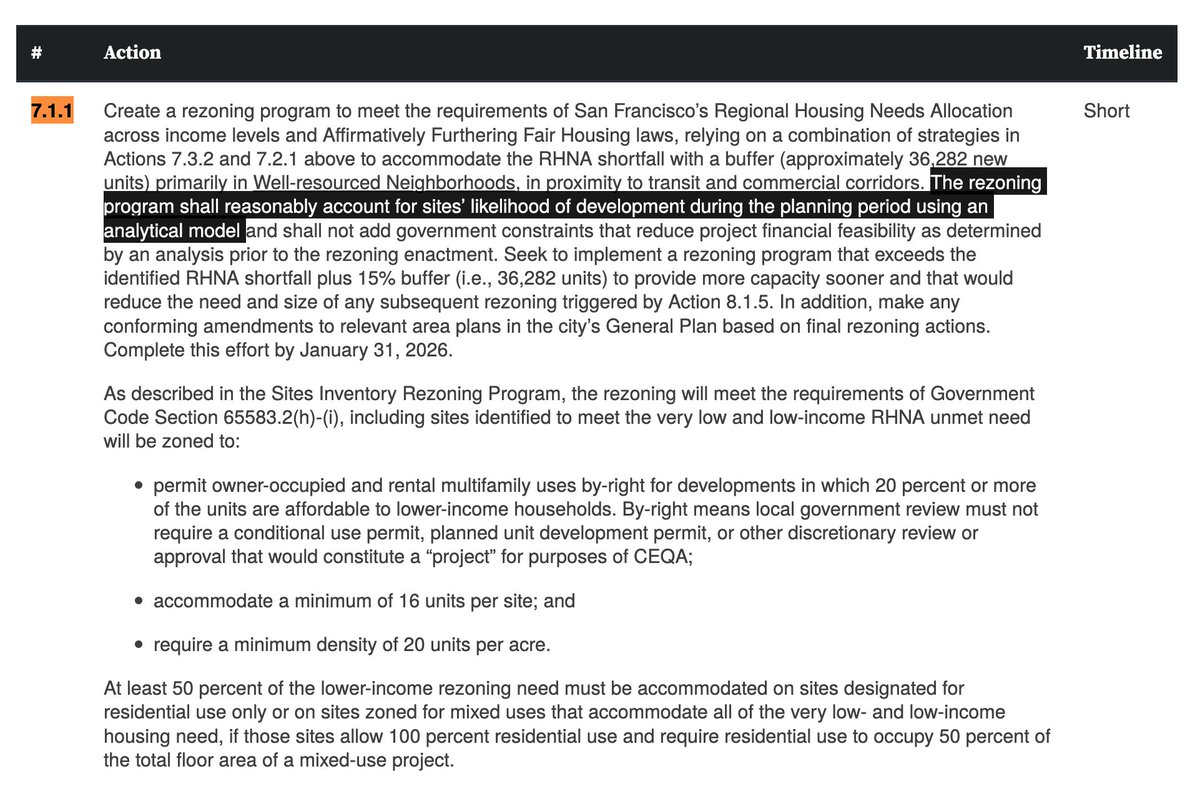
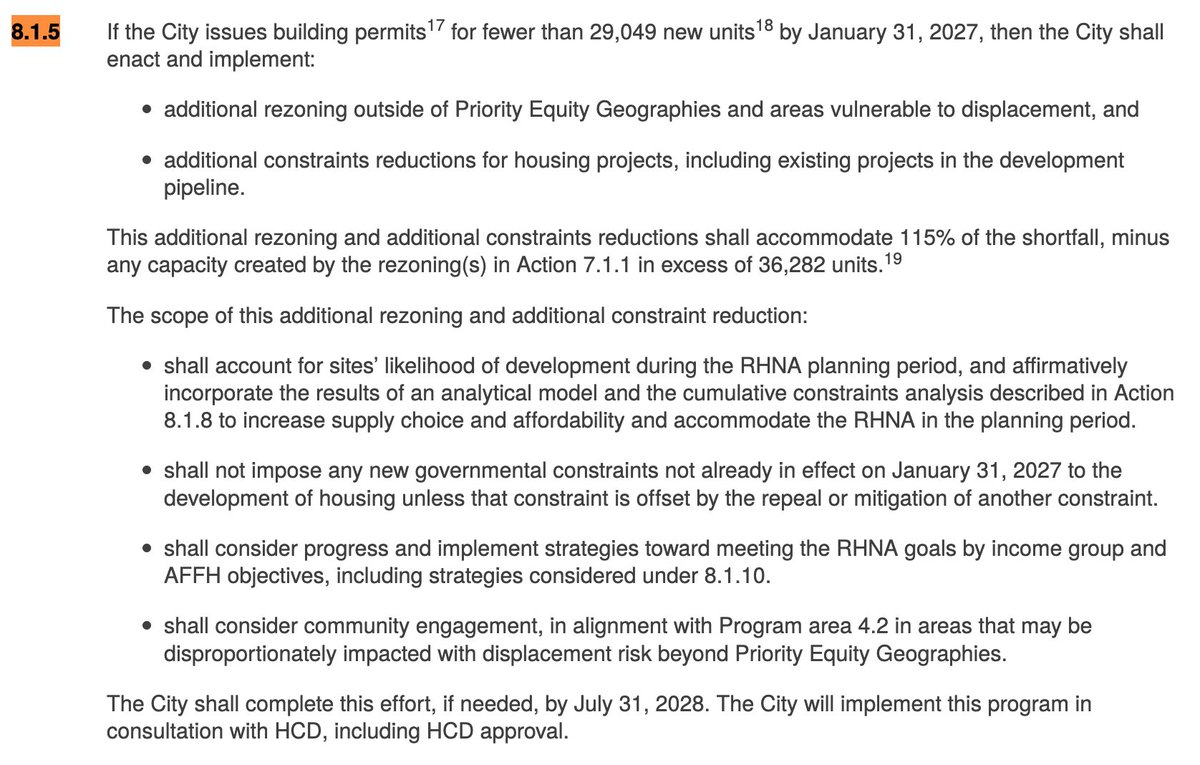
State law gave city 3 years to complete the rezoning that implements core commitment of the housing element, i.e., to make up the agreed-upon 36,000 unit shortfall of "realistic capacity."
That 3-year deadline is nearly upon us (Jan 2025).
/11
That 3-year deadline is nearly upon us (Jan 2025).
/11
.@DanielLurie's Family Zoning Plan is supposed to deliver the goods.
City planners claimed it was sufficient to meet 36k target. Their analysis was suspect & definitely not reviewed by economists...
Here's what they said to HCD,
/12drive.google.com/file/d/1ZOcNve…
City planners claimed it was sufficient to meet 36k target. Their analysis was suspect & definitely not reviewed by economists...
Here's what they said to HCD,
/12drive.google.com/file/d/1ZOcNve…
HCD responded that it was “pleased to preliminarily [approve]” the rezoning, but also told SF "to continue to explore additional and multiple methods [for estimating sites’ likelihood of development] and make adjustments as appropriate.”
/13
sfgov.legistar.com/View.ashx?M=F&…
/13
sfgov.legistar.com/View.ashx?M=F&…
In any other city, that would have been the end of the story.
But thanks to 2004 ballot measure, SF has a city economist, who is charged w/ preparing economic-impact analyses of pending ordinances.
/14
But thanks to 2004 ballot measure, SF has a city economist, who is charged w/ preparing economic-impact analyses of pending ordinances.
/14
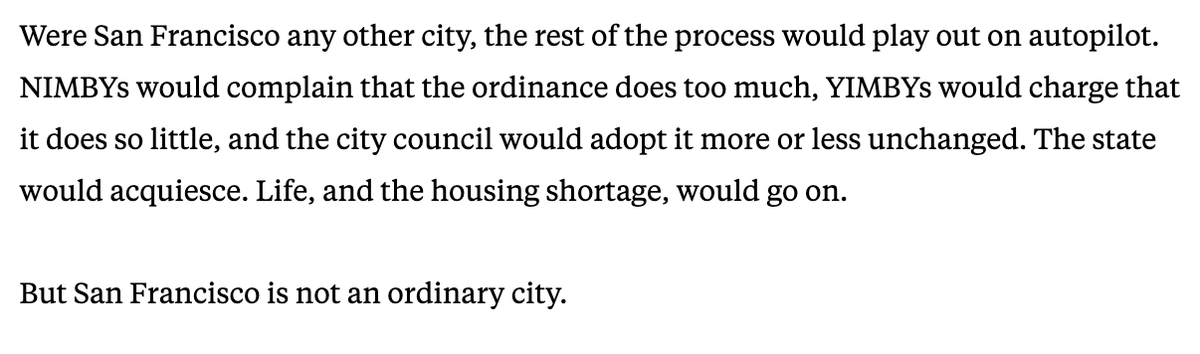
To gauge economic impact, he had to forecast development under Family Zoning Plan.
His ***highly optimistic, best case scenario*** projects that the plan will yield only ~14,000 new units over the next two decades, nowhere near the 36,000 by 2030 obligation.
Oops.
/15
His ***highly optimistic, best case scenario*** projects that the plan will yield only ~14,000 new units over the next two decades, nowhere near the 36,000 by 2030 obligation.
Oops.
/15
If S.F. doesn't enact a compliant plan by Jan 31, it's subject to Builder's Remedy, meaning that developers may build 3x more densely than the density allowed on their site by city or state law. Height limits & anything else that precludes their project will be waived.
/16
/16
Now take a deep breath, step back, and contemplate the craziness.
The whole theory of this planning framework is that b/c housing has positive regional spillovers (true), cities shouldn't get to decide for themselves how much to allow, but that...
/17
The whole theory of this planning framework is that b/c housing has positive regional spillovers (true), cities shouldn't get to decide for themselves how much to allow, but that...
/17
b/c city pols understand local preferences better than state administrators do (probably true), city pols should get to decide where the new housing goes.
Yet 5 years into planning cycle (& 3 months shy of Builder's Remedy), there's no agreed-upon model for scoring plans!
/18
Yet 5 years into planning cycle (& 3 months shy of Builder's Remedy), there's no agreed-upon model for scoring plans!
/18
The supes can't do their job w/o knowing how a plan will be scored. Instead of providing a model to score the plans, HCD just told the city to "continue to explore additional and multiple methods."
If I were a supervisor or city attorney, I'd be blowing my top.
/19
If I were a supervisor or city attorney, I'd be blowing my top.
/19
I don't mean to harsh on HCD. They're doing the job the Legislature gave them, with the staff the Legislature gave them. (No economists...)
/20
/20
But the process needs an overhaul.
Cities need realistic, economically-informed targets.
Even more important, they need realistic, economically-informed tools with which they can quickly & easily gauge a rezoning plan's sufficiency.
/20
Cities need realistic, economically-informed targets.
Even more important, they need realistic, economically-informed tools with which they can quickly & easily gauge a rezoning plan's sufficiency.
/20
The state needs to provide these tools.
It makes no sense to tell city planners to devise their own models, as the planners have neither the technical knowledge nor the political incentives to come up with something reasonable.
End the guessing games. Please.
/21
It makes no sense to tell city planners to devise their own models, as the planners have neither the technical knowledge nor the political incentives to come up with something reasonable.
End the guessing games. Please.
/21
@threadreaderapp unroll
• • •
Missing some Tweet in this thread? You can try to
force a refresh