I'll give you three reasons why someone might be into a watch.
I will use three watches in my personal collection. 🧵
I will use three watches in my personal collection. 🧵
https://twitter.com/ErrataRob/status/1984807194789851233
As some may know, my family is from Vietnam. My parents fled Saigon shortly after the Tet Offensive, as bombs were falling around them and they weren't sure what was going to happen once the North Vietnamese took over the city. 

When my dad left Vietnam, he wasn't able to take much with him — just some family photos of life back home, some clothes, and a 1960s Rolex Datejust he bought as a present for himself. Growing up, I always saw my dad wear this watch. It was basically part of his body.

So when he gave it to me as a birthday present many years ago, I felt it was very special. I love the watch because it reminds me of him, one of the most important people in my life.
IMO, the Rolex Datejust is a perfect accompaniment to casual tailoring and dressier casualwear.
IMO, the Rolex Datejust is a perfect accompaniment to casual tailoring and dressier casualwear.


My second watch is an Omega "Dirty Dozen."
During WWII, the British Ministry of Defense (MoD) wanted a watch that would stand up to the rigors of war. So they spec'd out a watch: black dial, luminous markers, Arabic numerals, shatterproof crystal, and stainless steel case.
During WWII, the British Ministry of Defense (MoD) wanted a watch that would stand up to the rigors of war. So they spec'd out a watch: black dial, luminous markers, Arabic numerals, shatterproof crystal, and stainless steel case.

The idea was that this could be easily read at all times and be durable. Companies that fulfilled the order included some famous watchmaking names, such as Jaeger-LeCoultre, Omega, and IWC. And some lesser-known names, such as Record, Timor, and Vertex.

The back of a Dirty Dozen watch will have two engravings. WWW stands for Watch, Wrist, Waterproof. The broad arrow signals this is governmental goods. My specific watch was made by Omega and features a replacement NATO dial (so no radioactive radium lume).


I like the watch because of its history in the fight against fascism. IMO, the style goes well with hoodies, flannels, chore coats, trucker jackets, and anything that can be described as rugged or workwear.


Finally, my third watch is a Patek 2551. It descends from the Patek 96. First released in 1932 with a LeCoultre movement, the 96 is generally regarded as the watch that set the template for dress watches. The round, coin-edge case and simple proportions has been endlessly copied.

The prob is that the 96 wears rather small for contemporary standards, so people like me, who enjoy the simplicity of the 96 but prefer a slightly larger size, often go for another model. Mine is the Patek 2551, a 36mm 1950s watch with a "Disco Volante" case (flying saucer).

I like it partly for its technical innovation. The 2551 is powered by Patek's 12-600, which is the company's first automatic movement. The movement was much better than any other automatic at the time, partly because of its impeccable finishing.

In this video, you can see a watchmaker take the movement apart — all the radiating stripes, "swirling" circles, and chamfered edges you see were done by hand. The 18k bi-directional gold rotor also features an engine-turned barleycorn guilloché (also done by hand).
The 12-600 features Patek's Gyromax balance wheel. Instead of having adjustable screws on the outside of the balance rim (video 1), Patek put turnable weights into recessed sections on top of the rim (pic 2).
Video via IG peterelliotglomb
Video via IG peterelliotglomb

According to Patek, this allows for a larger balance diameter, which increases the moment of inertia and improves stability. This also reduces air resistance (since no screws protrude), enables finer and more stable rate adjustment, and contributes to greater long-term accuracy.

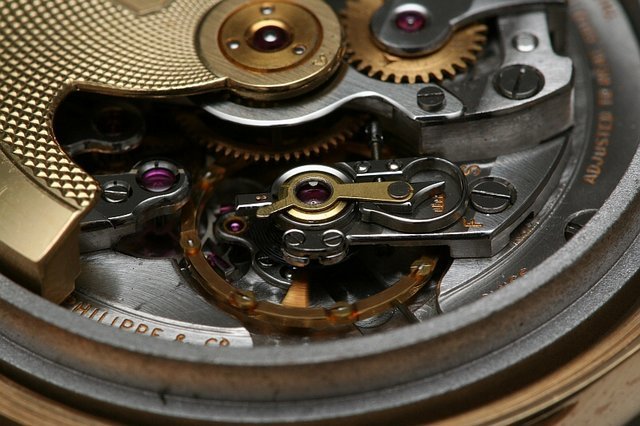
For me, there's something very romantic about Patek's designs. IMO, they are the perfect dress watch. And so, they sit naturally with dressier clothes, such as dark worsteds suits and evening clothes (even if it's just a gray tweed with charcoal flannel trousers).


So here we see three reasons to like a watch:
— Personal connection
— Relation to history
— Design and technical engineering
There are certainly people who buy watches purely as a financial flex. But in my years of wearing a watch, few have commented unless they're into watches
— Personal connection
— Relation to history
— Design and technical engineering
There are certainly people who buy watches purely as a financial flex. But in my years of wearing a watch, few have commented unless they're into watches
I personally don't like smart watches because I think of them as semi-disposable. You use them for five years and that's it. As more of our world gets consumed by disposable products and AI, I think it's amazing to see a handcrafted item last 100+ years.
IG peterelliotglomb
IG peterelliotglomb
• • •
Missing some Tweet in this thread? You can try to
force a refresh