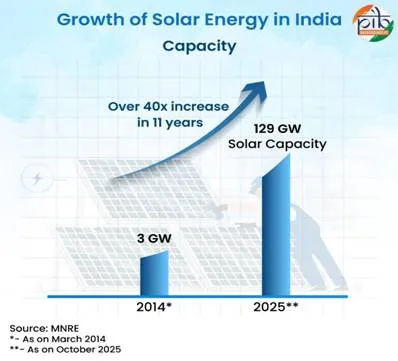
India raced to build solar factories so fast that we already surpassed our 2030 renewable capacity target. But all this speed has created a strange problem: we now have more solar supply than the market can absorb. 🧵👇
Manufacturers are sitting on huge inventories and cutting prices just to keep factories running. Margins have collapsed, and some companies have slipped into losses.
Image: PIB
Yet even with this glut, developers who want to build new solar farms are struggling to find buyers for their power. As of September, 44 GW of awarded renewable capacity has no power purchase agreements.
We know transformers keep the grid running, but most of us never stop to ask what they actually do or why they matter so much.
So we dug into the transformer industry. How they work, why global supply is strained, and where India fits into this story. 👇
Start with the basics. A transformer’s job is simple: change electricity from one form into another. High voltage to low, or low to high.
Think of electricity like water. You can send a slow, heavy flow through a wide pipe or a fast, narrow stream through a small pipe. If you balance them correctly, the same amount of water reaches the town.
Voltage is the pressure. Current is the flow. For any given amount of power, you can run low voltage with high current or high voltage with low current.
Any discussion about AI today eventually lands on a single question: is AI a bubble? 🧵👇
Bubbles aren’t always bad. Many big technological shifts, from smartphones to the internet, came out of bubbles. What matters is how a bubble is built and whether the investment remains useful even if it bursts.
In this case, the AI surge is being powered almost entirely by the United States. AI data-center spending has become a major pillar of the US economy.
AI-related capex alone accounts for roughly 40% of US economic growth this year. That is an unusually large share for a single theme.
The quick commerce industry is moving faster than anyone expected. So much has changed in just a few months that it is worth stepping back to see where things stand. A 🧵 on whats happening.
Zepto raised new capital and is now rumored to be inching toward an IPO. Reliance Retail said it has shifted its quick-commerce model to 30-minute delivery by riding on its nationwide store network. Swiggy is raising funds after earlier saying it did not need external capital. Blinkit is adding stores at record speed. The momentum is remarkable.
We are skipping the debate on valuations. What matters here is what the two biggest listed players, Swiggy and Eternal (Zomato), actually said and did this quarter. This space changes so quickly that every quarter feels like a fresh chapter.
Let’s walk through how quick commerce performed this quarter.
India’s energy story is entering its most ambitious phase yet.
We’re building new renewable capacity, modernising our grids, and revamping how electricity moves across the country. Here's what's happening 🧵👇
According to the National Electricity Plan, India’s power capacity could hit 609 GW by 2027 and 900 GW by 2032. That’s nearly double today’s capacity.
But this transformation won’t come cheap. It will need ₹32 lakh crore of capital spending between FY26 and FY32. And roughly three-fourths of that will have to be financed by debt.
In October, a bunch of headlines caught our eye: the government was pushing for “coal gasification” and had just opened auctions for underground gasification blocks.
That sounded strange. Coal is solid. How on earth do you turn it into gas? 🧵👇
That question led us down a fascinating rabbit hole.
Because what India’s trying now could completely change how we use coal, our dirtiest but most abundant fuel.
To start with, the idea is simple. Solid fuels like coal are messy to burn. They create uneven heat, soot, and pollution.
But gases? Those burn evenly. Think of your kitchen stove, a clean flame you can control with a knob.