Stock–Flow Consistent Formulation of
Kalecki–Young Sectoral Inflation Decomposition (KYSID)
"Recasting KYSID within a stock–flow consistent (SFC) framework clarifies that the inflation process is a balance-sheet outcome."
Core flow-of-funds identity
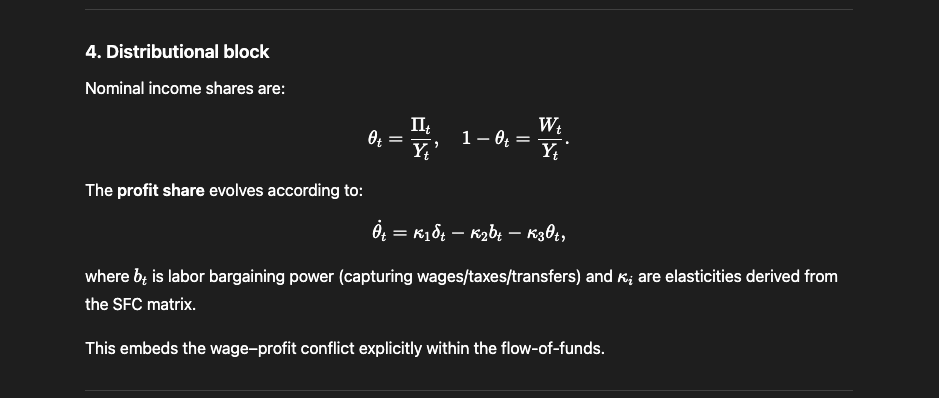
Distributional block
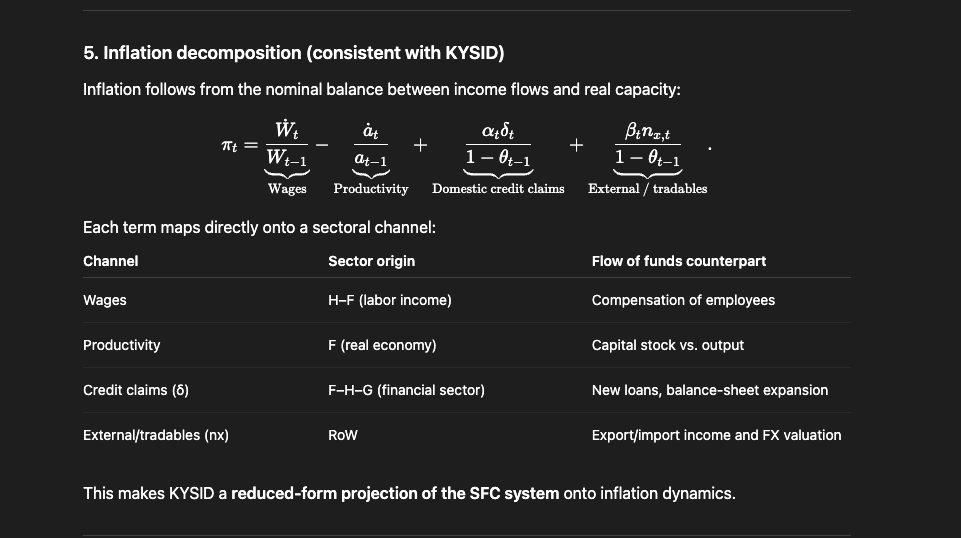
Inflation decomposition (consistent with KYSID)
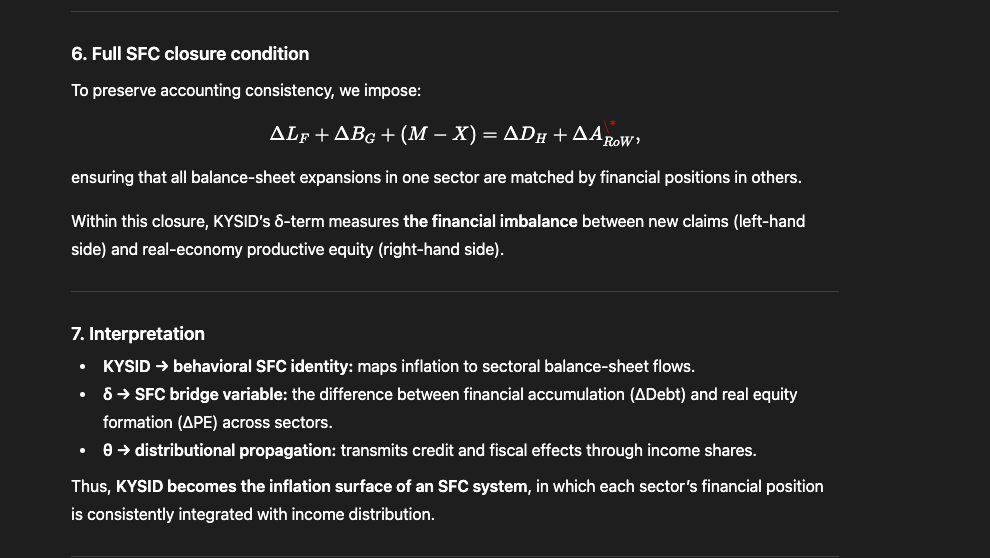
Full SFC closure condition
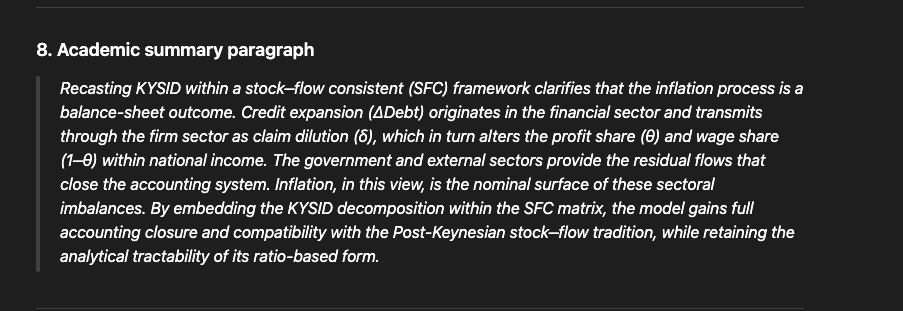
By embedding the KYSID decomposition within the SFC matrix, the model gains full accounting closure and compatibility with the Post-Keynesian stock–flow tradition, while retaining the analytical tractability of its ratio-based form.
@threadreaderapp
unroll
• • •
Missing some Tweet in this thread? You can try to
force a refresh

Kalecki = Godley: The Unified Income–Financing Identity
A central result of this paper is that Kalecki’s profit identity and Godley’s sectoral balances identity are not separate theoretical constructions but two expressions of the same underlying mechanism, viewed from different sides of the national accounts.
Kalecki presents the income side; Godley presents the financing side.
Once placed within a stock–flow consistent (SFC) framework, the equivalence becomes exact.
"It lets you both model inflation and attribute it sectorally—to wages, productivity, domestic debt saturation, and the external / tradables channel—within a consistent stock–flow, income‑distribution perspective."
The Constant-Rate Interest Burden as the Hidden Driver of Capital Share: Evidence from Balance-Sheet Saturation
This balance-sheet mechanism explains the secular rise in the capital share and the decline in labor share observed since the 1980s without appealing to exogenous technology shocks.
Conceptually, it represents the interest-service load that would prevail if monetary policy had not reduced nominal rates in response to debt expansion. While the actual burden rtL/Y fluctuates with policy cycles, the constant-rate version isolates the structural leverage component, reflecting the underlying stock of liabilities relative to income.
Ergodicity vs expected-utility assumes the return distribution is exogenous.
But in a credit economy, returns are endogenously driven by balance-sheet expansion (A≈L).
Investors maximize share of system claims subject to leverage guardrails — not abstract utility or stationary distributions.
Kelly works within a balance-sheet regime, not instead of one.



