Artificial Analysis Profile picture
Nov 17, 2025 8 tweets 7 min read Read on X
Announcing AA-Omniscience, our new benchmark for knowledge and hallucination across >40 topics, where all but three models are more likely to hallucinate than give a correct answer

Embedded knowledge in language models is important for many real world use cases. Without knowledge, models make incorrect assumptions and are limited in their ability to operate in real world contexts. Tools like web search can support but models need to know what to search for (e.g. models should not search for ‘Multi Client Persistence’ for an MCP query when it clearly refers to ‘Model Context Protocol’).

Hallucination of factual information is a barrier to being able to rely on models and has been perpetuated by every major evaluation dataset. Grading correct answers with no penalty for incorrect answers creates an incentive for models (and the labs training them) to attempt every question. This problem is clearest when it comes to knowledge: factual information should never be made up, while in other contexts attempts that might not work are useful (e.g. coding new features).

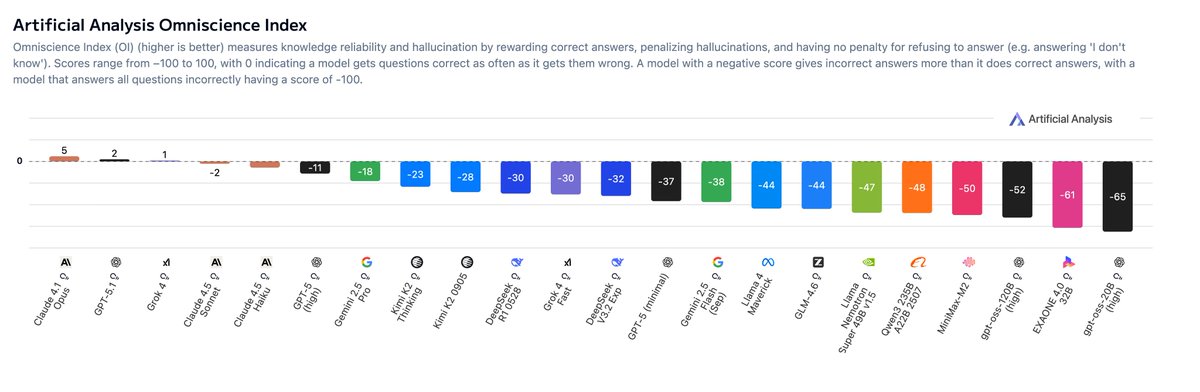
Omniscience Index is the the key metric we report for AA-Omniscience, and it punishes hallucinations by deducting points where models have guessed over admitting they do not know the answer. AA-Omniscience shows that all but three models are more likely to hallucinate than provide a correct answer when given a difficult question. AA-Omniscience will complement the Artificial Analysis Intelligence Index to incorporate measurement of knowledge and probability of hallucination.

Details below, and more charts in the thread.

AA-Omniscience details:

- 🔢6,000 questions across 42 topics within 6 domains (’Business’, ‘Humanities & Social Sciences’, ‘Health’, ‘Law’, ‘Software Engineering’, and ‘Science, Engineering & Mathematics’)
- 🔍 89 sub-topics including Python data libraries, Public Policy, Taxation, and more, giving a sharper view of where models excel and where they fall short across nuanced domains
- 🔄 Incorrect answers are penalized in our Knowledge Reliability Index metrics to punish hallucinations
- 📊3 Metrics: Accuracy (% correct), Hallucination rate (% incorrect of incorrect/abstentions), Omniscience Index (+1 for correct, -1 for incorrect where answered, 0 for abstentions where the model did not try to answer)
- 🤗 Open source test dataset: We’re open sourcing 600 questions (10%) to support labs develop factual and reliable models. Topic distribution and model performance follows the full set (@huggingface link below)
- 📃 Paper: See below for a link to the research paper

Key findings:

- 🥇 Claude 4.1 Opus takes first place in Omniscience Index, followed by last week’s GPT-5.1 and Grok 4: Even the best frontier models score only slightly above 0, meaning they produce correct answers on the difficult questions that make up AA-Omniscience only marginally more often than incorrect ones. @AnthropicAI’s leadership is driven by low hallucination rate, whereas OpenAI and xAI’s positions are primarily driven by higher accuracy (percentage correct).

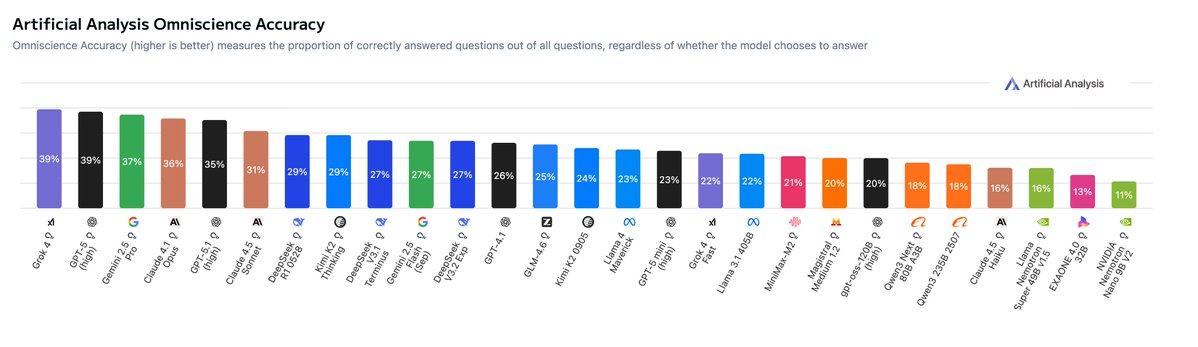
- 🥇 xAI’s Grok 4 takes first place in Omniscience Accuracy (our simple ‘percentage correct’ metric), followed by GPT-5 and Gemini 2.5 Pro: @xai's win may be enabled by scaling total parameters and pre-training compute: @elonmusk revealed last week that Grok 4 has 3 trillion total parameters, which may be larger than GPT-5 and other proprietary models

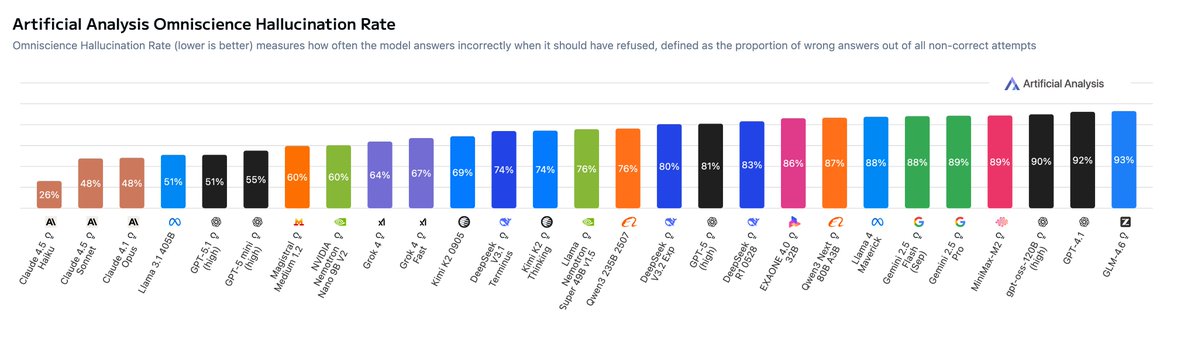
- 🥇 Claude sweeps the hallucination leaderboard: Anthropic takes the top three spots for lowest hallucination rate, with Claude 4.5 Haiku leading at 28%, over three times lower than GPT-5 (high) and Gemini 2.5 Pro. Claude 4.5 Sonnet and Claude 4.1 Opus follow in second and third at 48%

- 💭 High knowledge does not guarantee low hallucination: Hallucination rate measures how often a model guesses when it lacks the required knowledge. Models with the highest accuracy, including the GPT-5 models and Gemini 2.5 Pro, do not lead the Omniscience Index due to their tendency to guess over abstaining. Anthropic models tend to manage uncertainty better, with Claude 4.5 Haiku achieving the lowest hallucination rate at 26%, ahead of 4.5 Sonnet and 4.1 Opus (48%)

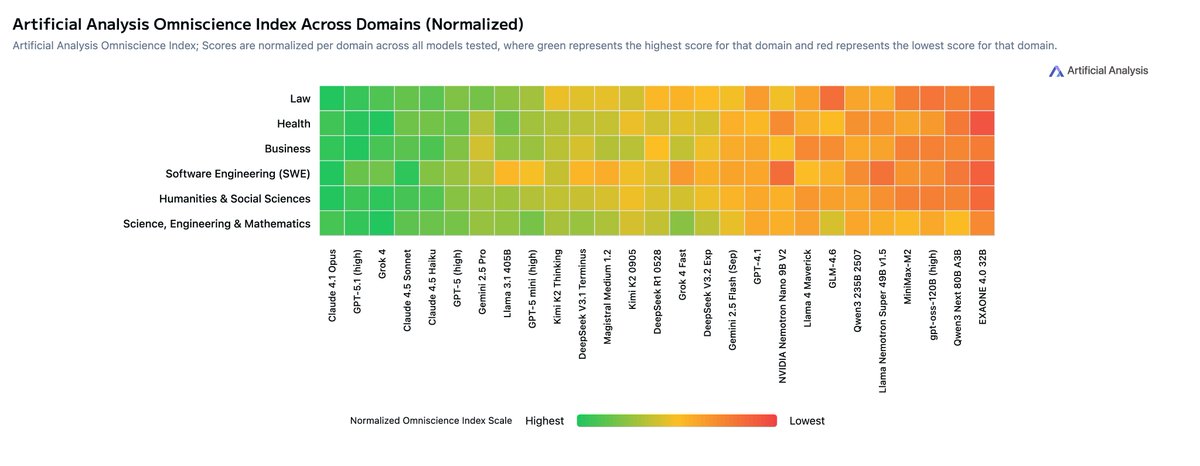
- 📊 Models vary by domain: Models differ in their performance across the six domains of AA-Omniscience - no model dominates across all. While Anthropic’s Claude 4.1 Opus leads in Law, Software Engineering, and Humanities & Social Sciences, GPT-5.1 from @OpenAI achieves the highest reliability on Business questions, and xAI’s Grok 4 performs best in Health and in Science, Engineering & Mathematics. Model choice should align with the the use case rather than choosing the overall leader

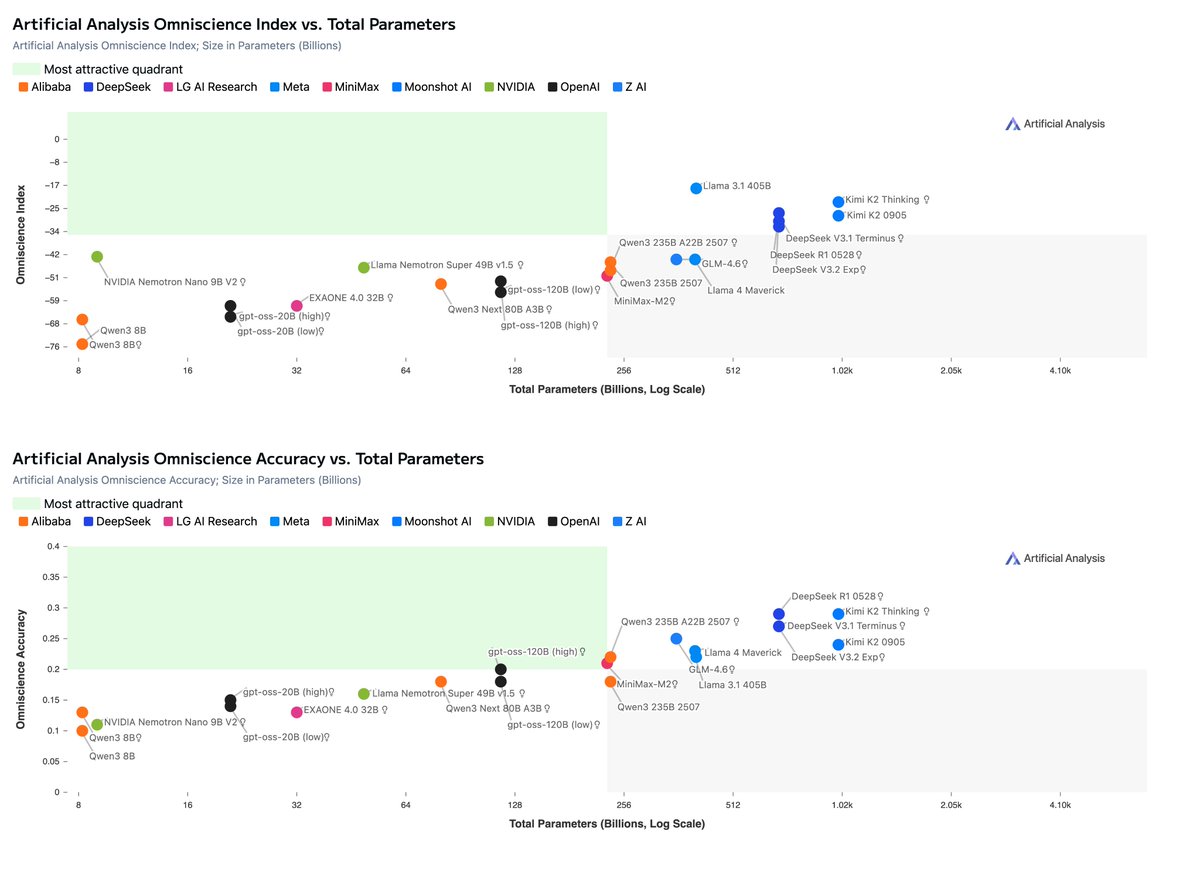
- 📈 Larger models score higher on accuracy, but not always reliability: Larger models tend to have higher levels of embedded knowledge, with Kimi K2 Thinking and DeepSeek R1 (0528) topping accuracy charts over smaller models. This advantage does not always hold on the Omniscience Index. For example, Llama 3.1 405B from @AIatMeta beats larger Kimi K2 variants due to having one of the lowest hallucination rates among models (51%)Image
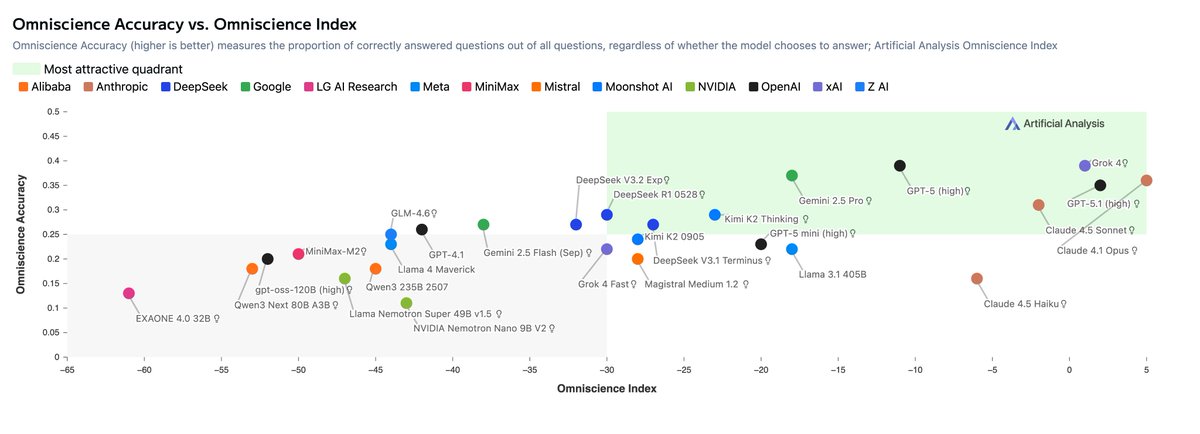
Grok 4 by @xai, GPT-5 by @OpenAI and Gemini 2.5 Pro by @GoogleDeepMind achieve the highest accuracy in AA-Omniscience. The reason they do not achieve the highest Omniscience Index due to the low hallucination rates of @AnthropicAI’s Claude models Image
@AnthropicAI takes the top three spots for lowest hallucination rate, with Claude 4.5 Haiku leading at 28%, over three times lower than GPT-5 (high) and Gemini 2.5 Pro. Claude 4.5 Sonnet and Claude 4.1 Opus follow in second and third at 48% Image
Models with the highest accuracy, including Grok 4, GPT-5.1 and Gemini 2.5 Pro, do not lead the Omniscience Index due to their tendency to guess over abstaining. Claude 4.1 Opus has the best balance of accuracy (31%) and hallucination (48%), giving it the highest score in the Omniscience IndexImage
Models differ in their performance across the six domains of AA-Omniscience - no model dominates across all. While @AnthropicAI's Claude 4.1 Opus leads in Law, Software Engineering, and Humanities & Social Sciences, GPT-5.1 from @OpenAI achieves the highest Omniscience Index on Business questions, and @xai's Grok 4 performs best in Health and Science, Engineering & Mathematics. Model choice should align with the the use case rather than choosing the overall leaderImage
Larger models tend to have higher levels of embedded knowledge, with Kimi K2 Thinking and DeepSeek R1 (0528) topping accuracy charts over smaller models. This advantage does not always hold on the Omniscience Index. For example, Llama 3.1 405B from @AIatMeta beats larger Kimi K2 variants due to having one of the lowest hallucination rates among models (51%)Image
Read more about the evaluation and methodology in our AA-Omniscience paper (published arXiv link coming later today):
huggingface.co/datasets/Artif…

Explore sample questions and evaluate your model on the public set of AA-Omniscience with our HuggingFace dataset:
huggingface.co/datasets/Artif…

See details AA-Omniscience results on Artificial Analysis:
artificialanalysis.ai/evaluations/om…
The AA-Omniscience paper is now live on arXiv: arxiv.org/abs/2511.13029

• • •

Missing some Tweet in this thread? You can try to force a refresh

 

Keep Current with Artificial Analysis

Artificial Analysis Profile picture

Stay in touch and get notified when new unrolls are available from this author!

Read all threads

This Thread may be Removed Anytime!

PDF

Twitter may remove this content at anytime! Save it as PDF for later use!

Try unrolling a thread yourself!

how to unroll video
  1. Follow @ThreadReaderApp to mention us!

  2. From a Twitter thread mention us with a keyword "unroll"
@threadreaderapp unroll

Practice here first or read more on our help page!

More from @ArtificialAnlys

Apr 30
xAI has launched Grok 4.3, achieving 53 on the Artificial Analysis Intelligence Index with improved agentic performance, ~40% lower input price, and ~60% lower output price than Grok 4.20

The release of Grok 4.3 places @xAI just above Muse Spark and Claude Sonnet 4.6 on the Intelligence Index, and a 4 points ahead of the latest version of Grok 4.20. Grok 4.3 improves its Artificial Analysis Intelligence Index score while reducing cost to run the benchmark suite.

Key Takeaways:

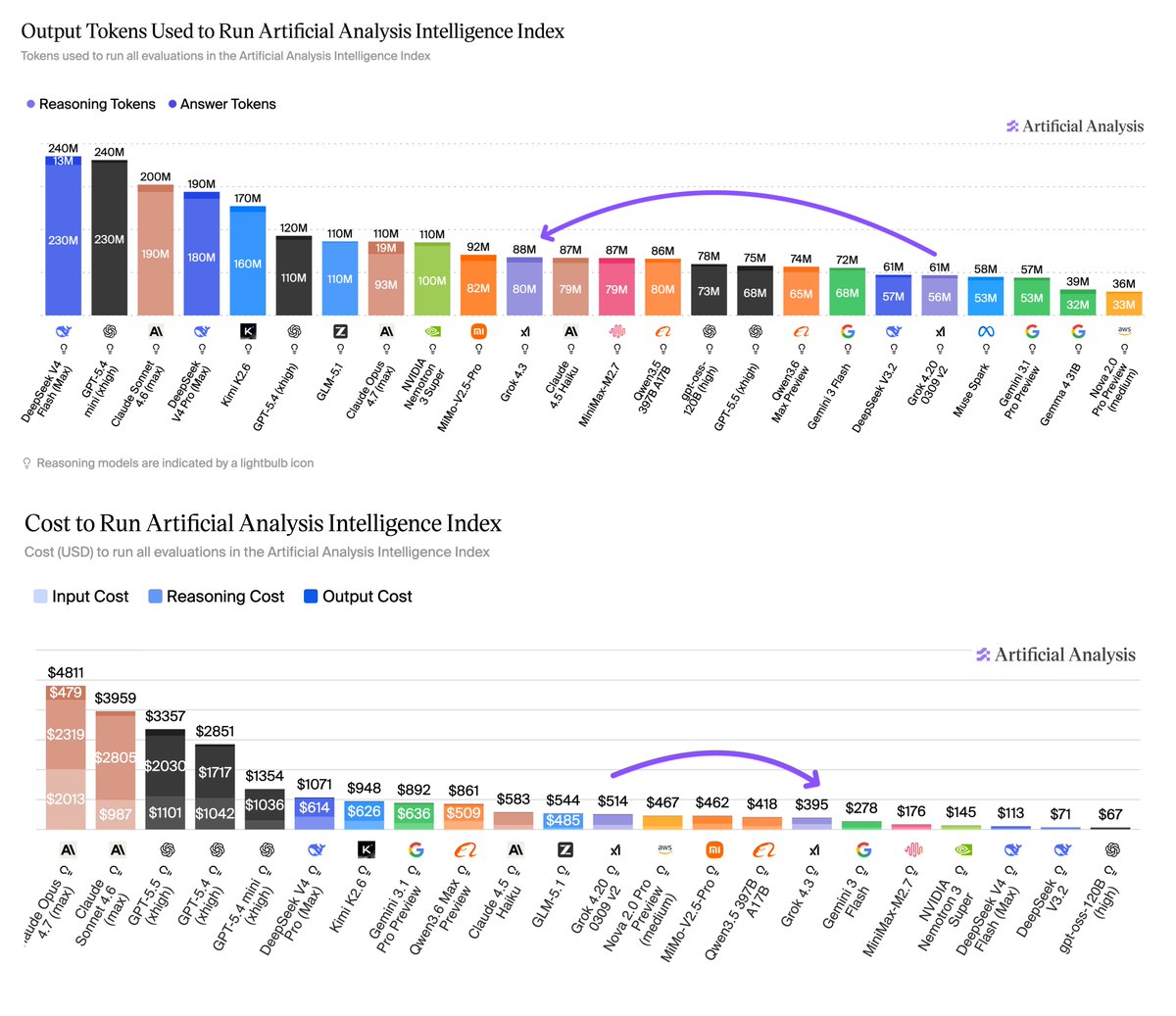
➤ Grok 4.3 improves on cost-per-intelligence relative to Grok 4.20 0309 v2: it scores higher on the Intelligence Index while costing less to run the full benchmark suite. Grok 4.3 costs $395 to run the Artificial Analysis Intelligence Index, around 20% lower than Grok 4.20 0309 v2, despite using more output tokens. This makes it one of the lower-cost models at its intelligence level

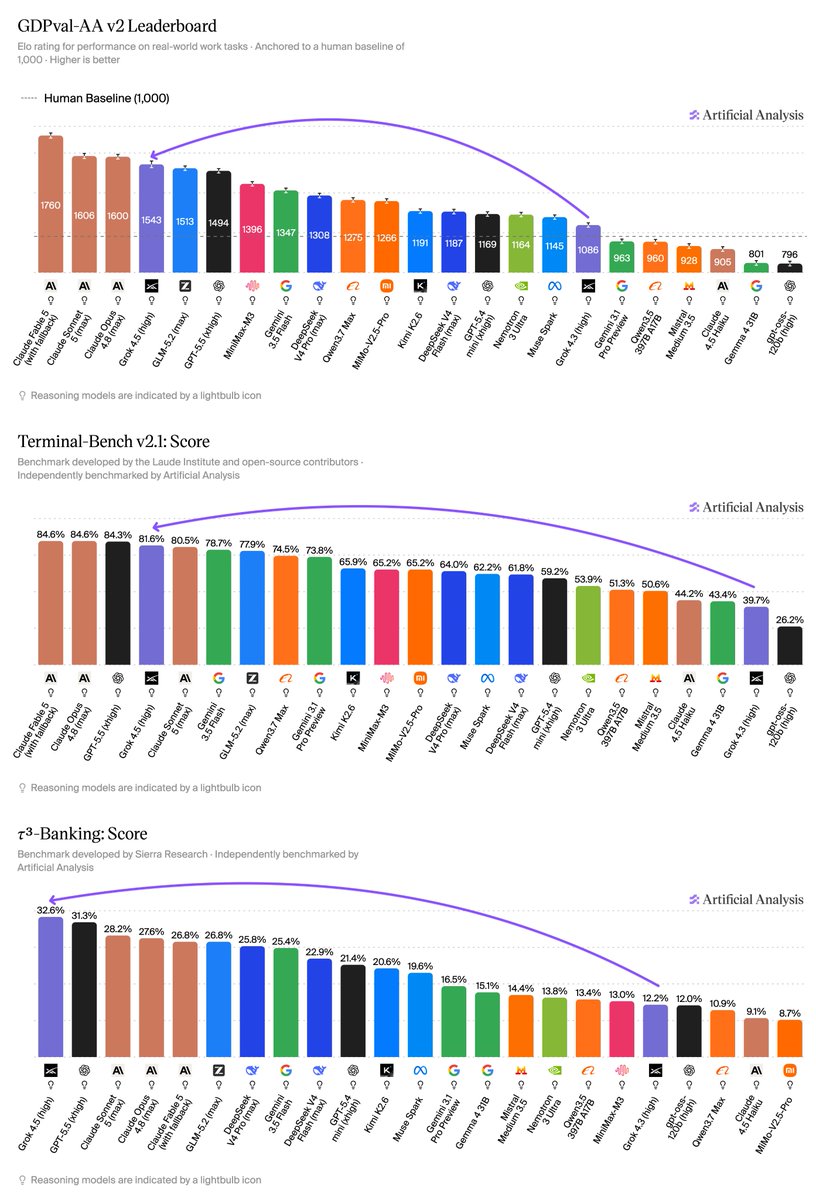
➤ Large increase in real world agentic task performance: The largest single benchmark improvement is on GDPval-AA, where Grok 4.3 scores an ELO of 1500, up 321 points from Grok 4.20 0309 v2’s score of 1179 Grok 4.3, surpassing Gemini 3.1 Pro Preview, Muse Spark, Gpt-5.4 mini (xhigh), and Kimi K2.5. Grok 4.3 narrows the gap to the leading model on GDPval-AA, but still trails GPT-5.5 (xhigh) by 276 Elo points, with an expected win rate of ~17% against GPT-5.5 (xhigh) under the standard Elo formula

➤ Grok 4.3’s performs strongly on instruction following and agentic customer support tasks. It gains 5 points on 𝜏²-Bench Telecom to reach 98%, in line with GLM-5.1. Grok 4.3 maintains an 81% IFBench score from Grok 4.20 0309 v2

➤ Gains 8 points on AA-Omniscience Accuracy, but at the cost of lower AA-Omniscience Non-Hallucination Rate of 8 points, so Grok 4.20 0309 v2 still leads AA-Omniscience Non-Hallucination Rate, followed by MiMo-V2.5-Pro, in line with Grok 4.3

Congratulations to @xAI and @elonmusk on the impressive release!Image
This release shows increased cost efficiency to run the Artificial Analysis Intelligence Index, with Grok 4.3 sitting comfortably on the Pareto frontier for intelligence versus cost

Driven by 37.5% lower input token prices and 58.3% lower output token prices, it costs $395 to run the Intelligence Index evaluations, an overall ~20% decrease from Grok 4.20 0309 v2Image
Grok 4.3 uses ~44% more output tokens to run the Artificial Analysis Intelligence Index than Grok 4.20 0309 v2, but uses a similar number of tokens to models like Minimax M2.7 and remains less verbose than other leading models Image
Read 6 tweets
Feb 19
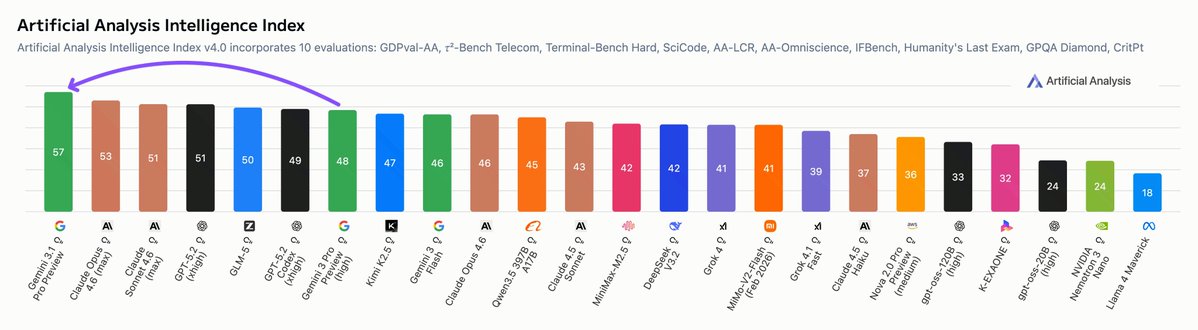
Google is once again the leader in AI: Gemini 3.1 Pro Preview leads the Artificial Analysis Intelligence Index, 4 points ahead of Claude Opus 4.6 while costing less than half as much to run

@GoogleDeepMind gave us pre-release access to Gemini 3.1 Pro Preview. It leads 6 of the 10 evaluations that make up the Artificial Analysis Intelligence Index and improves significantly over Gemini 3 Pro Preview across capabilities, with the biggest gains in reasoning and knowledge, coding, and hallucination reduction.

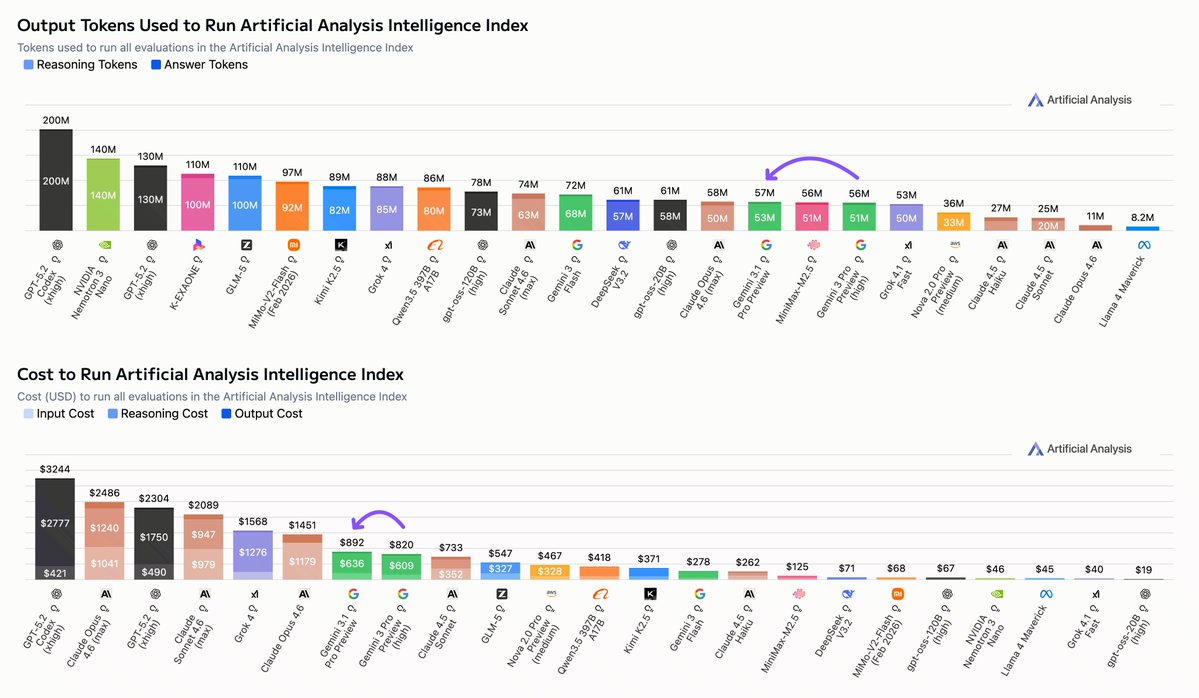
Gemini 3.1 Pro Preview also remains relatively token efficient, using ~57M tokens to run the Artificial Analysis Intelligence Index (+1M from Gemini 3 Pro Preview), lower than other frontier models at max reasoning settings such as Opus 4.6 (max) and GPT-5.2 (xhigh). Combined with lower per-token pricing, Gemini 3.1 Pro Preview is cost-efficient among frontier peers, costing less than half as much as Opus 4.6 (max) to run the full Intelligence Index, though still nearly 2x the leading open-weights model, GLM-5.

Key Takeaways:

➤ State-of-the-art intelligence at lower costs: Gemini 3.1 Pro Preview is leading 6 of the 10 evaluations that make up the Artificial Analysis Intelligence Index at less than half the cost to run of frontier peers from @OpenAI and @AnthropicAI. It obtains the highest score in Terminal-Bench Hard (agentic coding), AA-Omniscience (knowledge & hallucination), Humanity’s Last Exam (reasoning & knowledge), GPQA-Diamond (scientific reasoning), SciCode (coding) and CritPt (research-level physics). The CritPt score is particularly notable, scoring 18% on unpublished, research-level physics reasoning problems, over 5 p.p. above the next best model

➤ Improved real-world agentic performance, but not leading: Gemini 3.1 Pro Preview shows an improvement in GDPval-AA, our agentic evaluation focusing on real-world tasks, but is still not the leading model in this area. The model increases its ELO score over 100 points to 1316 (up from Gemini 3 Pro Preview), however still sits behind Claude Sonnet 4.6, Opus 4.6, GPT-5.2 (xhigh), and GLM-5

➤ Leading coding abilities: Gemini 3.1 Pro Preview leads the Artificial Analysis Coding Index, achieving the highest score in both Terminal-Bench Hard (54%) and SciCode (59%)

➤ Reduced hallucinations: Gemini 3.1 Pro Preview shows a major improvement in tendency to guess incorrectly when it doesn’t know the answer, reducing its AA-Omniscience hallucination rate by 38 p.p. from Gemini 3 Pro Preview

➤ Maintained token and cost efficiency: Gemini 3.1 Pro Preview improves without material increases in cost or token usage. It uses only ~2% more tokens to run the Artificial Analysis Intelligence Index than Gemini 3 Pro Preview, and keeps the same pricing ($2/$12 per 1M input/output tokens for ≤200k context). Its cost to run the Artificial Analysis Intelligence Index of $892 is less than half of frontier models such as Opus 4.6 (max) and GPT-5.2 (xhigh), though still ~2x the cost of leading open weights models such as GLM 5 ($547)

➤ Google takes top 3 spots in multi-modality: Gemini 3.1 Pro Preview ranks #1 on MMMU-Pro, our multimodal understanding and reasoning benchmark, ahead of Gemini 3 Pro Preview and Gemini 3 Flash, reinforcing Google’s leadership in multimodal reasoning

➤ Other model details: Gemini 3.1 Pro Preview retains the same 1 million token context window as its predecessor, and includes support for tool calling, structured outputs, and JSON modeImage
Gemini 3.1 Pro Preview improves without becoming more expensive or much more verbose, using only ~1M more tokens compared to Gemini 3 Pro Preview, representing a $72 increase in cost to run the Artificial Analysis Intelligence Index. This cost is less than half of frontier peers such as Opus 4.6 (max) and GPT-5.2 (xhigh), though still ~2x the cost of leading open-weights models such as GLM 5 and Kimi K2.5.Image
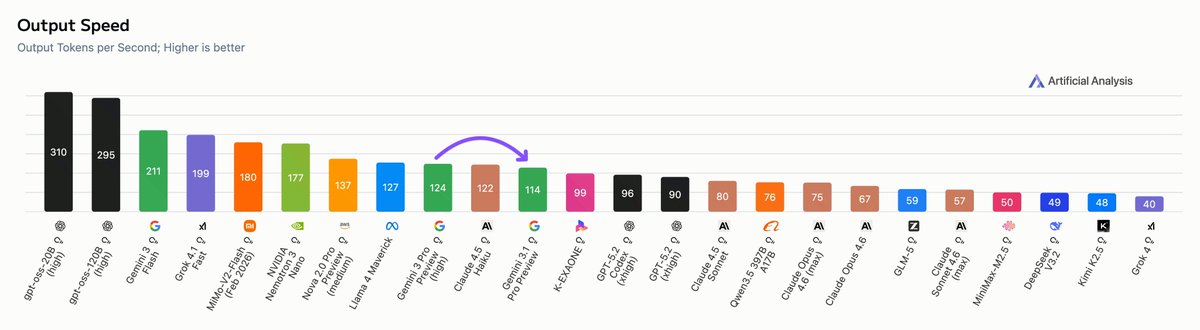
Gemini 3.1 Pro Preview has an average speed of 114 output tokens/s. Although slightly slower than its predecessor (-10 t/s), it remains one of the fastest models in the top 10 of the Artificial Analysis Intelligence Index, trailing only other Google models (Gemini 3 Flash and Gemini 3 Pro Preview).Image
Read 8 tweets
Dec 20, 2025
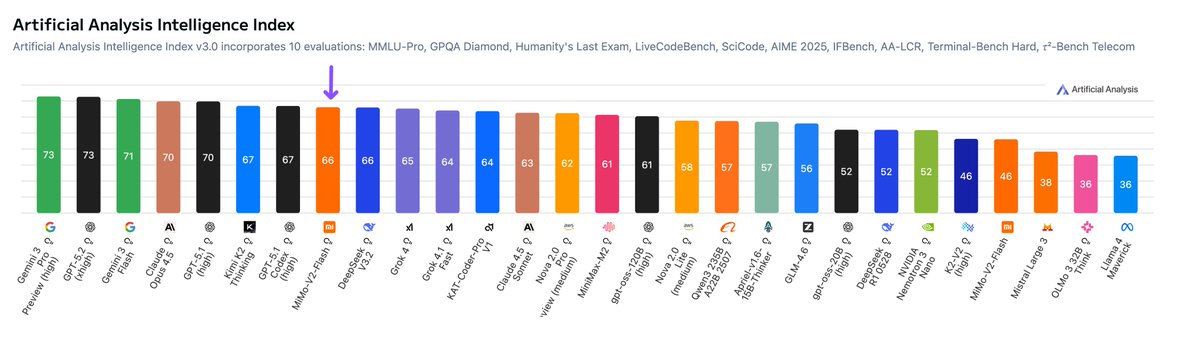
Xiaomi has just launched MiMo-V2-Flash, a 309B open weights reasoning model that scores 66 on the Artificial Analysis Intelligence Index. This release elevates Xiaomi to alongside other leading AI model labs.

Key benchmarking takeaways:

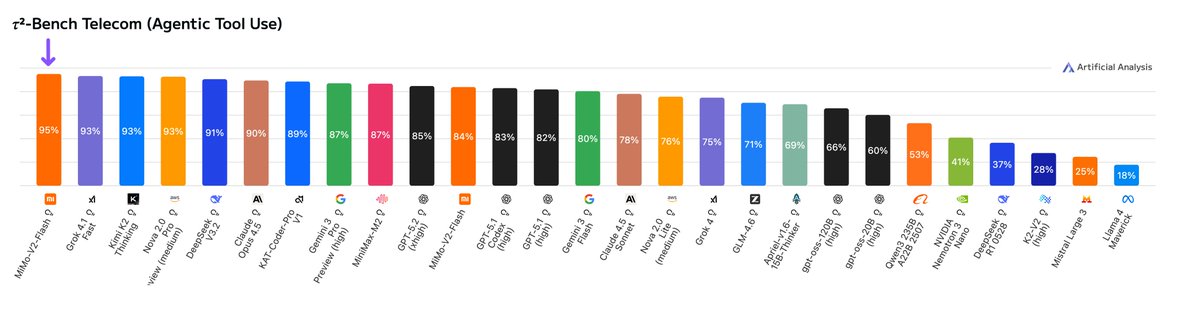
➤ Strengths in Agentic Tool Use and Competition Math: MiMo-V2-Flash scores 95% on τ²-Bench Telecom and 96% on AIME 2025, demonstrating strong performance on agentic tool-use workflows and competition-style mathematical reasoning. MiMo-V2-Flash currently leads the τ²-Bench Telecom category among evaluated models

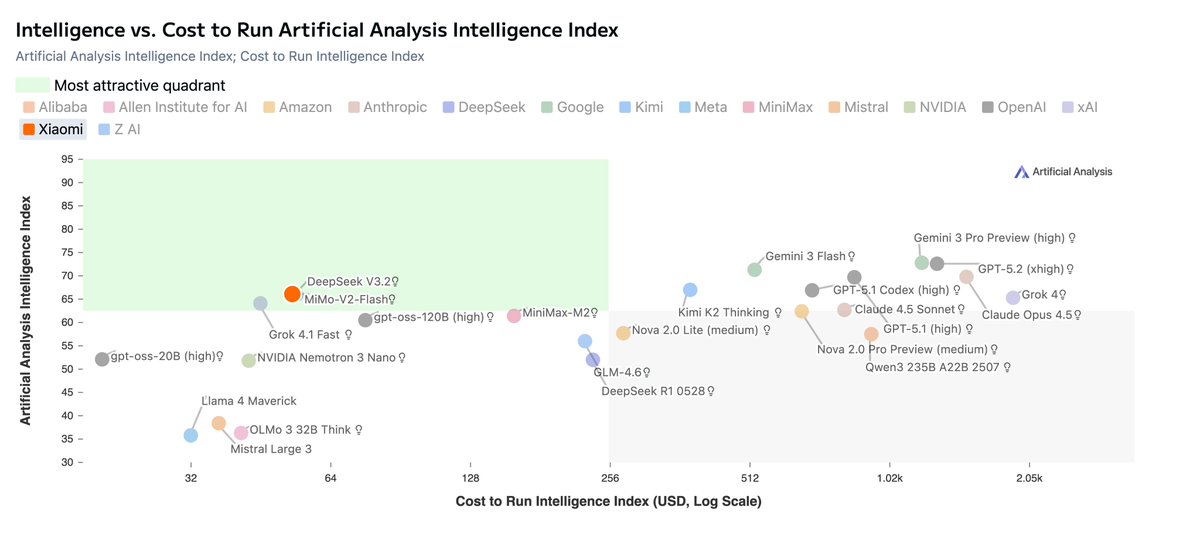
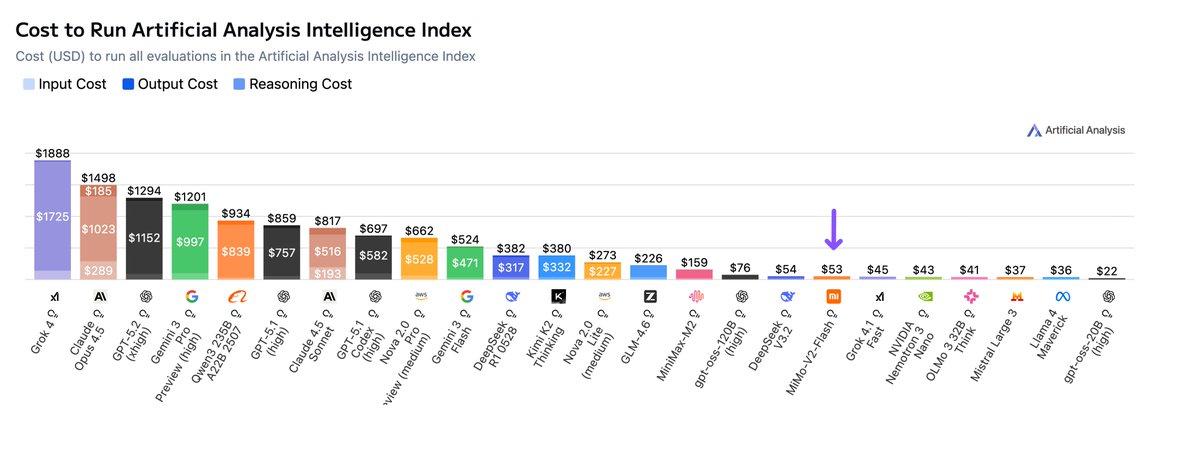
➤ Cost competitive: The full Artificial Analysis evaluation suite cost just $53 to run. This is supported by MiMo-V2-Flash’s highly competitive pricing of $0.10 per million input and $0.30 per million output, making it particularly attractive for cost-sensitive deployments and large-scale production workloads. This is similar to DeepSeek V3.2 ($54 total cost to run), and well below GPT-5.2 ($1,294 total cost to run)

➤ High token usage: MiMo-V2-Flash is demonstrates high verbosity and token usage relative to other models in the same intelligence tier, using ~150M reasoning tokens across the Artificial Analysis Intelligence suite

➤ Open weights: MiMo-V2-Flash is open weights and is 309B parameters with 15B active at inference time. Weights are released under a MIT license, continuing the trend of Chinese AI model labs open sourcing their frontier models

See below for further analysis:Image
MiMo-V2-Flash demonstrates particular strength in agentic tool-use and Competition Math, scoring 95% on τ²-Bench Telecom and 96% on AIME 2025. This places it amongst the best performing models in these categories. Image
MiMo-V2-Flash is one of the most cost-effective models for its intelligence, priced at only $0.10 per million input tokens and $0.30 per million output tokens. Image
Image
Read 7 tweets
Dec 10, 2025
Announcing Stirrup, our new open source framework for building agents. It’s lightweight, flexible, extensible and incorporates best-practices from leading agents like Claude Code

Stirrup differs from other agent frameworks by avoiding the rigidity that can degrade output quality. Stirrup lets models drive their own workflow, like Claude Code, while still giving developers structure and building in essential features like context management, MCP support and code execution. We use Stirrup at Artificial Analysis as part of our agentic benchmarks, including as part of our GDPval-AA evaluation being released later today. Just ‘pip install stirrup’ to start building your own agents today!

Key advantages:
➤ Works with the model, not against it: Stirrup steps aside and lets the model decide how to solve multi step tasks, as opposed to existing frameworks which impose strict patterns that limit performance.

➤ Best practices built in: We studied leading agent systems (e.g. Claude Code) to extract practical patterns around context handling, tool design, and workflow stability, and embedded those directly into the framework.

➤ Fully customizable: Use Stirrup as a package or as a starting template to build your own fully customized agents.

Feature highlights:
➤ Essential tools ready to use: Ships with pre built tools such as online search and browsing, code execution (local, docker, or using an @e2b sandbox), MCP client and document IO

➤ Flexible tool layer: A Generic Tool interface makes it simple to define and extend custom tools

➤ Context management: Automatic summarization to stay within context limits while preserving task fidelity

➤ Provider flexibility: Built in support for OpenAI compatible APIs (including @OpenRouterAI) and LiteLLM, or bring your own client

➤ Multimodal support: Process images, video, and audio with automatic format handlingImage
Stirrup agents can be easily set up in just a few lines of code
Stirrup includes built in logging to help you observe and debug agents
Read 4 tweets
Dec 1, 2025
Introducing the Artificial Analysis Openness Index: a standardized and independently assessed measure of AI model openness across availability and transparency

Openness is not just the ability to download model weights. It is also licensing, data and methodology - we developed a framework underpinning the Artificial Analysis Openness Index to incorporate these elements. It allows developers, users, and labs to compare across all these aspects of openness on a standardized basis, and brings visibility to labs advancing the open AI ecosystem.

A model with a score of 100 in Openness Index would be open weights and permissively licensed with full training code, pre-training data and post-training data released - allowing users to not just use the model but reproduce its training in full, or take inspiration from some or all of the model creator’s approach to build their own model. We have not yet awarded any models a score of 100!

Key details:
🔒 Few models and providers take a fully open approach. We see a strong and growing ecosystem of open weights models, including leading models from Chinese labs such as Kimi K2, Minimax M2, and DeepSeek V3.2. However, releases of data and methodology are much rarer - OpenAI’s gpt-oss family is a prominent example of open weights and Apache 2.0 licensing, but minimal disclosure otherwise.

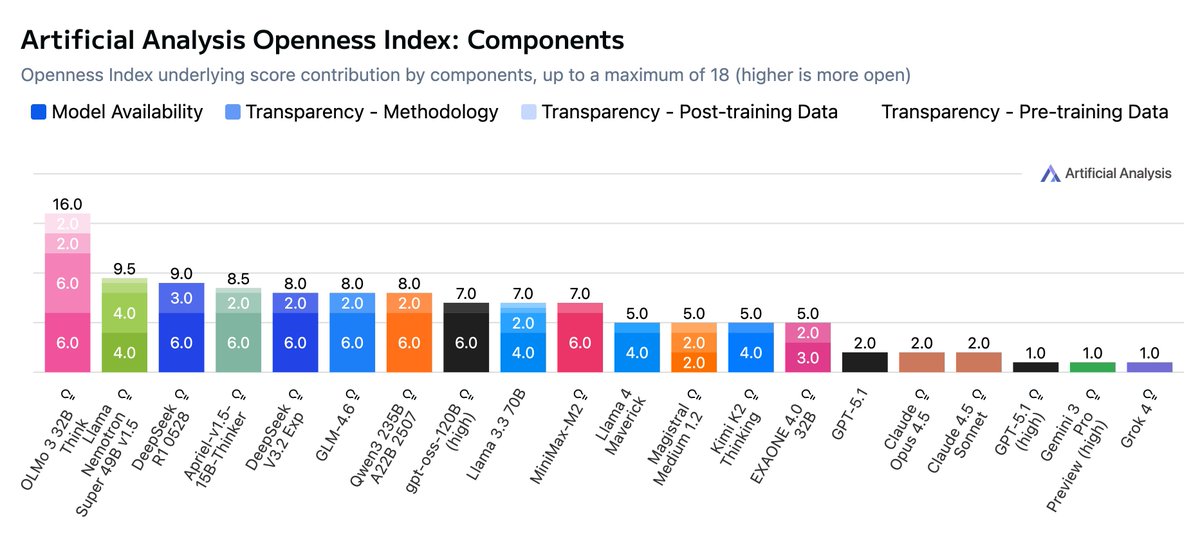
🥇 OLMo from @allen_ai leads the Openness Index at launch. Living up to AI2’s mission to provide ‘truly open’ research, the OLMo family achieves the top score of 89 (16 of a maximum of 18 points) on the Index by prioritizing full replicability and permissive licensing across weights, training data, and code. With the recent launch of OLMo 3, this included the latest version of AI2’s data, utilities and software, full details on reasoning model training, and the new Dolci post-training dataset.

🥈 NVIDIA’s Nemotron family also performs strongly for openness. @NVIDIAAI models such as NVIDIA Nemotron Nano 9B v2 reach a score of 67 on the Index due to their release alongside extensive technical reports detailing their training process, open source tooling for building models like them, and the Nemotron-CC and Nemotron post-training datasets.

📉 We’re tracking both open weights and closed weights models. Openness Index is a new way to think about how open models are, and we will be ranking closed weights models alongside open weights models to recognize the scope of methodology and data transparency associated with closed model releases.

Methodology & Context:
➤ We analyze openness using a standardized framework covering model availability (weights & license) and model transparency (data and methodology). This means we capture not just how freely a model can be used, but visibility into its training and knowledge, and potential to replicate or build on its capabilities or data.

➤ Model availability is measured based on the access and licensing of the model/weights themselves, while transparency comprises subcomponents for access and licensing for methodology, pre-training data, and post-training data.

➤ As seen with releases like DeepSeek R1, sharing methodology accelerates progress. We hope the Index encourages labs to balance competitive moats with the benefits of sharing the "how" alongside the "what."

➤ AI model developers may choose not to fully open their models for a wide range of reasons. We feel strongly that there are important advantages to the open AI ecosystem and supporting the open ecosystem is a key reason we developed the Openness Index. We do not, however, wish to dismiss the legitimacy of the tradeoffs that greater openness comes with, and we do not intend to treat Openness Index as a strictly ‘higher is better’ scale.

See below for further analysis and details 👇Image
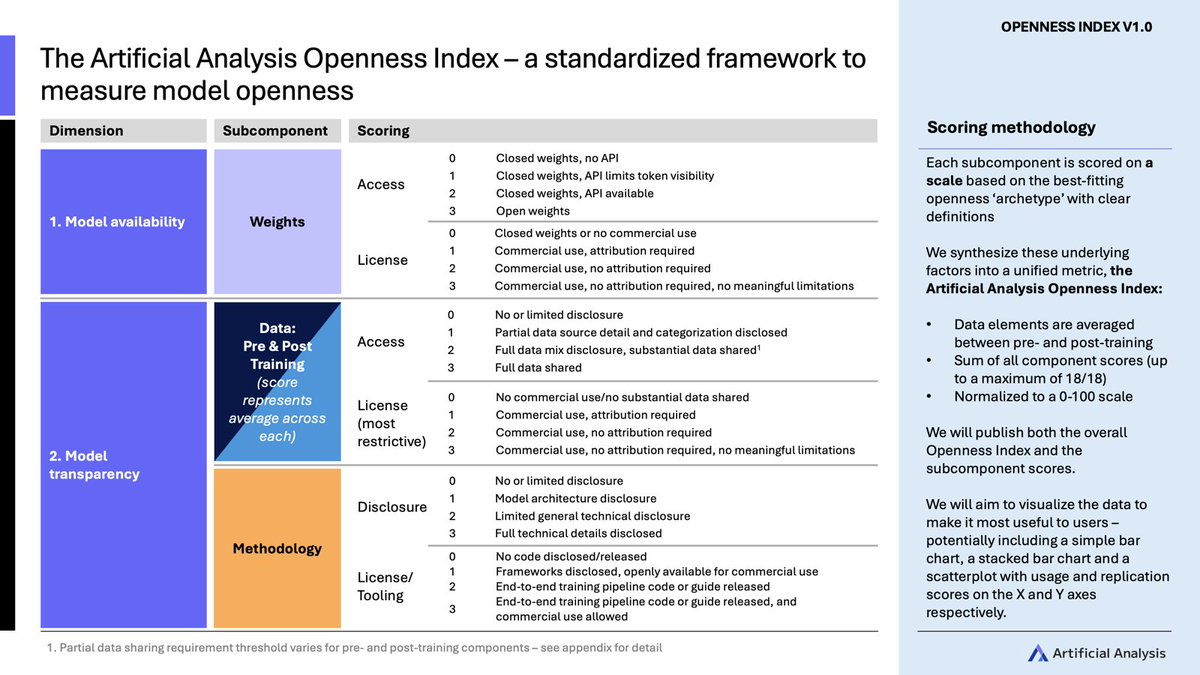
The Openness Index breaks down a total of 18 points across the four subcomponents, and we then represent the overall value on a normalized 0-100 scale. We will continue to review and iterate this framework as the model ecosystem develops and new factors emerge. Image
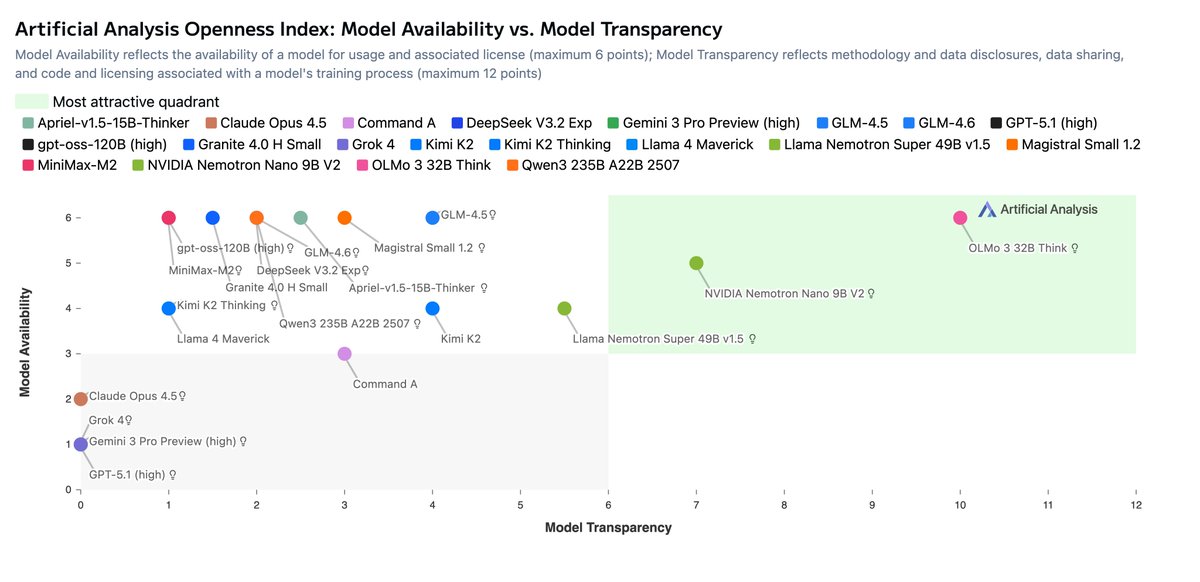
In today’s model landscape, transparency is much rarer than availability. While we see a wide range of models with open weights and permissive licensing, nearly all are clustered in the top left quadrant of the chart with lower-end transparency. This reflects the current state of the ecosystem - many models have open weights, but few have open data or methodologies.Image
Read 5 tweets
Nov 25, 2025
Anthropic’s new Claude Opus 4.5 is the #2 most intelligent model in the Artificial Analysis Intelligence Index, narrowly behind Google’s Gemini 3 Pro and tying OpenAI’s GPT-5.1 (high)

Claude Opus 4.5 delivers a substantial intelligence uplift over Claude Sonnet 4.5 (+7 points on the Artificial Analysis Intelligence Index) and Claude Opus 4.1 (+11 points), establishing it as @AnthropicAI's new leading model. Anthropic has dramatically cut per-token pricing for Claude Opus 4.5 to $5/$25 per million input/output tokens. However, compared to the prior Claude Opus 4.1 model it used 60% more tokens to complete our Intelligence Index evaluations (48M vs. 30M). This translates to a substantial reduction in the cost to run our Intelligence Index evaluations from $3.1k to $1.5k, but not as significant as the headline price cut implies. Despite Claude Opus 4.5 using substantially more tokens to complete our Intelligence Index, the model still cost significantly more than other models including Gemini 3 Pro (high), GPT-5.1 (high), and Claude Sonnet 4.5 (Thinking), and among all models only cost less than Grok 4 (Reasoning).

Key benchmarking takeaways:

➤ 🧠 Anthropic’s most intelligent model: In reasoning mode, Claude Opus 4.5 scores 70 on the Artificial Analysis Intelligence Index. This is a jump of +7 points from Claude Sonnet 4.5 (Thinking), which was released in September 2025, and +11 points from Claude Opus 4.1 (Thinking). Claude Opus 4.5 is now the second most intelligent model. It places ahead of Grok 4 (65) and Kimi K2 Thinking (67), ties GPT-5.1 (high, 70), and trails only Gemini 3 Pro (73). Claude Opus 4.5 (Thinking) scores 5% on CritPt, a frontier physics eval reflective of research assistant capabilities. It sits only behind Gemini 3 Pro (9%) and ties GPT-5.1 (high, 5%)

➤ 📈 Largest increases in coding and agentic tasks: Compared to Claude Sonnet 4.5 (Thinking), the biggest uplifts appear across coding, agentic tasks, and long-context reasoning, including LiveCodeBench (+16 p.p.), Terminal-Bench Hard (+11 p.p.), 𝜏²-Bench Telecom (+12 p.p.), AA-LCR (+8 p.p.), and Humanity's Last Exam (+11 p.p.). Claude Opus achieves Anthropic’s best scores yet across all 10 benchmarks in the Artificial Analysis Intelligence Index. It also earns the highest score on Terminal-Bench Hard (44%) of any model and ties Gemini 3 Pro on MMLU-Pro (90%)

➤ 📚 Knowledge and Hallucination: In our recently launched AA-Omniscience Index, which measures embedded knowledge and hallucination of language models, Claude Opus 4.5 places 2nd with a score of 10. It sits only behind Gemini 3 Pro Preview (13) and ahead of Claude Opus 4.1 (Thinking, 5) and GPT-5.1 (high, 2). Claude Opus 4.5 (Thinking) scores the second-highest accuracy (43%) and has the 4th-lowest hallucination rate (58%), trailing only Claude Haiku (Thinking, 26%), Claude Sonnet 4.5 (Thinking, 48%), and GPT-5.1 (high). Claude Opus 4.5 continues to demonstrate Anthropic’s leadership in AI safety with a lower hallucination rate than select other frontier models such as Grok 4 and Gemini 3 Pro

➤ ⚡ Non-reasoning performance: In non-reasoning mode, Claude Opus 4.5 scores 60 on the Artificial Analysis Intelligence Index and is the most intelligent non-reasoning model. It places ahead of Qwen3 Max (55), Kimi K2 0905 (50), and Claude Sonnet 4.5 (50)

➤ ⚙️ Token efficiency: Anthropic continues to demonstrate impressive token efficiency. It has improved intelligence without a significant increase in token usage (compared to Claude Sonnet 4.5, evaluated with a maximum reasoning budget of 64k tokens). Claude Opus 4.5 uses 48M output tokens to run the Artificial Analysis Intelligence Index. This is lower than other frontier models, such as Gemini 3 Pro (high, 92M), GPT-5.1 (high, 81M), and Grok 4 (Reasoning, 120M)

➤ 💲 Pricing: Anthropic has reduced the per-token pricing of Claude Opus 4.5 compared to Claude Opus 4.1. Claude Opus 4.5 is priced at $5/$25 per 1M input/output tokens (vs. $15/$75 for Claude Opus 4.1). This positions it much closer to Claude Sonnet 4.5 ($3/$15 per 1M tokens) while offering higher intelligence in thinking mode

Key model details:

➤ 📏 Context window: 200K tokens

➤ 🪙 Max output tokens: 64K tokens

➤ 🌐 Availability: Claude Opus 4.5 is available via Anthropic‘s API, Google Vertex, Amazon Bedrock and Microsoft Azure. Claude Opus 4.5 is also available via Claude app and Claude CodeImage
A key differentiator for the Claude models remains that they are substantially more token-efficient than all other reasoning models. Claude Opus 4.5 has significantly increased intelligence without a large increase in output tokens, differing substantially from other model families that rely on greater reasoning at inference time (i.e., more output tokens). On the Output Tokens Used in Artificial Analysis Intelligence Index vs Intelligence Index chart, Claude 4.5 Opus (Thinking) sits on the Pareto frontier.Image
This output token efficiency contributes to Claude Opus 4.5 (in Thinking mode) offering a better tradeoff between intelligence and cost to run the Artificial Analysis Intelligence Index than Claude Opus 4.1 (Thinking) and Grok 4 (Reasoning). Image
Read 7 tweets

Did Thread Reader help you today?

Support us! We are indie developers!


This site is made by just two indie developers on a laptop doing marketing, support and development! Read more about the story.

Become a Premium Member ($3/month or $30/year) and get exclusive features!

Become Premium

Don't want to be a Premium member but still want to support us?

Make a small donation by buying us coffee ($5) or help with server cost ($10)

Donate via Paypal

Or Donate anonymously using crypto!

Ethereum

0xfe58350B80634f60Fa6Dc149a72b4DFbc17D341E copy

Bitcoin

3ATGMxNzCUFzxpMCHL5sWSt4DVtS8UqXpi copy

Thank you for your support!

Follow Us!

:(