Niall Ferguson Profile picture
Nov 21, 2025 5 tweets 1 min read Read on X
The best is the enemy of the good. Contrary to recent press speculation, the draft 28-point plan for peace in Ukraine is in fact a reasonable basis for negotiations. Journalists can gripe about it as they griped about the 20-point Gaza plan. But wars are not ended by op-eds. 1/5
Wars are ended either by victory or by compromise. This plan affirms Ukraine's sovereignty. It provides Ukraine with a US-backed security guarantee. It envisages Ukrainian reconstruction. Of course, the territorial terms and the amnesty for war crimes are hard to swallow. 2/5
⁠But if you want to take back territory and try Putin, you have to win the war. And realistically Ukraine has never been in a position to defeat Russia. The critics should also acknowledge that President Trump has taken some risk here. 3/5
I do not believe it is in the Ukrainian people's interests for the war to be prolonged for another year. The risks seem to me too great. So I hope @ZelenskyyUa will use his eloquence to explain why the time is right to negotiate. 4/5
@ZelenskyyUa Ukrainians have fought heroically for their independence. It is now time to consolidate what they have achieved through diplomacy. 5/5

• • •

Missing some Tweet in this thread? You can try to force a refresh

 

Keep Current with Niall Ferguson

Niall Ferguson Profile picture

Stay in touch and get notified when new unrolls are available from this author!

Read all threads

This Thread may be Removed Anytime!

PDF

Twitter may remove this content at anytime! Save it as PDF for later use!

Try unrolling a thread yourself!

how to unroll video
  1. Follow @ThreadReaderApp to mention us!

  2. From a Twitter thread mention us with a keyword "unroll"
@threadreaderapp unroll

Practice here first or read more on our help page!

More from @nfergus

Jun 3
The unfolding history of artificial intelligence has now arrived at what may be its most dangerous moment. There are two barely controlled AI races, one between around five American companies—@Anthropic, @GoogleDeepMind, @Meta, @OpenAI, and @xai lead the field—and the other between the two geopolitical superpowers: the United States and China, with its own competing companies. The leadership of the competitors in this race is, to say the least, of mixed quality. 1/10
These two AI races have several inherent constraints, including the amount of data available for training models, the supply of computational power, and the capacity of capital markets to finance trillions of dollars in capital expenditures. But regulation does not feature on the list. 2/10
That's because United States government has taken a conscious decision not to regulate AI. This is perfectly clear from this year’s National AI Legislative Framework, which punts responsibility for AI regulation to Congress, before enjoining Congress “not [to] create any new federal rulemaking body to regulate AI.” The new Executive Order has teeth the way a goldfish does. 3/10
Read 10 tweets
Apr 26
For those wondering how on earth a @Caltech graduate becomes a would-be assassin, this is your reminder that the Great Awokening was especially demented in California, and that there is no pendulum magically swinging back to sanity in the established universities.
Obviously, we don't yet know what motivated Cole Allen to carry out his attack last night. My point is a more general one. Even Caltech, which I've long regarded as one of the few truly meritocratic institutions in U.S. higher ed, also had its encounter with wokeism.
Read 4 tweets
Apr 16
If you are having trouble making sense of the deep strategic mess in which Britain finds itself, do read John Bew's brilliant new @spectator essay. Come for the Joyce reference, stay for the geopolitical masterclass.
"If the UK is simultaneously more distant from the US and failing adequately to fund defence commitments in our own near neighbourhood, then two of the principal pillars of our enduring national security strategy are in danger."--John Bew
"The hard realities of secure energy, reindustrialisation, access to rare earths, investment in technology and a truly agile and modern army, navy and air force require our attention."--John Bew (As @KemiBadenoch argued at the @LondonDefConf on Saturday.)
Read 4 tweets
Apr 3
American Suez. A doleful essay for Good Friday.
"There is now a rising probability that Trump’s war backfires on him much as Eden’s did—economically, politically, and geopolitically. Which raises the question: Is this the American Suez?" 1/5 Image
"The crisis begins as an attempt to overthrow an unfriendly regime in the Middle East, in concert with the state of Israel. It is also a struggle for control of a key commercial waterway. Despite lacking a plausible basis in international law and popular support at home, the military operation is nevertheless a success in its own terms. The armed forces of the invaded state are swiftly overwhelmed." 2/5
"But the economic consequences of the conflict—not just the closure of a crucial oil choke point, but also the financial ramifications of the crisis—result in political damage and strategic defeat. The result is humiliating withdrawal." 3/5
Read 5 tweets
Mar 25
"A society that has secured abundant energy, industrial production, and physical safety creates the conditions in which political attention can migrate upward into questions of identity, moral positioning, and self-actualization." 1/6
"The pathology arrives when those governing from the upper floors lose the ability to perceive the importance of the foundations beneath them, and begin making decisions that erode that base in the service of ideological commitments the foundations had made affordable." 2/6
"Today [Europe] consumes roughly 38 EJ against only 6 EJ produced domestically ... This represents an extraordinary inversion of insecure hydrocarbon import dependency from 30% in 1995 to 80% in 2026." 3/6
Read 6 tweets
Mar 6
My new @TheFP essay asks the ten key questions about U.S.-Israeli war against Iran. 1. How long will this war last?
2. Do we have enough firepower relative to Iran?
3. Can the Iranians keep the Strait of Hormuz closed?
4. Can the Iranians hit Saudi and other Gulf oil infrastructure?
5. At what point does Iranian "regime alteration" happen?
6. How widespread will the war get?
7. Can the U.S. get the oil flowing even if the war drags on?
8. How big a shock would it take to damage the U.S. economy?
9. How long can the Republican Party sustain this domestically in a midterm year?
10. What does the war against Iran mean for other actual or potential conflicts?
"According to Secretary of Defense Pete Hegseth, 'You can say four weeks, but it could be six, it could be eight, it could be three.' That’s fair. But wars that last, say, six days have happened in the Middle East. On the other hand, George W. Bush’s war lasted eight years. One report on Thursday said the Pentagon thinks this could go on until September. That would be bad."
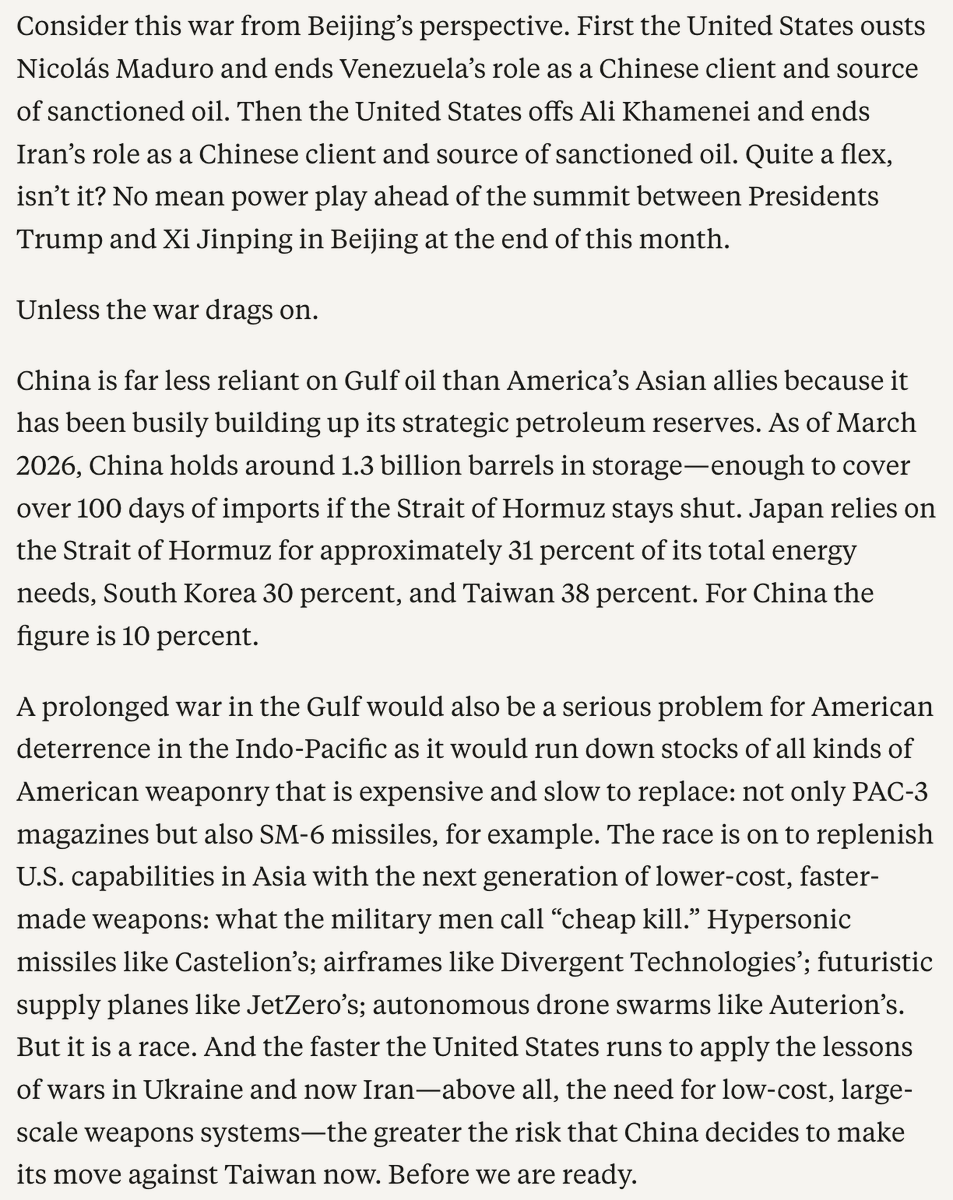
"The war against Iran is not, from an American perspective, a regional undertaking for the benefit of Israel. It clearly does not help other American allies and friends. For the Europeans, India, Japan, Korea, and Taiwan—all major hydrocarbon importers—every day of this war imposes a heavy cost in the form of more expensive oil and gas. The war therefore makes sense only as part of the U.S. global cold war with China."Image
Read 4 tweets

Did Thread Reader help you today?

Support us! We are indie developers!


This site is made by just two indie developers on a laptop doing marketing, support and development! Read more about the story.

Become a Premium Member ($3/month or $30/year) and get exclusive features!

Become Premium

Don't want to be a Premium member but still want to support us?

Make a small donation by buying us coffee ($5) or help with server cost ($10)

Donate via Paypal

Or Donate anonymously using crypto!

Ethereum

0xfe58350B80634f60Fa6Dc149a72b4DFbc17D341E copy

Bitcoin

3ATGMxNzCUFzxpMCHL5sWSt4DVtS8UqXpi copy

Thank you for your support!

Follow Us!

:(