Jonathon P Sine Profile picture
Nov 28 7 tweets 4 min read Read on X
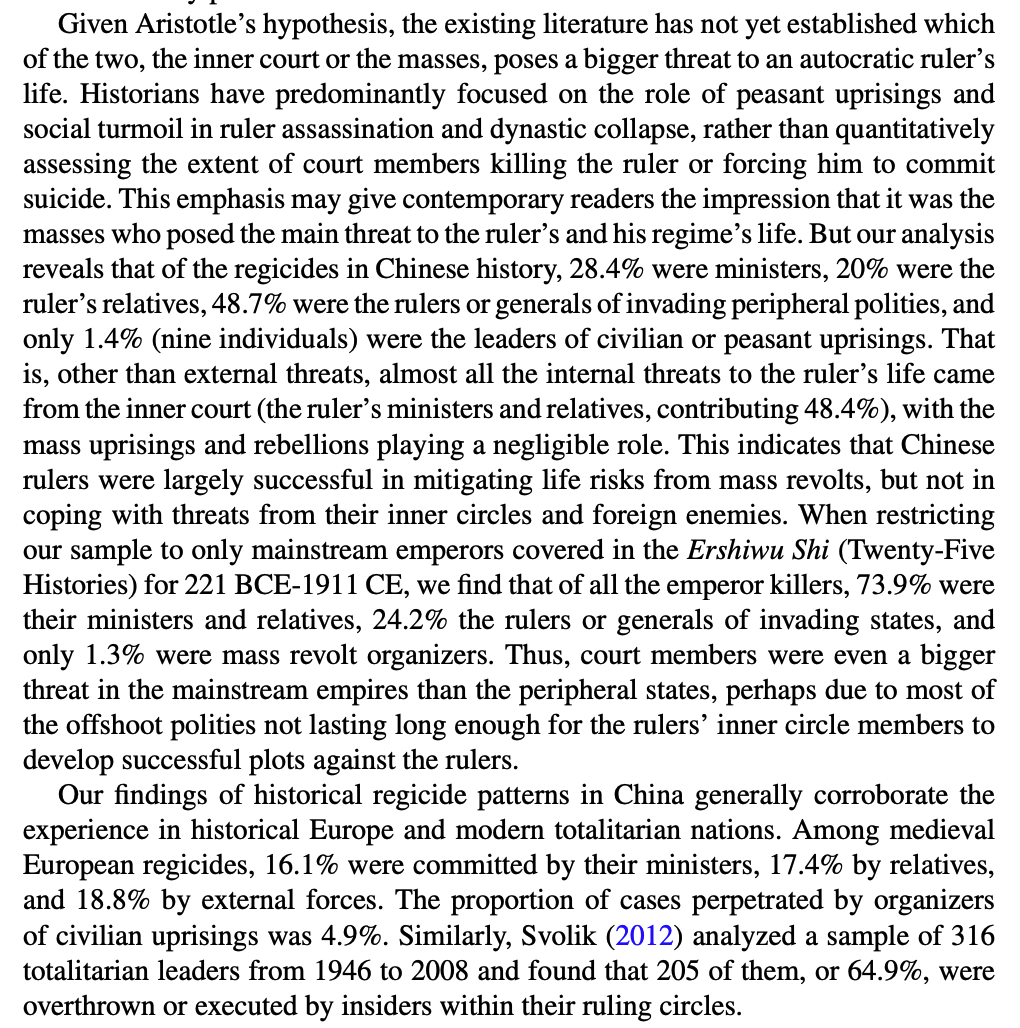
Historically, regicide was an epidemic. It was safer to fight in a war than to be a Chinese Emperor or European King.

But who killed the kings, historically speaking?

Mostly: other elites in the inner circle.

Of post Qin unification Emperors that died on the throne, 70%+ were killed by their the inner court, (ministers, eunuchs, relatives etc).

Europe was a bit more varied, but roughly 35% of European kings that died on the throne did so at the hands of their own ministers or family members.

Ironically, mass revolts, which have received so much theorizing and historic attention, have rarely been responsible for regicide. Just 1% in China and 5% across Europe.

In contemporary totalitarian regimes, estimates are that of those overthrown or executed, insiders within their ruling circles were responsible for 64.9%.Image
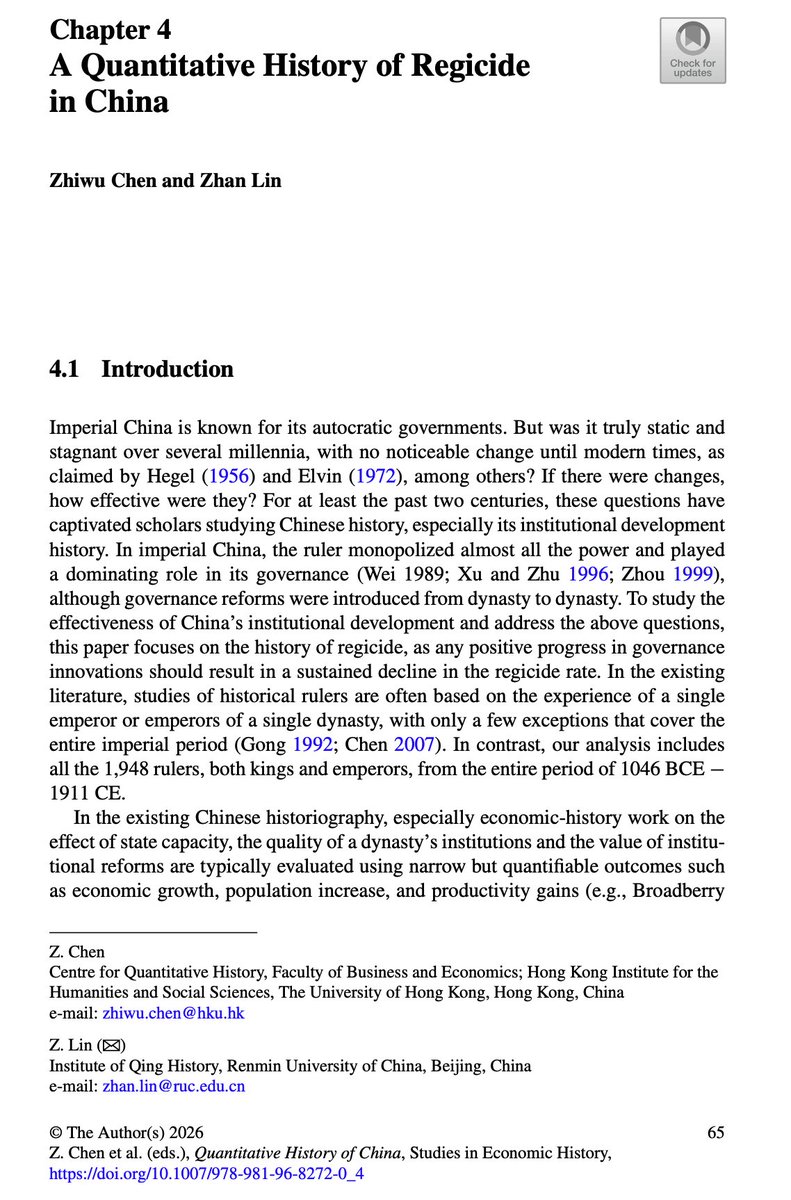
Source for the above is page 68, chapter 4 "A Quantitative History of Regicide in China," in the Quantitive History of China book in the QT. Image
Image
"Using data on the deaths of 1,513 kings from 45 European kingdoms between 600 and 1800 CE, Eisner (2011) found a regicide ratio of 22%...

Among the 1,948 rulers in our full sample, 695 were victims of regicide, accounting for 35.7%." Image
The authors compile the most extensive list of Chinese rulers yet to get at this question. Broken into three subsamples.

A: pre-Qin kings
B: emperors captured in the Ershiwu Shi (Twenty-Five Histories)
C: all post-Qin rulers of peripheral and rebel regimes within the territorial boudnaries established by the Qing at its height.
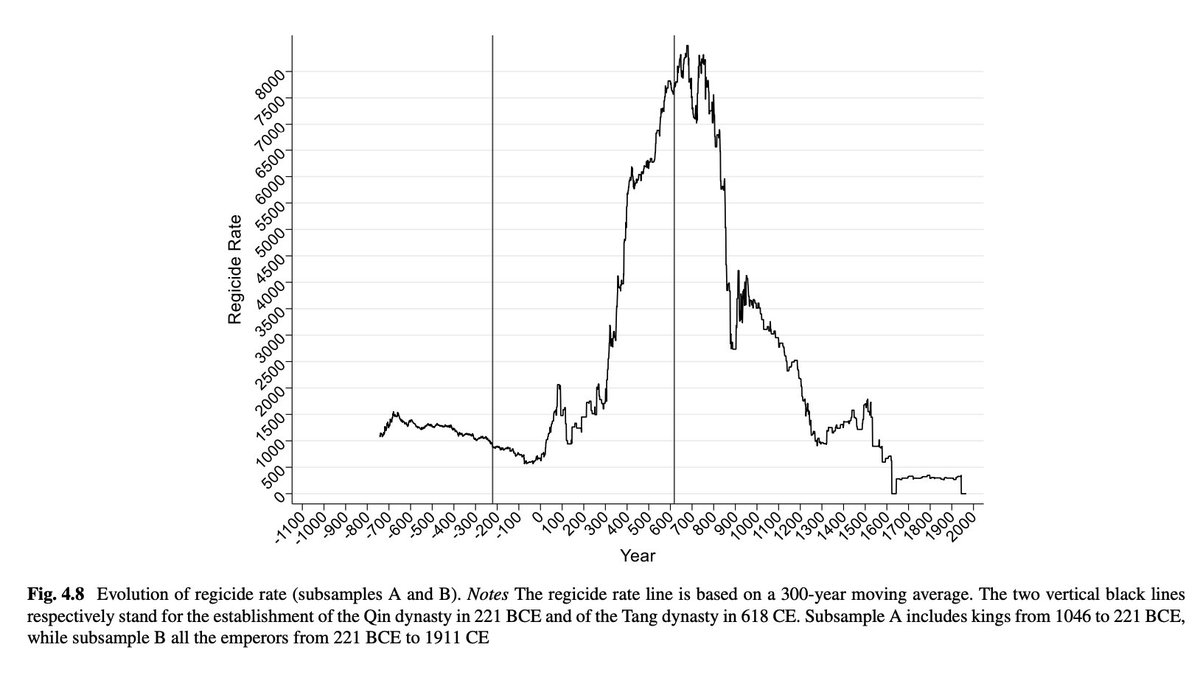
The subsamples tell very different stories.

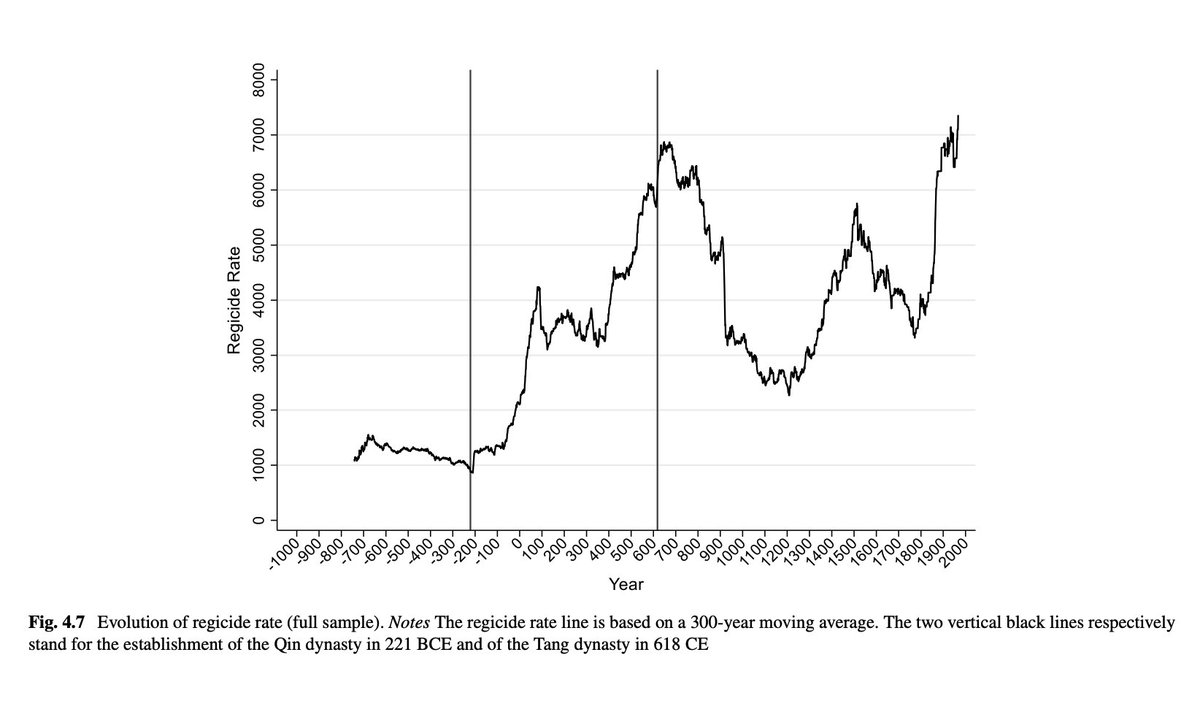
It remained risky to be a ruler in the periphery (largest N of the sample). Risk peaking in the Qing.

But post-Tang, China's Emperor grew safer and safer. Image
Image
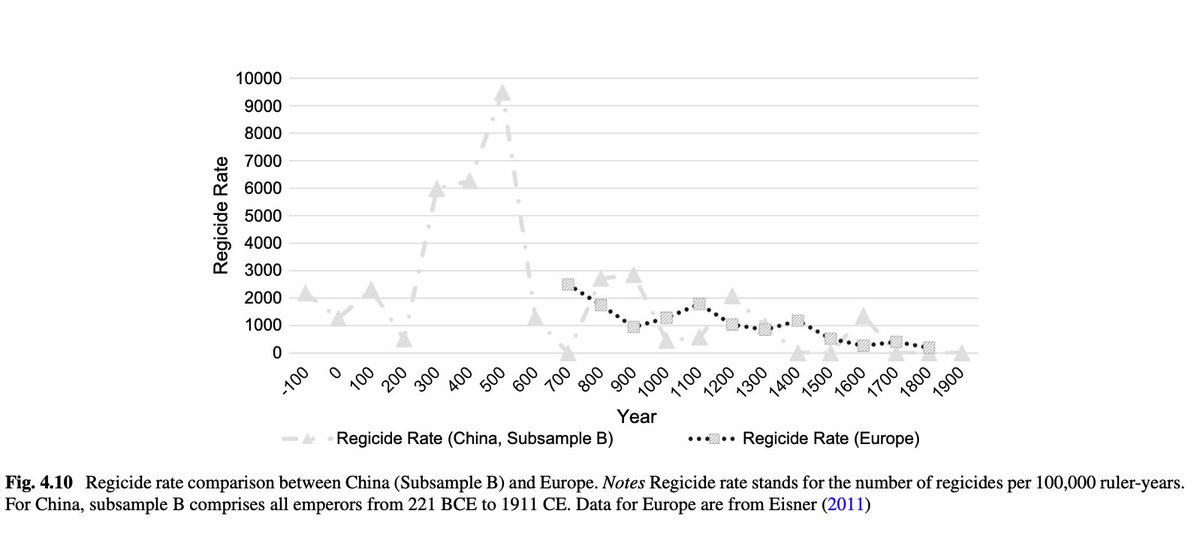
The post 600 AD regicide rates in Europe vs China are very comparable, both declining steadily over time.

(uses the 25 Histories sample of emperors for China, i.e. subsample B's smaller group of officially recognized rulers) Image
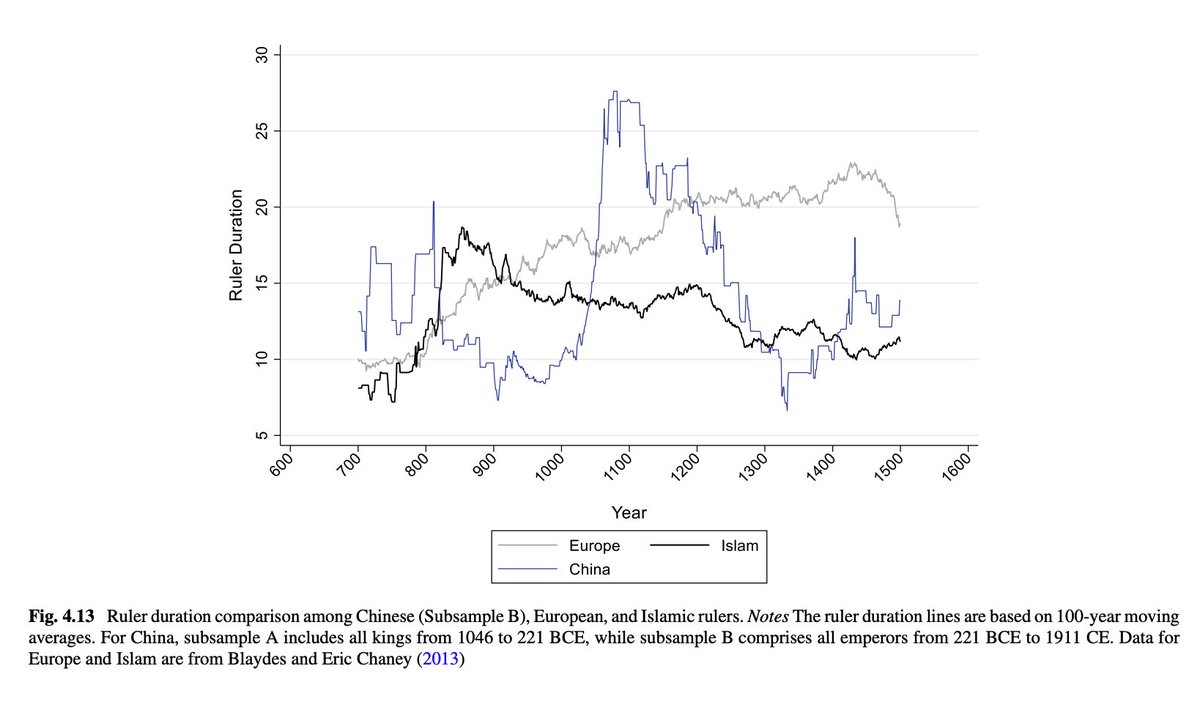
In contrast to some recent accounts (The Rise and Fall of the EAST), the data on ruler longevity here don't appear to show secular increase over time. Image
• • •

Missing some Tweet in this thread? You can try to force a refresh

 

Keep Current with Jonathon P Sine

Jonathon P Sine Profile picture

Stay in touch and get notified when new unrolls are available from this author!

Read all threads

This Thread may be Removed Anytime!

PDF

Twitter may remove this content at anytime! Save it as PDF for later use!

Try unrolling a thread yourself!

how to unroll video
  1. Follow @ThreadReaderApp to mention us!

  2. From a Twitter thread mention us with a keyword "unroll"
@threadreaderapp unroll

Practice here first or read more on our help page!

More from @JonathonPSine

Nov 25
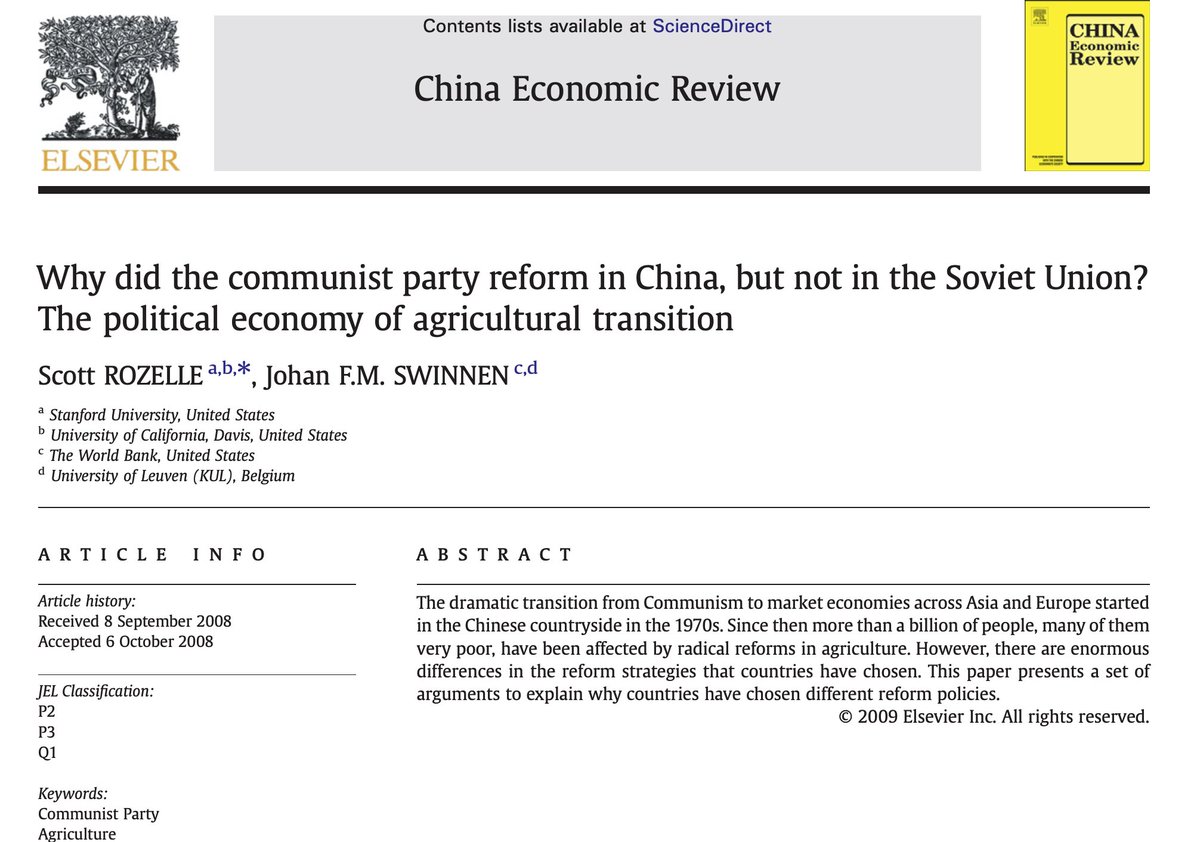
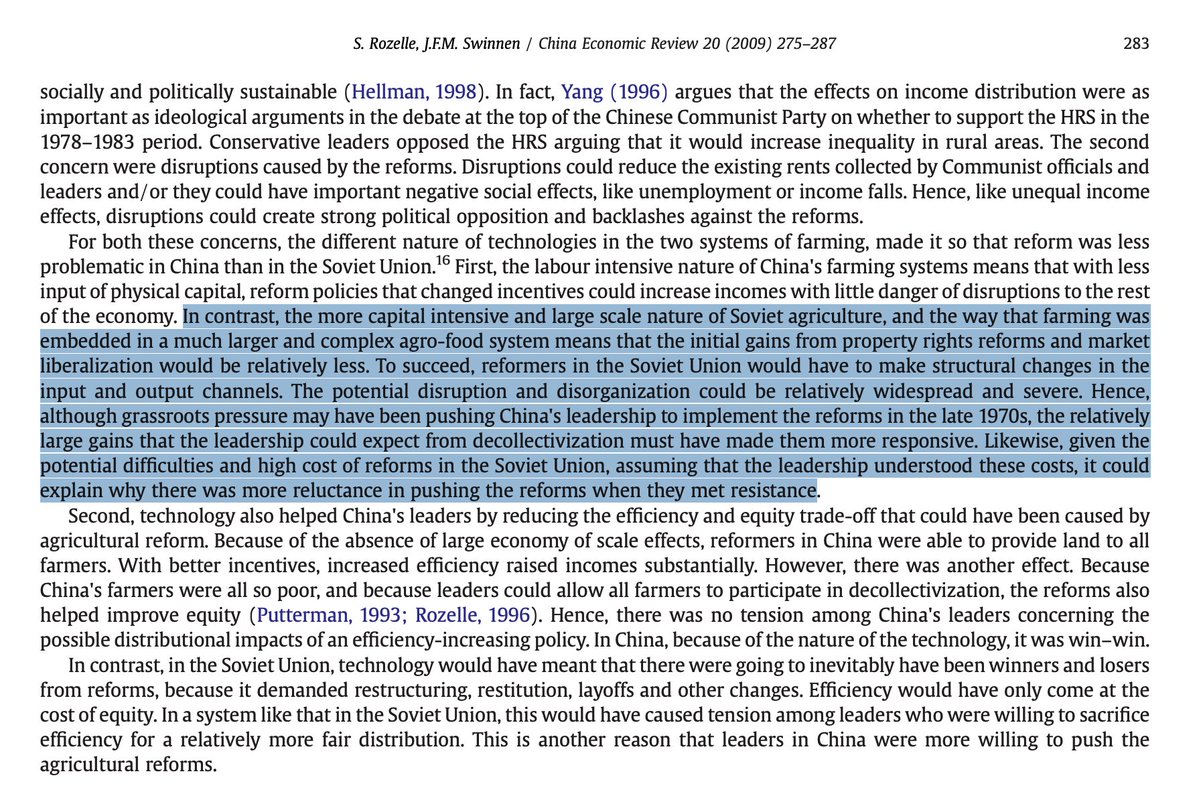
Great summary of political economy of farm sector reform. The real incentives and constraints. Rozelle & Swinnen, “Why Did the Communist Party Reform in China, but Not in the Soviet Union?” (2009)

Much better than recent “entrenched elites would've killed Gorbachev” storybooks. Image
The issue was not really elite level opposition.

It was the very very difficult political-economic transformation problem whose resolution almost certainly would require a period of disorganization and recession.

Coupled with G's misbegotten notions.
If the Soviets wanted more efficient use of resources and to reduce the increasingly costly budgetary outlays supporting decreasingly productive farms, the only sensible path forward was large-scale restructuring with obvious losers. As they discuss sciencedirect.com/science/articl…

(this is what happened after the Party-state imploded.)

BTW this is also the case in industry see eg:
Olivier Blanchard and Michael Kremer, Disorganization (1997), jstor.org/stable/2951267Image
Read 5 tweets
Nov 17
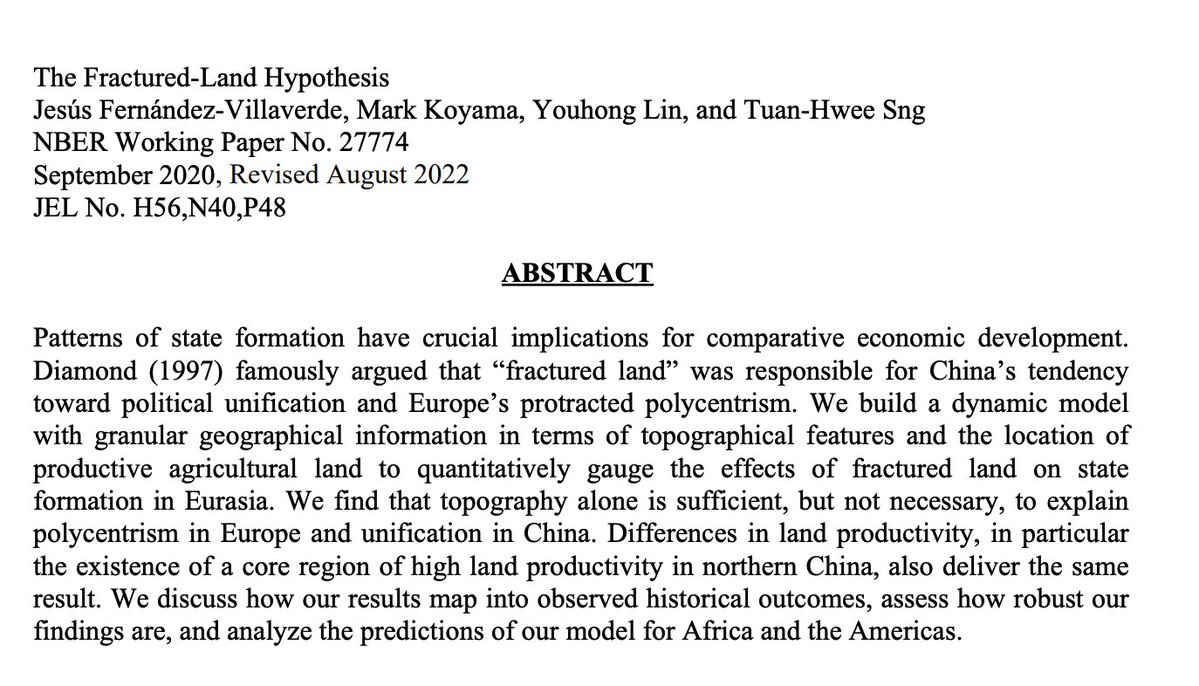
The single best paper I'm aware of on why China was historically unified and Europe politically fragmented.

G e o g r a p h y Image
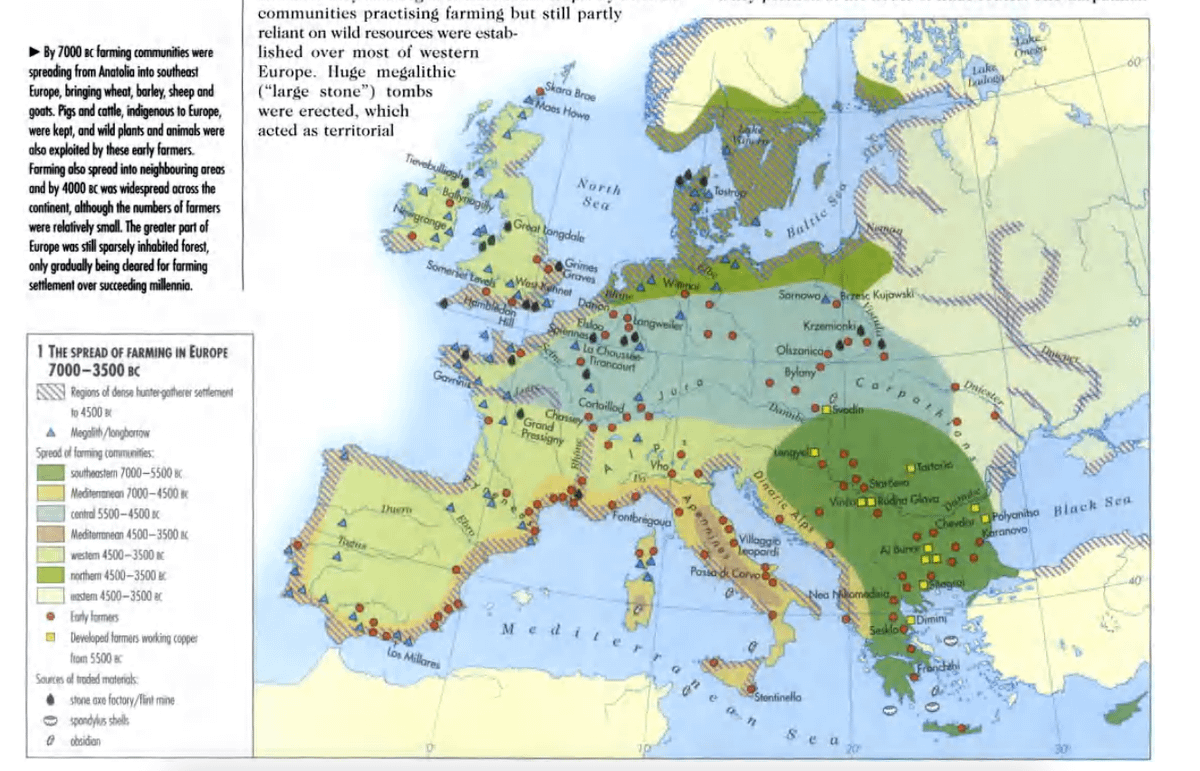
Human population density mediated by agricultural viability. Secondarily, nature and location of topographical features eg mountains and rivers.

(pics via Phillips Atlas of World History) nber.org/system/files/w…Image
Image
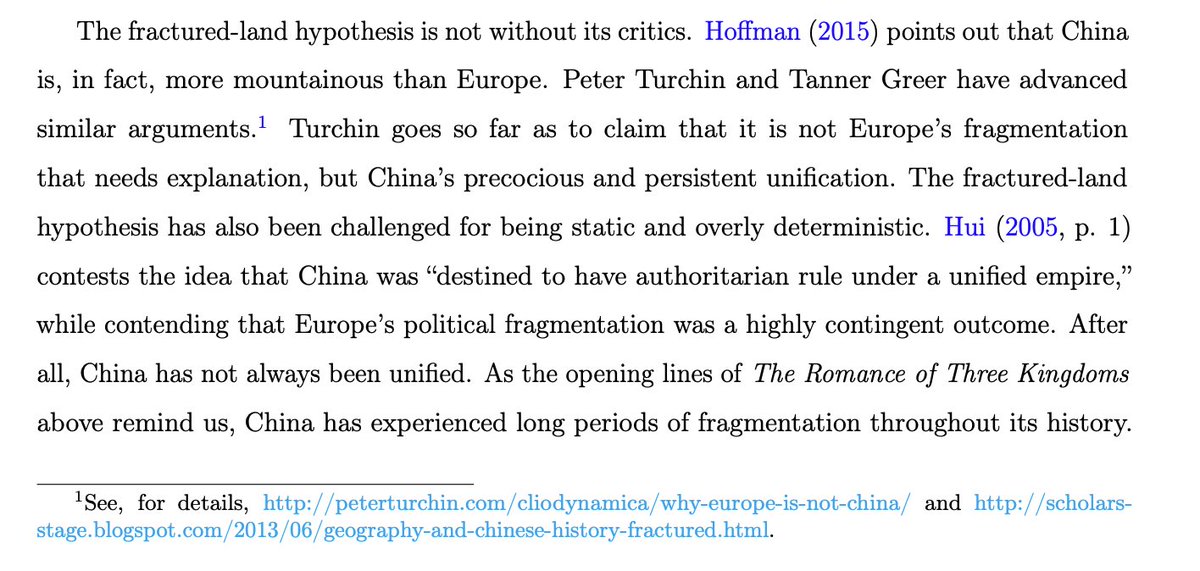
Before I came across this paper I had already encountered the critiques of Diamond's fractured land hypothesis by Hoffman (2015), Hui (2005), and Turchin & Greer. Many new comers (eg Huang 2023) have piled on. But IMO all are wanting.

This paper is a very convincing rebuttal. Image
Read 10 tweets
Aug 28
On Dan Wang's new book: Breakneck

This essay assesses the book's big idea: China is an engineering state facing off against America, a lawyerly society. The book is well-informed and packed with wit.

But I wanted more data. So I assembled some.🧵
cogitations.co/p/litigation-n…
I look at two imperfect data sets: undergraduate and graduate enrollment, and the education backgrounds of government leaders.

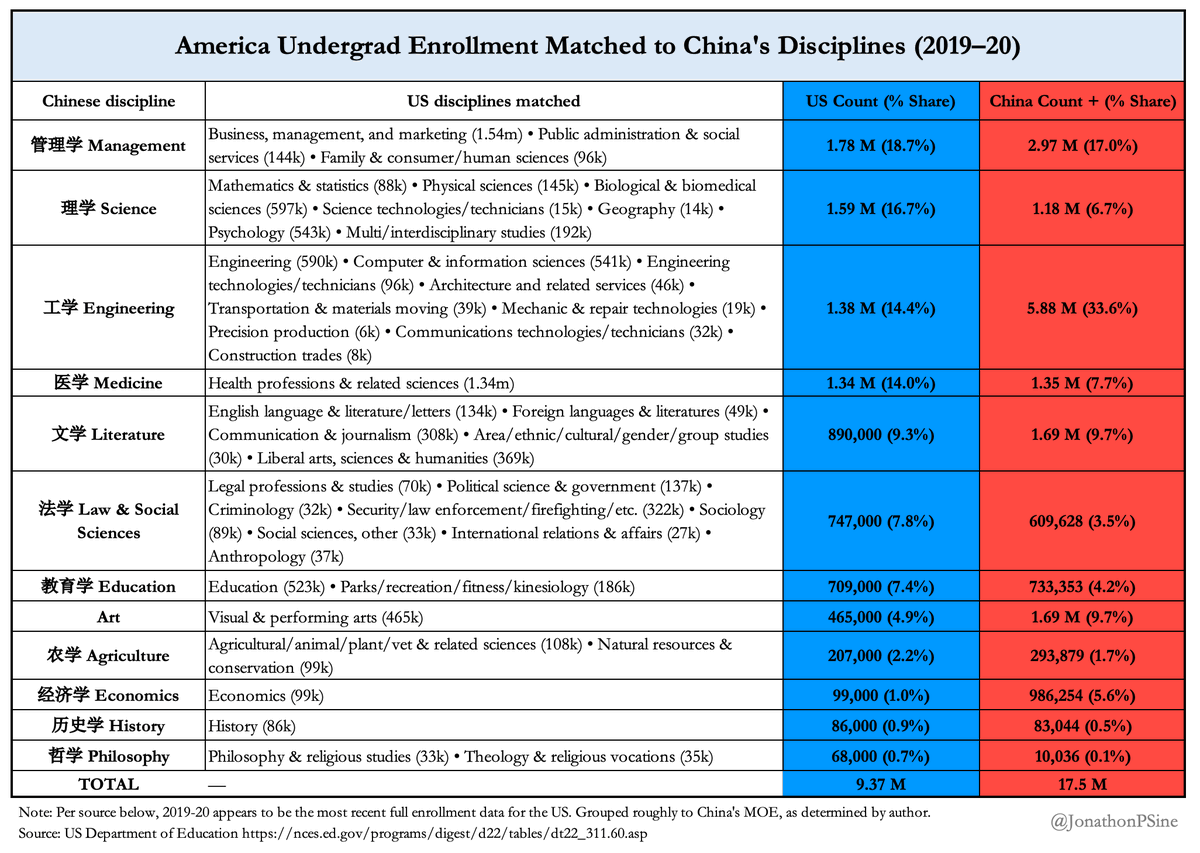
In China there's no doubt: the children are jazzed on the world of atoms. An astounding 34% of China's roughly 20 million undergrads study engineering. Image
BUT there are more American undergraduates in STEM than one might expect.

I re-grouped US college majors by Chinese disciplines to allow for rough comparison.

For both, the combined share of science + engineering + medicine is ~45%. Image
Read 25 tweets
Jul 18
🚨✍️ NEW POST — Industrial Colossus: China vs 1950s America

In a number of ways, China mirrors America at the height of its industrial powers.

Despite UN projections and the dreams of some industrial maximalists, as share of global manufacturing, China is peaking. 🧵 Image
Image
Image
Image
I highlight two reasons:

1) A global scramble for industrial might is intensifying

2) Domestically: China is having its own post-Moses moment. A Leninist-inflected legalism and proceduralization.
cogitations.co/p/industrial-c…
Chinese industrial policy maximalist Lu Feng has argued that China today resembles the United States on the eve of World War I.

But Lu Feng’s analogy is less analytical than instrumental. high-capacity.com/p/chinese-indu…
Read 15 tweets
Jul 2
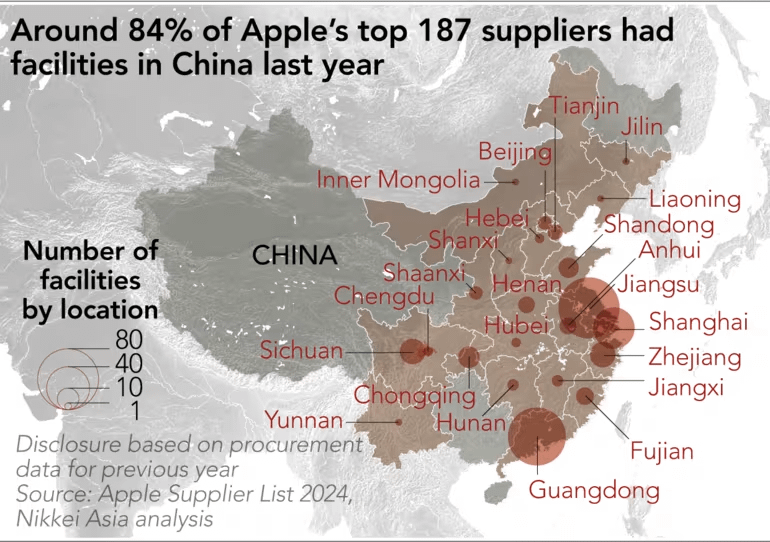
Finally read this. It's quite good for what it is: a journalistic gloss on Apple’s manufacturing history and embedding in China.

Most impressively to me, the author broke through the Apple omerta to get nearly 200 Apple employees to talk. But there are some issues. 🧵 Image
A study of Apple in China is a great microcosm to understand the rapid upskilling of China’s workforce. I doubt any foreign company played a more important role facilitating China’s manufacturing rise.

China’s vocational schooling: not rly. Apple: yes.
Apple’s impact has been more diffuse and far-reaching than even the typical joint venture model: embedding hundreds of top-tier engineers and billions of dollars’ worth of machinery across 1,600 supplier factories—1st, 2nd, 3rd tier—and co-developing production processes. Image
Read 21 tweets
Jul 1
I did not see any good answers to these questions, so I put together a selection of readings on science and technology in the Soviet Union. 🧵
Science, Tech, and Industry Development Overviews
1. Science and Industrialization in the USSR - R. A. Lewis, 1979
2. The Technological Level of Soviet Industry - R. Amann, J. M. Cooper and R. W. Davies, 1977.
3. Industrial Innovation in the Soviet Union - R. Amann and J. M. Cooper, 1982
4. “Technology and the transformation of the Soviet economy” by R.A. Lewis in The Economic Transformation of the Soviet Union, 1913-1945 - R.W. Davies et al, 1994Image
Soviet Innovation and Technology from a Firm and Institutional Perspective
1. The Innovation Decision in Soviet Industry, Joseph Berliner
2. Mark R. Beissinger Scientific Management, Socialist Discipline, and Soviet Power
3. The Implementation and Integration of Innovations in Soviet-Type Economies by Gertrude Schroeder (1989) cato.org/sites/cato.org…Image
Read 7 tweets

Did Thread Reader help you today?

Support us! We are indie developers!


This site is made by just two indie developers on a laptop doing marketing, support and development! Read more about the story.

Become a Premium Member ($3/month or $30/year) and get exclusive features!

Become Premium

Don't want to be a Premium member but still want to support us?

Make a small donation by buying us coffee ($5) or help with server cost ($10)

Donate via Paypal

Or Donate anonymously using crypto!

Ethereum

0xfe58350B80634f60Fa6Dc149a72b4DFbc17D341E copy

Bitcoin

3ATGMxNzCUFzxpMCHL5sWSt4DVtS8UqXpi copy

Thank you for your support!

Follow Us!

:(