A great new meta-analysis of the psychological impacts of economic inequality just came out.
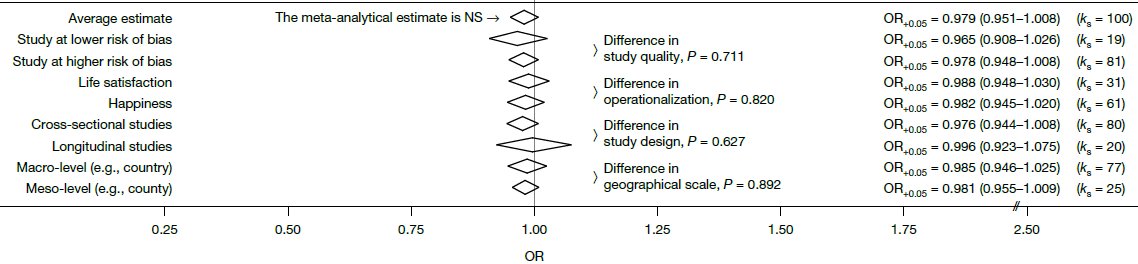
Its first big finding was that across 100 studies, there was no significant effect on subjective well-being: not cross-sectionally, longitudinally, or at a small or large level.
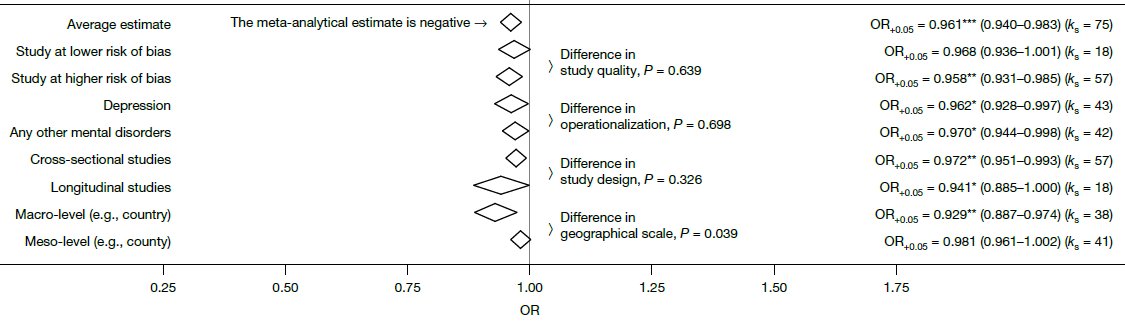
The next big finding was that inequality was very slightly—statistically but not practically significantly —related to worse mental health:
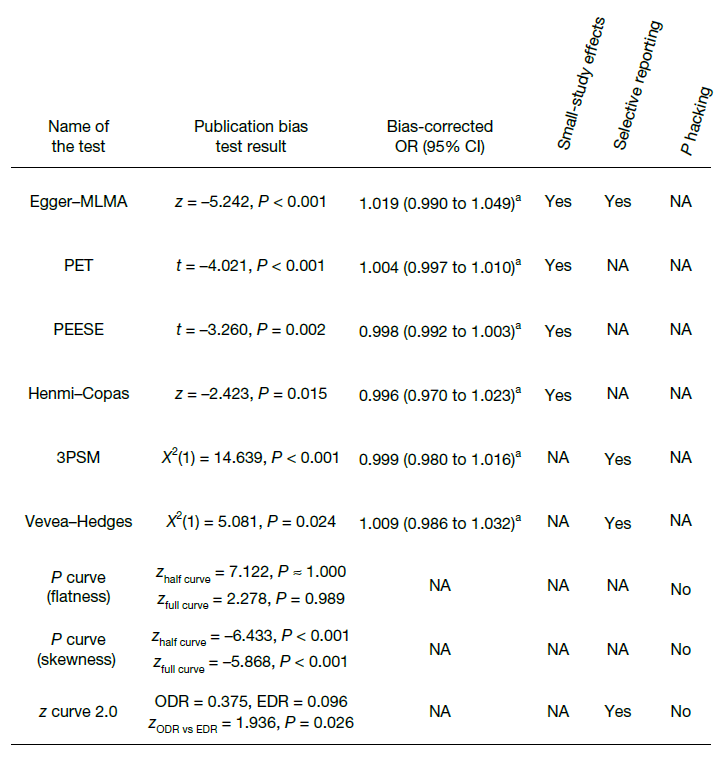
But what was up with that result? Is it real? No, as it turns out, it is not! The authors demonstrated this by checking for publication bias. Every test they ran supported its presence, and every correction made the association not just practically, but also statistically nonsignificant:
The authors followed this up with a meta-analytic specification curve analysis, varying the number and type of covariates used, and showing that, as it turned out, their result was incredibly robust: generally effects were nonsignificant, and they are always practically nonsignificant, for both well-being and mental health measures.
Normally, doing all this would be enough to make for a top-tier meta-analysis, but these authors went further and conducted machine learning-guided meta-regressions and found that very few were significant, mattered, etc., but for well-being, inflation did, with an OR of 0.95, meaning that with more inflation, inequality was more related to worse well-being.
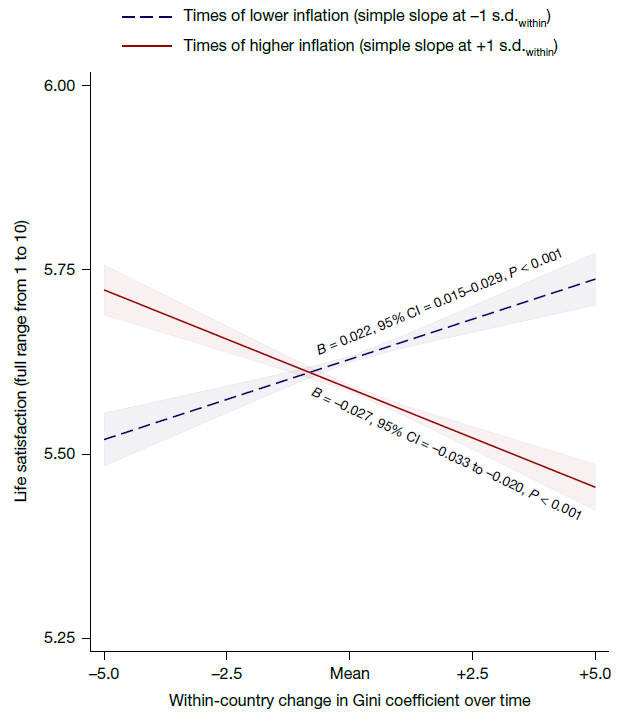
This makes theoretical sense, no? I propose that it does! Higher inflation makes for harder times, and in harder times, people reasonably kvetch more. And the authors confirmed that this held up using individual-level data from the Gallup World Poll, for 153 countries, across sixteen years, covering almost two million participants. The result was robust outside the meta-analysis:
These essentially null findings complement a large literature on this subject across other many different domains. For example, the relationship between inequality and crime meta-analytically also doesn't hold up: x.com/cremieuxrecuei…. Much the same, changes in inequality do not predict changes in the homicide rate: x.com/cremieuxrecuei….
The broader picture that was famously raised by Lichbach back in 1989 was that economic inequality is not a meaningful contributor to political conflict—violence writ very large! And this has held up more recently, with papers basically always failing to find that inequality contributes to civil war. In fact, civil war is generally hard to predict from measured variables like polarization, fractionalization, and so on.
I suspect this is true, and that inequality in general is not that meaningful for humans, because people can't really see inequality. Instead, as Bryan Caplan has noted, it's the perception of inequality that matters, not objective inequality. And the two quantities are only rarely related.
Now look back at the inflation result from the meta-analysis and its replication in the large Gallup poll data. What does predict political conflict is low income, low growth, recent instability, and neighbors with the same problems.
It's not even clear objective inequality can matter, because in most situations, we just can't see it.
Sources:
nature.com/articles/s4158…
cambridge.org/core/journals/…
xhxhxhx.tumblr.com/post/163194561…
econlib.org/archives/2015/…
Its first big finding was that across 100 studies, there was no significant effect on subjective well-being: not cross-sectionally, longitudinally, or at a small or large level.
The next big finding was that inequality was very slightly—statistically but not practically significantly —related to worse mental health:
But what was up with that result? Is it real? No, as it turns out, it is not! The authors demonstrated this by checking for publication bias. Every test they ran supported its presence, and every correction made the association not just practically, but also statistically nonsignificant:
The authors followed this up with a meta-analytic specification curve analysis, varying the number and type of covariates used, and showing that, as it turned out, their result was incredibly robust: generally effects were nonsignificant, and they are always practically nonsignificant, for both well-being and mental health measures.
Normally, doing all this would be enough to make for a top-tier meta-analysis, but these authors went further and conducted machine learning-guided meta-regressions and found that very few were significant, mattered, etc., but for well-being, inflation did, with an OR of 0.95, meaning that with more inflation, inequality was more related to worse well-being.
This makes theoretical sense, no? I propose that it does! Higher inflation makes for harder times, and in harder times, people reasonably kvetch more. And the authors confirmed that this held up using individual-level data from the Gallup World Poll, for 153 countries, across sixteen years, covering almost two million participants. The result was robust outside the meta-analysis:
These essentially null findings complement a large literature on this subject across other many different domains. For example, the relationship between inequality and crime meta-analytically also doesn't hold up: x.com/cremieuxrecuei…. Much the same, changes in inequality do not predict changes in the homicide rate: x.com/cremieuxrecuei….
The broader picture that was famously raised by Lichbach back in 1989 was that economic inequality is not a meaningful contributor to political conflict—violence writ very large! And this has held up more recently, with papers basically always failing to find that inequality contributes to civil war. In fact, civil war is generally hard to predict from measured variables like polarization, fractionalization, and so on.
I suspect this is true, and that inequality in general is not that meaningful for humans, because people can't really see inequality. Instead, as Bryan Caplan has noted, it's the perception of inequality that matters, not objective inequality. And the two quantities are only rarely related.
Now look back at the inflation result from the meta-analysis and its replication in the large Gallup poll data. What does predict political conflict is low income, low growth, recent instability, and neighbors with the same problems.
It's not even clear objective inequality can matter, because in most situations, we just can't see it.
Sources:
nature.com/articles/s4158…
cambridge.org/core/journals/…
xhxhxhx.tumblr.com/post/163194561…
econlib.org/archives/2015/…
• • •
Missing some Tweet in this thread? You can try to
force a refresh