What's interesting is that there made me coins that portray the Prophet Muhammad. Robert Hoyland makes interesting arguments as to why the coins in the Abbasid-era portray the Prophet 🧵
https://x.com/JordanAcademia0/status/1997277291790082109
First of all, the Qurʾān lacks a clearly articulated prohibition against images. On the Qurʾān and early Muslim attitudes towards images see: Lammens, “Arts figurés,” 241; Arnold, Painting, 4‒6; Georges Marçais, “La question des images dans l’art musulman,” Byzantion 7 (1932): 161‒183; Creswell, “Lawfulness”; Aḥmad Muḥammad ʿĪsā, with Harold W. Glidden, tr., “Muslims and Taswīr,” The Muslim World 45 (1955): 250‒268; Bishr Farès, “Philosophie et jurisprudence illustrées par les arabes: la querelle des images en Islam,” Mélanges Louis Massignon, 3 vols., Damascus: Institut français de Damas, 1956‒1958[?], ii, 77‒109; Grabar, Formation, 78 ff; G.R. Hawting, The Idea of Idolatry and the Emergence of Islam: From Polemic to History, Cambridge: Cambridge University Press, 1999, 45‒66.
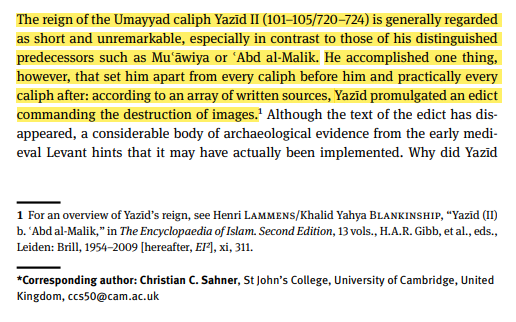
The main reason for the prohibition of images would be popularized by the reign of the Umayyad caliph Yazīd II (101‒105/720‒724). He is generally regarded as short and unremarkable, especially in contrast to those of his distinguished predecessors such as Muʿāwiya or ʿAbd al-Malik. He accomplished one thing, however, that set him apart from every caliph before him and practically every caliph after: according to an array of written sources, Yazīd promulgated an edict commanding the destruction of images (see Henri Lammens/Khalid Yahya Blankinship, “Yazīd (II) b. ʿAbd al-Malik,” in The Encyclopaedia of Islam. Second Edition, 13 vols., H.A.R. Gibb, et al., eds., Leiden: Brill, 1954‒2009 [hereafter, EI²], xi, 311).
The main reason for the prohibition of images would be popularized by the reign of the Umayyad caliph Yazīd II (101‒105/720‒724). He is generally regarded as short and unremarkable, especially in contrast to those of his distinguished predecessors such as Muʿāwiya or ʿAbd al-Malik. He accomplished one thing, however, that set him apart from every caliph before him and practically every caliph after: according to an array of written sources, Yazīd promulgated an edict commanding the destruction of images (see Henri Lammens/Khalid Yahya Blankinship, “Yazīd (II) b. ʿAbd al-Malik,” in The Encyclopaedia of Islam. Second Edition, 13 vols., H.A.R. Gibb, et al., eds., Leiden: Brill, 1954‒2009 [hereafter, EI²], xi, 311).
In fact, this iconoclasm by Yazid was so popular, that it even inspired Byzantine iconoclasm in the 700s (C.H. Becker, “Christliche Polemik und islamische Dogmenbildung,” Zeitschrift für Assyriologie und Vorderasiatische Archäologie 26 (1912): 191‒195; Gerhart B. Ladner, “Origin and Significance of the Byzantine Iconoclastic Controversy,” Mediaeval Studies 2 (1940): 129; André Grabar, L’iconoclasme byzantine: dossier archéologique. Paris: Collège de France, 1957, 120‒127; G.E. von Grunebaum, “Byzantine Iconoclasm and the Influence of the Islamic Environment,” History of Religions 2 (1962): 1‒10; Oleg Grabar, “Islamic Art and Byzantium,” Dumbarton Oaks Papers 18 (1964): 83 n. 40; Stephen Gero, Byzantine Iconoclasm during the Reign of Leo III with Particular Attention to the Oriental Sources, Louvain: Secrétariat du Corpus SCO, 1973, 59‒84; L.W. Barnard, The GraecoRoman and Oriental Background of the Iconoclastic Controversy, Leiden: Brill, 1974, 10‒33; Cyril Mango, “Historical Introduction,” in Iconoclasm: Papers Given at the Ninth Spring Symposium of Byzantine Studies, University of Birmingham, March 1975. Anthony Bryer/Judith Herrin, eds., Birmingham: Centre for Byzantine Studies, University of Birmingham, 1977, 1‒6; Gotthard Strohmaier, “Der Kalif Yazīd II und sein Traumdeuter: Eine byzantini sche Legende über den Ursprung des Ikonoklasmus,” Jahrbuch für Geschichte des Feudalismus 3 (1979): 11‒17; Patricia Crone, “Islam, Judeo-Christianity and Byzantine Iconoclasm,” Jerusalem Studies in Arabic and Islam 2 (1980): 59‒95; L.W. Barnard, “The Sources of the Byzantine Iconoclastic Controversy: Leo III and Yazīd II – a Reconsideration,” in Überlieferungsgeschichtliche Untersuchungen, Franz Paschke, ed., Berlin: Akademie Verlag, 1981, 29‒37; Leslie Brubaker/ John Haldon, Byzantium in the Iconoclast Era, c. 680‒850, Cambridge: Cambridge University Press, 2011, 105‒117).

In nearly every text, Yazīd is portrayed as the primary instigator of the edict. That it was a real piece of legislation is implied by several texts, which refer to a “command” (fūqdānā, 1234, cf. Zuqnīn), a “general letter” (egkuklion epistolēn, John of Jerusalem), a “universal edict” (dogma katholikon, Theophanes, cf. Antirrheticus III), and a “written order” (kitāb, Tahgr, cf. Kindī, Maqrīzī). We learn that Yazīd was primarily concerned with churches (Zuqnīn, John of Jerusalem, Theophanes, Ep. ad Theophilum, George Kedrenos, John Zonaras, History of the Patriarchs, Maqrīzī) and other Christian religious buildings (Zuqnīn, Michael the Syrian, 1234, Bar Hebraeus, Antirrheticus III), but several sources also state that “homes” were attacked (Zuqnīn, Michael the Syrian, 1234, Nuʿaym b. Ḥammād, John of Jerusalem). The Muslim authorities were mainly interested in images of living beings (Michael the Syrian, Bar Hebraeus, John of Jerusalem, Antirrheticus III), and to drive this point home, the sources utilize words which emphasize “representation” and “likeness” (e. g. Gk. homoiōma, Antirrheticus III; Ar. tamāthīl). These seem to reflect specifically Muslim concerns about images endowed with “spirit” (Ar. rūḥ), per the ḥadīth discussed in the final section. The list of destroyed objects included statues (Michael the Syrian, 1234, Antirrheticus III, Antirrheticus IV, Ibn ʿAbd alḤakam, Kindī, Maqrīzī, Ibn Taghrībirdī), books (Michael the Syrian, 1234, Bar Hebraeus), liturgical vessels (John of Jerusalem, Antirrheticus III), vestments (John of Jerusalem, Antirrheticus III), images on walls (Michael the Syrian, 1234, Bar Hebraeus, John of Jerusalem, Ep. ad Theophilum), and mosaics (John of Jerusalem).
The slow formation of a prohibition on images is also suggested by the many examples of representational art from the first two centuries after the Hijra. These include the coins that circulated before ʿAbd al-Malik’s financial reforms, including the so-called standing caliph issue (which as Robert Hoyland has argued, may even portray the Prophet Muḥammad) (Robert G. Hoyland, “Writing the Biography of the Prophet Muhammad: Problems and Solutions,” History Compass 5/2 (2007): 593‒596); the statuary of Umayyad castles such as Khirbat al-Mafjar near Jericho or Qaṣr al-Ḥayr al-Gharbī near Palmyra (Khirbat al-Mafjar: R.W. Hamilton, Khirbat alMafjar: An Arabian Mansion in the Jordan Valley, Oxford: Clarendon Press, 1959; Mikko Louhivuori, “The Palace of Hisham and 8th Century, C.E. Iconoclasm,” in Encounters of the Children of Abraham from Ancient to Modern Times, Antti Laato/Pekka Lindqvist, eds., Leiden: Brill, 2010, 99‒214); the shockingly vivid wall paintings of Quṣayr ʿAmra east of ʿAmmān (Fowden, Quṣayr ʿAmra); the statue of the mounted rider that reportedly adorned the green dome at the heart of al-Manṣūr’s Round City at Baghdad; and the wall. paintings from the ʿAbbāsid palace at Sāmarrāʾ. Even an avowed iconoclast like Yazīd could savor images in certain contexts, as evidenced by the palace that he (or his son) built at al-Qasṭal, 25 km south of ʿAmmān, which features mosaic images of lions, leopards, bulls, and gazelles. Despite these famous examples, we should not forget that iconic art was the exception in early Islamic culture rather than the norm (Grabar, Formation, 87).
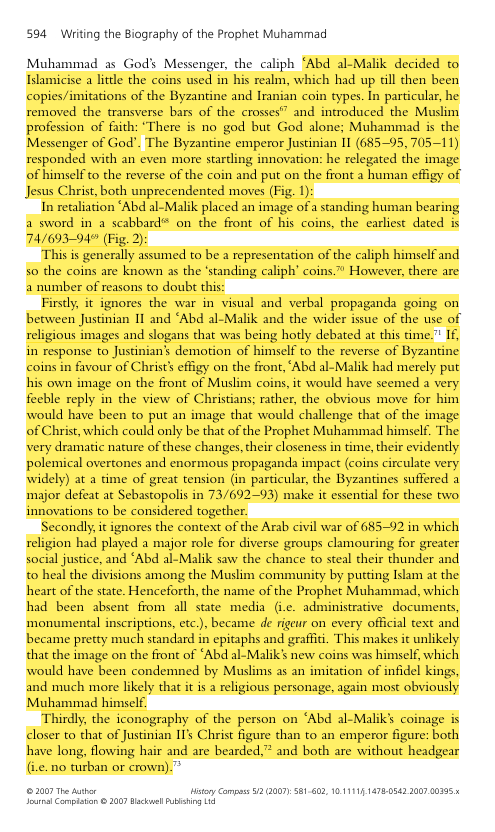
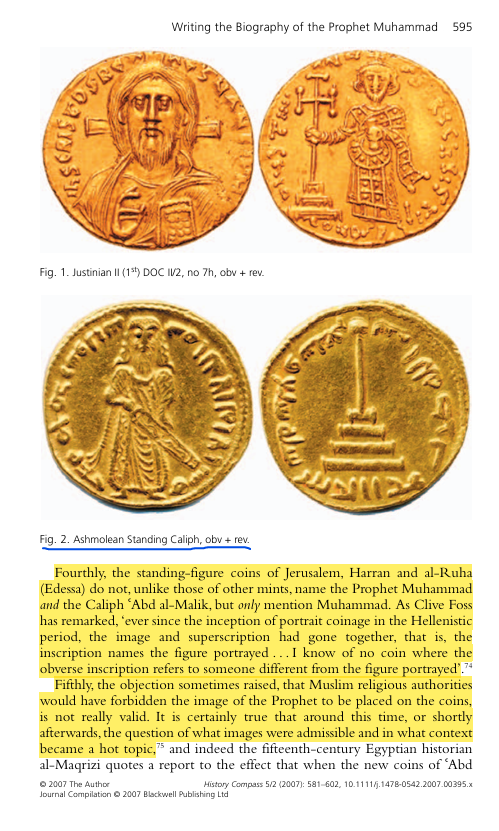
Robert Hoyland gives reasons as to why the figures on the coin should be the Prophet rather than the caliph himself!
- (1) The coin was part of a propaganda battle with Byzantium, Justinian II put Christ’s portrait on his coins but putting his own face would be weak. The only figure that could rival Christ’s image was the Prophet.
- (2) The early Islamic state had just started promoting Muhammad’s name, after the Muslim civil war, Abd al-Malik made the Prophet’s name appear on official inscriptions, documents, and epitaphs. Putting his own portrait on coins would look like copying non-Muslim kings.
- (3) The figure looks more like Justinian’s Christ than like an emperor. It has a Long hair and beard like Byzantine Christ images. No crown or royal headgear (Umayyad princes wore crowns or styled hair), so the figure doesn't look like Abd al-Malik, it looks like a religious figure.
- (4) Some mints name only Muhammad, not Abd al-Malik, on coins from Jerusalem, Harran, and Edessa, the inscription mentions Muhammad alone. In ancient coinage, the inscription always names the person shown.
- (5) The idea that depicting Muhammad was forbidden is anachronistic, it did not exist yet. Historical sources show early Muslims tolerating or even displaying images of Muhammad.
- (6) The type was used only briefly, it was only minted for a few years (AH 74-77, 693-697 C.E), soon after, Islamic coins became fully aniconic.
- (1) The coin was part of a propaganda battle with Byzantium, Justinian II put Christ’s portrait on his coins but putting his own face would be weak. The only figure that could rival Christ’s image was the Prophet.
- (2) The early Islamic state had just started promoting Muhammad’s name, after the Muslim civil war, Abd al-Malik made the Prophet’s name appear on official inscriptions, documents, and epitaphs. Putting his own portrait on coins would look like copying non-Muslim kings.
- (3) The figure looks more like Justinian’s Christ than like an emperor. It has a Long hair and beard like Byzantine Christ images. No crown or royal headgear (Umayyad princes wore crowns or styled hair), so the figure doesn't look like Abd al-Malik, it looks like a religious figure.
- (4) Some mints name only Muhammad, not Abd al-Malik, on coins from Jerusalem, Harran, and Edessa, the inscription mentions Muhammad alone. In ancient coinage, the inscription always names the person shown.
- (5) The idea that depicting Muhammad was forbidden is anachronistic, it did not exist yet. Historical sources show early Muslims tolerating or even displaying images of Muhammad.
- (6) The type was used only briefly, it was only minted for a few years (AH 74-77, 693-697 C.E), soon after, Islamic coins became fully aniconic.
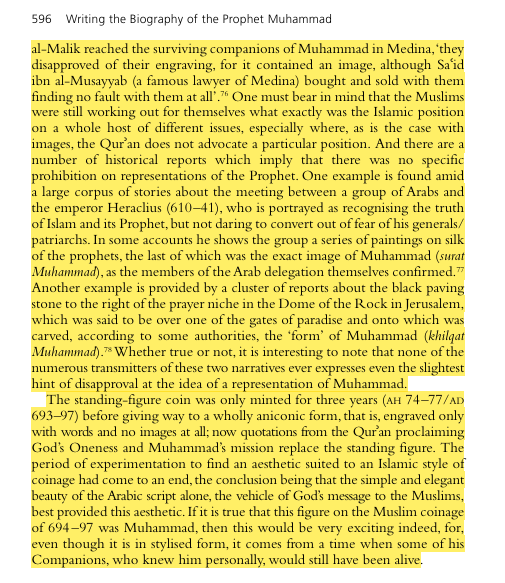
Full reasons in text as to why it's not Abd al-Malik 📜
- Firstly, it ignores the war in visual and verbal propaganda going on between Justinian II and Abd al-Malik and the wider issue of the use of religious images and slogans that was being hotly debated at this time. If, in response to Justinian’s demotion of himself to the reverse of Byzantine coins in favour of Christ’s effigy on the front, vAbd al-Malik had merely put his own image on the front of Muslim coins, it would have seemed a very feeble reply in the view of Christians; rather, the obvious move for him would have been to put an image that would challenge that of the image of Christ, which could only be that of the Prophet Muhammad himself. The very dramatic nature of these changes, their closeness in time, their evidently polemical overtones and enormous propaganda impact (coins circulate very widely) at a time of great tension (in particular, the Byzantines suffered a major defeat at Sebastopolis in 73/692–93) make it essential for these two innovations to be considered together.
- Secondly, it ignores the context of the Arab civil war of 685–92 in which religion had played a major role for diverse groups clamouring for greater social justice, and Abd al-Malik saw the chance to steal their thunder and to heal the divisions among the Muslim community by putting Islam at the heart of the state. Henceforth, the name of the Prophet Muhammad, which had been absent from all state media (i.e. administrative documents, monumental inscriptions, etc.), became rigor on every official text and became pretty much standard in epitaphs and graffiti. This makes it unlikely that the image on the front of Abd al-Malik’s new coins was himself, which would have been condemned by Muslims as an imitation of infidel kings, and much more likely that it is a religious personage, again most obviously Muhammad himself.
- Thirdly, the iconography of the person on Abd al-Malik’s coinage is closer to that of Justinian II’s Christ figure than to an emperor figure: both have long, flowing hair and are bearded (Miles,‘Gold Coinage’, 216 n. 36, does note that ‘his long hair and beard also resemble those of Christ on the Byzantine coin’, but does not pursue this point. On the appearance of Umayyad princes see G. Fowden, Qusayr wAmra: Art and the Umayyad Elite in Late Antique Syria, 115–41), and both are without headgear (i.e. no turban or crown) (‘servant of Christ’ and Abd al-Malik’s use of ‘deputy of God’. For the wider context of this see P. Crone, ‘Islam, Judeo-Christianity and Byzantine Iconoclasm’, Jerusalem Studies in Arabic and Islam, 2 (1980): 59–95). On Byzantine coins the emperors wore crowns, so the bare-headed Christ is in striking contrast to this; the Umayyad prince in Sasanian attire at Qasr al-Hayr al-Gharbi appears to be wearing some sort of royal headgear (ibid., 121, fig. 39); the one at Khirbat al-Mafjar has his hair exposed on the sides (the top of his head is broken off, so we cannot be sure that he was bareheaded), but tightly coiffed, not flowing, as on the coinage (ibid., 162 fig. 46).
- Fourthly, the standing-figure coins of Jerusalem, Harran and al-Ruha (Edessa) do not, unlike those of other mints, name the Prophet Muhammad and the Caliph vAbd al-Malik, but only mention Muhammad. As Clive Foss has remarked, ‘ever since the inception of portrait coinage in the Hellenistic period, the image and superscription had gone together, that is, the inscription names the figure portrayed . . . I know of no coin where the obverse inscription refers to someone different from the figure portrayed’ (C. Foss, ‘Anomalous Arab-Byzantine Coins’, ONS Newsletter, 166 (2001): 9, and repeated in Foss,‘The Coinage of the First Century of Islam’, Journal of Roman Archaeology, 16 (2003): 758).
- Fifthly, the objection sometimes raised, that Muslim religious authorities would have forbidden the image of the Prophet to be placed on the coins, is not really valid. It is certainly true that around this time, or shortly afterwards, the question of what images were admissible and in what context became a hot topic (R. Paret,‘Die Entstehungszeit des islamischen Bilderverbots’, Kunst des Orients, 11 (1976 7): 158–81; D. van Reenen, ‘The Bilderverbot, a New Survey’, Der Islam, 67 (1990): 27–77), and indeed the fifteenth-century Egyptian historian al-Maqrizi quotes a report to the effect that when the new coins of Abd al-Malik reached the surviving companions of Muhammad in Medina,‘they disapproved of their engraving, for it contained an image, although Savid ibn al-Musayyab (a famous lawyer of Medina) bought and sold with them finding no fault with them at all’. ‘Kitab al-nuqud al-qadima al-islamiyya’ (also known as Shudhur al-wuqud fi wilm al-nuqud) in A. al-Karmali, Rasavil fi l-nuqud al-warabiyya wa-l-islamiyya wa-wilm al-nummiyyat (Cairo, 1987), 41. He also says that the caliph Muvawiya (40–60/660–80) ‘struck dinars on which was an effigy (timthal) girt with a sword’ and which an army officer proclaimed to be badly struck (ibid., 39); it is usually assumed that he confused Muvawiya with vAbd al-Malik, though it is possible that the report is correct and that no examples of this coin-type have survived/yet been discovered. Al-Baladhuri, Futuh, 452, also mentions the disapproval of the Companions at Medina, but gives no reason, though it is implied it is connected with their weight.
- Firstly, it ignores the war in visual and verbal propaganda going on between Justinian II and Abd al-Malik and the wider issue of the use of religious images and slogans that was being hotly debated at this time. If, in response to Justinian’s demotion of himself to the reverse of Byzantine coins in favour of Christ’s effigy on the front, vAbd al-Malik had merely put his own image on the front of Muslim coins, it would have seemed a very feeble reply in the view of Christians; rather, the obvious move for him would have been to put an image that would challenge that of the image of Christ, which could only be that of the Prophet Muhammad himself. The very dramatic nature of these changes, their closeness in time, their evidently polemical overtones and enormous propaganda impact (coins circulate very widely) at a time of great tension (in particular, the Byzantines suffered a major defeat at Sebastopolis in 73/692–93) make it essential for these two innovations to be considered together.
- Secondly, it ignores the context of the Arab civil war of 685–92 in which religion had played a major role for diverse groups clamouring for greater social justice, and Abd al-Malik saw the chance to steal their thunder and to heal the divisions among the Muslim community by putting Islam at the heart of the state. Henceforth, the name of the Prophet Muhammad, which had been absent from all state media (i.e. administrative documents, monumental inscriptions, etc.), became rigor on every official text and became pretty much standard in epitaphs and graffiti. This makes it unlikely that the image on the front of Abd al-Malik’s new coins was himself, which would have been condemned by Muslims as an imitation of infidel kings, and much more likely that it is a religious personage, again most obviously Muhammad himself.
- Thirdly, the iconography of the person on Abd al-Malik’s coinage is closer to that of Justinian II’s Christ figure than to an emperor figure: both have long, flowing hair and are bearded (Miles,‘Gold Coinage’, 216 n. 36, does note that ‘his long hair and beard also resemble those of Christ on the Byzantine coin’, but does not pursue this point. On the appearance of Umayyad princes see G. Fowden, Qusayr wAmra: Art and the Umayyad Elite in Late Antique Syria, 115–41), and both are without headgear (i.e. no turban or crown) (‘servant of Christ’ and Abd al-Malik’s use of ‘deputy of God’. For the wider context of this see P. Crone, ‘Islam, Judeo-Christianity and Byzantine Iconoclasm’, Jerusalem Studies in Arabic and Islam, 2 (1980): 59–95). On Byzantine coins the emperors wore crowns, so the bare-headed Christ is in striking contrast to this; the Umayyad prince in Sasanian attire at Qasr al-Hayr al-Gharbi appears to be wearing some sort of royal headgear (ibid., 121, fig. 39); the one at Khirbat al-Mafjar has his hair exposed on the sides (the top of his head is broken off, so we cannot be sure that he was bareheaded), but tightly coiffed, not flowing, as on the coinage (ibid., 162 fig. 46).
- Fourthly, the standing-figure coins of Jerusalem, Harran and al-Ruha (Edessa) do not, unlike those of other mints, name the Prophet Muhammad and the Caliph vAbd al-Malik, but only mention Muhammad. As Clive Foss has remarked, ‘ever since the inception of portrait coinage in the Hellenistic period, the image and superscription had gone together, that is, the inscription names the figure portrayed . . . I know of no coin where the obverse inscription refers to someone different from the figure portrayed’ (C. Foss, ‘Anomalous Arab-Byzantine Coins’, ONS Newsletter, 166 (2001): 9, and repeated in Foss,‘The Coinage of the First Century of Islam’, Journal of Roman Archaeology, 16 (2003): 758).
- Fifthly, the objection sometimes raised, that Muslim religious authorities would have forbidden the image of the Prophet to be placed on the coins, is not really valid. It is certainly true that around this time, or shortly afterwards, the question of what images were admissible and in what context became a hot topic (R. Paret,‘Die Entstehungszeit des islamischen Bilderverbots’, Kunst des Orients, 11 (1976 7): 158–81; D. van Reenen, ‘The Bilderverbot, a New Survey’, Der Islam, 67 (1990): 27–77), and indeed the fifteenth-century Egyptian historian al-Maqrizi quotes a report to the effect that when the new coins of Abd al-Malik reached the surviving companions of Muhammad in Medina,‘they disapproved of their engraving, for it contained an image, although Savid ibn al-Musayyab (a famous lawyer of Medina) bought and sold with them finding no fault with them at all’. ‘Kitab al-nuqud al-qadima al-islamiyya’ (also known as Shudhur al-wuqud fi wilm al-nuqud) in A. al-Karmali, Rasavil fi l-nuqud al-warabiyya wa-l-islamiyya wa-wilm al-nummiyyat (Cairo, 1987), 41. He also says that the caliph Muvawiya (40–60/660–80) ‘struck dinars on which was an effigy (timthal) girt with a sword’ and which an army officer proclaimed to be badly struck (ibid., 39); it is usually assumed that he confused Muvawiya with vAbd al-Malik, though it is possible that the report is correct and that no examples of this coin-type have survived/yet been discovered. Al-Baladhuri, Futuh, 452, also mentions the disapproval of the Companions at Medina, but gives no reason, though it is implied it is connected with their weight.
🔍 If you found this thread insightful, please follow and repost to support more historical research and threads like this.
📷 Join the discussion & access more resources: discord.gg/R4m6SWJRD8
📷jordanjournal.substack.com
📷 Join the discussion & access more resources: discord.gg/R4m6SWJRD8
📷jordanjournal.substack.com
• • •
Missing some Tweet in this thread? You can try to
force a refresh