Where our taxes go, First Nations Edition
KPMG audited the Federation of Sovereign Indigenous Nations (FSIN) representing 74 First Nations in Saskatchewan
They analyzed spending between April 2019 and March 2024
Hang on🧵
KPMG audited the Federation of Sovereign Indigenous Nations (FSIN) representing 74 First Nations in Saskatchewan
They analyzed spending between April 2019 and March 2024
Hang on🧵

#1 - COVID Funding
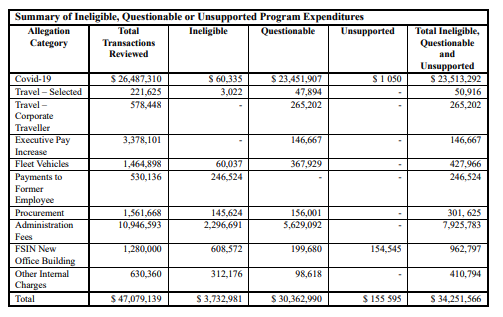
$26 million was audited
KPMG found $23.5 million was questionable
** an 89% failure rate**
- no records
- missing contracts
- missing invoices
$26 million was audited
KPMG found $23.5 million was questionable
** an 89% failure rate**
- no records
- missing contracts
- missing invoices

# 2 - Travel expenditures
$800K of travel spending was audited
$316K was flagged by auditors, a 39% failure rate
Half the travel bookings couldn't be justified, either policy violations or they couldn't explain the purpose. And one Vice Chief was billing personal trips
$800K of travel spending was audited
$316K was flagged by auditors, a 39% failure rate
Half the travel bookings couldn't be justified, either policy violations or they couldn't explain the purpose. And one Vice Chief was billing personal trips

# 3 - Executive Pay Raises during Covid
On November 5, 2020, a briefing note went to FSIN's Treasury Board recommending:
$60,000 pay raise for the Chief
$40,000 pay raise for each Vice Chief
Retroactive 8 months prior
On November 5, 2020, a briefing note went to FSIN's Treasury Board recommending:
$60,000 pay raise for the Chief
$40,000 pay raise for each Vice Chief
Retroactive 8 months prior

# 4 - Fleet Vehicles
$1.4 million in fleet purchases examined
$427,966 flagged as questionable, a 29% failure rate
Executives purchased new trucks every couple of years, but couldn't prove it was necessary, and then sold the old vehicles to themselves at a loss
$1.4 million in fleet purchases examined
$427,966 flagged as questionable, a 29% failure rate
Executives purchased new trucks every couple of years, but couldn't prove it was necessary, and then sold the old vehicles to themselves at a loss

# 5 - Payments to former employee
$530,136 was audited
$246,524 was flagged, a 46% failure rate
One person had a side company billing for work they were being paid to do as an employee.
They also resigned to obtain severance, only to be rehired a week later
$530,136 was audited
$246,524 was flagged, a 46% failure rate
One person had a side company billing for work they were being paid to do as an employee.
They also resigned to obtain severance, only to be rehired a week later
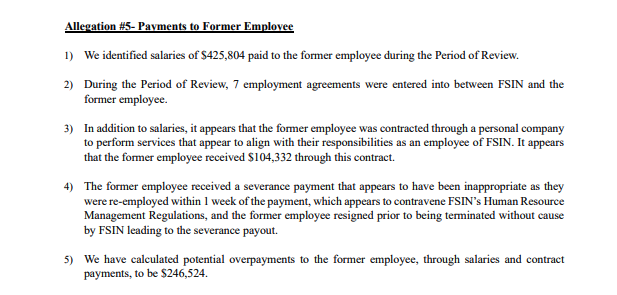
#6 - Procurement
$1.5M audited
$300,000 flagged, a 19% failure rate
9 vendors used the same invoice template paid out of a Vice Chief's program, where the "deliverable is unknown"
49 transactions totalling $492,332 didn't have proper approval for the purchase
$1.5M audited
$300,000 flagged, a 19% failure rate
9 vendors used the same invoice template paid out of a Vice Chief's program, where the "deliverable is unknown"
49 transactions totalling $492,332 didn't have proper approval for the purchase
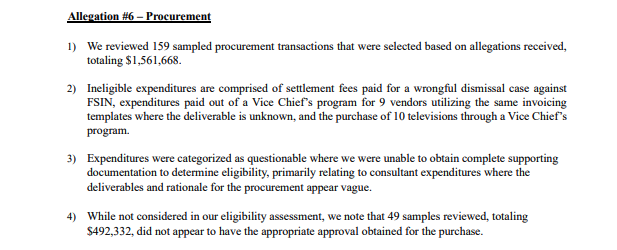
#7 - Administration
$11 million audited
$8 million flagged, a 72% failure rate
$5.2 million went to "executive offices"
$2.3 million went to new vehicles and a building
$11 million audited
$8 million flagged, a 72% failure rate
$5.2 million went to "executive offices"
$2.3 million went to new vehicles and a building
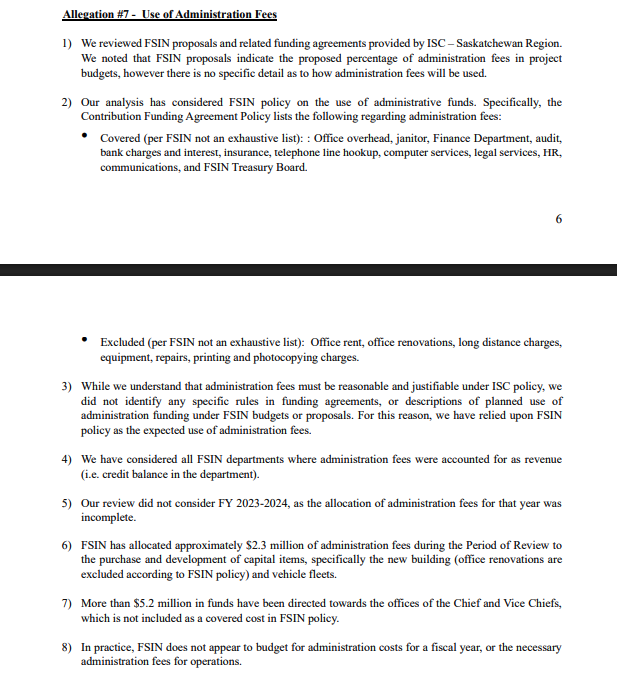
# 8 - New Office Building
$1.2 million audited
$962,000 flagged, a 75% failure rate
FSIN used grant money to pay for the building. Then claimed rent payments for repayment by Ottawa
As well, they doubled billed taxpayers for utility and maintenance costs
$1.2 million audited
$962,000 flagged, a 75% failure rate
FSIN used grant money to pay for the building. Then claimed rent payments for repayment by Ottawa
As well, they doubled billed taxpayers for utility and maintenance costs
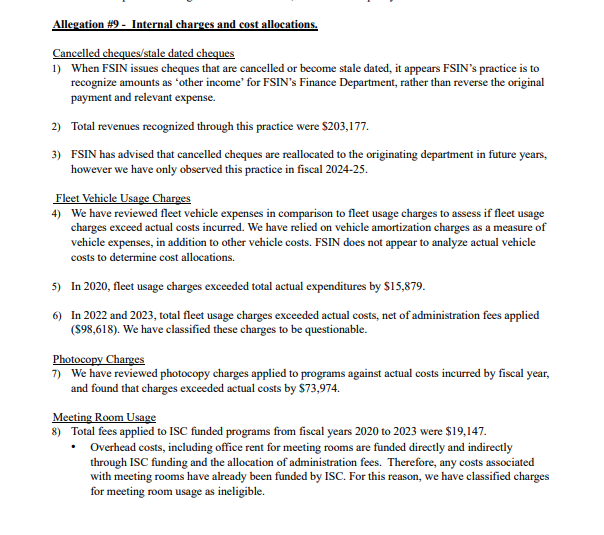
# 9 - Fees and Charges for Services
$630,000 audited
$410,000 flagged , a 65% failure rate
- took ineligible payments
- over charged $74,000 for photo copies
- over billed $98,000 for vehicle expenses
- double billed $20K in rental fees
$630,000 audited
$410,000 flagged , a 65% failure rate
- took ineligible payments
- over charged $74,000 for photo copies
- over billed $98,000 for vehicle expenses
- double billed $20K in rental fees
FSIN is not an Indian Band but a First Nations middle man
They are an Indigenous NGO receiving tax dollars to administer government programs, like Covid relief
They cheat their own people, and taxpayers
And nothing will come of this audit, cause it would be "RaCiSt" /Fin
They are an Indigenous NGO receiving tax dollars to administer government programs, like Covid relief
They cheat their own people, and taxpayers
And nothing will come of this audit, cause it would be "RaCiSt" /Fin
Last one - the FSIN @fsinations is the same as Coastal First Nations @CFNGBI and Union of BC Indian Chiefs @UBCIC
NGO's taking money away from other First Nations, its people, and CDN tax payers
NGO's taking money away from other First Nations, its people, and CDN tax payers
The FSIN is an independent NGO, comprised of Indigenous from various bands.
The audit is not of the spending of 74 different bands, but the single NGO who works on there behalf to administer government programs
The audit is not of the spending of 74 different bands, but the single NGO who works on there behalf to administer government programs
Link to report
https://x.com/TheReclamare/status/1998156571222937868?s=20
• • •
Missing some Tweet in this thread? You can try to
force a refresh