The affordability crisis is an inequality crisis. When prices spike in key sectors, it's not just inflation—it's a massive redistribution shock that hits poor households hardest. In our **new working paper**, we identify the sectors that matter most. A 🧵 scholarworks.umass.edu/entities/publi…
Standard inflation analysis reduces inflation to a single aggregate index. This conceals that inflation is often triggered by price shocks and that consumption baskets differ systematically across income groups, producing unequal inflation burdens. 2/16
Sectoral cost shocks are therefore non-neutral: when relative prices shift unevenly across essential goods, inflation redistributes income, increasing income inequality. 3/16
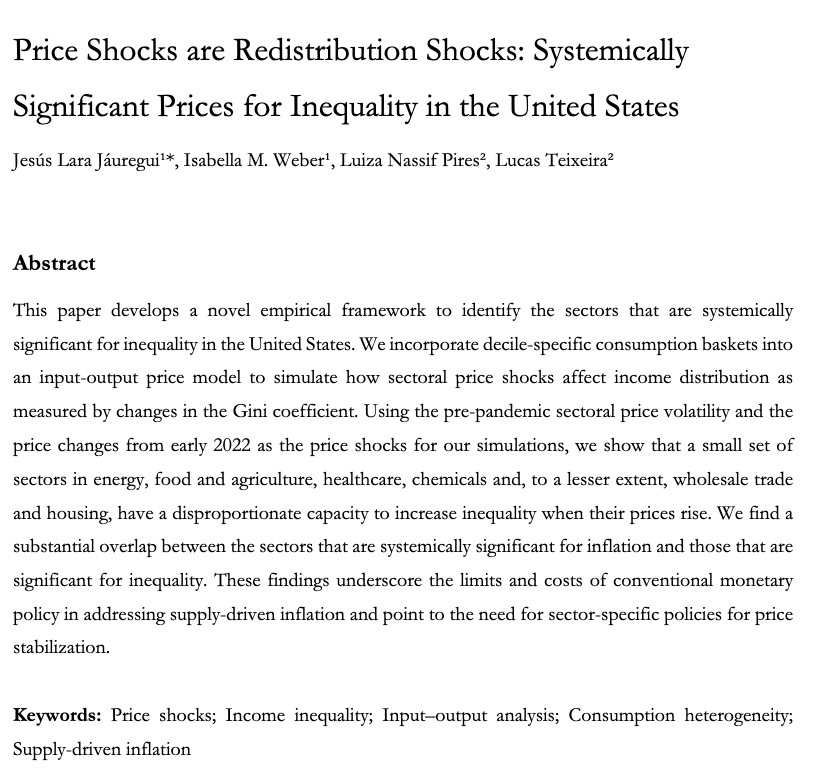
We ask: which sectors' price shocks have the largest potential to raise income inequality in the US, and how do these sectors overlap with the systemically significant sectors for inflation identified in earlier work? 4/16
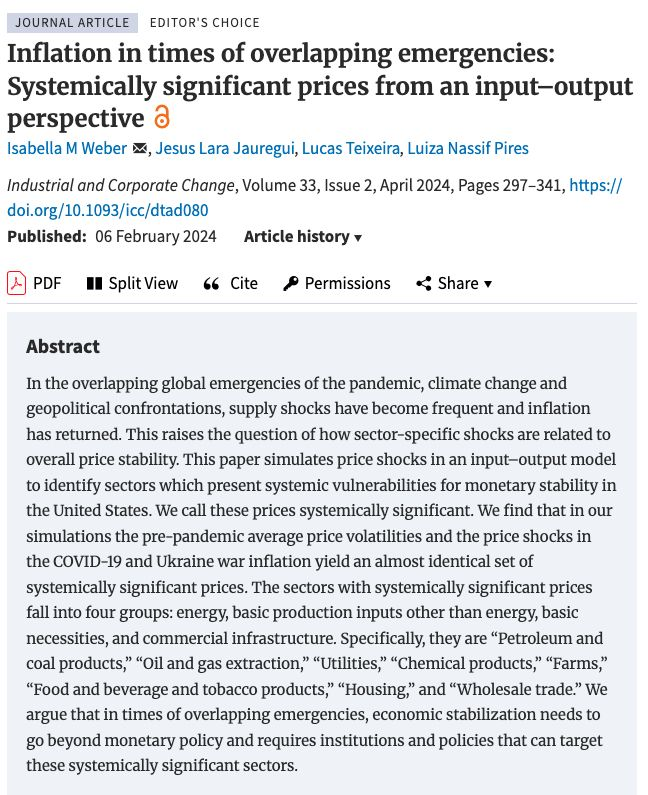
We extend the input–output price model developed by Weber et al. (2024), which traces how a price shock in one sector propagates through production linkages, increasing the overall price level. 5/16 academic.oup.com/icc/article/33…
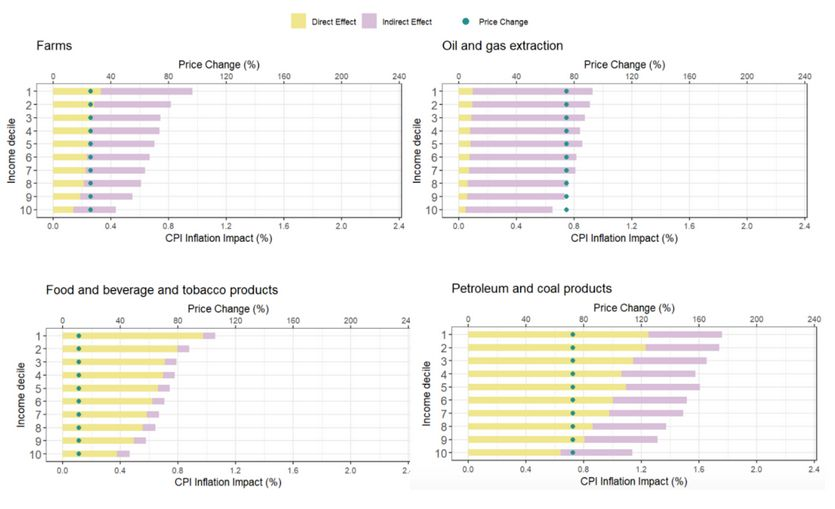
Using decile-specific consumption baskets, we simulate how each sectoral price shock affects each income group’s cost of living, mapping these heterogeneous effects into changes in the Gini coefficient, ranking sectors by inequality impact. 6/16
Consumption heterogeneity is central: even a uniform initial price increase produces sharply different inflation outcomes for poor and rich households, depending on the structure of spending across income groups. 7/16
For example, a shock to food generates inflation 126% higher for the poorest than the richest decile; for petroleum and coal products, inflation is 54% higher for the poorest, revealing sectors where price increases have systemic distributional effects. 8/16
Using pre-pandemic sectoral price volatility and real 2022 Q2–2023 Q2 price changes as shocks, we find that the capacity to increase inequality is highly concentrated within a small set of systemically significant sectors for inequality (SSS-I). 9/16
These sectors span energy (oil, gas, petroleum & coal), food and agriculture, chemicals, housing, wholesale trade, and healthcare. With the important exception of healthcare, they mirror the sectors that propagate inflation systemically. 10/16
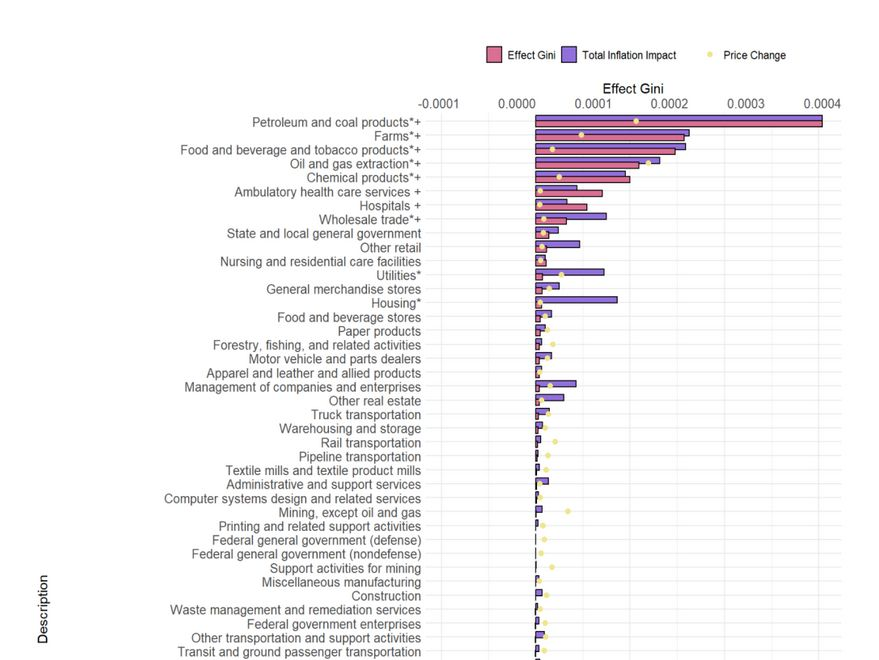
This overlap implies that targeted price stabilization must be studied jointly with inflation and inequality, because shocks to these prices simultaneously raise the price level and regressively redistribute real income. 11/16
The 2021-2022 joint shock to the eight systemically significant sectors raises the Gini coefficient by 0.0023—approximately one full year of the average annual increase in inequality observed during 1980–2021. 12/16
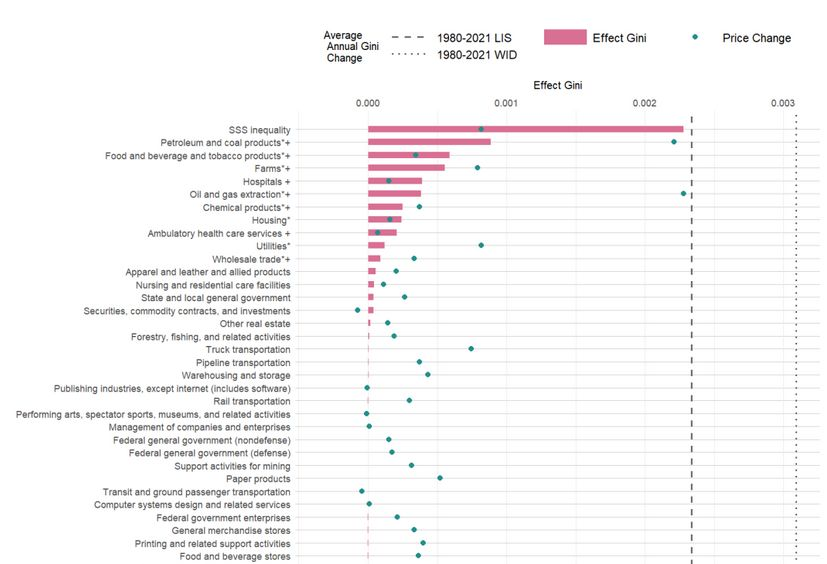
Shocks to petroleum and coal products alone ≈ 1/3 of a yearly inequality increase, while food and agriculture shocks each ≈ 2/3 of that last magnitude, underscoring their disproportionate redistributive capacity. 13/16
These shocks do not simply move the aggregate price level—they reshape the distribution of real income, compressing structural inequality dynamics in a single inflationary episode. 14/16
Interest-rate hikes do little to lower the price of oil or food, yet they raise debt costs and weaken labor markets, amplifying inequality. Using blunt monetary tightening against supply shocks is both inefficient and regressive. 15/16
Macroeconomic stability and the stability of the real income distribution are intertwined. A toolkit based on strategic reserves, supply resilience, and sector-specific price instruments can contain inflation without worsening inequality. 16/16
• • •
Missing some Tweet in this thread? You can try to
force a refresh

“My friends, the world is changing. It's not a question of whether that change will come. It's a question of who will change it.” @ZohranKMamdani
People are choosing real alternatives instead of continuity. Mamdani stands for an antifascist economics in the name of the many. 🧵
His program puts affordability first: a rent freeze on stabilized apartments, construction of 200,000 affordable homes, free buses, universal childcare from 6 weeks to 5 years, & city-run grocery stores in food deserts, funded through higher taxes on millionaires & corporations.
Critics dismiss this as “pie-in-the-sky socialism.” But what they truly object to is something more fundamental: the notion that democratic governments should guarantee people’s basic needs, even if that means intervening in markets.
Germany is facing its deepest economic and democratic crisis in decades. Real wages are down, the far right is rising—and the new government has no plan that speaks to the scale of the challenge. A thread 🧵
Germany’s economy has stalled. After six years of stagnation, real GDP growth has plateaued and is almost ten percent below where it should be. The 2022 energy shock triggered the largest one-year drop in real wages since World War II. 2/10
Despite some gains in 2024, real wages are still eight percent below the pre-pandemic trend. Economic insecurity is fueling political extremism. The far-right AfD just finished second in federal elections—and since jumped to the first rank in some polls. 3/10
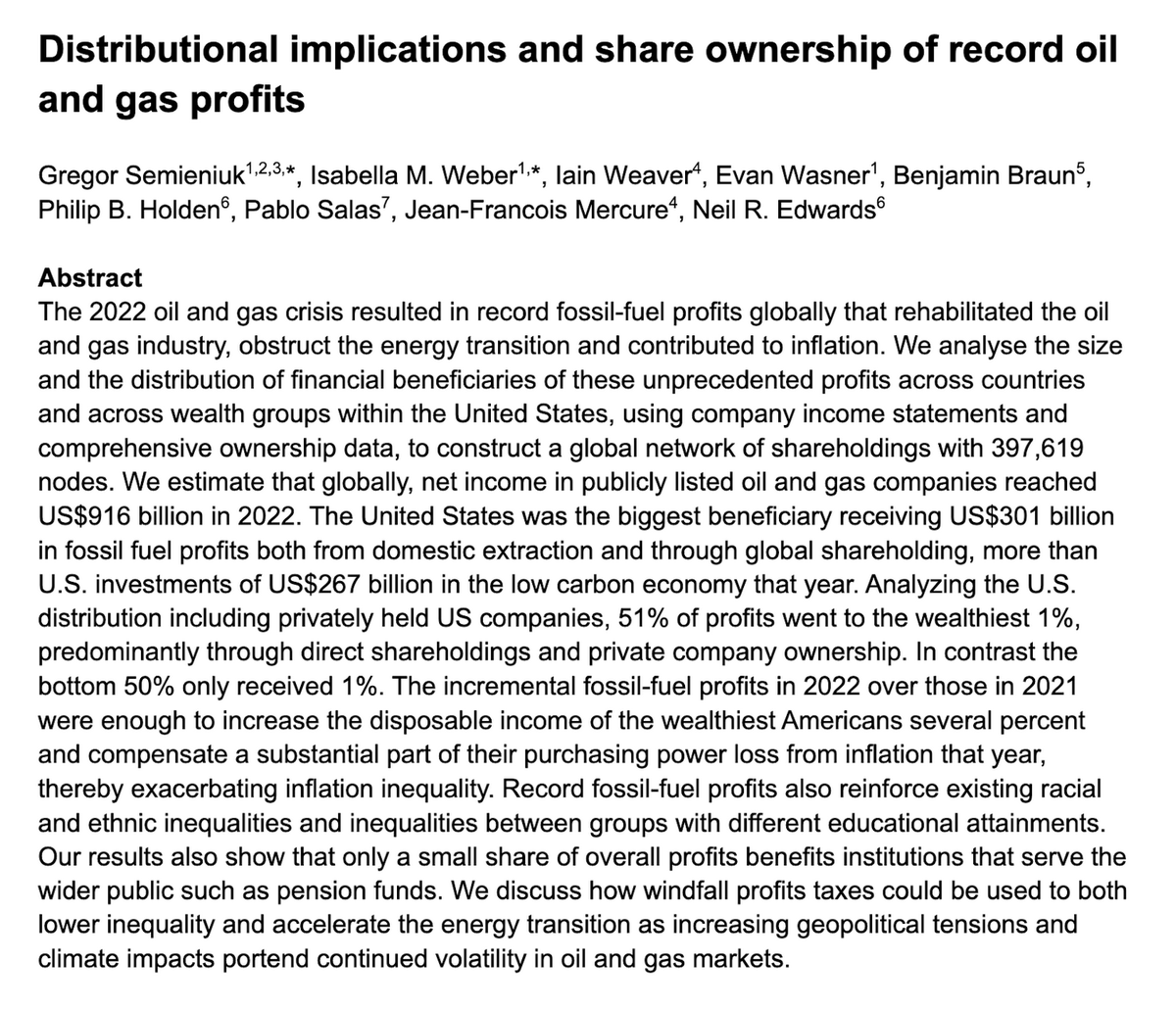
NEW PAPER: The 2022 fossil fuel price jumps caused an oil and gas profit explosion. We show the US reaped the largest profit increase (USD 275bn) of any country. Big Oil claims this benefits the American people. In fact, 51% went to the richest 1%, only 1% to the bottom 50%. A 🧵
This new working paper has been the outcome of an interdisciplinary collaboration with high powered modelers and wonderful colleagues. @GregorSemieniuk @BJMbraun @JFMercure @PabloSalasB Link:
2/ scholarworks.umass.edu/server/api/cor…
@GregorSemieniuk @BJMbraun @JFMercure @PabloSalasB At the height of the global energy crisis in 2022 that threw people around the world into energy poverty, quarterly net profits in stock market-listed oil and gas companies were at a record globally, peaking in quarter 2. 3/
Economic stabilization used to be part of the disaster preparedness toolbox. It is time we add it back in. Just as it was recognized that some banks were too big to fail after the global financial crisis, we have to recognize that some sectors are “too essential to fail.”
In essential sectors, we need to move from a pure efficiency logic to strategic redundancies. This requires policy interventions.
Ports and other critical infrastructure should have spare capacity and a well-paid work force large enough to ramp up activity when needed. 16/
The Strategic Petroleum Reserve, a publicly owned buffer stock, should be employed systematically to buy when prices collapse & sell when prices explode to avoid price extremes. Buffer stocks can operate in commodity markets like central banks in money markets. 17/
Unemployment weakens governments. Inflation kills. The politically destructive power of inflation had been forgotten. Standard policy tools left us unprepared and fueled inequality. The re-election of Trump should serve as a warning to all democrats.
My first @nytopinion. 1/
In this age of emergencies threats to supply chains are becoming commonplace. Each threat brings the risk of inflation & its power to destabilize governments. If we learned anything from last week’s election, it's that we need new means of protecting our society & democracy. 2/
Among the biggest problems that need fixing: Many business sectors today are dominated by large corporations that can profit from these one-time events. 3/
1/ Former President Trump recently called VP Kamala Harris “full communist” for her stance against price gouging. Some economists argue such policies are “not sensible.” This debate isn’t just about politics—it’s about the foundations of economic theory.
2/ The textbook view says prices should adjust freely to balance supply and demand. This idea is so deeply ingrained in economics that real-world facts are often overlooked. Take Furman’s claim that egg prices rose last year to adjust the supply of eggs.