Varsity Profile picture
Dec 9 7 tweets 3 min read Read on X
REITs are often bought for ‘passive income from real estate’ without actually owning the property. We looked at payout data since 2022 to ask: did the income match the yield you’d expect, and did payouts keep rising every year?

Here’s a Varsity explainer, plus the biggest REIT myth.Image
India currently has five publicly listed REITs: Embassy, Brookfield, Mindspace, Nexus Select Trust, and Knowledge Realty Trust. The REIT story in India is still fairly recent; the first public REIT, Embassy Office Parks REIT, was listed only in 2019.

Most Indian REITs are predominantly focused on office spaces. Nexus Select Trust, on the other hand, is primarily retail-focused (shopping malls).
If you’re buying REITs mainly for passive income, here’s what the data from above table suggests:

- Has the income been consistent? Broadly, yes. REITs typically pay distributions quarterly.

- Has the amount you receive grown every year? Not necessarily. You can’t expect it with certainty because vacancies, tenant movement, and costs affect what gets paid out.

- Have distributions kept pace with inflation every year? Maybe over the long run, they could, but not necessarily in every single year. India’s inflation over the last few years has roughly been in the 4% to 6.5% range, and distributions haven’t outpaced inflation year after year consistently. Also, the market is still young, so we need more years of data to conclude this strongly.
Do these observations change dramatically in the future? Mostly, no. The exact rupee amount you receive will vary with your entry price (since that decides how many units you own). But the broader trends observed above will mostly remain the same.
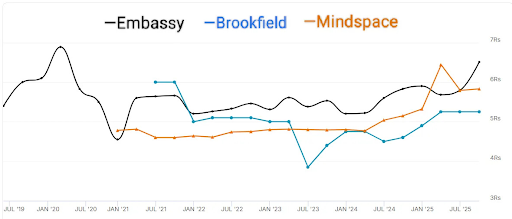
Now, the biggest REIT myth: “Distributions rise every year because commercial rents have escalation clauses."

Sounds logical. But payout data since 2022 doesn’t support it. Some REITs had flat or even lower payouts in certain years. Image
Why so?

- Escalations may kick in only once every 3–5 years

- Tenants leave → vacancies hit cash flows

- Borrowing gets expensive when rates rise

- Maintenance/capex reduces what’s available to distribute

And a couple of other factors.

So expect a regular income stream, but not a guaranteed yearly increase.
And finally, as you know that distributions are only one part of REIT returns. The second part is capital appreciation. Over time, if the underlying buildings become more valuable, the REIT’s portfolio value can rise too. But your realised return also depends on the price you pay in the market.

Our recent Second Order newsletter covered how to assess a REIT and the current state of REITs in India.

zerodhavarsity.substack.com/p/indian-reits…

• • •

Missing some Tweet in this thread? You can try to force a refresh

 

Keep Current with Varsity

Varsity Profile picture

Stay in touch and get notified when new unrolls are available from this author!

Read all threads

This Thread may be Removed Anytime!

PDF

Twitter may remove this content at anytime! Save it as PDF for later use!

Try unrolling a thread yourself!

how to unroll video
  1. Follow @ThreadReaderApp to mention us!

  2. From a Twitter thread mention us with a keyword "unroll"
@threadreaderapp unroll

Practice here first or read more on our help page!

More from @ZerodhaVarsity

Nov 28
India got a C from the IMF.

Many headlines are discussing the C grade India got, but there’s more to it.

We looked at the actual IMF report, and here is a Varsity primer on it. (1/) Image
IMF rates data quality from A to D: A is the highest and D the lowest.
A - data is adequate for surveillance
B- data has some shortcomings, but is broadly adequate
C - data shortcomings could somewhat hamper surveillance
D- serious shortcomings that hamper surveillance (2/)
The ratings are part of the IMF’s report on India’s economy, which expects India’s GDP to grow 6.5% in 2025-26. Growth in private consumption, macroeconomic stability, and the resilience of India’s financial sector are considered key drivers behind the country's GDP growth. (3/) Image
Read 9 tweets
Nov 24
New Labour Codes: How your gratuity, PF, leave encashment and overtime pay may change 👇

The Government has merged 29 labour laws into four Labour Codes. They cover timely salary payments, overtime pay (after 8 hours/day or 48 hours/week), gender equality, minimum wages, and extending key employee benefits to contract workers.

But the change that may impact salaried employees the most is the definition of “wages.” Here’s a Varsity explainer. 🧵Image
Generally, “wages” = basic pay + dearness allowance (DA).

Most companies structure salaries so that (basic + DA) is ~40% of total pay. Some keep it even lower; only few keep it above 50%.

The remaining amount is paid out through a bouquet of allowances: a fixed allowance, a special allowance, a travel/communication allowance, etc.

The new Labour Code indicates:
👉 Basic + DA to be at least 50% of total remuneration. (or such % as may be notified).
What happens if 50% limit applies?

Salary structures will need to be rearranged — allowances may be reduced and basic + DA will rise to meet the 50% floor.

Since many social security benefits (PF, gratuity, etc) are linked to wages, such payouts change.

Let’s take a simple illustration using ‘Gita’, who currently earns ₹1 lakh per month with (basic + DA) currently at 40%. Gita has been with the company for 10 years.
Read 10 tweets
Oct 20
When a bank says your FD rate is 7% (compounded quarterly) and the annualized yield is 7.7%, it sounds like you’re actually earning 7.7% compounded every year. But you’re not.

Here’s a Varsity thread on what you should know about yields shown by banks🧵👇
First, FDs can be of two types:

Cumulative: Interest is reinvested and paid at maturity.

Non-cumulative: Interest is paid out periodically (quarterly, twice a year, etc.)

For cumulative FDs, most banks usually show two numbers - the interest rate and the yield, as shown in the image below.Image
If you invest ₹1 lakh at 7% pa in a cumulative FD, your total interest for the first year isn’t just ₹7,000 (Rs 1lakh*7%). It’s slightly more because of the quarterly compounding most banks offer.

If you notice, the effective rate you earn on an FD annually isn’t immediately intuitive because of quarterly compounding. And you can’t directly compare these FD rates with CAGR or YTM because the latter assumes annual compounding.
Read 8 tweets
Oct 17
Aswath Damodaran called Walmart’s acquisition of Flipkart the most expensive facelift in history.

He said Walmart was an old company trying to look young with Flipkart.

Here’s a Varsity explainer on Damodaran’s views and why Walmart acquired Flipkart.🧵 (1/n)
In the eighteen years of its existence, Flipkart has not delivered a net profit. That is what Damodaran perhaps had an issue with.
But Walmart saw value beyond profits in Flipkart. (2/n)
Flipkart did in India what Amazon did in the US. It prioritized growth over profits, focused on capturing market share before competitors came in, and built customer loyalty through aggressive discounting. (3/n)
Read 11 tweets
Oct 14
Silver is up 82% in 2025. Precious metals usually do not rally so much. The rally happened despite many investors being fearful.

So, we spoke to a few experts to understand what is happening, and here is a Varsity explainer on why Silver is firing on all cylinders. 🧵(1/n) Image
1⃣Besides being a precious metal, Silver’s applications in solar panels, EVs, wind turbines, semiconductors, and advanced electronics have been on the rise. But this has been known for the past few years. Perhaps, something deeper is brewing in the silver markets. (2/n)
2⃣According to the Silver Institute’s World Silver Survey 2025, demand for silver is expected to exceed supply in 2025. The demand has already been outstripping supply for the past four years. (3/n)
Read 12 tweets
Oct 9
Central banks have been blamed for the Great Depression, the 1970s inflation, and the 2008 crisis. So... do we even need them? 🤔
🧵(1/11)
Let's travel back to 1700s Scotland - the wild west of banking. Anyone could set up a bank. No central authority. No one controlling money supply. Just pure competition. And contrary to what you'd expect, it actually worked. Here's how...(2/11)
First concern: "Won't every bank printing its own currency cause inflation?" Not quite. These banknotes were redeemable on demand - if you had a £1 note, the bank had to pay you in gold or silver. This meant banks needed real reserves backing their paper money. (3/11)
Read 11 tweets

Did Thread Reader help you today?

Support us! We are indie developers!


This site is made by just two indie developers on a laptop doing marketing, support and development! Read more about the story.

Become a Premium Member ($3/month or $30/year) and get exclusive features!

Become Premium

Don't want to be a Premium member but still want to support us?

Make a small donation by buying us coffee ($5) or help with server cost ($10)

Donate via Paypal

Or Donate anonymously using crypto!

Ethereum

0xfe58350B80634f60Fa6Dc149a72b4DFbc17D341E copy

Bitcoin

3ATGMxNzCUFzxpMCHL5sWSt4DVtS8UqXpi copy

Thank you for your support!

Follow Us!

:(