Most people have never heard of the National Security Strategy (NSS), but it quietly shapes almost everything America does overseas. Let's break down Trump's 2025 NSS, a thread: 🧵 
If you would like the full, 8500 word article breakdown, please visit my Substack here: open.substack.com/pub/gbnt1952/p…
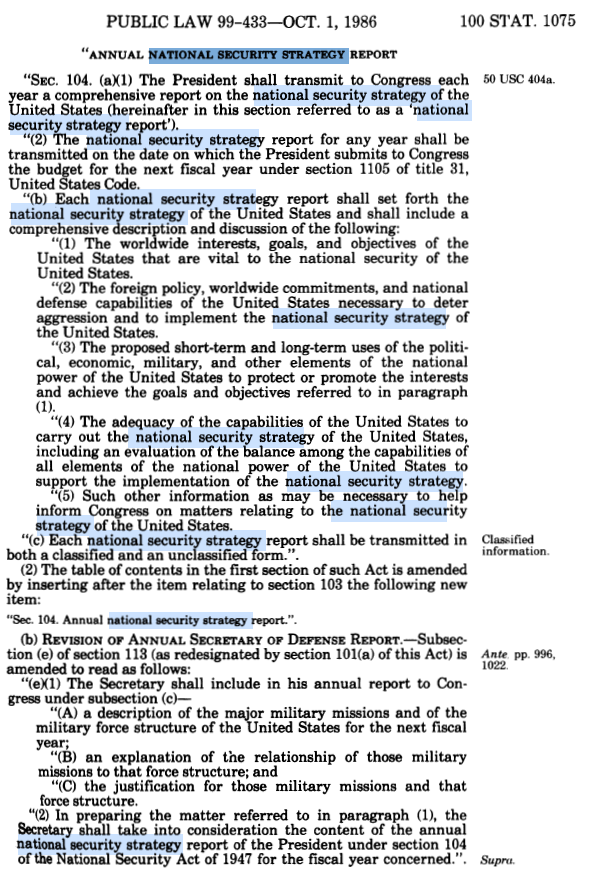
By law, every president has to publish an NSS that explains what our goals are, what threats we face, and how we plan to use our power, military, economic, diplomatic, informational, to protect the country.
Think of it as the “playbook” that tells Congress, the Pentagon, the State Department, and our allies: Here’s what we care about and here’s what we’re going to do.
Trump’s new 2025 NSS puts a very different spin on that playbook compared to the last few presidents. It’s openly “America First,” more focused, and much more skeptical of global institutions and vague global causes.
This thread breaks down what’s in it, what’s new, what’s good, and what might be risky; all in plain English that even a progressive can read.
Think of it as the “playbook” that tells Congress, the Pentagon, the State Department, and our allies: Here’s what we care about and here’s what we’re going to do.
Trump’s new 2025 NSS puts a very different spin on that playbook compared to the last few presidents. It’s openly “America First,” more focused, and much more skeptical of global institutions and vague global causes.
This thread breaks down what’s in it, what’s new, what’s good, and what might be risky; all in plain English that even a progressive can read.
First, what does this NSS say America wants?
At the top of the list: keep the United States alive, free, and sovereign as a constitutional republic.
That means protecting our territory, our people, our economy, and our way of life from attack, terrorism, espionage, propaganda, drug cartels, and foreign manipulation. It also means guarding our borders, controlling who comes in and in what numbers, and ending what the document calls “mass migration.”
The strategy argues that a nation that loses control of its borders eventually loses control of its future.
So, from the start, Trump’s NSS ties national security directly to sovereignty, immigration, and everyday safety at home, not just tanks and aircraft carriers abroad.
At the top of the list: keep the United States alive, free, and sovereign as a constitutional republic.
That means protecting our territory, our people, our economy, and our way of life from attack, terrorism, espionage, propaganda, drug cartels, and foreign manipulation. It also means guarding our borders, controlling who comes in and in what numbers, and ending what the document calls “mass migration.”
The strategy argues that a nation that loses control of its borders eventually loses control of its future.
So, from the start, Trump’s NSS ties national security directly to sovereignty, immigration, and everyday safety at home, not just tanks and aircraft carriers abroad.

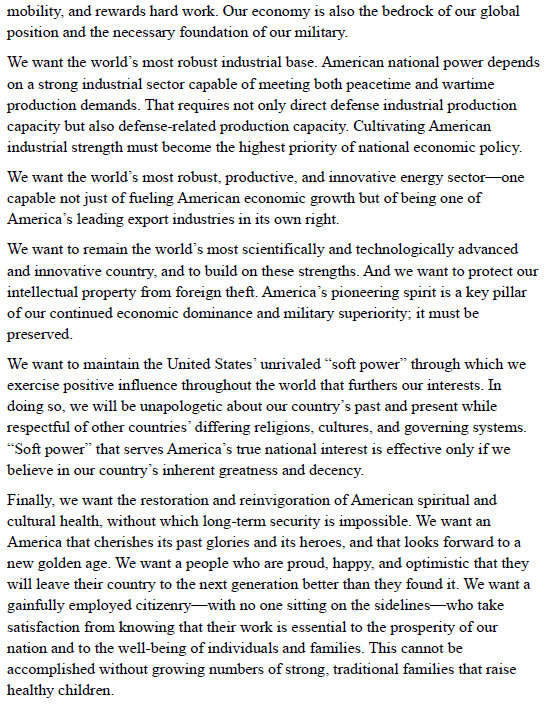
One big theme: “To focus on everything is to focus on nothing.”
Past strategies (Republican and Democrat) treated almost every global issue as a vital U.S. interest: climate, nation-building, global governance, endless humanitarian projects.
Trump’s NSS says that approach made us overextended and unfocused, wasting money and lives on things that don’t actually protect Americans.
Instead, it narrows “national interest” to things that clearly touch U.S. security and prosperity: hostile powers, border security, critical supply chains, key regions, and core allies.
In plain language: stop trying to fix the entire world and concentrate on what actually matters for American citizens.
That’s a major shift in mindset, and it drives everything else in the document.
Past strategies (Republican and Democrat) treated almost every global issue as a vital U.S. interest: climate, nation-building, global governance, endless humanitarian projects.
Trump’s NSS says that approach made us overextended and unfocused, wasting money and lives on things that don’t actually protect Americans.
Instead, it narrows “national interest” to things that clearly touch U.S. security and prosperity: hostile powers, border security, critical supply chains, key regions, and core allies.
In plain language: stop trying to fix the entire world and concentrate on what actually matters for American citizens.
That’s a major shift in mindset, and it drives everything else in the document.

Compared to Biden’s NSS, the differences are sharp.
Biden framed the world as a struggle between “democracies and autocracies,” emphasized climate change as an “existential threat,” and leaned heavily on international institutions and global cooperation.
Trump’s 2025 NSS instead centers on great power competition (especially with China), border control, economic security, and energy dominance.
Climate policy is not treated as a top security priority; in fact, the strategy criticizes “Net Zero” ideas as damaging to Western economies and helping adversaries.
It also puts less weight on global organizations telling the U.S. what to do, and more on each nation handling its own problems.
You can think of it as a shift from “global governance and ideology” to “hard power, borders, and national interest.”
Biden framed the world as a struggle between “democracies and autocracies,” emphasized climate change as an “existential threat,” and leaned heavily on international institutions and global cooperation.
Trump’s 2025 NSS instead centers on great power competition (especially with China), border control, economic security, and energy dominance.
Climate policy is not treated as a top security priority; in fact, the strategy criticizes “Net Zero” ideas as damaging to Western economies and helping adversaries.
It also puts less weight on global organizations telling the U.S. what to do, and more on each nation handling its own problems.
You can think of it as a shift from “global governance and ideology” to “hard power, borders, and national interest.”
The core principles of Trump’s NSS, in everyday terms, look like this:
– Peace through strength: Build overwhelming military and economic power so enemies don’t dare attack.
– High bar for intervention: Don’t send troops or topple governments unless there’s a clear, direct U.S. interest at stake.
– Sovereignty first: The U.S. should not let global bodies or foreign governments overrule our laws, speech, or borders.
– Realism over ideology: We prefer dealing with friendly democracies, but we’ll also work with non-democracies when it serves our interests.
– Pro-worker economics: Trade and foreign policy must help American workers and industry, not just boost abstract GDP numbers or global elites.
– Peace through strength: Build overwhelming military and economic power so enemies don’t dare attack.
– High bar for intervention: Don’t send troops or topple governments unless there’s a clear, direct U.S. interest at stake.
– Sovereignty first: The U.S. should not let global bodies or foreign governments overrule our laws, speech, or borders.
– Realism over ideology: We prefer dealing with friendly democracies, but we’ll also work with non-democracies when it serves our interests.
– Pro-worker economics: Trade and foreign policy must help American workers and industry, not just boost abstract GDP numbers or global elites.


The strategy also makes a big deal out of economic security.
It says you cannot have a strong military if you hollow out your factories, your energy sector, and your middle class.
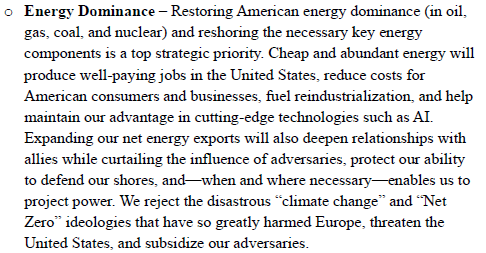
So, it calls for: re-shoring critical industries, protecting supply chains, pushing back on unfair trade (especially from China), and using American oil, gas, and nuclear power as a strength, not something to shut down.
The NSS treats cheap, reliable U.S. energy as a tool to power our economy, support our allies, and weaken authoritarian petrostates. It also wants tight protection for American technology and intellectual property, especially in areas like AI and advanced manufacturing, so rivals can’t steal their way into dominance.
Bottom line: “make stuff here again,” and don’t depend on hostile countries for critical goods.
It says you cannot have a strong military if you hollow out your factories, your energy sector, and your middle class.
So, it calls for: re-shoring critical industries, protecting supply chains, pushing back on unfair trade (especially from China), and using American oil, gas, and nuclear power as a strength, not something to shut down.
The NSS treats cheap, reliable U.S. energy as a tool to power our economy, support our allies, and weaken authoritarian petrostates. It also wants tight protection for American technology and intellectual property, especially in areas like AI and advanced manufacturing, so rivals can’t steal their way into dominance.
Bottom line: “make stuff here again,” and don’t depend on hostile countries for critical goods.


On China, the gloves come off.
The NSS openly says past U.S. policy was wrong to assume that giving China markets and technology would make it “play nice.”
Instead, China became richer and more aggressive, so this strategy aims to rebalance the relationship: fewer dependencies, tougher trade terms, stronger alliances in the Indo-Pacific, and a clear military deterrent around Taiwan and critical sea lanes. It talks about working with India, Japan, South Korea, Australia, and others to build a regional balance of power that China can’t dominate. It also pushes allies to block Chinese control of key infrastructure, ports, and tech, not just in Asia but worldwide.
For Americans, the simple idea is: stop feeding the rise of a strategic rival that openly wants to replace U.S. leadership.
The NSS openly says past U.S. policy was wrong to assume that giving China markets and technology would make it “play nice.”
Instead, China became richer and more aggressive, so this strategy aims to rebalance the relationship: fewer dependencies, tougher trade terms, stronger alliances in the Indo-Pacific, and a clear military deterrent around Taiwan and critical sea lanes. It talks about working with India, Japan, South Korea, Australia, and others to build a regional balance of power that China can’t dominate. It also pushes allies to block Chinese control of key infrastructure, ports, and tech, not just in Asia but worldwide.
For Americans, the simple idea is: stop feeding the rise of a strategic rival that openly wants to replace U.S. leadership.


On Europe, the message is “we’re with you, but you need to grow up.”
The NSS says Europe must take primary responsibility for defending itself, especially as Russia remains a threat and as the war in Ukraine drags on.
It still supports NATO but expects much higher defense spending (it talks about a 5% of GDP benchmark for allies) and less dependence on the U.S. as the “Atlas” holding the world on its shoulders.
On Ukraine, the strategy favors pushing hard for a negotiated end to the war rather than an open-ended “as long as it takes” approach. The logic is: end the war, prevent escalation, help Ukraine survive, and free up resources to deal with China and other priorities.
Conservatives will see this as pragmatic; critics will worry about rewarding Russian aggression. The NSS clearly leans toward fast, hard diplomacy over endless war.
The NSS says Europe must take primary responsibility for defending itself, especially as Russia remains a threat and as the war in Ukraine drags on.
It still supports NATO but expects much higher defense spending (it talks about a 5% of GDP benchmark for allies) and less dependence on the U.S. as the “Atlas” holding the world on its shoulders.
On Ukraine, the strategy favors pushing hard for a negotiated end to the war rather than an open-ended “as long as it takes” approach. The logic is: end the war, prevent escalation, help Ukraine survive, and free up resources to deal with China and other priorities.
Conservatives will see this as pragmatic; critics will worry about rewarding Russian aggression. The NSS clearly leans toward fast, hard diplomacy over endless war.


In the Middle East, Trump’s NSS is very different from the old “democracy-promotion” playbook.
It highlights the Abraham Accords and other peace deals as the model: get countries (especially Arab states and Israel) to normalize relations and cooperate against common threats like Iran and terrorism. It says the U.S. will support partners, protect Israel, prevent Iran from going nuclear, and crush terrorist networks, but avoid new long, open ended military occupations.
It also stresses working with countries “as they are,” instead of trying to force American style systems on them. In simple terms: fewer regime change adventures, more deals, and hard security cooperation, with the U.S. as a peace-broker and arsenal, not a permanent occupying force.
For Americans who are tired of Middle East wars, that’s a big shift.
It highlights the Abraham Accords and other peace deals as the model: get countries (especially Arab states and Israel) to normalize relations and cooperate against common threats like Iran and terrorism. It says the U.S. will support partners, protect Israel, prevent Iran from going nuclear, and crush terrorist networks, but avoid new long, open ended military occupations.
It also stresses working with countries “as they are,” instead of trying to force American style systems on them. In simple terms: fewer regime change adventures, more deals, and hard security cooperation, with the U.S. as a peace-broker and arsenal, not a permanent occupying force.
For Americans who are tired of Middle East wars, that’s a big shift.


Closer to home, the Western Hemisphere gets special attention.
The strategy revives a tougher version of the old Monroe Doctrine: no hostile outside power (like China or Russia) should be allowed to gain military footholds or control key assets in our backyard. That includes ports, telecom networks, critical minerals, and political influence bought through debt and corruption.
It also connects this to the border: weak states in our neighborhood plus cartels and mass migration = direct threats to U.S. security. So, the NSS calls for more focus on Latin America and the Caribbean, not as charity projects, but as vital to homeland defense and economic security.
Think: secure hemisphere, secure border, less room for adversaries to operate near us.
The strategy revives a tougher version of the old Monroe Doctrine: no hostile outside power (like China or Russia) should be allowed to gain military footholds or control key assets in our backyard. That includes ports, telecom networks, critical minerals, and political influence bought through debt and corruption.
It also connects this to the border: weak states in our neighborhood plus cartels and mass migration = direct threats to U.S. security. So, the NSS calls for more focus on Latin America and the Caribbean, not as charity projects, but as vital to homeland defense and economic security.
Think: secure hemisphere, secure border, less room for adversaries to operate near us.


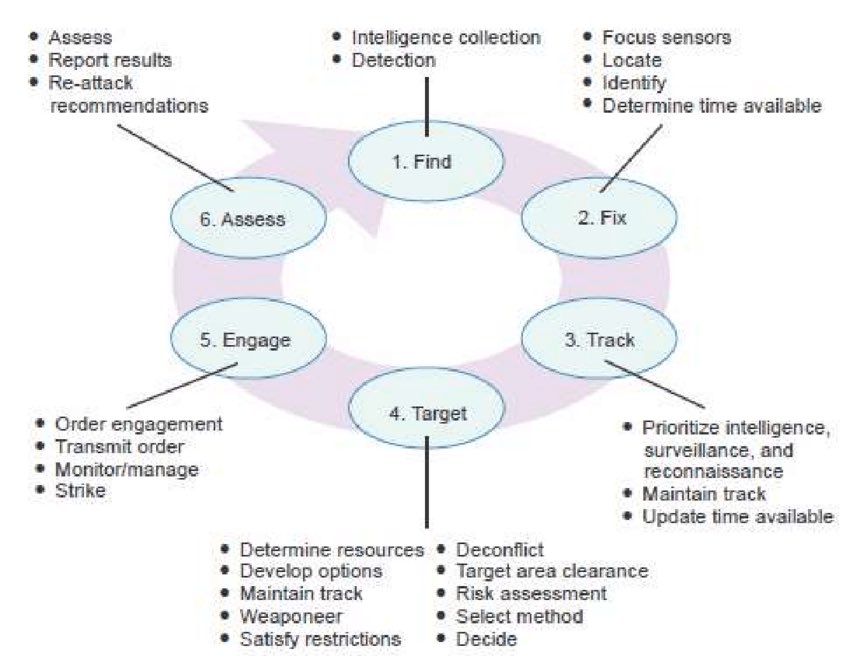
Two big, cross cutting ideas in this NSS come straight out of the modern military and intel world: information warfare and unconventional threats.
The strategy warns about foreign propaganda, influence operations, and cultural subversion; attempts to divide Americans, censor viewpoints, and twist our politics from the outside. It lines up with doctrine (like Joint Publication 3-13) that treats the information space as a battlefield: adversaries will use media, social platforms, bots, and narratives the same way they use missiles and spies.
The NSS says the U.S. will push back hard against foreign censorship, disinformation, and attempts to buy or bully our institutions. At the same time, it talks about dealing with irregular threats like terrorists, cartels, and proxies by working with partners, using special operations and targeted force, not just big conventional wars.
In short: it recognizes that modern conflict is as much about data, stories, and proxies as it is about tanks and planes.
The strategy warns about foreign propaganda, influence operations, and cultural subversion; attempts to divide Americans, censor viewpoints, and twist our politics from the outside. It lines up with doctrine (like Joint Publication 3-13) that treats the information space as a battlefield: adversaries will use media, social platforms, bots, and narratives the same way they use missiles and spies.
The NSS says the U.S. will push back hard against foreign censorship, disinformation, and attempts to buy or bully our institutions. At the same time, it talks about dealing with irregular threats like terrorists, cartels, and proxies by working with partners, using special operations and targeted force, not just big conventional wars.
In short: it recognizes that modern conflict is as much about data, stories, and proxies as it is about tanks and planes.


From a Constitutional Conservative perspective, there’s a lot to like.
It openly ties national security to the Constitution: protecting free speech, religious liberty, and fair elections from both foreign enemies and abusive use of government power.
It rejects the idea that agencies can use “security” as an excuse to censor Americans or crush political opposition.
It focuses on core duties: defend the homeland, secure the border, deter enemies, avoid unnecessary wars, and preserve the Republic’s independence.
It sees economic strength, energy independence, and a strong middle class as pillars of security, not side issues.
And it aims for peace, but through strength, not through wishful thinking.
It openly ties national security to the Constitution: protecting free speech, religious liberty, and fair elections from both foreign enemies and abusive use of government power.
It rejects the idea that agencies can use “security” as an excuse to censor Americans or crush political opposition.
It focuses on core duties: defend the homeland, secure the border, deter enemies, avoid unnecessary wars, and preserve the Republic’s independence.
It sees economic strength, energy independence, and a strong middle class as pillars of security, not side issues.
And it aims for peace, but through strength, not through wishful thinking.

There are also real challenges and risks.
Pushing allies hard on money and burden-sharing could strain relationships if it’s handled clumsily.
Relying heavily on “deal-making” and fast peace agreements might overestimate how quickly deep conflicts can actually be settled.
And the wish list is huge: missile shields, reindustrialization, total border control, energy dominance, alliance reform; all of that takes time, money, and a lot of competence in government.
Even if the strategy is sound, implementation will be a grind and will face political resistance at home and abroad.
Pushing allies hard on money and burden-sharing could strain relationships if it’s handled clumsily.
Relying heavily on “deal-making” and fast peace agreements might overestimate how quickly deep conflicts can actually be settled.
And the wish list is huge: missile shields, reindustrialization, total border control, energy dominance, alliance reform; all of that takes time, money, and a lot of competence in government.
Even if the strategy is sound, implementation will be a grind and will face political resistance at home and abroad.

So, what does Trump’s 2025 NSS really mean for regular Americans?
It means the U.S. intends to prioritize your safety, your job, your border, and your freedoms over abstract global projects.
It means fewer promises to reshape the world, and more effort to rebuild strength at home and deter serious enemies abroad.
It means we will still have allies and partnerships, but on fairer terms, and with the U.S. as a strong leader, not an exhausted babysitter.
From a constitutional conservative angle, it’s a long overdue reset: back to sovereignty, realism, and peace through strength.
Also, ignore the noise of some of the things that were left out. One of the priorities of this NSS was to cut down to the core issues of most importance, so it not mentioning the Philippines or some other international entanglement does not mean that it is not a priority at some level, it just means it's not a priority at this level for this document.
Whether you agree or disagree, this NSS is a clear statement of how Trump’s team believes America should move in a very dangerous world, and that’s exactly the kind of thing citizens should be paying attention to.
It means the U.S. intends to prioritize your safety, your job, your border, and your freedoms over abstract global projects.
It means fewer promises to reshape the world, and more effort to rebuild strength at home and deter serious enemies abroad.
It means we will still have allies and partnerships, but on fairer terms, and with the U.S. as a strong leader, not an exhausted babysitter.
From a constitutional conservative angle, it’s a long overdue reset: back to sovereignty, realism, and peace through strength.
Also, ignore the noise of some of the things that were left out. One of the priorities of this NSS was to cut down to the core issues of most importance, so it not mentioning the Philippines or some other international entanglement does not mean that it is not a priority at some level, it just means it's not a priority at this level for this document.
Whether you agree or disagree, this NSS is a clear statement of how Trump’s team believes America should move in a very dangerous world, and that’s exactly the kind of thing citizens should be paying attention to.
• • •
Missing some Tweet in this thread? You can try to
force a refresh