Aaron Siri says no one has identified errors in his ACIP presentation. Here are several, with citations to the primary literature. 🧵
https://twitter.com/AaronSiriSG/status/1998415514234704277
1/ THE CORE TRICK
When Siri claims a vaccine was "never tested against a placebo," he's relying on a narrow legal definition: that the specific trial submitted for the current U.S. license used an active comparator rather than saline.
He's auditing regulatory paperwork. Not science.
He systematically omits foundational placebo-controlled trials that established the safety of the antigen. Trials conducted before the current product's U.S. licensure, trials run in other countries, and trials published in journals but not listed in a specific FDA filing.
The science exists. He's looking at the wrong documents.
When Siri claims a vaccine was "never tested against a placebo," he's relying on a narrow legal definition: that the specific trial submitted for the current U.S. license used an active comparator rather than saline.
He's auditing regulatory paperwork. Not science.
He systematically omits foundational placebo-controlled trials that established the safety of the antigen. Trials conducted before the current product's U.S. licensure, trials run in other countries, and trials published in journals but not listed in a specific FDA filing.
The science exists. He's looking at the wrong documents.
2/
Regulatory submissions are administrative records for a specific commercial approval. The scientific evidence base is far larger, spanning decades of research across dozens of countries.
Conflating the two is the core sleight of hand. It's the same technique RFK Jr. uses. Both treat FDA package inserts as if they contain the sum total of vaccine safety evidence. They do not.
Regulatory submissions are administrative records for a specific commercial approval. The scientific evidence base is far larger, spanning decades of research across dozens of countries.
Conflating the two is the core sleight of hand. It's the same technique RFK Jr. uses. Both treat FDA package inserts as if they contain the sum total of vaccine safety evidence. They do not.
3/ HEPATITIS B
Claim: Hep B vaccines were licensed based on "uncontrolled trials" with safety monitored for only "4-5 days."
False. The safety of Hepatitis B vaccination is established by numerous placebo-controlled RCTs with follow-up measured in years, not days. Here are three:
Wong et al. (Lancet, 1984): Randomized, double-blind, placebo-controlled trial in Hong Kong newborns. Placebo was 0.66 mg aluminum phosphate in 1 ml physiological saline. Follow-up: 12-24 months. "No serious side-effects" attributable to vaccination. The placebo group had a 73.2% chronic carrier rate. The vaccine reduced this to 2.9%. pubmed.ncbi.nlm.nih.gov/6143868/
Claim: Hep B vaccines were licensed based on "uncontrolled trials" with safety monitored for only "4-5 days."
False. The safety of Hepatitis B vaccination is established by numerous placebo-controlled RCTs with follow-up measured in years, not days. Here are three:
Wong et al. (Lancet, 1984): Randomized, double-blind, placebo-controlled trial in Hong Kong newborns. Placebo was 0.66 mg aluminum phosphate in 1 ml physiological saline. Follow-up: 12-24 months. "No serious side-effects" attributable to vaccination. The placebo group had a 73.2% chronic carrier rate. The vaccine reduced this to 2.9%. pubmed.ncbi.nlm.nih.gov/6143868/
4/
Szmuness et al. (NEJM, 1980): 1,083 subjects randomized to vaccine or placebo. Placebo was alum in vaccine diluent, visually indistinguishable from the vaccine. Follow-up: 24-30 months for clinical hepatitis and serologic events. Side effects: 24.3% vaccine vs 21.4% placebo. No significant difference. Efficacy: 92%.
This is not "4-5 days." This is two and a half years of follow-up in a randomized, blinded trial. pubmed.ncbi.nlm.nih.gov/6997738/
Francis et al. (Ann Intern Med, 1982): 1,402 participants randomized to vaccine or placebo containing all vaccine constituents minus the HBsAg protein. "Essentially free of side effects." Between months 3 and 15: 56 HBV events in placebo vs 11 in vaccine.
pubmed.ncbi.nlm.nih.gov/6810736/
Szmuness et al. (NEJM, 1980): 1,083 subjects randomized to vaccine or placebo. Placebo was alum in vaccine diluent, visually indistinguishable from the vaccine. Follow-up: 24-30 months for clinical hepatitis and serologic events. Side effects: 24.3% vaccine vs 21.4% placebo. No significant difference. Efficacy: 92%.
This is not "4-5 days." This is two and a half years of follow-up in a randomized, blinded trial. pubmed.ncbi.nlm.nih.gov/6997738/
Francis et al. (Ann Intern Med, 1982): 1,402 participants randomized to vaccine or placebo containing all vaccine constituents minus the HBsAg protein. "Essentially free of side effects." Between months 3 and 15: 56 HBV events in placebo vs 11 in vaccine.
pubmed.ncbi.nlm.nih.gov/6810736/
5/
The National Academies documented over 50 placebo-controlled trials of plasma-derived Hep B vaccine alone, involving over 100,000 participants.
So why does the insert Siri cites show only 147 infants? Because that trial was a bridging study for a new recombinant formulation, demonstrating equivalence to vaccines already proven safe in the trials above.
Siri is auditing the bridge, and ignoring the foundation it connects to.
The National Academies documented over 50 placebo-controlled trials of plasma-derived Hep B vaccine alone, involving over 100,000 participants.
So why does the insert Siri cites show only 147 infants? Because that trial was a bridging study for a new recombinant formulation, demonstrating equivalence to vaccines already proven safe in the trials above.
Siri is auditing the bridge, and ignoring the foundation it connects to.
6/
Why no new placebo trials in infants today? In the Wong trial, 73% of placebo recipients became chronic carriers. Once efficacy was proven, withholding the vaccine became unethical.
Since universal infant vaccination began in 1991, acute Hep B in U.S. children has declined 99%. The vaccine works. The trials proved it. The disease data confirm it.
Why no new placebo trials in infants today? In the Wong trial, 73% of placebo recipients became chronic carriers. Once efficacy was proven, withholding the vaccine became unethical.
Since universal infant vaccination began in 1991, acute Hep B in U.S. children has declined 99%. The vaccine works. The trials proved it. The disease data confirm it.
7/ PNEUMOCOCCAL
Claim: PCV13 was tested against PCV7, a "chain of controls" with no true baseline.
This audits the U.S. licensure filing for one product while ignoring the foundational science. Pneumococcal conjugate vaccines were tested in large placebo-controlled trials, including some of the biggest pediatric RCTs ever run:
Cutts et al. (Lancet, 2005): 17,437 Gambian infants randomized to 9-valent PCV or placebo with no pneumococcal antigens. Follow-up: ~2 years. Results: 77% efficacy against vaccine-type invasive disease, 16% reduction in all-cause mortality. SAEs: 110 vaccine vs 131 placebo. Fewer serious adverse events in the vaccinated group. pubmed.ncbi.nlm.nih.gov/15794968/
Claim: PCV13 was tested against PCV7, a "chain of controls" with no true baseline.
This audits the U.S. licensure filing for one product while ignoring the foundational science. Pneumococcal conjugate vaccines were tested in large placebo-controlled trials, including some of the biggest pediatric RCTs ever run:
Cutts et al. (Lancet, 2005): 17,437 Gambian infants randomized to 9-valent PCV or placebo with no pneumococcal antigens. Follow-up: ~2 years. Results: 77% efficacy against vaccine-type invasive disease, 16% reduction in all-cause mortality. SAEs: 110 vaccine vs 131 placebo. Fewer serious adverse events in the vaccinated group. pubmed.ncbi.nlm.nih.gov/15794968/
8/
Lucero et al. (2009): 12,191 Filipino infants randomized to 11-valent PCV or placebo. Placebo: 0.83% sodium chloride buffered with phosphate. Saline. SAE rates were similar between groups.
This trial exists. It is indexed in PubMed. It used saline. It directly refutes the claim that pneumococcal vaccines were "never tested against saline." pubmed.ncbi.nlm.nih.gov/19483514/
Klugman et al. (NEJM, 2003): 39,836 South African infants randomized to PCV or placebo. "The incidence of serious adverse events was similar in the two groups." 83% efficacy against vaccine-type invasive disease.
pubmed.ncbi.nlm.nih.gov/14523142/
Lucero et al. (2009): 12,191 Filipino infants randomized to 11-valent PCV or placebo. Placebo: 0.83% sodium chloride buffered with phosphate. Saline. SAE rates were similar between groups.
This trial exists. It is indexed in PubMed. It used saline. It directly refutes the claim that pneumococcal vaccines were "never tested against saline." pubmed.ncbi.nlm.nih.gov/19483514/
Klugman et al. (NEJM, 2003): 39,836 South African infants randomized to PCV or placebo. "The incidence of serious adverse events was similar in the two groups." 83% efficacy against vaccine-type invasive disease.
pubmed.ncbi.nlm.nih.gov/14523142/
9/ DTaP
Claim: DTaP was tested against whole-cell DTP rather than saline.
This ignores the component isolation trials. To test the pertussis component, researchers compared DTaP to DT (diphtheria-tetanus without pertussis). Both arms received D and T protection; only DTaP received pertussis. DT serves as the placebo for the pertussis antigen. This is how you isolate the safety signal of a single component.
Gustafsson et al. (NEJM, 1996): 9,829 Swedish infants randomized to DTaP, whole-cell DTP, or DT control. "The rates of adverse events were similar for the acellular vaccines and the control DT vaccine." Whole-cell caused significantly more fever and local reactions. pubmed.ncbi.nlm.nih.gov/8538705/
Claim: DTaP was tested against whole-cell DTP rather than saline.
This ignores the component isolation trials. To test the pertussis component, researchers compared DTaP to DT (diphtheria-tetanus without pertussis). Both arms received D and T protection; only DTaP received pertussis. DT serves as the placebo for the pertussis antigen. This is how you isolate the safety signal of a single component.
Gustafsson et al. (NEJM, 1996): 9,829 Swedish infants randomized to DTaP, whole-cell DTP, or DT control. "The rates of adverse events were similar for the acellular vaccines and the control DT vaccine." Whole-cell caused significantly more fever and local reactions. pubmed.ncbi.nlm.nih.gov/8538705/
10/
Greco et al. (NEJM, 1996): 15,601 Italian infants. Fever >40.5°C: 0.8% DTaP vs 1.3% DT vs 6.8% whole-cell DTP.
We switched from whole-cell to acellular pertussis because the trials showed DTaP was safer and still effective. DTaP reduced high fever by ~90% compared to whole-cell. Comparing DTaP to DTP wasn't hiding harm. It was proving superiority. pubmed.ncbi.nlm.nih.gov/8538704/
Between the Swedish and Italian trials alone, over 25,000 infants were enrolled in controlled studies of DTaP.
Greco et al. (NEJM, 1996): 15,601 Italian infants. Fever >40.5°C: 0.8% DTaP vs 1.3% DT vs 6.8% whole-cell DTP.
We switched from whole-cell to acellular pertussis because the trials showed DTaP was safer and still effective. DTaP reduced high fever by ~90% compared to whole-cell. Comparing DTaP to DTP wasn't hiding harm. It was proving superiority. pubmed.ncbi.nlm.nih.gov/8538704/
Between the Swedish and Italian trials alone, over 25,000 infants were enrolled in controlled studies of DTaP.
11/ OTHER ANTIGENS
The pattern holds across the schedule. Here are examples of placebo-controlled trials for other antigens:
Polio: Francis Field Trial (1954). 400,000+ children. Placebo was Medium 199 (cell culture fluid without virus). 71% efficacy in placebo-controlled arm. One of the largest RCTs in history.
Hib: Ward et al. (1990). Saline placebo.
Varicella: Weibel (1984), vehicle placebo. Huang (2024), saline.
Hep A: Werzberger (1992). 1,037 children in Monroe, NY. 0 cases vaccine vs 34 placebo.
The pattern holds across the schedule. Here are examples of placebo-controlled trials for other antigens:
Polio: Francis Field Trial (1954). 400,000+ children. Placebo was Medium 199 (cell culture fluid without virus). 71% efficacy in placebo-controlled arm. One of the largest RCTs in history.
Hib: Ward et al. (1990). Saline placebo.
Varicella: Weibel (1984), vehicle placebo. Huang (2024), saline.
Hep A: Werzberger (1992). 1,037 children in Monroe, NY. 0 cases vaccine vs 34 placebo.
12/
HPV: Reisinger (2007). 1,781 children aged 9-15 randomized to Gardasil or saline placebo. Fever and systemic SAE rates similar between groups.
This trial exists. It is indexed in PubMed. It used saline. pubmed.ncbi.nlm.nih.gov/17484215/
Rotavirus: Ruiz-Palacios (2006), 63,225 infants. Vesikari (2006), 68,038 infants. SAEs monitored for one year. Over 131,000 infants in placebo-controlled trials with extended follow-up. For one vaccine.
Influenza: Cowling (2012), Pepin (2019). Saline placebos.
Meningococcal: Gasparini (2010), Halperin (2010). Saline placebos.
HPV: Reisinger (2007). 1,781 children aged 9-15 randomized to Gardasil or saline placebo. Fever and systemic SAE rates similar between groups.
This trial exists. It is indexed in PubMed. It used saline. pubmed.ncbi.nlm.nih.gov/17484215/
Rotavirus: Ruiz-Palacios (2006), 63,225 infants. Vesikari (2006), 68,038 infants. SAEs monitored for one year. Over 131,000 infants in placebo-controlled trials with extended follow-up. For one vaccine.
Influenza: Cowling (2012), Pepin (2019). Saline placebos.
Meningococcal: Gasparini (2010), Halperin (2010). Saline placebos.
13/ VARICELLA AND NEOMYCIN
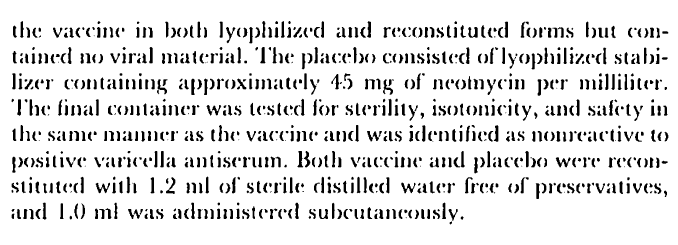
Siri highlights a 1984 varicella trial where the placebo contained neomycin.
First: the paper lists "45 mg per milliliter." This must be a typo. Modern Varivax contains trace quantities (<25 μg). Same manufacturer, same process. The published unit is off by a factor of >1,000. (I'll send @NEJM about the erratum.)
Second: our database classifies neomycin-containing placebos as excipient controls, not inert comparators. That was always the methodology, even though trace neomycin at these doses is clinically benign.
Third: Siri's argument still backfires. The study used toxicological isolation. Vaccine: virus + stabilizer + trace neomycin. Placebo: stabilizer + trace neomycin. If the excipients caused harm, the placebo group would show it. They didn't. The only significant difference was minor local reactions in the vaccine group, attributable to the live virus.
nejm.org/doi/abs/10.105…
Siri highlights a 1984 varicella trial where the placebo contained neomycin.
First: the paper lists "45 mg per milliliter." This must be a typo. Modern Varivax contains trace quantities (<25 μg). Same manufacturer, same process. The published unit is off by a factor of >1,000. (I'll send @NEJM about the erratum.)
Second: our database classifies neomycin-containing placebos as excipient controls, not inert comparators. That was always the methodology, even though trace neomycin at these doses is clinically benign.
Third: Siri's argument still backfires. The study used toxicological isolation. Vaccine: virus + stabilizer + trace neomycin. Placebo: stabilizer + trace neomycin. If the excipients caused harm, the placebo group would show it. They didn't. The only significant difference was minor local reactions in the vaccine group, attributable to the live virus.
nejm.org/doi/abs/10.105…
14/ SAFETY MONITORING
Claim: Safety reviewed for only "4-5 days."
Each trial actually has two monitoring windows. Solicited events (fever, soreness, injection site reactions) are recorded on diary cards for 4-7 days. Serious adverse events are monitored for months to years. Siri cites the diary card period and ignores the SAE data in the same documents.
From the package inserts: Prevnar 20 monitored SAEs for 6 months. Gardasil 9 monitored SAEs for up to 4 years. RotaTeq monitored SAEs for 1 year. The Szmuness Hep B trial monitored participants for 30 months.
That's not "4-5 days."
Claim: Safety reviewed for only "4-5 days."
Each trial actually has two monitoring windows. Solicited events (fever, soreness, injection site reactions) are recorded on diary cards for 4-7 days. Serious adverse events are monitored for months to years. Siri cites the diary card period and ignores the SAE data in the same documents.
From the package inserts: Prevnar 20 monitored SAEs for 6 months. Gardasil 9 monitored SAEs for up to 4 years. RotaTeq monitored SAEs for 1 year. The Szmuness Hep B trial monitored participants for 30 months.
That's not "4-5 days."
15/ COMMON CLAIMS
Claim: The schedule "exploded" from 3 vaccines to 70+ doses, overwhelming immune systems.
This confuses injections with antigens. The 1980 whole-cell pertussis vaccine contained ~3,000 bacterial proteins per dose. Today's entire schedule contains fewer than 200 antigens to prevent 16+ diseases. More protection, a fraction of the immunological challenge. pubmed.ncbi.nlm.nih.gov/11773551/
Claim: Mortality dropped before vaccines, so sanitation saved us.
This conflates death with disease. Better hospitals reduced polio deaths, but paralysis stayed high until the Salk vaccine. Before measles vaccine, 400-500 Americans died annually but 48,000 were hospitalized. Vaccines didn't just stop death. They stopped paralysis, deafness, brain damage.
Claim: The schedule "exploded" from 3 vaccines to 70+ doses, overwhelming immune systems.
This confuses injections with antigens. The 1980 whole-cell pertussis vaccine contained ~3,000 bacterial proteins per dose. Today's entire schedule contains fewer than 200 antigens to prevent 16+ diseases. More protection, a fraction of the immunological challenge. pubmed.ncbi.nlm.nih.gov/11773551/
Claim: Mortality dropped before vaccines, so sanitation saved us.
This conflates death with disease. Better hospitals reduced polio deaths, but paralysis stayed high until the Salk vaccine. Before measles vaccine, 400-500 Americans died annually but 48,000 were hospitalized. Vaccines didn't just stop death. They stopped paralysis, deafness, brain damage.
16/ THE "VAXXED VS UNVAXXED" STUDY
Claim: We need an RCT of fully vaccinated vs completely unvaccinated children.
To run this study, you'd randomly assign thousands of infants to receive no protection against measles, polio, or tetanus. No IRB would approve it. You cannot ethically assign children to a group designed to leave them vulnerable to deadly diseases.
The demand is the trick: ask for something unethical, then claim its absence proves vaccines are untested.
Claim: We need an RCT of fully vaccinated vs completely unvaccinated children.
To run this study, you'd randomly assign thousands of infants to receive no protection against measles, polio, or tetanus. No IRB would approve it. You cannot ethically assign children to a group designed to leave them vulnerable to deadly diseases.
The demand is the trick: ask for something unethical, then claim its absence proves vaccines are untested.
17/ THE 1986 ACT AND ETHICS
Claim: Manufacturers have no liability.
The 1986 Act created the safety infrastructure Siri uses to attack vaccines. It established VAERS and the Vaccine Injury Compensation Program, which has paid approximately $4.5 billion to families. The system catches rare harms and compensates for them.
Before 1986, lawsuits threatened vaccine supply. For every $1 earned on DTP, companies spent $11 on legal defense. Congress intervened to preserve the supply, not hide harm. Manufacturers still face liability for defects and failure to warn.
Once a vaccine is proven effective, it becomes the standard of care. Under the Declaration of Helsinki, new interventions must be tested against the best current proven treatment. If researchers followed Siri's demand and gave a control group saline instead of DTaP, and a child died of whooping cough, those researchers would be guilty of gross negligence. We don't sacrifice children to satisfy a lawyer's demand for "new" data.
Claim: Manufacturers have no liability.
The 1986 Act created the safety infrastructure Siri uses to attack vaccines. It established VAERS and the Vaccine Injury Compensation Program, which has paid approximately $4.5 billion to families. The system catches rare harms and compensates for them.
Before 1986, lawsuits threatened vaccine supply. For every $1 earned on DTP, companies spent $11 on legal defense. Congress intervened to preserve the supply, not hide harm. Manufacturers still face liability for defects and failure to warn.
Once a vaccine is proven effective, it becomes the standard of care. Under the Declaration of Helsinki, new interventions must be tested against the best current proven treatment. If researchers followed Siri's demand and gave a control group saline instead of DTaP, and a child died of whooping cough, those researchers would be guilty of gross negligence. We don't sacrifice children to satisfy a lawyer's demand for "new" data.
18/ HOW SIRI DISMISSES EVIDENCE
When shown placebo-controlled trials, he employs predictable tactics:
Tactic 1: Narrow the scope. He restricts "valid evidence" to only trials in FDA package inserts, excluding post-licensure studies, international trials, and the broader peer-reviewed literature.
Tactic 2: Attack definitions. When shown inert placebos, he calls the classifications "fast and loose."
This is not scientific discourse. This is cross-examination.
Tactic 3: Demand the impossible trifecta. He insists a single trial must have (1) saline placebo, (2) years of follow-up, and (3) power to detect rare events. He explicitly says "it needs all three."
No single trial can do all three. Power comes from large samples. Long-term safety comes from post-market surveillance. Placebo controls come from pre-licensure efficacy trials. By demanding one trial do everything, he can dismiss the entire body of evidence.
When shown placebo-controlled trials, he employs predictable tactics:
Tactic 1: Narrow the scope. He restricts "valid evidence" to only trials in FDA package inserts, excluding post-licensure studies, international trials, and the broader peer-reviewed literature.
Tactic 2: Attack definitions. When shown inert placebos, he calls the classifications "fast and loose."
This is not scientific discourse. This is cross-examination.
Tactic 3: Demand the impossible trifecta. He insists a single trial must have (1) saline placebo, (2) years of follow-up, and (3) power to detect rare events. He explicitly says "it needs all three."
No single trial can do all three. Power comes from large samples. Long-term safety comes from post-market surveillance. Placebo controls come from pre-licensure efficacy trials. By demanding one trial do everything, he can dismiss the entire body of evidence.
19/ ANTICIPATED OBJECTIONS
"That placebo contained aluminum." Some trials used adjuvant placebos to isolate the antigen. Others used saline. Both are valid designs depending on the research question. Lucero (2009) used 0.83% NaCl. Reisinger (2007) used saline.
"That wasn't in children." Wong enrolled newborns. Cutts enrolled infants 6-51 weeks. The Sweden and Italy trials enrolled 25,000 infants combined.
"Those weren't American children." Biology doesn't change at borders. FDA regulations (21 CFR § 312.120) permit foreign trial data for U.S. licensure. Sample sizes in these trials (17,437... 39,836... 63,225... 68,038) are among the largest RCTs in medical history.
"Lancet and NEJM are pharma-funded." If you disqualify those journals, you disqualify evidence-based medicine, including any study cited to claim vaccine harms.
"That placebo contained aluminum." Some trials used adjuvant placebos to isolate the antigen. Others used saline. Both are valid designs depending on the research question. Lucero (2009) used 0.83% NaCl. Reisinger (2007) used saline.
"That wasn't in children." Wong enrolled newborns. Cutts enrolled infants 6-51 weeks. The Sweden and Italy trials enrolled 25,000 infants combined.
"Those weren't American children." Biology doesn't change at borders. FDA regulations (21 CFR § 312.120) permit foreign trial data for U.S. licensure. Sample sizes in these trials (17,437... 39,836... 63,225... 68,038) are among the largest RCTs in medical history.
"Lancet and NEJM are pharma-funded." If you disqualify those journals, you disqualify evidence-based medicine, including any study cited to claim vaccine harms.
20/
Show a placebo trial: "But that was in Africa." Show one in Finland: "But that used a buffer." Show one with saline: "But that was only 60,000 kids."
If the standard shifts every time evidence is provided, the goal is not safety. It's constructing a position no evidence can satisfy.
Show a placebo trial: "But that was in Africa." Show one in Finland: "But that used a buffer." Show one with saline: "But that was only 60,000 kids."
If the standard shifts every time evidence is provided, the goal is not safety. It's constructing a position no evidence can satisfy.
21/ THE EVIDENCE BASE
Our review identified over 1,700 RCTs involving more than 10 million participants. Of these, approximately 680 used inert placebos (saline, water, or buffer without antigen).
Every antigen on the routine childhood schedule has been studied in placebo-controlled trials. The claim that the schedule is "untested" requires ignoring every single one.
Siri is a skilled litigator. His presentation is structured like a legal brief: narrow the scope to one specific FDA filing, exclude hundreds of other trials, and declare victory when the artificially constrained record appears thin.
That works in a courtroom. It's not how science works.
docs.google.com/spreadsheets/d…
Our review identified over 1,700 RCTs involving more than 10 million participants. Of these, approximately 680 used inert placebos (saline, water, or buffer without antigen).
Every antigen on the routine childhood schedule has been studied in placebo-controlled trials. The claim that the schedule is "untested" requires ignoring every single one.
Siri is a skilled litigator. His presentation is structured like a legal brief: narrow the scope to one specific FDA filing, exclude hundreds of other trials, and declare victory when the artificially constrained record appears thin.
That works in a courtroom. It's not how science works.
docs.google.com/spreadsheets/d…
22/
The science doesn't live in Section 6 of a package insert. It lives in hundreds of studies. It lives in the Vaccine Safety Datalink. It lives in the near-elimination of diseases that once killed thousands of children annually.
That evidence exists. It's indexed in PubMed. It's available to anyone willing to look.
"No evidence exists" is not a legitimate critique when the evidence is sitting in PubMed.
The claim that "no one has identified errors" does not survive contact with the primary sources.
The science doesn't live in Section 6 of a package insert. It lives in hundreds of studies. It lives in the Vaccine Safety Datalink. It lives in the near-elimination of diseases that once killed thousands of children annually.
That evidence exists. It's indexed in PubMed. It's available to anyone willing to look.
"No evidence exists" is not a legitimate critique when the evidence is sitting in PubMed.
The claim that "no one has identified errors" does not survive contact with the primary sources.
23/ TL;DR: Siri isn't uncovering a lack of testing. He's restricting "evidence" to a narrow slice of administrative paperwork and ignoring decades of randomized trials and safety monitoring.
The trials exist. The data exist. Pretending they don't is a choice.
The trials exist. The data exist. Pretending they don't is a choice.
A NOTE ON THE TERM "PLACEBO":
Some confusion here is semantic. In everyday language, "placebo" means sugar pill or saline. Something inert. In clinical trials, "placebo" means the control arm that lacks the active ingredient being tested. These aren't always the same thing.
When testing an aluminum-adjuvanted vaccine, researchers sometimes use alum alone as the control. The VAQTA package insert calls this "placebo (alum diluent)." Szmuness (1980) describes it as "alum alone in the vaccine diluent." Researchers aren't hiding the composition. They're naming it precisely.
Why use alum? Two reasons. Blinding: the vaccine is cloudy white, saline is clear. If you use saline, everyone can see which syringe is which. And isolation: by giving alum to both groups, any difference in adverse events is attributable to the antigen alone. Alum had been in vaccines since 1926. These trials were testing the new antigen, not the adjuvant.
Our database uses specific categories: "Placebo - inert" for saline and buffers, "Placebo - adjuvant" for alum-only controls. We don't lump them together.
The question isn't what we call the control arm. The question is what the trial can detect. Adjuvant-controlled trials detect harm from the antigen. Inert-controlled trials detect harm from the entire formulation. Both are valid designs for different questions.
Some confusion here is semantic. In everyday language, "placebo" means sugar pill or saline. Something inert. In clinical trials, "placebo" means the control arm that lacks the active ingredient being tested. These aren't always the same thing.
When testing an aluminum-adjuvanted vaccine, researchers sometimes use alum alone as the control. The VAQTA package insert calls this "placebo (alum diluent)." Szmuness (1980) describes it as "alum alone in the vaccine diluent." Researchers aren't hiding the composition. They're naming it precisely.
Why use alum? Two reasons. Blinding: the vaccine is cloudy white, saline is clear. If you use saline, everyone can see which syringe is which. And isolation: by giving alum to both groups, any difference in adverse events is attributable to the antigen alone. Alum had been in vaccines since 1926. These trials were testing the new antigen, not the adjuvant.
Our database uses specific categories: "Placebo - inert" for saline and buffers, "Placebo - adjuvant" for alum-only controls. We don't lump them together.
The question isn't what we call the control arm. The question is what the trial can detect. Adjuvant-controlled trials detect harm from the antigen. Inert-controlled trials detect harm from the entire formulation. Both are valid designs for different questions.
• • •
Missing some Tweet in this thread? You can try to
force a refresh