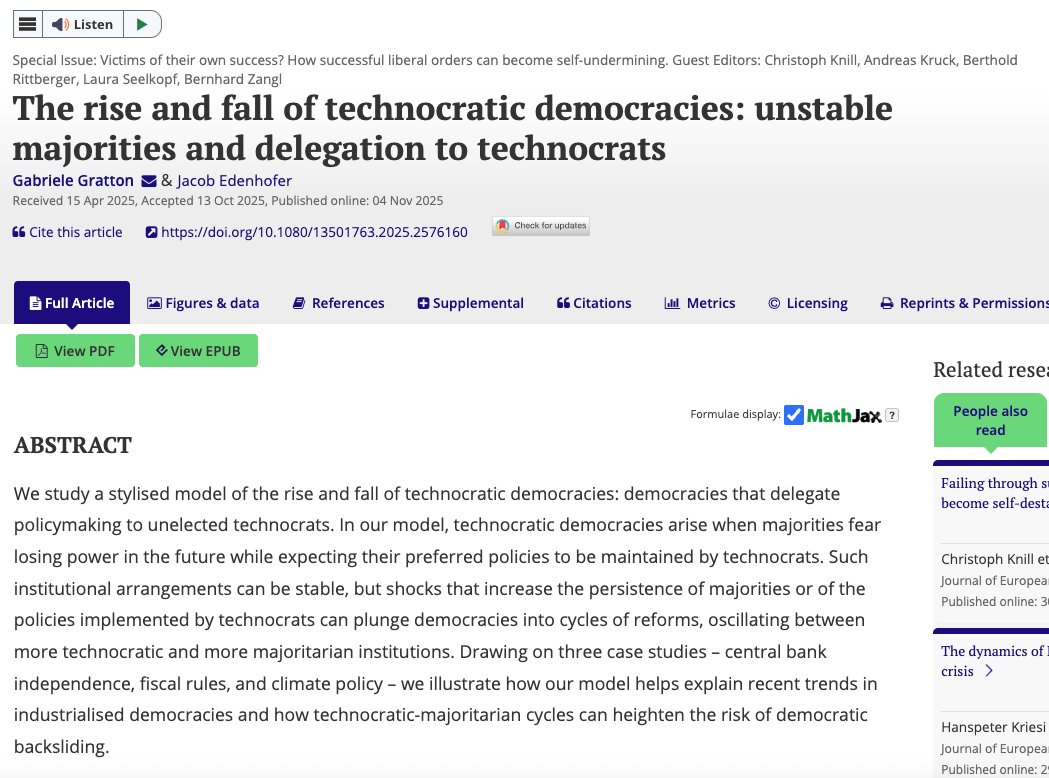
Recently, I have been thinking about the political economy of policy advice. Below are my thoughts; I'd be curious to hear what "practitioners" think about these. Let's start by thinking about the demand for and supply in the market for policy advice.
Policymakers rely on expert advice because it serves two purposes.
1⃣ Expertise can lead to better policies or implementation by providing an evidence-based overview of the costs and benefits of different policy instruments or objectives.
2⃣Expertise can provide legitimation.
1⃣ Expertise can lead to better policies or implementation by providing an evidence-based overview of the costs and benefits of different policy instruments or objectives.
2⃣Expertise can provide legitimation.
Expert statements (e.g. in interviews) can help policymakers justify their preferred positions to coalition partners, interest groups, or attentive elites. The relative weight of these functions depends on the institutional and political environment in which policymakers operate.
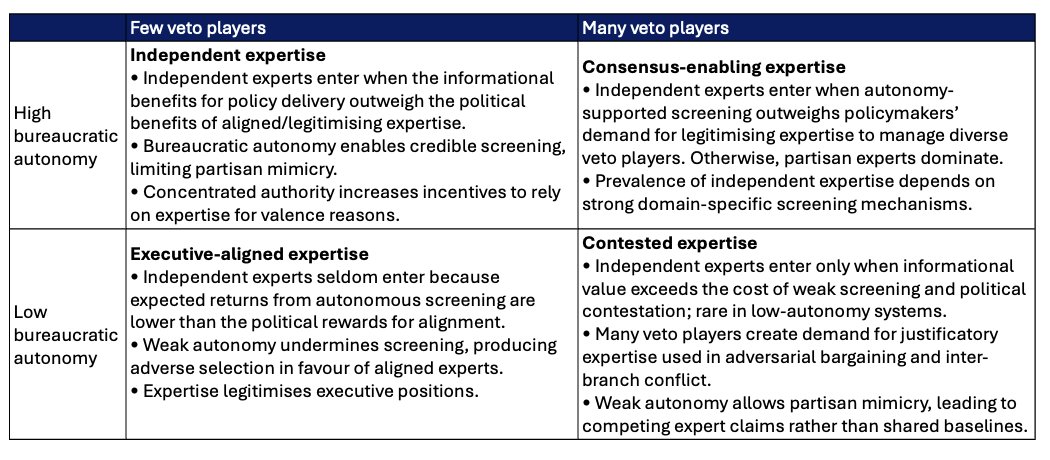
Two parameters strike me as especially important: the complexity of the policy issue at hand and the extent of disagreement among veto players (VP) on this issue, as summarised in the table below. When policymakers confront complex issues where VPs largely agree, they primarily 

demand independent expertise (this is also where delegation becomes most attractive when these issues recur). Conversely, when policymaking is shaped by substantial ideological conflict among VPs (e.g. coalition partners), policymakers value experts
https://x.com/edenhofer_jacob/status/1736338887486640624?s=20
primarily for the justificatory narratives they can supply, especially when the issue is not all that complex. Under such conditions, the informational content of expertise matters less than its usefulness in sustaining political support. You can see this clearly in the German
context, where disputes between coalition partners often give rise to interviews in the main newspapers between the 'favourite' experts of the respective parties. This brings me to the supply side: the incentives that experts face. Fundamentally, I'd argue that experts confront
a trade-off between access to power and independence: experts who seek access will often be 'forced' to adopt positions that simply reinforce the policymaker’s pre-existing preferences -- this type of parroting can undermine their reputation as an 'serious' scholars; whereas
those who prioritise independence will stick to their positions and, in doing so, sacrifice access to policymakers when their opinions are not en vogue or helpful for resolving intra-elite conflicts. While any given expert's objectives will be the convex combination of these two
motivations, it is useful to think about two stylised types: partisan experts (those who prioritise access) and independent ones (those who prioritise independence). The interaction between policymakers and experts is best understood as a two-stage process in which the
entry into the market is determined before any exchange of information occurs. In the first stage, experts decide whether to participate in the market for policy advice. Their decision depends on whether policymakers reward methodological independence or primarily value
politically aligned arguments. When policymakers show little interest in accurate or autonomous expertise—because their priority is to hold together their 'surival' coalitions—independent experts face weak incentives to engage. They are unlikely to enter the fray. The result is
an Akerlof-type market for epistemic lemons. A different configuration emerges when policymakers have a genuine demand for accurate information. In this environment, independent experts have reason to enter the advisory arena, and partisan experts also seek access because they
always value access to the powerful. Policymakers, however, cannot directly observe an expert’s underlying motivation, creating the potential for strategic mimicry: partisan experts adopt the outward markers of methodological rigour in order to resemble independent ones. As an
aside: this, I'd claim, is exactly what happens when politically aligned think tankers present their 'papers' or 'analyses'. Often hard for policymakers to distinguish between low- and high-quality analyses.
Whether policymakers can distinguish between these types depends on
Whether policymakers can distinguish between these types depends on
the strength of institutional screening mechanisms, such as formal advisory councils or bureaucrats, that allow independent experts to distinguish themselves from partisan ones. When these signals are sufficiently costly and policymakers attach real value to truthful information,
a separating-like pattern emerges in the second-stage communication game, and independent experts exert substantial influence on policymaking. Where signals are cheap, screening mechanisms weak, or policymakers’ incentives to screen limited, partisan experts can successfully
mimic independent ones, generating a pooling-like pattern.
Finally: how do these interactions vary across countries? I am not aware of any good works on this; so below are some tentative guesses.
H1: Fewer veto players reduce adverse selection and increase the entry of
Finally: how do these interactions vary across countries? I am not aware of any good works on this; so below are some tentative guesses.
H1: Fewer veto players reduce adverse selection and increase the entry of
independent experts. In these systems with few veto players, governments' clarity of responsibility is high and they can act decisively. This increases the expected value of accurate information for policy delivery, creating demand for independent expertise and thus incentives
for independents to throw their hat in the ring. That is, clarity of responsibility means policymakers can more easily appropriate the positive externalities of 'accurate' advice; better outcomes lead to valence advantages.
H2: Many veto players increase adverse selection
H2: Many veto players increase adverse selection
pressures and attract partisan experts.
Systems that distribute authority across multiple actors require negotiation and compromise across parties, regions. Expertise tends to be about hammering out intra-elite deals or ironing out differences.
Systems that distribute authority across multiple actors require negotiation and compromise across parties, regions. Expertise tends to be about hammering out intra-elite deals or ironing out differences.
H3: High bureaucratic capacity strengthens independent experts.
Where bureaucracies enjoy autonomy, tenure protections, professional norms, and access to internal analytical capacity, they function as screening mechanisms that make credible signals of independence more observable
Where bureaucracies enjoy autonomy, tenure protections, professional norms, and access to internal analytical capacity, they function as screening mechanisms that make credible signals of independence more observable
and costly to imitate. High-capacity bureaucracies can impose transparency requirements, methodological standards, or peer review processes that reduce the ability of partisan experts to engage in low-cost mimicry. See below for how this plays out.
For experts engaging in policymaking, the practical lesson is threefold. First, be aware of your competitors: partisan and aligned experts will often mimic independence, especially where screening is weak. Second, invest in educating bureaucrats and strengthening the
institutional routines that allow them to tell genuine expertise from partisan advocacy. Third, if such screening cannot realistically be improved, be selective about where you engage and avoid arenas where independent input is unlikely to be recognised or rewarded.
I'd be curious to hear your critical takes on this. @BachmannRudi, @ChFlachsland, @HenzeTimon, @fetzert, @MSchularick, @laderafrutal, @zingales, @Lars_Feld, @D_Langenmayr
@BachmannRudi @ChFlachsland @HenzeTimon @fetzert @MSchularick @laderafrutal @zingales @Lars_Feld @D_Langenmayr @maurerchr, @GeorgZachmann, @ben_moll, @helene_rey, @BaldwinRE, @AdamPosen, @NewLeftEViews, @bweder, @Isabel_Schnabel, @MonikaSchnitzer, @HannaSchwander, @jrgingrich, @benwansell, @DanielSpiro1, @JohnSpringford
• • •
Missing some Tweet in this thread? You can try to
force a refresh