2/ 18,000 adults, head-to-head against Fluzone. The mRNA vaccine reduced lab-confirmed flu by a third. If Fluzone was running around 50% effectiveness that season, the mRNA vaccine was likely in the 60-67% range.
That's exceptional for flu.
3/ The advantage was clearest against H3N2, our most difficult target.
Traditional vaccines underperform against H3N2 because egg-based manufacturing introduces mutations. mRNA bypasses eggs entirely, avoiding the adaptive mutations that kneecap H3N2 vaccines.
4/ Yes, reactogenicity was higher. More sore arms, more fatigue, more low-grade fevers.
But serious adverse events were identical between groups. No myocarditis. No pericarditis.
A French study of 28 million adults found mRNA vaccination associated with 25% lower all-cause mortality at 4 years. jamanetwork.com/journals/jaman…
5/ In August, @HHSGov terminated 22 mRNA vaccine programs under BARDA, including Moderna's $766 million bird flu program.
The rationale: mRNA vaccines don't stop transmission and don't provide durable protection. cidrap.umn.edu/avian-influenz…
6/ The Fitz-Patrick trial measured clinical protection against confirmed influenza. The mRNA vaccine provided it. T-cell responses persisted at 6 months.
That's what we ask vaccines to do.
7/ The replacement strategy, BPL-inactivated whole-virus vaccines, won't reach FDA approval until 2029. Manufacturing requires growing viral strains in culture, which takes months.
mRNA scales in weeks. That speed mattered in 2020. We're dismantling the infrastructure that made it possible. clinicaltrials.gov/study/NCT07215…
• • •
Missing some Tweet in this thread? You can try to
force a refresh

When Siri claims a vaccine was "never tested against a placebo," he's relying on a narrow legal definition: that the specific trial submitted for the current U.S. license used an active comparator rather than saline.
He's auditing regulatory paperwork. Not science.
He systematically omits foundational placebo-controlled trials that established the safety of the antigen. Trials conducted before the current product's U.S. licensure, trials run in other countries, and trials published in journals but not listed in a specific FDA filing.
The science exists. He's looking at the wrong documents.
2/ Regulatory submissions are administrative records for a specific commercial approval. The scientific evidence base is far larger, spanning decades of research across dozens of countries.
Conflating the two is the core sleight of hand. It's the same technique RFK Jr. uses. Both treat FDA package inserts as if they contain the sum total of vaccine safety evidence. They do not.
First, kids don't get 72 vaccines by age 18. The CDC schedule recommends 50-55 doses total, including annual flu shots. The inflated "72" figure may be intended to scare parents but it's false. I wrote about the "too many, too soon" myth here:
@statnews statnews.com/2025/06/24/too…
Second, different countries have different vaccine schedules based on local disease burden, healthcare systems, and demographics.
Anders Hviid, epidemiologist at Denmark's Statens Serum Institut, told @TheAtlantic: "I don't think it's fair to look at Denmark and say, 'Look how they're doing it, that should be a model for our country.' You cannot compare the Danish situation and health-care system to the situation in the U.S."
Denmark has universal healthcare with equitable access and high public trust. The US has massive health equity gaps and inconsistent care access. Our broader schedule helps protect vulnerable populations who might slip through the cracks. @KatherineJWu explains this well: theatlantic.com/health/archive…
Aaron Siri is misrepresenting flu vaccine evidence by selectively citing studies.
Doing this after the deadliest non-pandemic pediatric flu season on record — 280 children dead, 89% of whom were not fully vaccinated — is unconscionable.
Here’s what the data actually show. 🧵
2/ First, the Cochrane review he quotes, but only selectively. Yes, the 2018 review reported “no convincing evidence” that flu vaccines reduced mortality, hospital admissions, serious complications, or community transmission in healthy children. But that reflects a basic limitation of the evidence it examined, not a verdict that vaccines do nothing. The review focused on randomized trials in healthy kids, which were designed to measure how vaccination affects the risk of getting influenza, not rare outcomes like death or ICU admission. Even with more than 200,000 children across 41 trials, you will not see enough deaths or hospitalizations to show a statistically clear difference. That is a limitation of trial size and design, not proof of lack of benefit against severe disease.
Within that framework, Cochrane found high certainty that vaccination substantially reduced lab-confirmed influenza. Inactivated vaccines reduced lab-confirmed flu in 2 to 16 year olds from 30% to 11%, about a 64% reduction. Live attenuated vaccines reduced it from 18% to 4%, about a 78% reduction. The authors estimated that vaccinating 5 children with inactivated vaccine prevents 1 case of confirmed influenza.
These are not side notes. They are the main efficacy findings of the review. The “no convincing evidence” phrase he highlights refers specifically to the lack of statistical power for rare outcomes in these randomized trials. The actual measured outcome, laboratory-confirmed influenza, showed clear benefit. Presenting the rare-outcome caveat without the primary efficacy results misrepresents what the Cochrane review actually found.
3/ The Hong Kong trial he cites randomized 115 children to flu vaccine or placebo in 2008–09. It did find about a 4.4-fold increase in non-influenza viruses in vaccinated kids, mostly rhinoviruses and coxsackie or echoviruses. That is a real signal, but it needs context.
These were mild respiratory infections, not severe disease. The trial was too small to say much about influenza itself. The point estimate for flu infection actually leaned toward protection, but with a very wide confidence interval. Any “virus interference” effect, if it exists, seems limited to a short window after vaccination in children, not an entire season.
This was also a single, small study in one season with specific viral dynamics. Larger, multi-season studies have not shown a consistent net increase in overall respiratory illness among vaccinated children, and they do show substantial protection against flu hospitalization and critical illness. Using this one trial to claim vaccines cause a “net increase in infections” ignores the weight of evidence on severe outcomes.
Our systematic review on Covid-19, RSV, and influenza vaccines was just published in @NEJM. With federal vaccine guidance processes in flux, we felt independent evidence synthesis was crucial for the 2025-2026 respiratory virus season. 🧵nejm.org/doi/full/10.10…
2/ We screened 17,263 references and included 511 studies - updating the evidence base since the last comprehensive ACIP reviews. This was a massive team effort completed over 12 intensive weeks. We excluded animal studies, case reports <10 participants, and preprints.
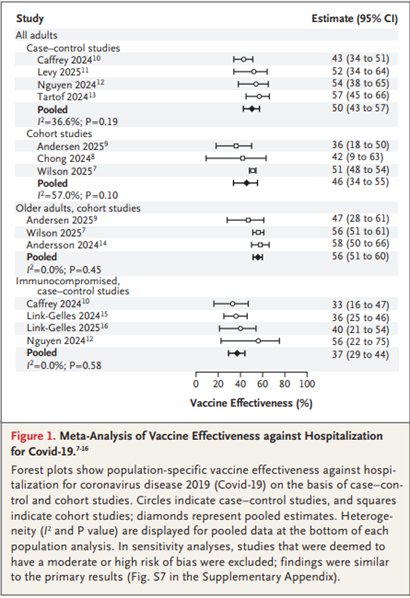
3/ Covid-19 vaccine effectiveness (VE):
Quick context on these numbers: Nearly everyone has some degree of Covid immunity now from vaccines, infections, or both. When studies report "vaccine effectiveness," they're measuring added benefit of updated vaccines - incremental protection, not protection in naive populations. Most used test-negative designs - comparing vaccination rates in those testing positive vs negative. The "unvaccinated" comparison groups often had prior vaccines or infections, which lowers their baseline risk and makes vaccines appear less effective than they would against truly naive individuals.
Covid-19 VE against hospitalization varied by population
In adults, XBB.1.5 vaccines showed 46-50% effectiveness.
In immunocompromised adults: 37%.
These compare people who got XBB.1.5 vaccines to those who hadn't - a mix of unvaccinated and those with only older vaccine versions.
The mRNA from COVID vaccines primarily stays local at the injection site and its draining lymph nodes. I understand why this has become controversial and confusing. There's a lot of scary information out there. I'll try to clarify a few things: 🧵
2/
In vaccine biology, "local" means the injection site muscle and the lymph nodes that drain it (your armpit for a shoulder shot). That's where vaccines are designed to work.
Regulatory studies confirm this: highest concentrations remain at the injection site. Small amounts reach the liver briefly. Brain shows only trace amounts in animal studies. The vast majority stays local.
3/ The "706 days" claim refers to spike PROTEIN in some patients, not mRNA. These are completely different things.
mRNA degrades quickly - detectable in blood for days, in draining lymph nodes for weeks. Drew Weissman, who won the Nobel Prize for developing the modified mRNA technology used in these vaccines, recently addressed this directly:
"The RNA is gone in days... If you put a vaccine-equivalent dose, you see it in the muscle, you see it in the draining lymph node, and that's about it." statnews.com/2025/09/20/dre…
1/ Two days of ACIP chaos: Self-described "rookies" eliminated universal COVID vaccine recommendations, added FDA-debunked theories to consent forms, and voted outside their legal authority. They literally don't know what they're doing or what they're allowed to do.🧵
2/ The damage goes beyond specific votes. They normalized treating misrepresented lab findings without clinical context as equivalent to population-level safety data. ACIP voted to add "six risks and uncertainties" to COVID vaccine consent based on claims that FDA debunked in 2023, EMA rejected in 2025, and Australia's TGA called misinformation in 2024. They literally can't distinguish between actual safety signals and manufactured doubt.
3/ Meanwhile, they eliminated universal COVID vaccine recommendations entirely, moving everything to "shared clinical decision making." This creates immediate access problems: the uninsured lose clear guidance, pharmacists may not be able to participate in these "shared decisions" depending on state law, and people without primary care have nowhere to have these required conversations. AHIP says insurers will maintain coverage through 2026 for previously recommended vaccines, but that's just a temporary fix. Vulnerable populations lose access now. Come 2026, even the insured could lose coverage.