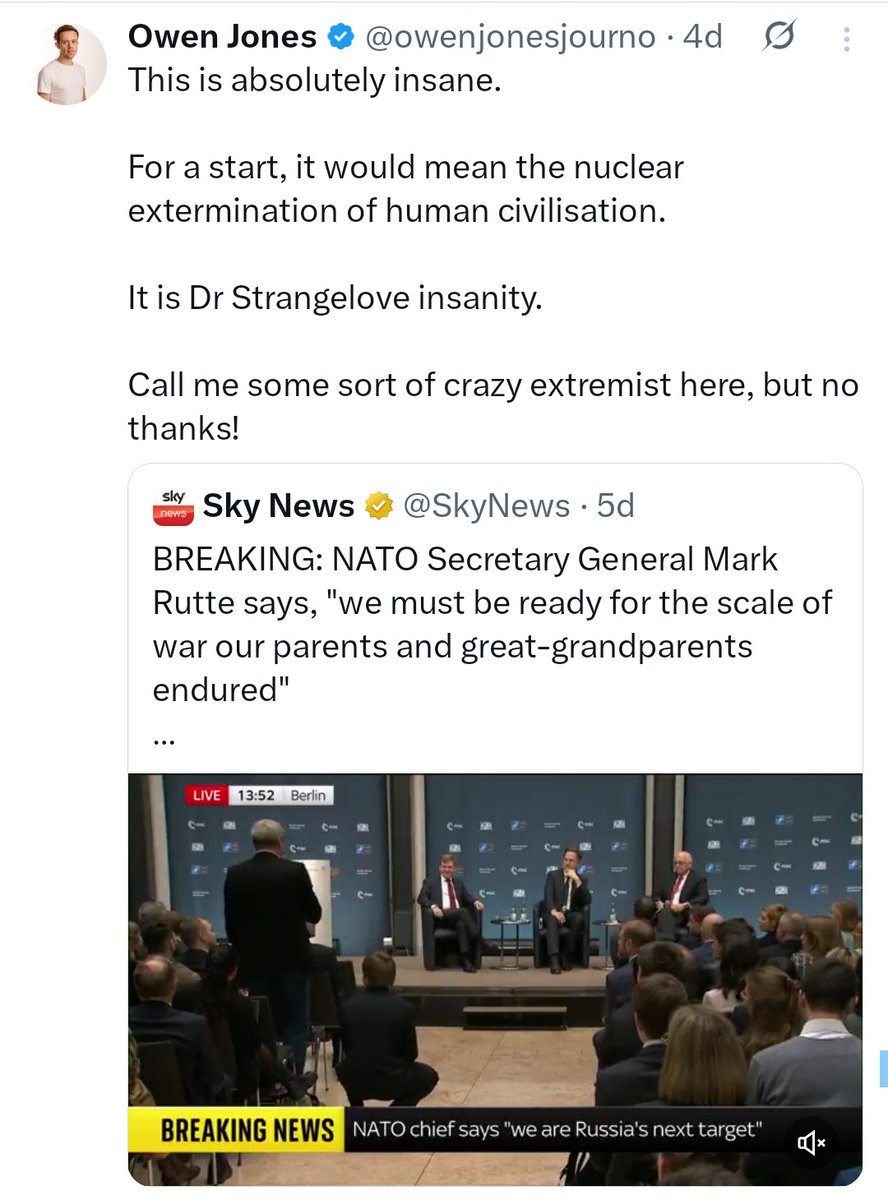
On both right and left, there's a lot of anger about the assessment of threat from Russia and the need to prepare to meet it. There's a lot I could say here (as my students know), but most of it boils down to two things. 🧵
1. For over a decade, but particularly since 2022, the ideology of Putin's presidency has rested on the claim that the West is an existential threat to Russia - that the main goal of the West is to destroy the Russian nation and state, Russian values and culture.
The need to destroy the Western "existential threat" to Russia is one of the key ideological pillars justifying Putin's domestic repression, the distortion of the economy, and the deaths of thousands of Russian soldiers. Putin's power now depends on the idea of war with the West.
Everything we can see tells us that Putin is never going to admit that the West is not, in fact, an existential threat to Russia, because he personally depends on the idea. And the UK is hated most of all.
2. The Russian political elite think power is *everything*. Power means you assert yourself; not asserting yourself means you're weak. Weak states are not sovereign and deserve what they will inevitably get. They see the West as weak but are now worried they might be wrong.
When dealing with this mafia version of Realism, coming from a state whose leadership's survival is now tied to perpetual enmity with the UK, opting out is not possible - it's not something we can do anything to change. All the UK can do is to protect itself, together with allies
TL;DR: The UK is Russia's enemy and there's nothing we can do to change that as long as Putin is in power. The choice is whether to be an undefeated enemy or a defeated one. That's all the choice we get.
• • •
Missing some Tweet in this thread? You can try to
force a refresh

Thread on the huge shift in US policy towards Russia visible in the new National Security Strategy - the biggest change since the collapse of the USSR. 🧵
This first striking thing about the new US National Security Strategy is how little Russia is mentioned in it: only 10 times. Every NSS since 1993 has mentioned Russia more than this one. The 1993 one only has fewer because it mostly still talks about the former Soviet Union.
The absence of Russia from the 2025 National Security Strategy looks really odd both because Russia is obviously one of the states having the most significant impact on global stability at the moment, and because the administration is so clearly interested in Russia.
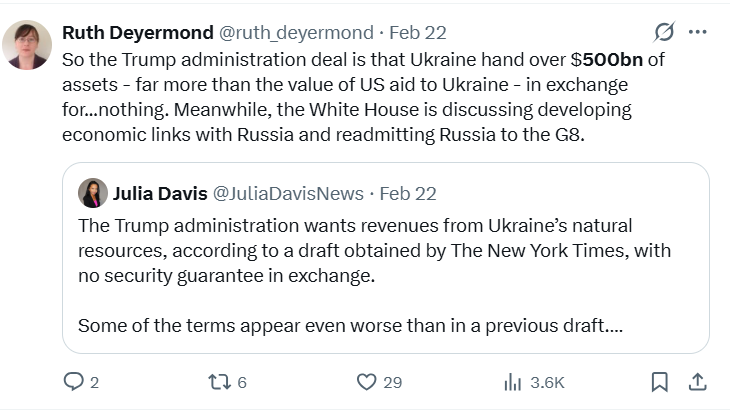
How is this a shock to anyone who's been paying any attention to what Trump has been saying and his admin have been doing all year? I posted this in Feb, for example. Officials who simply chose not to believe it because it's all too difficult might want to rethink their career.
This one was in April. If your job required you to look at US Russia policy at all in the last year - or in Trump's 1st term, when he talked about economic relations with Russia and readmitting them to the G8 - none of this should be remotely surprising.
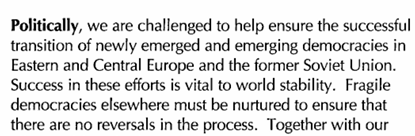
I'm not really surprised that some officials are surprised the Trump admin is prioritising economic relations with Russia. It's clear that some in Europe's policymaking communities simply can't get their heads round the fact that the post-1945 US-Europe relationship is over.
A quick run through of the Trump administration's proposal for a Ukraine security guarantee, which is a security guarantee in the same way that the Liberal Democratic Party of Russia is a party committed to liberalism and democracy. 🧵
The proposed security guarantee is allegedly modelled on NATO Article 5, but that doesn't contain any of these qualifications for action, let alone all of them.
This proposed security guarantee requires that an armed attack by Russia would have to be significant *and* deliberate *and* sustained to merit a response. In theory, Russia could drop a nuke on Kyiv and that wouldn't meet the criteria because the attack wouldn't be sustained.
Trump has been praising Putin for over a decade, yet somehow this is news. It shouldn't be complicated to understand: Trump admires Putin and Trump wants to do business with Russia. It's been this way for years and it is not going to change. 🧵
During the 2016 election, Trump said that Putin was a better president than Obama. Also during the campaign, Trump claimed that Putin would never invade Ukraine; when it was pointed out that he already had, Trump blamed Obama for the annexation of Crimea, not Putin.
Once elected, he appointed as Secretary of State a man who had been given the Order of Friendship by Putin. His first National Security Advisor had been paid $45,000 to give a speech at RT's anniversary party just over a year before he was appointed.
One last thing on Trump's embarrassing UN speech: watching it - in particular, listening to him read it - makes it clear that Trump has absolutely no interest in foreign policy. The only time he seemed remotely engaged was when he was complaining or bragging. That matters.🧵
Other presidents all had sets of ideas, however poorly thought through, about foreign policy: about the world and the US's place in it, what desirable goals and bearable outcomes are for the US, what will make the world more stable. Trump doesn't seem to care about any of that.
Trump's approach to foreign policy appears to be driven solely by the quest for personal benefits: status (praise, flattery, deference) and enrichment. He seems to have no understanding of, or interest in, anything larger than himself, including the interests of the US.
Important to note that there are different types of US-Russia presidential meetings. This type is particularly significant and thus a very clear sign of the Trump administration's desire to align with the Kremlin. 🧵
Before the 2022 invasion of Ukraine, it was standard for new US and Russian presidents to meet. This allowed them to work through issues of concern to the US (as the vastly more powerful state, the agenda was set by the US). This happened even when relations were cool.
Traditionally, when summits take place in periods of significant Washington-Moscow tension, they take place in 3rd party states. This was true during the Cold War and more recently during the first year of the Biden administration.