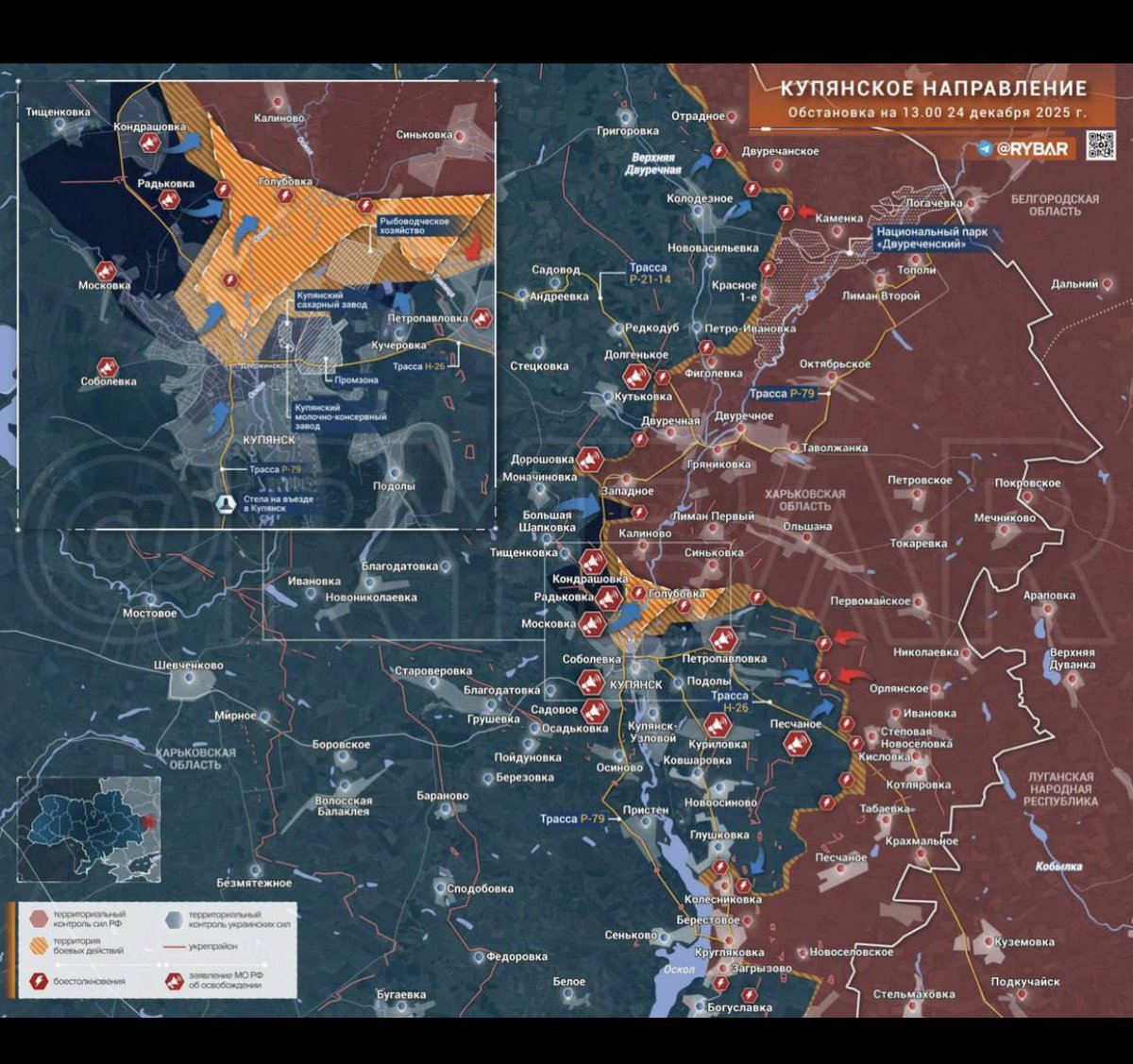
A somewhat long thread on the importance of the Ukrainian success in Kupyansk now that even Russian military analysts and correspondents acknowledge that the city is again under Ukrainian control. See below the map from Rybar (with lost positions colored orange.) 1/5
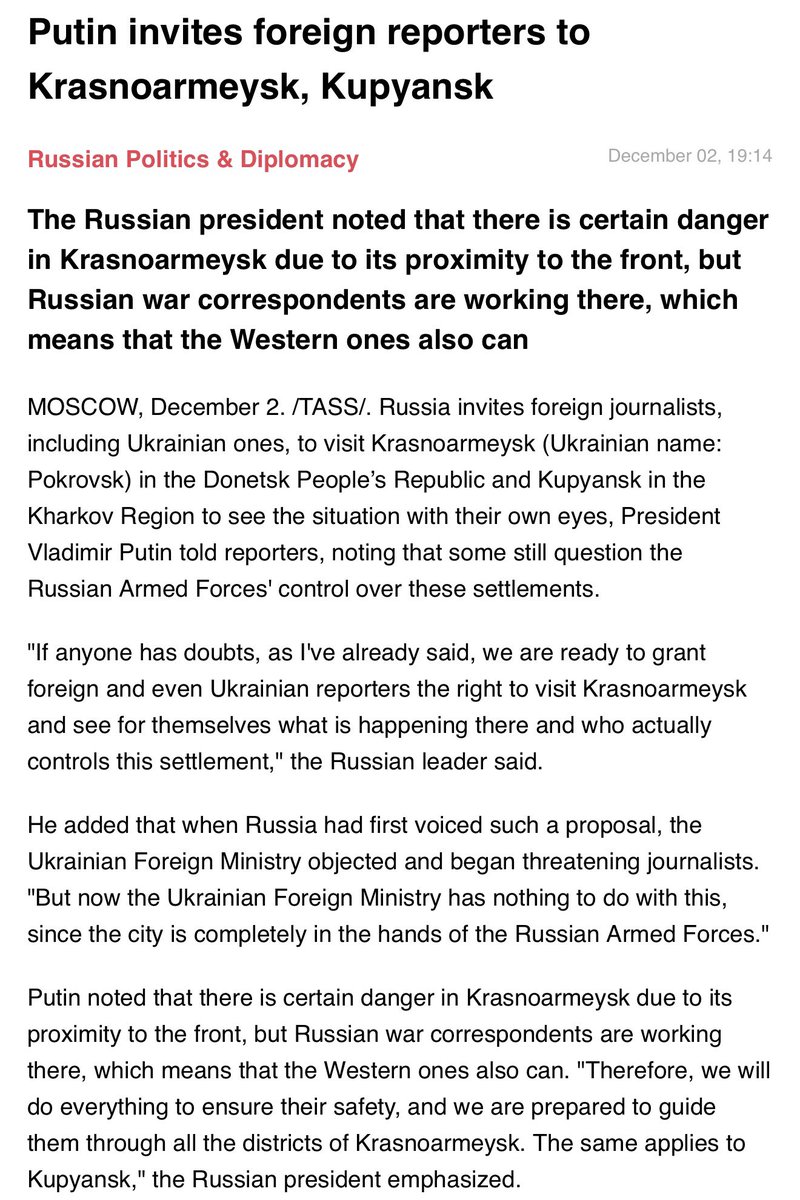
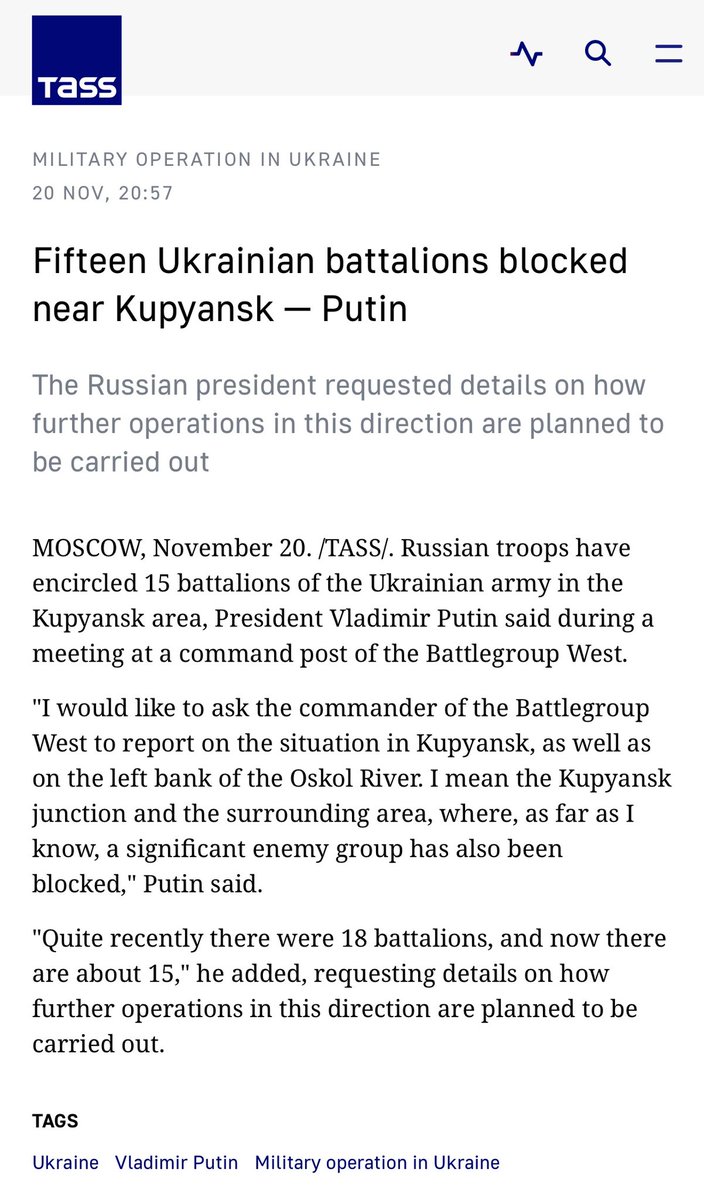
Putin repeatedly and publicly made outlandish claims about Russian control of Kupyansk, and about the allegedly encircled 15 Ukrainian battalions there. He even dismissed Zelensky’s recent visit to the city entrance as a fake. See Tass stories ⬇️
Why is Kupyansk important? Putin wants to trade the largely rural and insignificant parts of Kharkiv, Sumy and Dnipro regions that Russia currently controls for the major cities in northern Donetsk, as per the Witkoff-Dmitriev plan. Kupyansk, in Kharkiv, would have been the by far biggest of the cities in these areas. Now it is no longer one of Putin’s cards. (3/5)
Why is Kupyansk even more important? After two years of slow but continuous retreats, the Ukrainian Armed Forces have demonstrated that they retain the capacity for a large, sustained counteroffensive— and that territorial losses to Russia are not forever. This undercuts the argument that Kyiv should sign a bad deal immediately because the deal on the table in the future will be even worse. (4/5)
Does this mean that the trend of the overall war has reversed? No, Russia is still advancing, albeit slowly, on other axes, such as Huluaipole in Zaporizhzhia, an area where current frontlines are supposed to be frozen once the Witkoff-Dmitriev plan is agreed. But Kupyansk shows that Ukraine is not about to collapse, and that it has cards to play — and surprises up the sleeve.
• • •
Missing some Tweet in this thread? You can try to
force a refresh

Should the West seek to appease Russia to focus on China, a so-called “reverse Kissinger?”
Or should it do a “Deng 2.0,” biding time and hiding intentions with China while focusing its capabilities on Russia?
And is it even possible to treat the interconnected world crises separately?
My big analysis piece in @WSJ today. wsj.com/politics/natio…
“One of the things that America should do, from a purely American strategic perspective, is to figure out a way to have a grand bargain with Russia,” argues @MrMaitra “Whether that is doable or not is a difficult question, depending on where Russian red lines lie. But fundamentally it would mean a new security architecture in Europe.”
Many Democrats and Republicans counter by saying that accommodating Putin on Ukraine and European security would be catastrophic for U.S. power in Asia. “It would accelerate hedging by our partners in the Indo-Pacific and aggression by China. It would make every ally and partner we have, globally, question whether they can count on us,” @ChrisCoons told me.
If you wonder about the historic relationship between Jews and Dagestan: a “Mountain Jewish”community that speaks a language related to Persian and was classified as Tats by the USSR has lived in Dagestan, Chechnya and other parts of North Caucasus since pre-Islamic times (1/3)
With the exception of a thriving community in northern Azerbaijan, the vast majority of “Mountain Jews” left the region, which saw Islamist insurgencies and war in the 1990s and early 2000s. Many went to Israel. (2/3)
The attempted pogrom in the Makhachkala airport and riots elsewhere in North Caucasus were sparked by unsubstantiated rumors that some of the “Mountain Jews” are trying to return “where they came from” because of the war in Israel/Palestine (3/3)
Four fundamental assumptions in the Middle East have been upended by the Hamas attack. What are the new rules of game? My page-one analysis piece in today’s @WSJ 🧵(1/n) wsj.com/world/middle-e…
1. The assumptions about Israel’s military and intelligence prowess are gone — perhaps prematurely, as Israel’s military strength, particularly its Air Force, is intact. It’s a Pearl Harbor emotionally, but without losing any ships. (2/n)
2. Assumptions, in the West and in Israel, that Hamas somehow moderated its genocidal ideology and become pragmatic (hence the need for offices in Doha), are shattered by Saturday’s slaughter of several hundred Israeli civilians and the kidnapping of women and children (3/n)
Amid Russia’s imperial war on Ukraine, Pope Francis tells Russians to be inspired by their legacy as heirs of “the Great Russia of Peter the Great and Catherine II, of that Great Russian Empire, enlightened, of so much culture and so much humanity.” (1/4)
It’s akin to telling Belgians they should honor the legacy of the great humanitarian mission of King Leopold who had brought culture to the Congo. Peter I, whose imperial land grab Putin said he emulates, and Catherine II loom in Ukrainian history as the country’s enslavers. 2/4
Peter I curtailed Ukrainian self-rule and Catherine abolished it altogether, turning millions of free Ukrainians into serfs just as serfdom was being scrapped elsewhere in Europe. Unleashing forced assimilation, she essentially banned the Ukrainian language and book printing. 3/4
How a U.S. Navy noncommissioned officer created a pro-Russian propaganda network that brought to prominence stolen Pentagon files. Our investigation of the Donbass Devushka affair. wsj.com/articles/socia…
We spoke with Sarah Bils, a former Navy E7 who retired late last year and the person behind the Donbass Devushka, or Donbas Girl, persona. We also talked to her former Navy colleague.
Thanks to @P_Kallioniemi for doing a lot of research before we approached the story.
Kyiv is rife with rumors of a Biden visit today as the city center is shut down except for a huge VIP convoy and officials speak of a surprise trip by important partners.
There has been no announcement by the White House or the Ukrainian government. Biden is scheduled to be in Warsaw tomorrow.
And there is an air strike alert on in Kyiv and all over Ukraine.