Im #OneOfTheTwo because Im already disabled, and I know nothing is capable of saving me in this capitalist hellscape. No govt, no partner, no family member can save me if I become too disabled to work. If I cant work, I cant get the meds I need to stay alive. 1/5
Being disabled is incredibly expensive. Securing drs, paying for scans and bloodwork, covering compounded meds, buying safe foods - I could not afford these things on disability. I literally cannot afford to become more unwell. 2/5
As a historian I know what the government does to people it does not want to care for. And as a disabled community member, I see how poverty accelerates community members towards preventable deaths. 3/5
Call me whatever you want, it doesnt change the fact that I have a PhD in the topic. I am writing a book on care. I know what happens, past and present, when communities revoke care to those who need it most. (Hint: its eugenics) 4/5
Will I wear a mask "forever?" That really depends on society. Ill wear one until we have clean air. Ill wear one until we have a sterilizing vaccine. Ill wear one until I can be sure I pose no risk of death or disablement to anyone else. 5/5
• • •
Missing some Tweet in this thread? You can try to
force a refresh

In the 1810s, economists and govt officials in Europe and the US conducted a ton of poverty investigations. They concluded that poor people were poor because they were just lazy immoral alcoholics. Officials recommended mass incarceration. 1/9
Officials complained that "foreigners" were overcrowding American hospitals, that pension recipients were "faking" disability, and that everyone out of work receiving charity should be institutionalized and forced to work by the govt. 2/9
Officials argued that people needed to feel the "fear" and "shame" of poverty (see Philly report linked below) to actually change. Officials wanted to design a system where welfare was so terrible that ppl would do anything to avoid asking the govt for help. 3/9
Historian #1: wealthy ppl got upset they had to pay taxes for poor relief, so they built the carceral state and passed laws to cut relief. This was bad for poor people. Costs went down bc of threats of incarceration. 1/5
Historian #2: the city was plagued with high poverty rates, so the govt passed laws to regulate relief. Costs went down bc the city hired more govt officials to screen applicants and made "better" choices about who "deserved" care. This was good. 2/5
I google these people.
#1 - history prof, multiple teaching awards, wrote extensively on childhood, poverty, crime, family
#2 - econ prof who then worked in NYC as an economist 3/5
Western medicine is designed to react rather than prevent, which is why so many patients are discarded by it. Even though we talk about utilitarian ethics in emergency situations, the framrwork is behind all forms of care. And it all ties back to capitalism. 1/8
An acute issue, with clear therapeutics? This implies a high ROI - its worth it for the system to fix you. You might go back to school/work/"productivity" which js what capitalism wants. A chronic issue, or one without clear therapeutics? That means a lower ROI. 2/8
I think I experienced this most acutely when I was dealing with #MCAS and lost most foods. I continually went into anaphylaxis. Yet allergists told me to just keep using epi, going to ER, and warned me against limiting my diet. 3/8
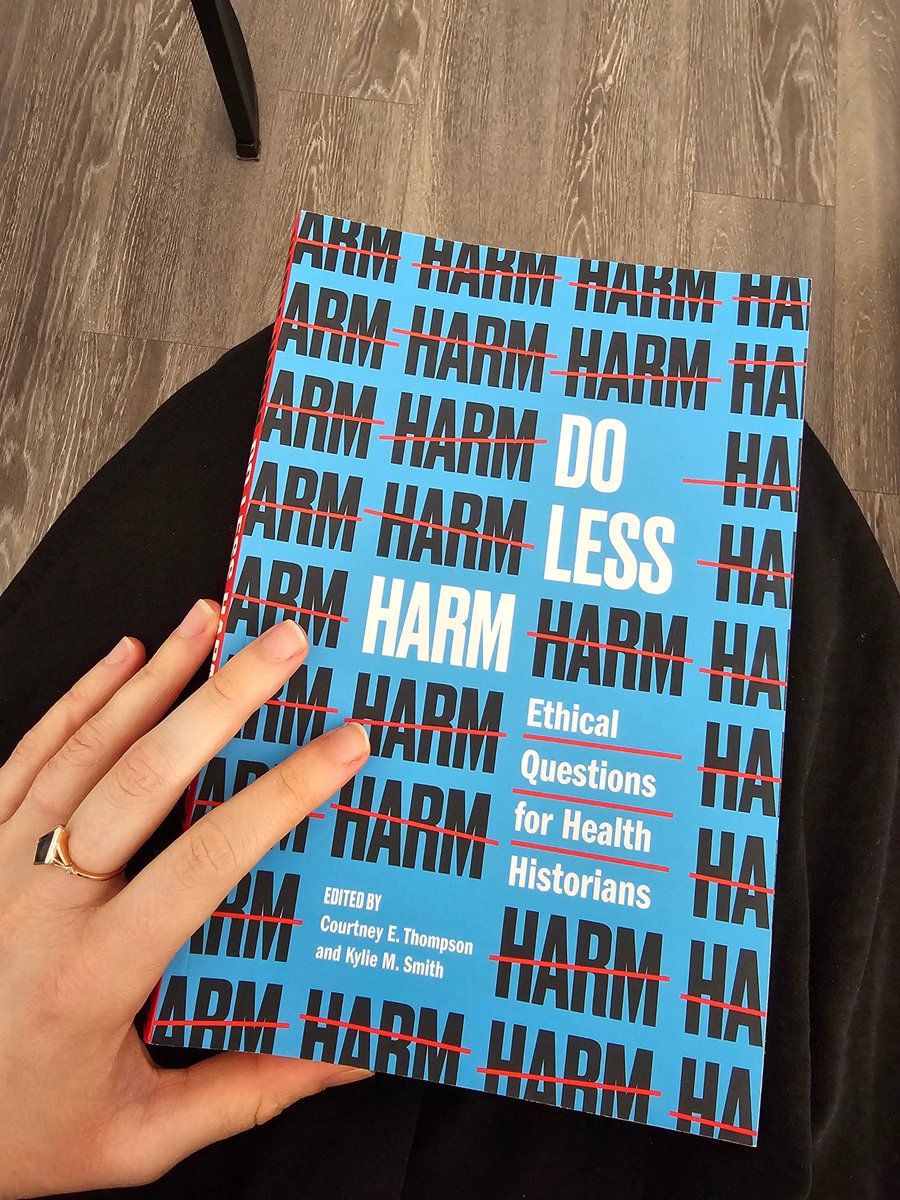
Its finally here! Feels SO good to finally see it in print. Many thanks to the editors who handled this book with such care, and the other contributors who challenged me to think about my own ethical commitments throughout this process. It was a dream to work with yall! 1/5
My chapter on "Accessibility" is an ode to every disabled scholar who's been barred from the academy because of ableism. It's also a love letter to those who continue to take COVID precautions, which is a critical component in fostering access for all people. 2/5
No one should be forced to choose between access or employment. No one should have to hide their disability. And disabled people should benefit from research that depends on our histories, our narratives, and our bodyminds. 3/5
Today is my 10-year brain surgery anniversary! A decade ago, I was under the knife getting a Chiari decompression surgery and a fusion of C1-C2. At the time I had daily debilitating headaches, struggled to stay upright, and had lost all sense of depth perception. 1/17
I was constantly dizzy, I had terrible hand-eye coordination, and I struggled with brain fog. Getting to my senior year undergrad classes, was so incredibly tough. I was either in class, or sleeping, or zoned out in an unending pain flare. 2/17
Before I went into that surgery, thought, I spent years seeking care. I saw three neuros before finding someone who listened. I had an hEDS diagnosis, I had a 10+ year history of POTS, and my mom had a Chiari (for which she had needed surgery too). I was an easy diagnosis. 3/17
Generative AI kills curiosity, critical reasoning, and is absolutely creating falsified records. This semester I found projects/papers with: 1. Bibliographies with sources that dont exist 2. Fake quotations from REAL books 3. Fake quotations from FAKE books 1/5
Plagiarism includes everything from copying someone elses ideas to copy/pasting existing content to FALSIFYING HISTORICAL RECORDS. These are all heinous, but falsifying records is a major violation in the field of history. 2/5
We talk about historians in the early 1900s who made statements with no proof, with no real source interrogation. We make fun of the men who just blurted their claims as fact as their wives plucked away at the typewriter. 3/5