Thread with excerpts from Boris Sax's "Stealing Fire", a book of the author reckoning with his discovery (after his father's death) that his father, Saville Sax, had been a major Soviet atomic spy, stealing important info on the A-bomb and likely the H-bomb and going unpunished. 
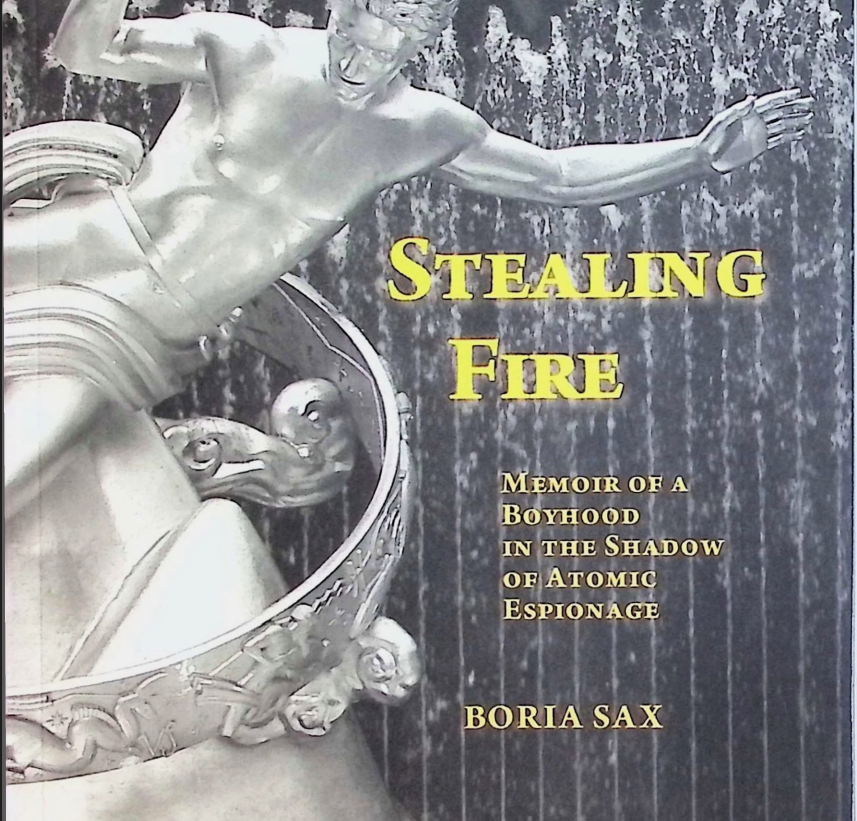
The author was initially devastated, but eventually relieved at this discovery as partly explaining his father's awful lifetime behavior (living in black slums, beating his wife and kids, torturing dogs, never getting a stable job, dropping out of Harvard twice).
Saville's mother (author's paternal grandmother) was a Jewish immigrant from Russia. According to the author, she, like many Jews, became a Communist as a way to partly recreate an idealized version of her Russian village without the Ukrainian pogromists in America.
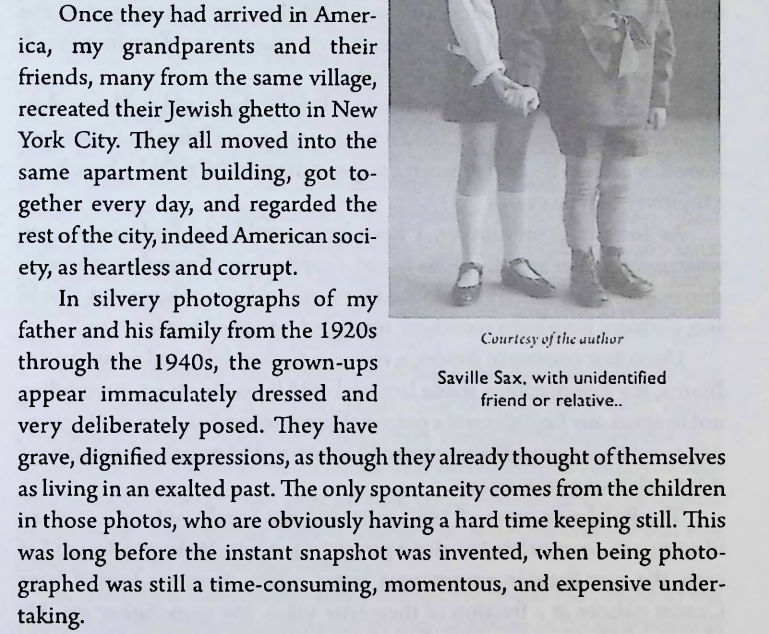
Saville's parents and friends recreated the Jewish ghetto in NYC, isolated from American society and seeing it as heartless and corrupt.
Saville's father was able to get rich selling looted Tsarist treasures in America after the Russian Revolution, crucially without having to actually accommodate himself to American society, and so remained a Communist.

The Jews of Saville's upbringing in their communist NYC ghetto despised their Orthodox cousins and saw communism as a way to provide cohesion to an apostate Jewish community. They scorned both Christians and religious Jews, and saw Jewishness and communism as synonyms.

Despite their secularism, this group was isolated enough to still practice arranged marriage. Saville's father nearly abandoned his mother in Soviet Russia to shack up with his mistress, but lost his nerve at the last moment.

Young men in the Russian-Jewish NYC ghetto were both prized and strictly controlled, taught that America was filled with covert Nazis.
Thanks to his parent's means of attaining wealth, Saville was brought up wealthy but completely outside the American mainstream, without such necessary habits as "showing up to work on time," and as such was downwardly mobile.
Apparently, baths were taken infrequently in the NYC Russian-Jewish ghetto to distinguish themselves from the American bourgeoise.
The author believes Saville (his father) was enticed to become a spy by the glamour and camaraderie. He worked with physicist Ted Hall. The two were discovered and surveilled after the fact by the FBI thanks to Venona, but not punished, perhaps to avoid leaking sources.

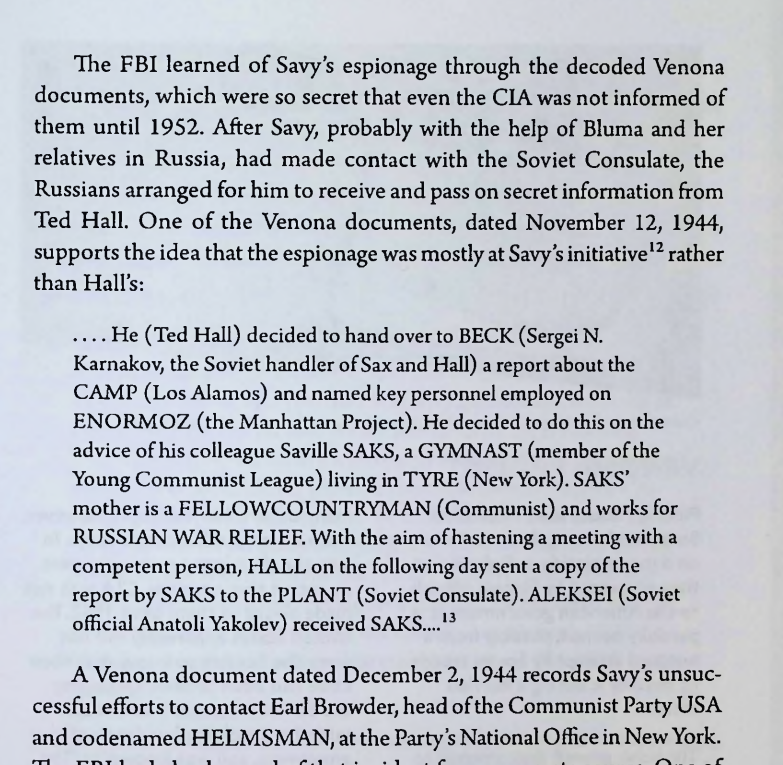

Saville and Hall were united by their status as spies, Communism, and Russian-Jewishness. But Hall, a brilliant physicist, was far more conventionally successful than Saville and wound up marrying a girl Saville liked, driving them apart.

The author's mother Susan, who eventually married Saville, was an "extreme liberal about racial equality" and was one of four founding members of CORE (Congress on Racial Equality) and an activist in the Civil Rights movement who later became disillusioned.


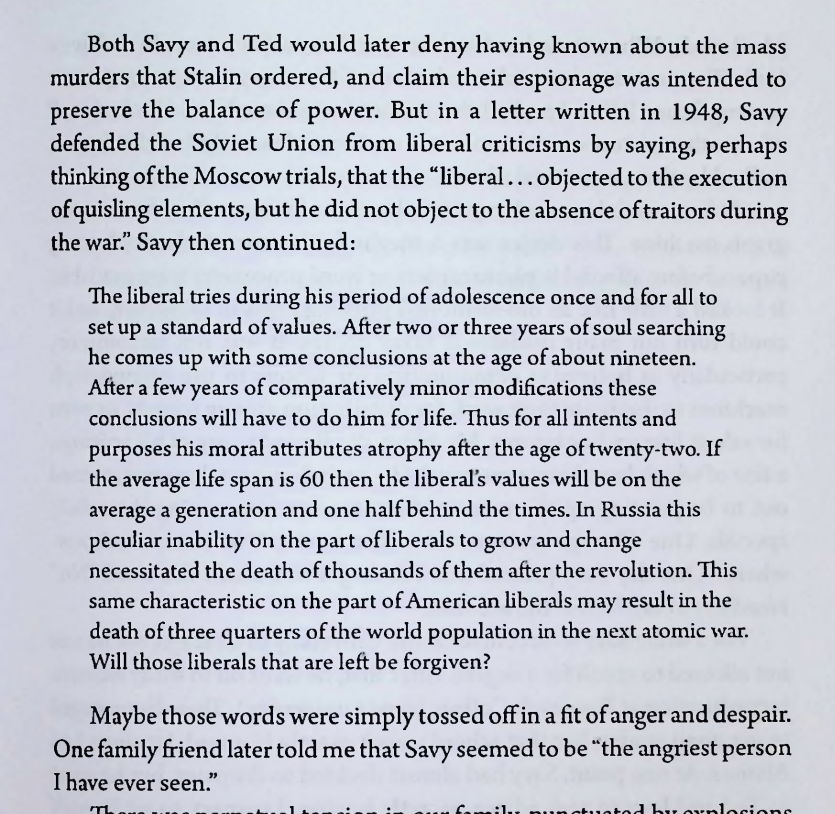
Saville was quite happy to defend murdering liberals as insufficiently advanced.
Saville was interviewed by the FBI, but never told his kids about the interview or the espionage, which made family life odd and him seem paranoid. The author, Boris, was harassed and attacked by the black kids he went to school with in Chicago for being white.

Saville hated Poles and Ukrainians (due to ethnic conflict in Eastern Europe), and saw blacks as allies and Christian whites as enemies, but the author believed support for Stalin disqualified one from moral authority, and was fascinated by the Polish neighborhood in Chicago.


As a result of growing up in a black ghetto, the author was not especially attracted to the culture and aesthetic as so many Americans were in the 60s.


Author's ethnic analogy: Jews (in Eastern Europe): Ukrainians : Russians :: Jews (in Chicago) : blacks : white Americans.

One of the more striking things about the book is the description of the 60s. Civil Rights protests and getting arrested (and immediately released) were perfectly normal for high schoolers.

Everyone pretty much went insane 1967-72. Cults and con artists and hippies and addicts and Communists and gangsters and prophets on every corner.

This was not really a youth rebellion, most of the leaders were older.

Another feature of the 60s: Saville was a fuckup by any metric (known Soviet spy, wife beater, unable to hold down a job, zero hygiene, double drop-out) who nevertheless marries, has kids, and lands a sinecure as a Program Director at the University of Southern Illinois.
Author's verdict on his father is mostly negative (and he is fairly conservative), but he did see a few positives (growing up outside the American mainstream made it easier to see what is actually was, fish/water etc). He believes generations are getting less serious.

• • •
Missing some Tweet in this thread? You can try to
force a refresh