
Our follow-up study on IgG4 in blood and saliva after 4 x COVID-19 mRNA vaccines is out on eBioMedicine 🧪
1)🧵So how does IgG4 influence responses to Omicron (XBB.1.5 and JN.1) and Sarbecoviruses (from bats, pangolins)? What epitopes are being targeted?
authors.elsevier.com/sd/article/S23…
1)🧵So how does IgG4 influence responses to Omicron (XBB.1.5 and JN.1) and Sarbecoviruses (from bats, pangolins)? What epitopes are being targeted?
authors.elsevier.com/sd/article/S23…

2) 🧵To begin, a quick recap that IgG antibodies switches from IgG3 >> IgG1 >> IgG2 >> IgG4
And that during chronic inflammation and allergies, IgG4 plays the important role of bringing balance back to the immune system
And that during chronic inflammation and allergies, IgG4 plays the important role of bringing balance back to the immune system
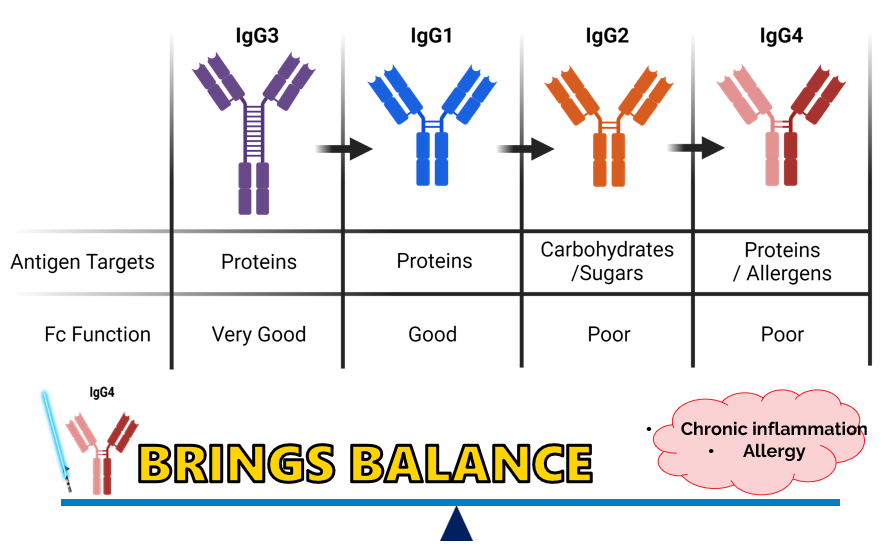
3) 🧵However, as we and others have published, IgG4 levels were also coming up after repeated doses of the COVID-19 mRNA vaccine.
Given the wide potential for mRNA vaccines (rapid development; scalable), we wanted to take a closer look to better understand what was happening 🧐
Given the wide potential for mRNA vaccines (rapid development; scalable), we wanted to take a closer look to better understand what was happening 🧐

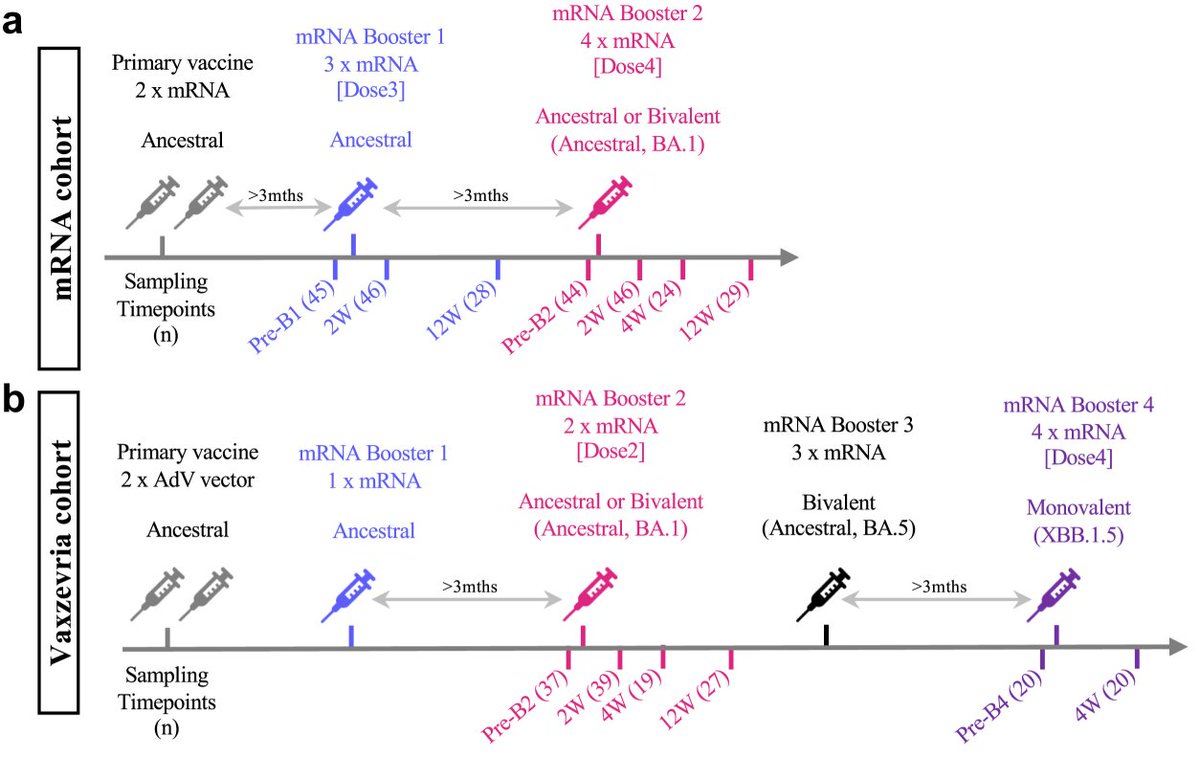
4)🧵To study how primary vaccines affected future IgG4 responses, we collected paired blood and saliva samples from 2 cohorts:
mRNA cohort
2 x primary mRNA + 2 x mRNA boosters
(total 4 mRNA dose)
Vaxzevria cohort
2 x primary AdV vector + 4 x mRNA boosters
(total 4 mRNA dose)
mRNA cohort
2 x primary mRNA + 2 x mRNA boosters
(total 4 mRNA dose)
Vaxzevria cohort
2 x primary AdV vector + 4 x mRNA boosters
(total 4 mRNA dose)
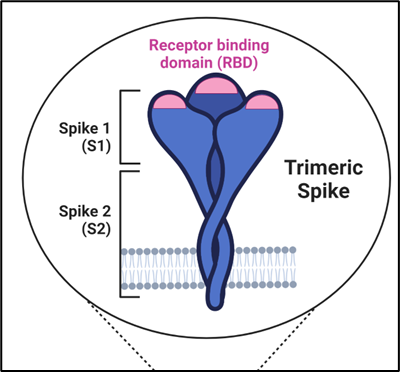
5) 🧵We also focused on antibodies binding the SARS-CoV-2 spike:
Receptor binding domain (RBD): Binding here blocks the virus from attaching to cells for infection. However, this area is prone to mutations
Spike (S) Trimer: The whole spike, including areas not prone to mutation
Receptor binding domain (RBD): Binding here blocks the virus from attaching to cells for infection. However, this area is prone to mutations
Spike (S) Trimer: The whole spike, including areas not prone to mutation
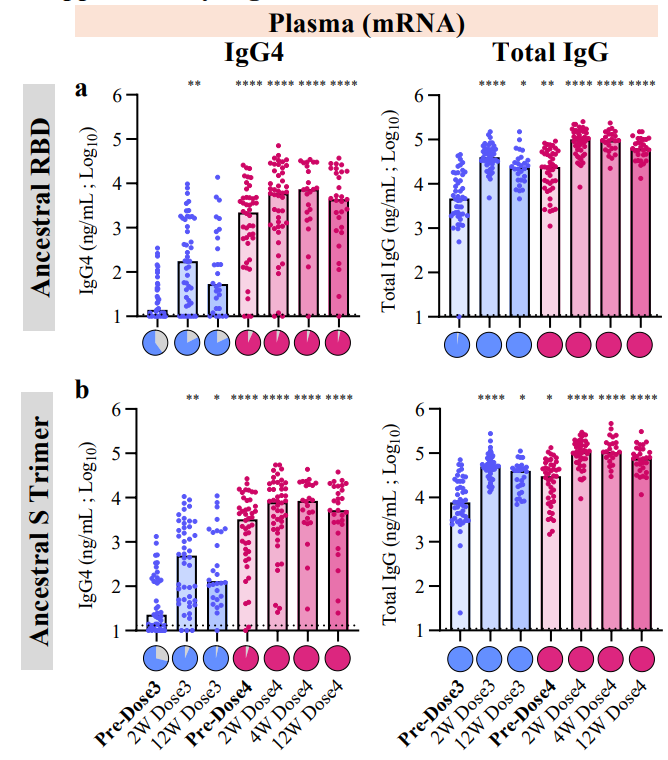
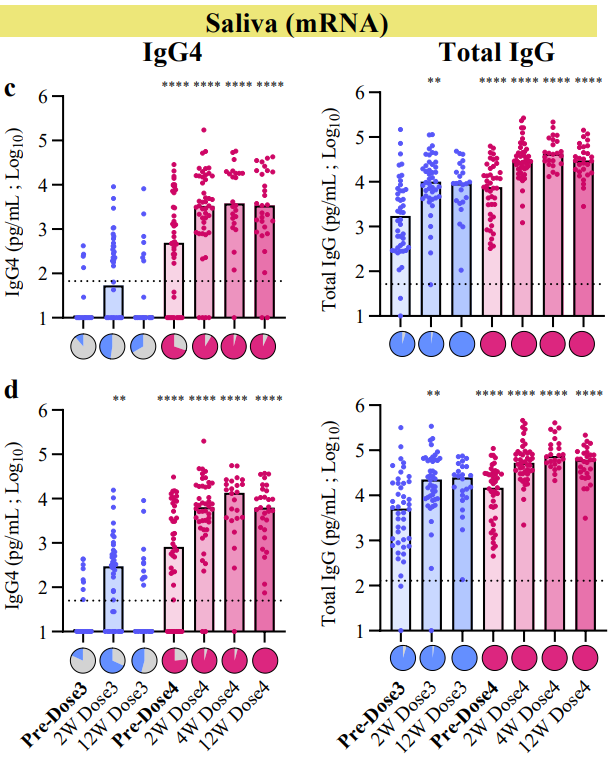
6)🧵First, we looked at the ancestral spike
mRNA cohort
IgG4 binding waned 12 weeks after the 3rd dose, but was noticeably higher by the 4th dose.
IgG4 rose after the 4th dose, and stayed elevated even after 12 weeks.
This trended similarly to total IgG in blood and saliva
mRNA cohort
IgG4 binding waned 12 weeks after the 3rd dose, but was noticeably higher by the 4th dose.
IgG4 rose after the 4th dose, and stayed elevated even after 12 weeks.
This trended similarly to total IgG in blood and saliva
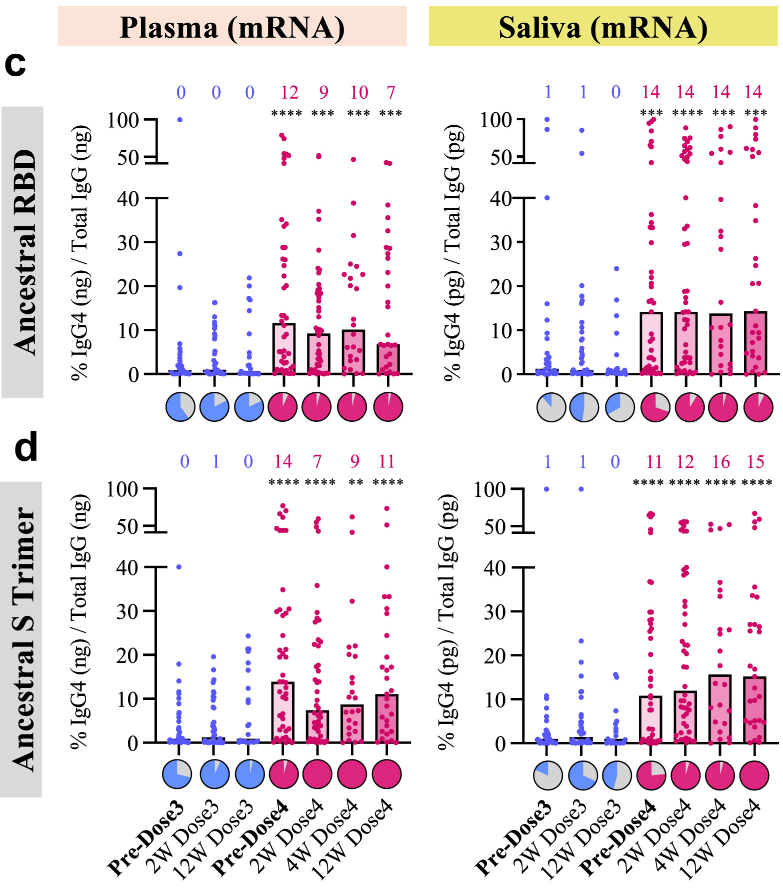
7) 🧵mRNA cohort
Focusing on the proportion of total IgG antibodies that is IgG4, we see a larger % of IgG4 in their plasma and saliva after their 4th dose (2nd mRNA booster), as compared to the 3rd dose.
This ratio remained elevated for up to 12 weeks.
Focusing on the proportion of total IgG antibodies that is IgG4, we see a larger % of IgG4 in their plasma and saliva after their 4th dose (2nd mRNA booster), as compared to the 3rd dose.
This ratio remained elevated for up to 12 weeks.
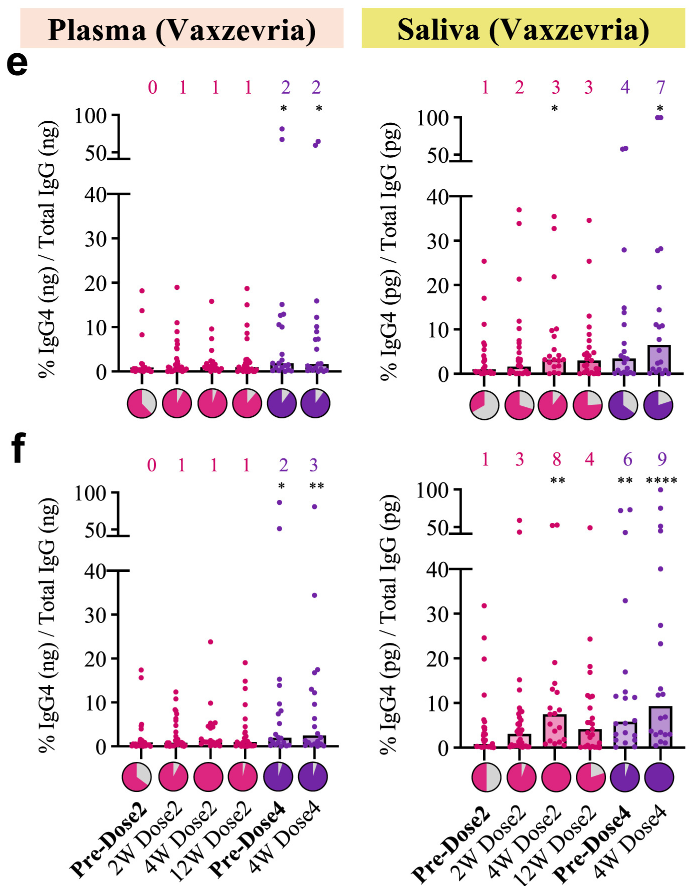
8) 🧵Vaxzevria cohort
In contrast, individuals who received 2 x primary adenoviral-vector vaccines still showed a smaller % of IgG4 even after their 4th mRNA boosters (4 x mRNA doses).
This suggests that initial priming with non-mRNA vaccines could mitigate the switch to IgG4.
In contrast, individuals who received 2 x primary adenoviral-vector vaccines still showed a smaller % of IgG4 even after their 4th mRNA boosters (4 x mRNA doses).
This suggests that initial priming with non-mRNA vaccines could mitigate the switch to IgG4.
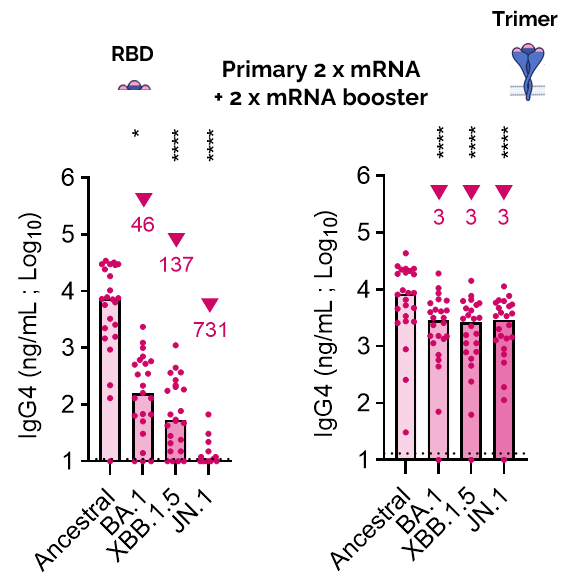
9) 🧵Next, we compared Omicron variants
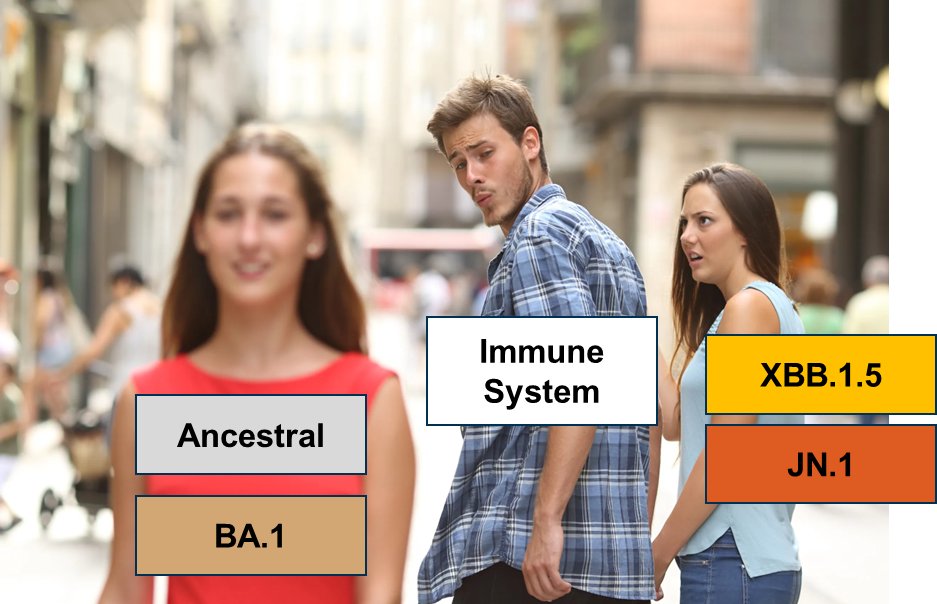
In line with ancestral imprinting, majority of IgG4 targets the ancestral spike and binds to more conserved regions.
This trends similarly with total IgG, and is observed across both cohorts.
In line with ancestral imprinting, majority of IgG4 targets the ancestral spike and binds to more conserved regions.
This trends similarly with total IgG, and is observed across both cohorts.
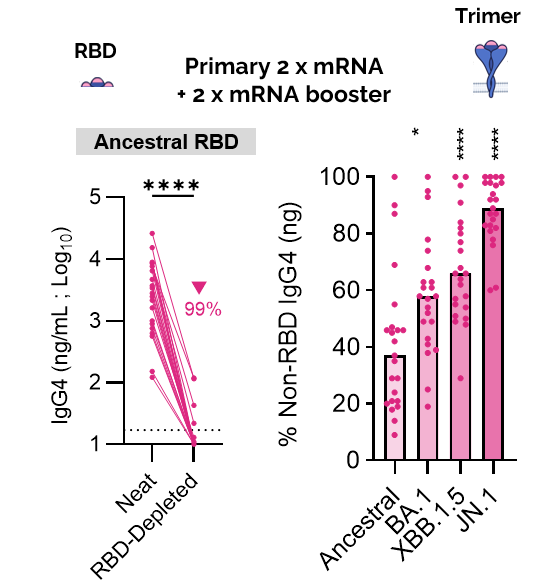
10) 🧵Since mRNA vaccines favor RBD antibodies, we wondered if IgG4 would trend similarly.
So, we depleted our samples of ancestral RBD antibodies (and 90% of cross-reactive Omicron RBD antibodies)
RBD-specific IgG4 responses only formed a majority against the ancestral spike.
So, we depleted our samples of ancestral RBD antibodies (and 90% of cross-reactive Omicron RBD antibodies)
RBD-specific IgG4 responses only formed a majority against the ancestral spike.
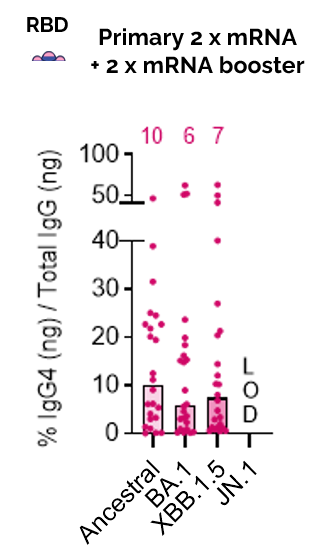
11) 🧵This ancestral-bias was also observed with total IgG responses, highlighting the wider effects of imprinting.
Furthermore, since IgG4 trended similarly to total IgG across all Omicron variants, the proportion of IgG4 antibodies remained fairly similar across variants.
Furthermore, since IgG4 trended similarly to total IgG across all Omicron variants, the proportion of IgG4 antibodies remained fairly similar across variants.
12) 🧵In line with switching from IgG1 >> IgG4, we also show that rising levels of IgG4 antibodies correlated with the decreasing concentrations of IgG1.
This relationship still held true even after we depleted the samples of IgG4, suggesting that it wasn't epitope competition.
This relationship still held true even after we depleted the samples of IgG4, suggesting that it wasn't epitope competition.

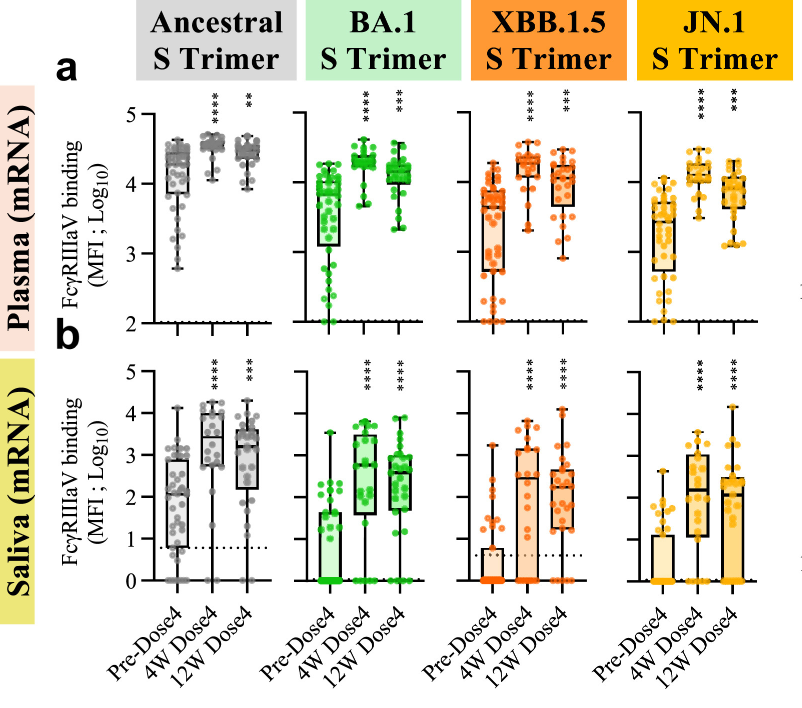
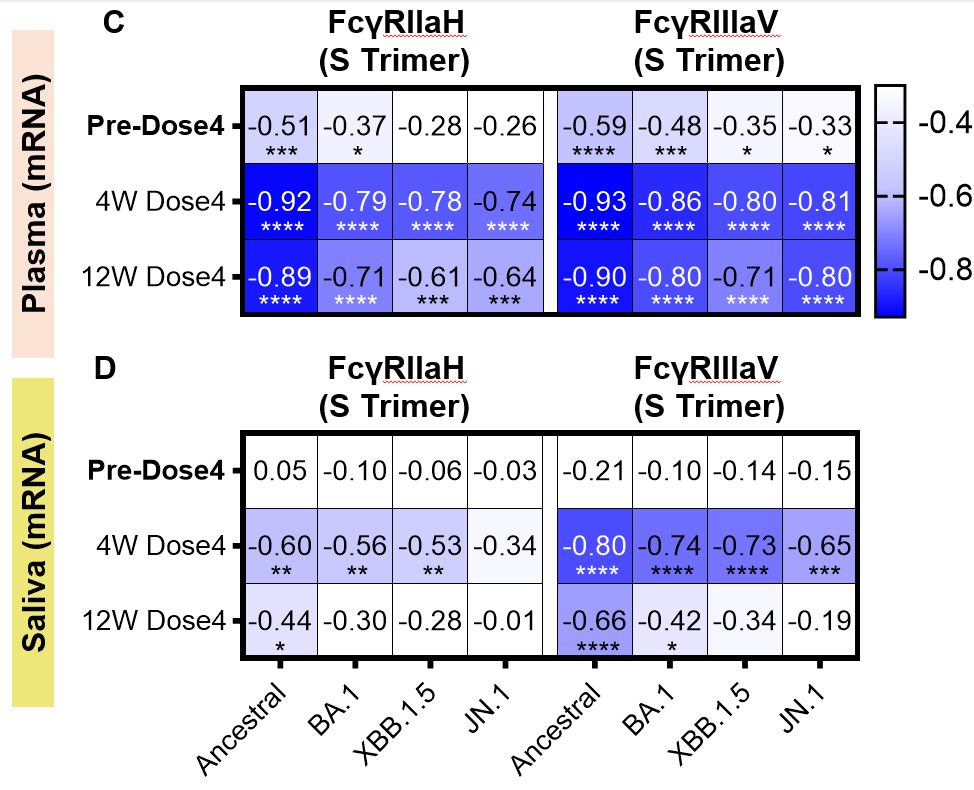
13) 🧵We then assessed Fc-binding responses.
This is a surrogate of how well antibodies would promote non-neutralising responses with immune cells.
Despite increased levels of IgG4, Fc-binding responses still improved significantly following the mRNA booster for up to 12 weeks
This is a surrogate of how well antibodies would promote non-neutralising responses with immune cells.
Despite increased levels of IgG4, Fc-binding responses still improved significantly following the mRNA booster for up to 12 weeks
14) 🧵Unsurprisingly, Fc-binding negatively correlated with increasing proportions of IgG4 (given the poor Fc-binding capacity of IgG4)
However, these associations weakened by 12 weeks, particularly for FcgR2a (CD32) which is largely utilised by phagocytes to clean up infection
However, these associations weakened by 12 weeks, particularly for FcgR2a (CD32) which is largely utilised by phagocytes to clean up infection
15) 🧵Since IgG4 antibodies were cross-reactive across Omicron variants, we wondered if this cross-reactivity would extend to other coronaviruses.
So, we tested IgG4 binding to Sarbecoviruses from bats & pangolins, which are related to SARS-CoV-2 and may potentially spill over.
So, we tested IgG4 binding to Sarbecoviruses from bats & pangolins, which are related to SARS-CoV-2 and may potentially spill over.
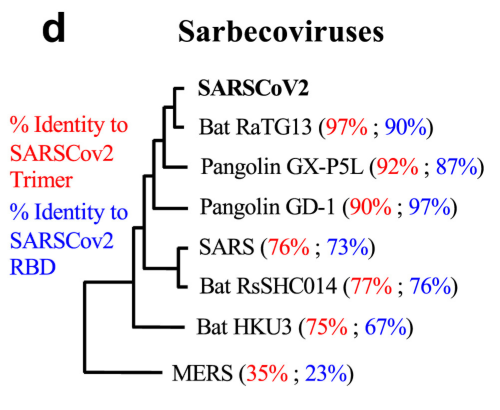
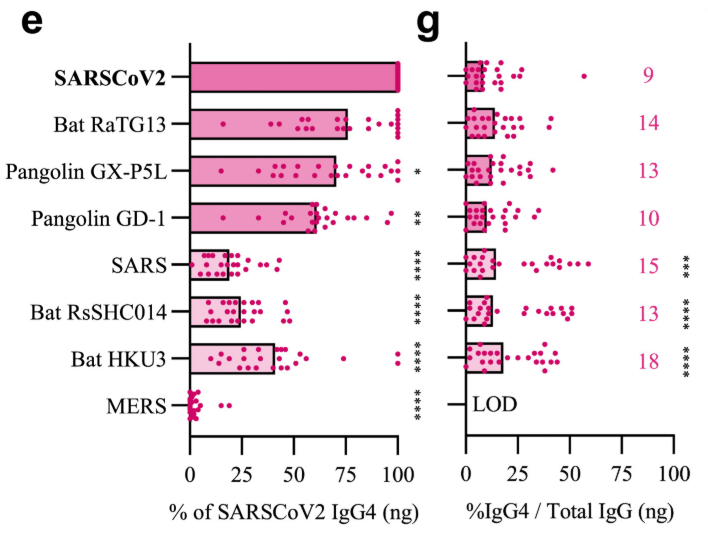
16) 🧵Indeed, IgG4 was cross-reactive across Sarbecoviruses, particularly those more similar to SARS-CoV-2.
This trended similarly with total IgG responses, resulting in similar proportions of IgG4 being observed across Sarbecoviruses.
This trended similarly with total IgG responses, resulting in similar proportions of IgG4 being observed across Sarbecoviruses.
17) 🧵Importantly, Fc-binding responses towards Sarbecoviruses also increased significantly following the COVID-19 mRNA booster, which might provide some non-neutralising protection.
Though, we did also observe negative correlations between rising IgG4 and Fc-binding responses.
Though, we did also observe negative correlations between rising IgG4 and Fc-binding responses.
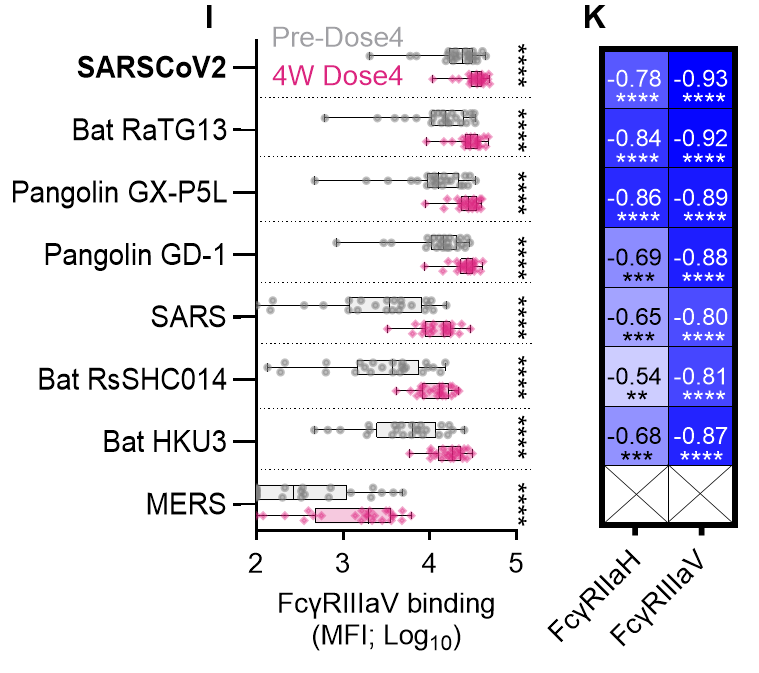
18) 🧵We also checked if cross-reactive IgG4 could also target other seasonal human coronaviruses.
While some cross-reactive IgG4 binding was observed for HKU1 and OC43 (which also beta-coronaviruses), it was a smaller proportion than that observed for SARS-CoV-2.
While some cross-reactive IgG4 binding was observed for HKU1 and OC43 (which also beta-coronaviruses), it was a smaller proportion than that observed for SARS-CoV-2.

19) 🧵As a majority of IgG4 targeting the ancestral spike was RBD-specific, we wondered if IgG4 could play a larger role in neutralisation.
Using blocking antibodies/nanobodies, we show that most RBD-specific IgG4 targets the receptor binding motif (green; part binding to cells)
Using blocking antibodies/nanobodies, we show that most RBD-specific IgG4 targets the receptor binding motif (green; part binding to cells)

20) 🧵However, despite similar proportions of RBD-specific IgG4 to total IgG across Omicron variants, the depletion of IgG4 antibodies from our samples had a much greater loss in the neutralising activity against the ancestral virus than Omicron variants tested (BA.1, XBB.1.5).
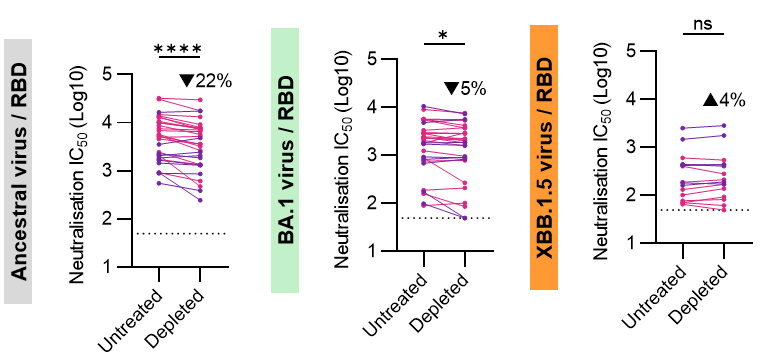
21) 🧵Despite this, we still observed negative correlations between the increasing proportions of IgG4 present in our samples and the neutralising activity against the viruses tested.
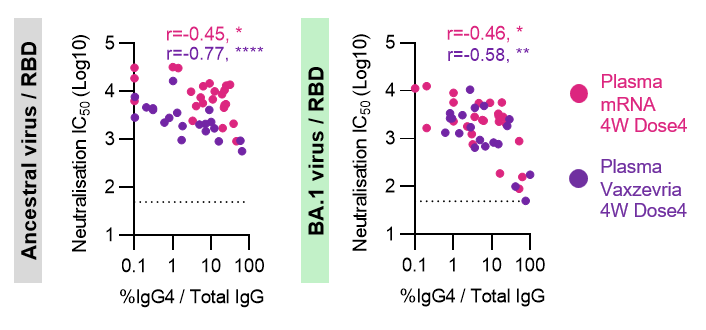
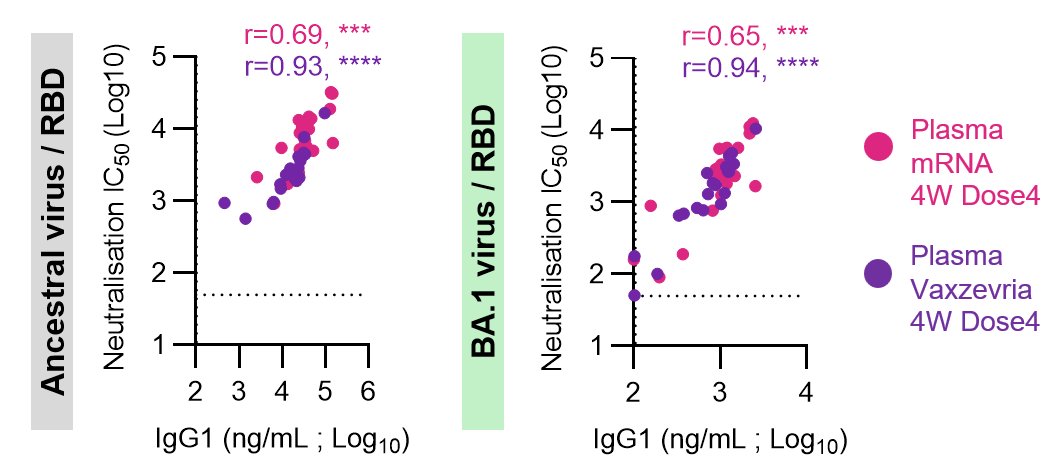
22) 🧵In contrast, neutralising activity was positively correlating with the amount of IgG1 present in our samples.
As before, with the whole spike trimer (12 🧵), the binding levels of RBD-specific IgG4 was also negatively correlating with that for RBD-specific IgG1.
As before, with the whole spike trimer (12 🧵), the binding levels of RBD-specific IgG4 was also negatively correlating with that for RBD-specific IgG1.
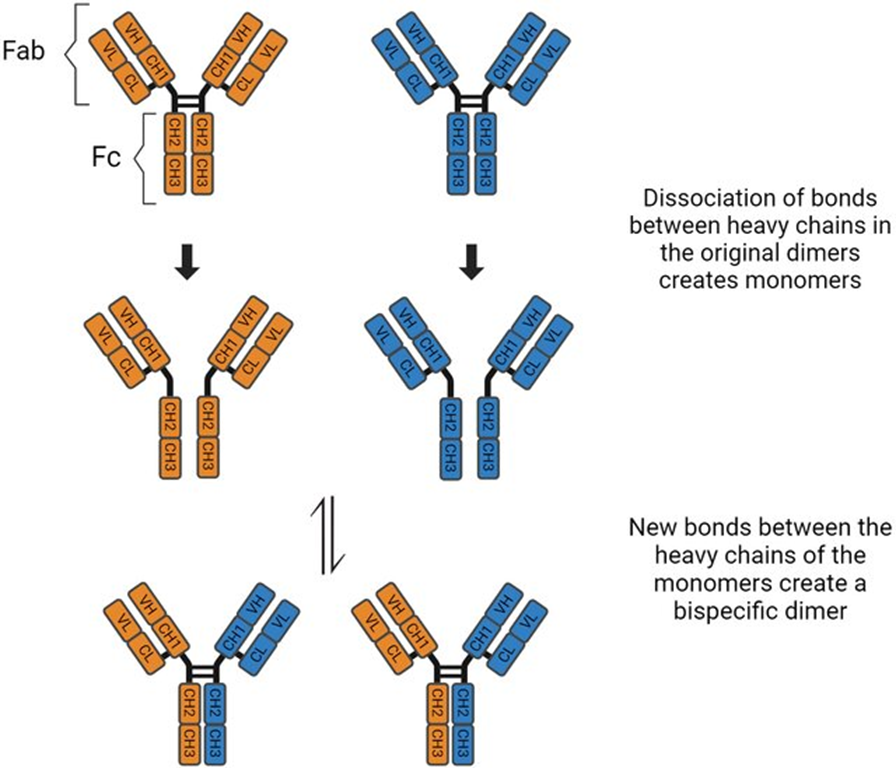
23) 🧵In contrast to other IgGs, IgG4 naturally dissociates into monomers and recombines randomly to form new bispecific IgG4 dimers (Fab arm exchange).
While this rapidly amplifies the amount of IgG4 against conserved allergens, it could weaken IgG4's binding to viral variants.
While this rapidly amplifies the amount of IgG4 against conserved allergens, it could weaken IgG4's binding to viral variants.
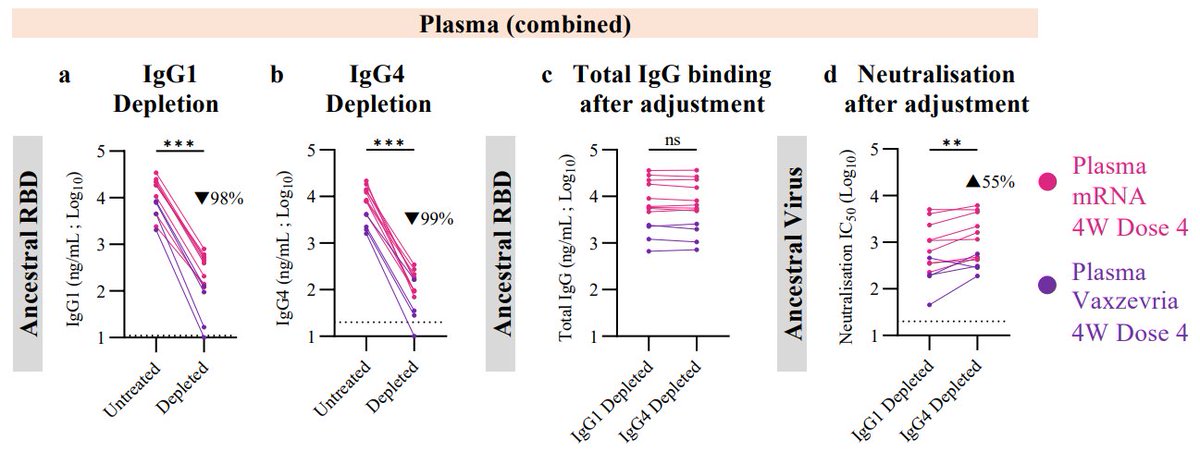
23) 🧵To explore this, we depleted IgG1 & IgG4 respectively from our samples.
Each pair of depleted fractions was adjusted to have similar total IgG binding to RBD, and used in neutralisation.
The fraction enriched in IgG4 (IgG1 depleted) neutralised poorer than its counterpart
Each pair of depleted fractions was adjusted to have similar total IgG binding to RBD, and used in neutralisation.
The fraction enriched in IgG4 (IgG1 depleted) neutralised poorer than its counterpart
24) 🧵In all, mRNA boosters still provided an overall improvement in both non-neutralising and neutralising responses against Omicron variants in our cohorts.
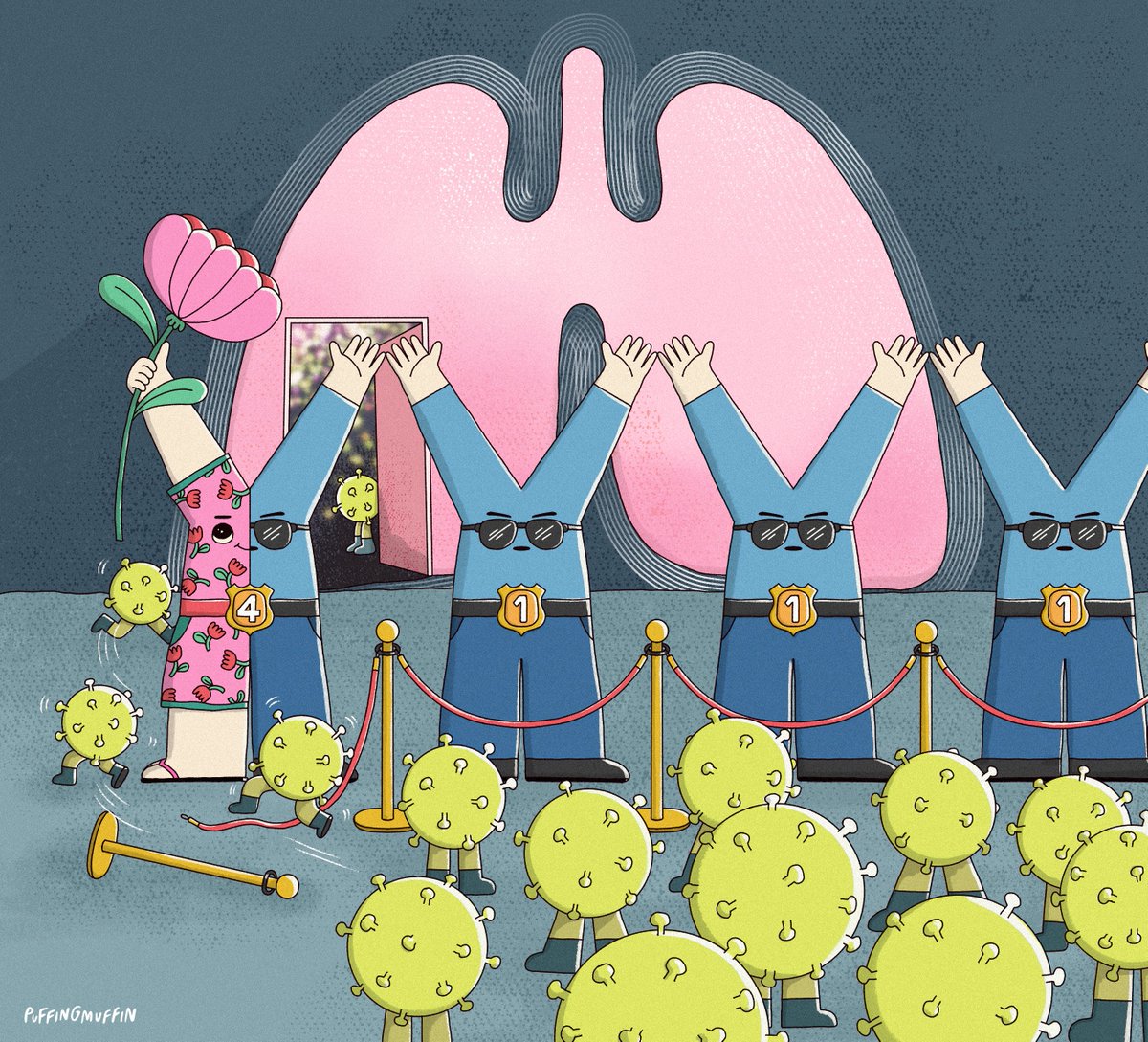
However, individuals who class-switch from IgG1 >> IgG4 may not be receiving the best possible gains from their booster.
However, individuals who class-switch from IgG1 >> IgG4 may not be receiving the best possible gains from their booster.
Huge thanks to the large collarative effort @WenShiLee @viralvaxlab @tham_lab @AmyWChung @DrLauraDownie
• • •
Missing some Tweet in this thread? You can try to
force a refresh




