People are asking ChatGPT, Grok, and other LLMs for contractor recommendations now.
"Who's the best plumber in Phoenix?"
If your business shows up nowhere online, you don't get recommended.
Here's how to fix that:
"Who's the best plumber in Phoenix?"
If your business shows up nowhere online, you don't get recommended.
Here's how to fix that:
LLMs work slightly differently than Google.
Google Maps ranks websites based on proximity, relevance, and authority.
ChatGPT, Gemini, and Google's AI Overviews use the same ranking criteria, BUT they pull from different sources.
They look at:
> News articles
> Press releases
> Brand mentions across the web
> Authoritative local sources
> Public social content
A business with 50 blog posts about "signs you need a new roof" probably won't show up.
A business mentioned in the local newspaper for sponsoring a charity event probably will.
Here's the playbook to get your business recommended by AI.
Google Maps ranks websites based on proximity, relevance, and authority.
ChatGPT, Gemini, and Google's AI Overviews use the same ranking criteria, BUT they pull from different sources.
They look at:
> News articles
> Press releases
> Brand mentions across the web
> Authoritative local sources
> Public social content
A business with 50 blog posts about "signs you need a new roof" probably won't show up.
A business mentioned in the local newspaper for sponsoring a charity event probably will.
Here's the playbook to get your business recommended by AI.
1. Digital PR over traditional link building.
Traditional SEO agencies build backlinks from random high DA blogs.
That can help with Google domain authroity, but it does almost nothing for AI visibility.
LLMs pull from sources that look like real news and trusted publications.
Here's how to get there:
Publish press releases for literally anything:
> 10 years in business
> General brand awareness
> New service area expansion
> New hire announcement
> Community involvement
The topic honestly doesn't matter.
Use a distribution service like EIN Presswire or PRWeb.
These get picked up by news aggregators and indexed across dozens of sites.
Each one becomes a data point that AI models can pull from.
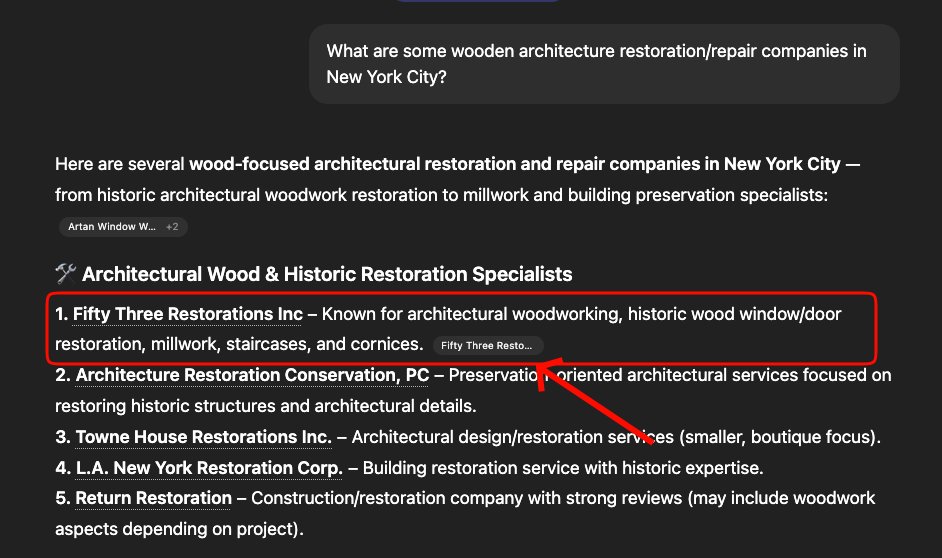
The screenshot below is of ChatGPT referencing a PR article we put out for a client. It has them ranking #1 in ChatGPT search.
Traditional SEO agencies build backlinks from random high DA blogs.
That can help with Google domain authroity, but it does almost nothing for AI visibility.
LLMs pull from sources that look like real news and trusted publications.
Here's how to get there:
Publish press releases for literally anything:
> 10 years in business
> General brand awareness
> New service area expansion
> New hire announcement
> Community involvement
The topic honestly doesn't matter.
Use a distribution service like EIN Presswire or PRWeb.
These get picked up by news aggregators and indexed across dozens of sites.
Each one becomes a data point that AI models can pull from.
The screenshot below is of ChatGPT referencing a PR article we put out for a client. It has them ranking #1 in ChatGPT search.
2. Publish listicle articles that mention your business.
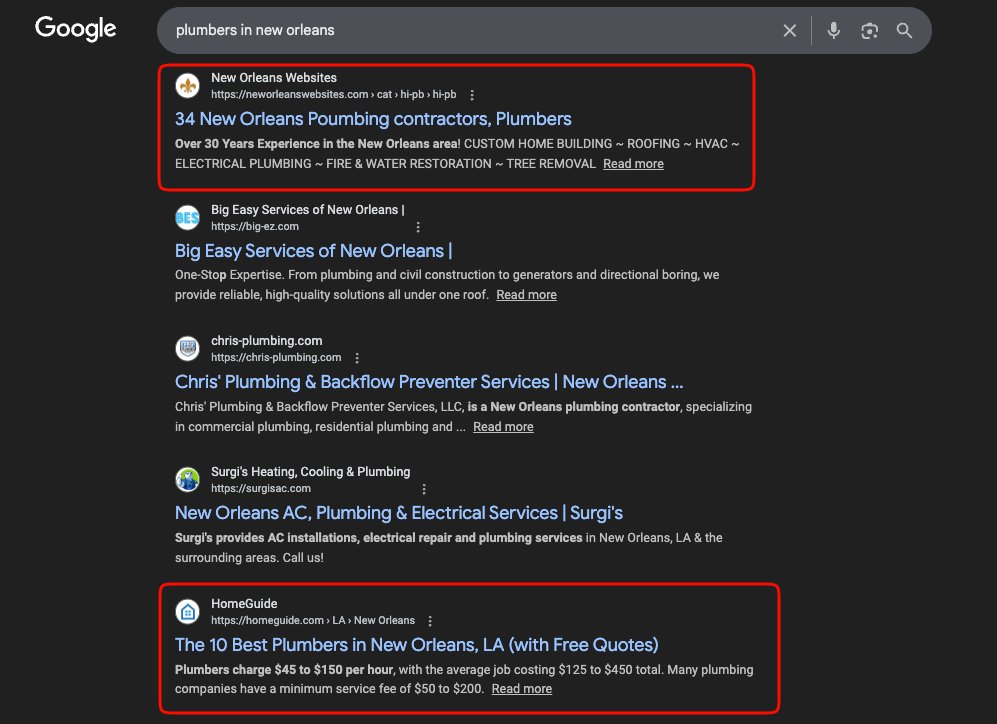
LLMs pull heavily from "best of" style content.
"Best plumbers in Phoenix"
"Top HVAC companies in Dallas"
When someone asks ChatGPT for a recommendation, it often summarizes these listicles.
Here's the play:
Create your own listicle content.
Publish it on your website blog, or parasites like Medium. You can even guest post on local/industry sites.
Title format: "Best [Service] in [City]: Top [Number] Companies for 2025"
Include yourself on the list, either first or second. Ideally, you have a proxy business (lead gen business) listed first and yours listed second.
Include real competitors with genuine pros and cons.
This adds legitimacy.
Write an actually useful description for your company, and less useful descriptions for the other company.
Google and LLMs can tell when a listicle is low effort spam versus genuinely helpful.
Publish 2 to 3 of these targeting different services.
"Best emergency plumbers in Scottsdale"
"Best water heater installers in Scottsdale"
Each one becomes another data point feeding AI models your business name connected to your service and city.
LLMs pull heavily from "best of" style content.
"Best plumbers in Phoenix"
"Top HVAC companies in Dallas"
When someone asks ChatGPT for a recommendation, it often summarizes these listicles.
Here's the play:
Create your own listicle content.
Publish it on your website blog, or parasites like Medium. You can even guest post on local/industry sites.
Title format: "Best [Service] in [City]: Top [Number] Companies for 2025"
Include yourself on the list, either first or second. Ideally, you have a proxy business (lead gen business) listed first and yours listed second.
Include real competitors with genuine pros and cons.
This adds legitimacy.
Write an actually useful description for your company, and less useful descriptions for the other company.
Google and LLMs can tell when a listicle is low effort spam versus genuinely helpful.
Publish 2 to 3 of these targeting different services.
"Best emergency plumbers in Scottsdale"
"Best water heater installers in Scottsdale"
Each one becomes another data point feeding AI models your business name connected to your service and city.
3. Get recommended in Facebook groups and Reddit.
This one is underrated.
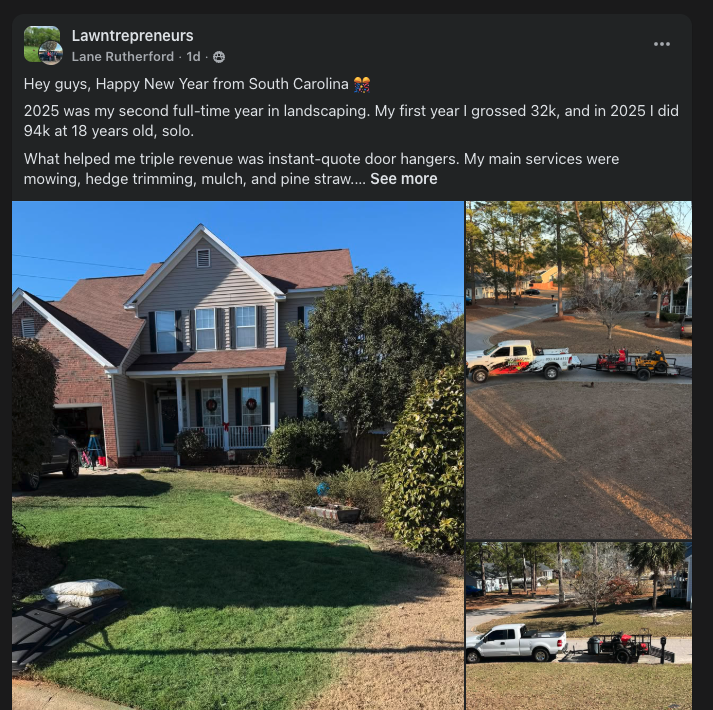
LLMs train on public social content.
Every time someone says "We used ABC Plumbing last month, highly recommend" in a local Facebook group, that becomes training data.
You can't control this directly (just kidding).
After every job, ask happy customers if they're in any local neighborhood groups.
"If anyone ever asks for a plumber recommendation, we'd appreciate you mentioning us."
Most people are happy to help if you did good work.
You can also manipulate this yourself by posting organically from real looking local accounts.
One organic recommendation in a Facebook group is worth more than 10 of your own posts.
It's also worth more than paid ads for AI visibility.
This one is underrated.
LLMs train on public social content.
Every time someone says "We used ABC Plumbing last month, highly recommend" in a local Facebook group, that becomes training data.
You can't control this directly (just kidding).
After every job, ask happy customers if they're in any local neighborhood groups.
"If anyone ever asks for a plumber recommendation, we'd appreciate you mentioning us."
Most people are happy to help if you did good work.
You can also manipulate this yourself by posting organically from real looking local accounts.
One organic recommendation in a Facebook group is worth more than 10 of your own posts.
It's also worth more than paid ads for AI visibility.
4. Multiplatform reviews.
Yes, Google reviews are still king for Google Maps (and LLMs).
But LLMs are also pulling from sites like Yelp and TrustPilot.
Might as well get reviews there as well to help your chances of ranking.
For now, prioritize Google reviews.
But try to sprinkle in some Yelp reviews every now and then.
Yes, Google reviews are still king for Google Maps (and LLMs).
But LLMs are also pulling from sites like Yelp and TrustPilot.
Might as well get reviews there as well to help your chances of ranking.
For now, prioritize Google reviews.
But try to sprinkle in some Yelp reviews every now and then.
If you want my help getting you ranked #1 on ChatGPT and LLMs, book a consultation with me: sustain-media.com/calendar.html
• • •
Missing some Tweet in this thread? You can try to
force a refresh