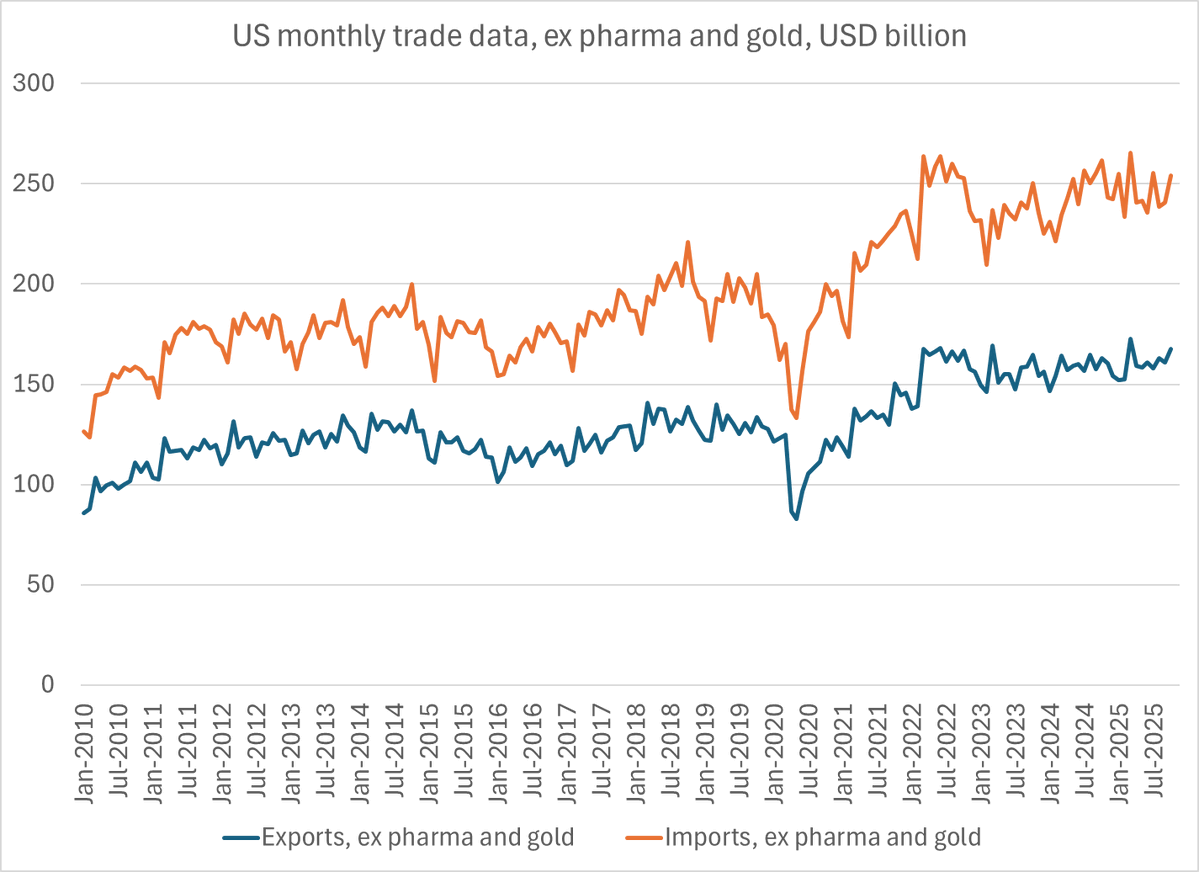
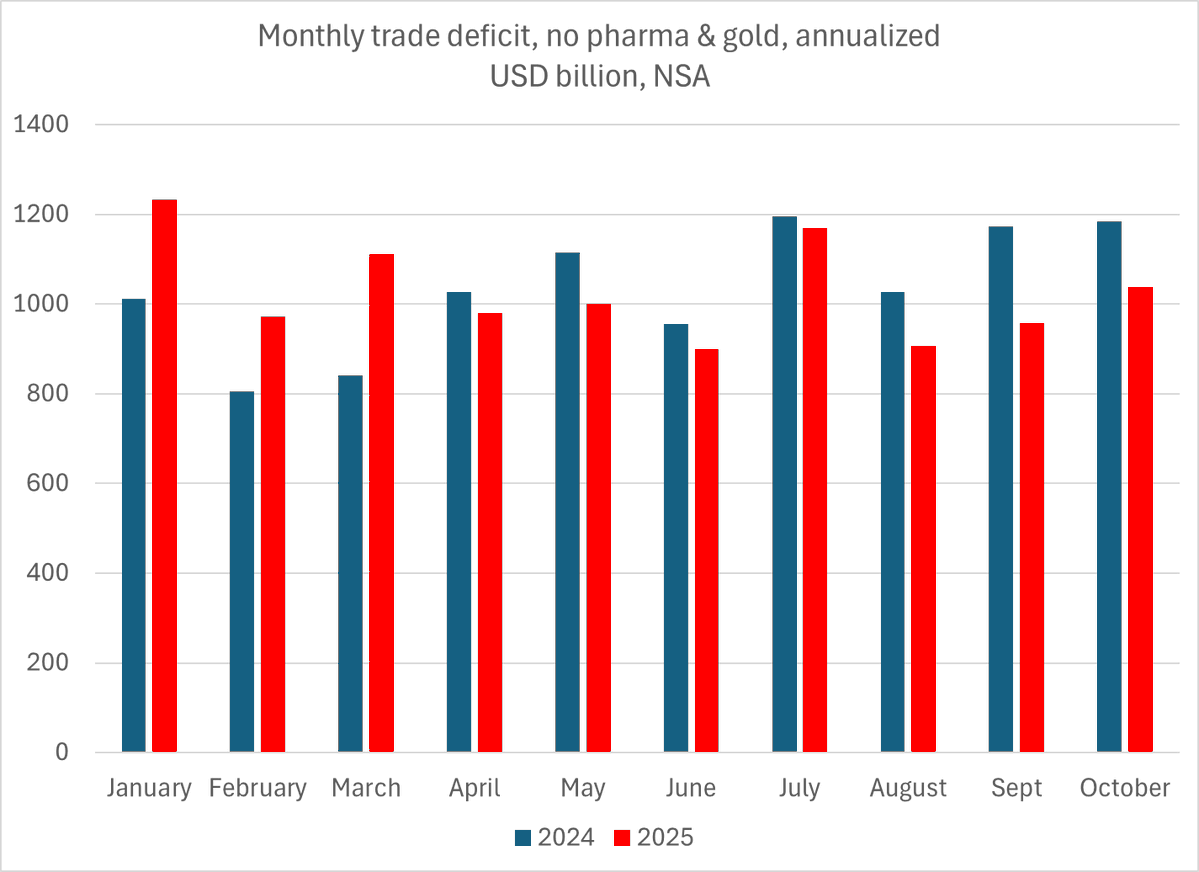
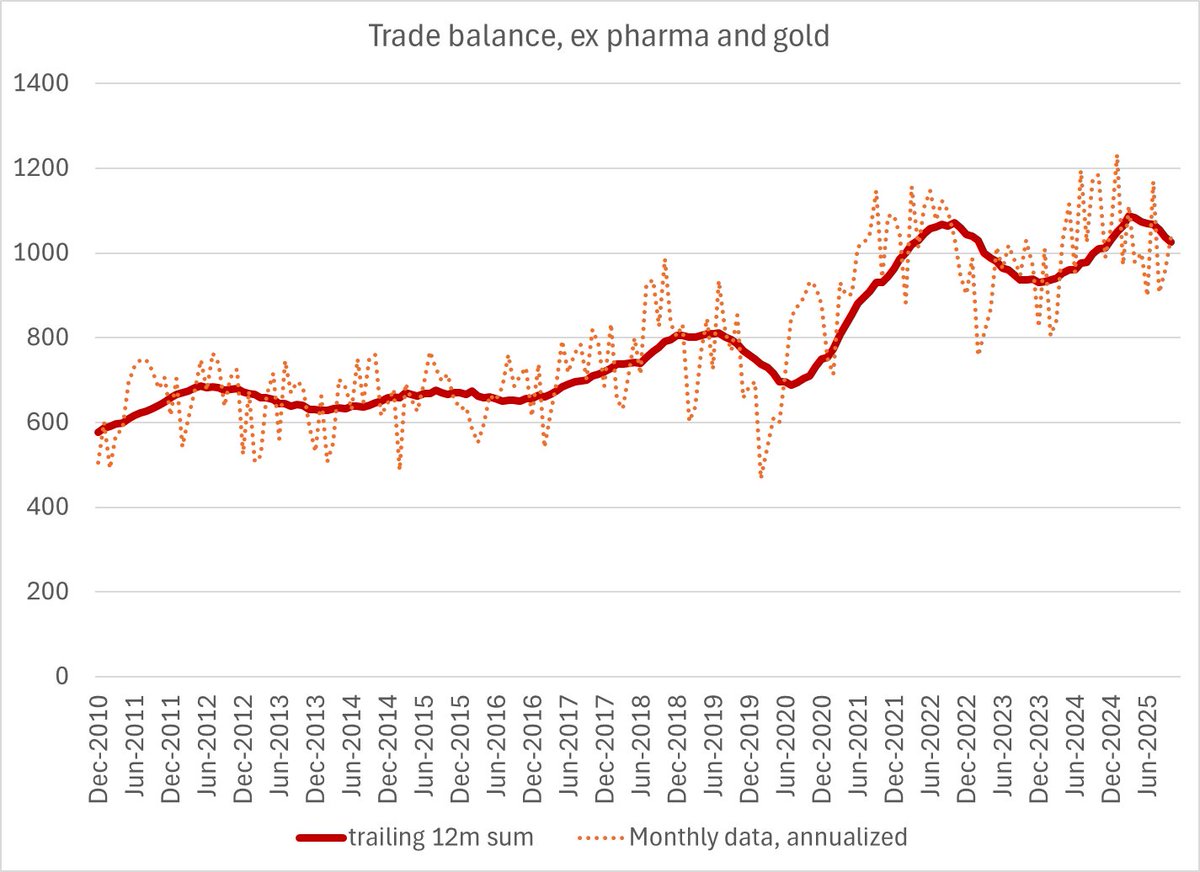
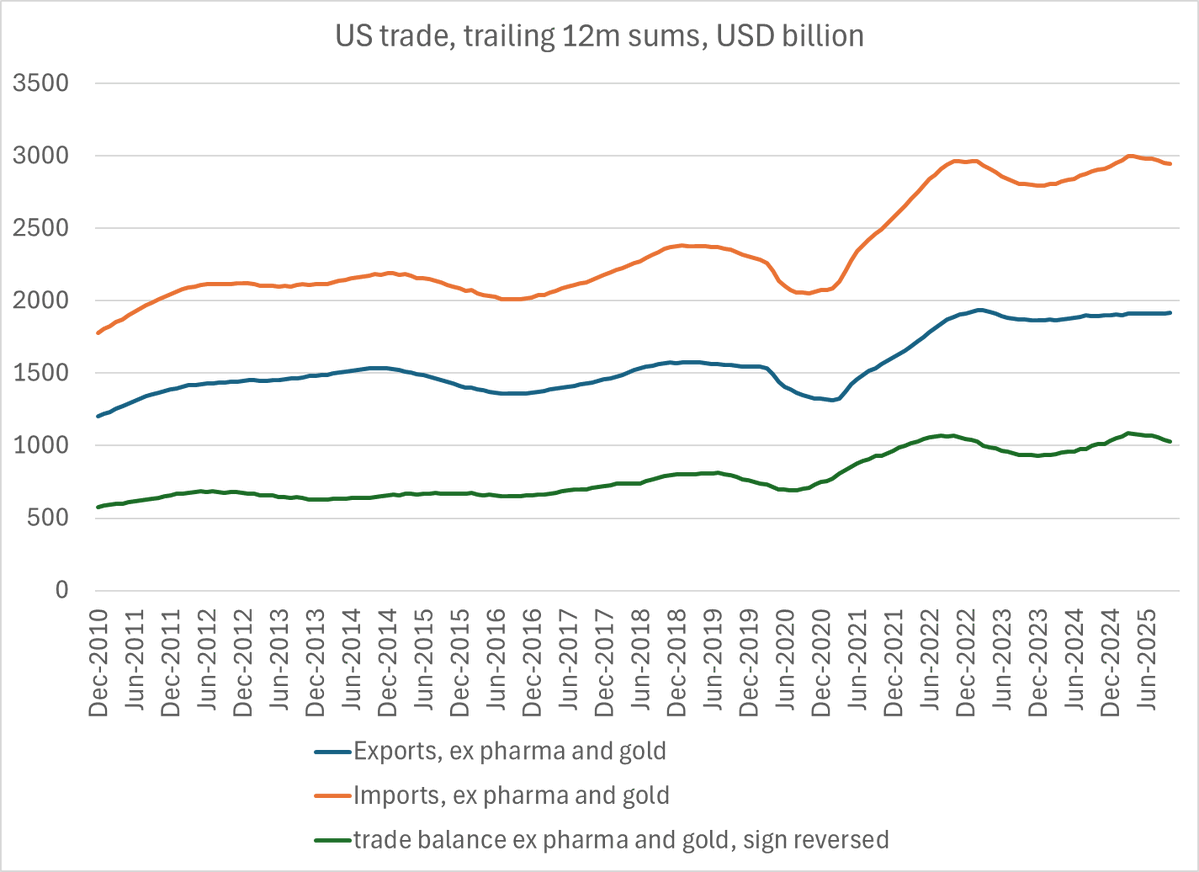
Ok, it is clear what happened in the October trade data
Imports of pharma collapsed, bring the pharma trade deficit WAY down (reversing the q1 front running); exports of gold soared, generating a big gold surplus
1/
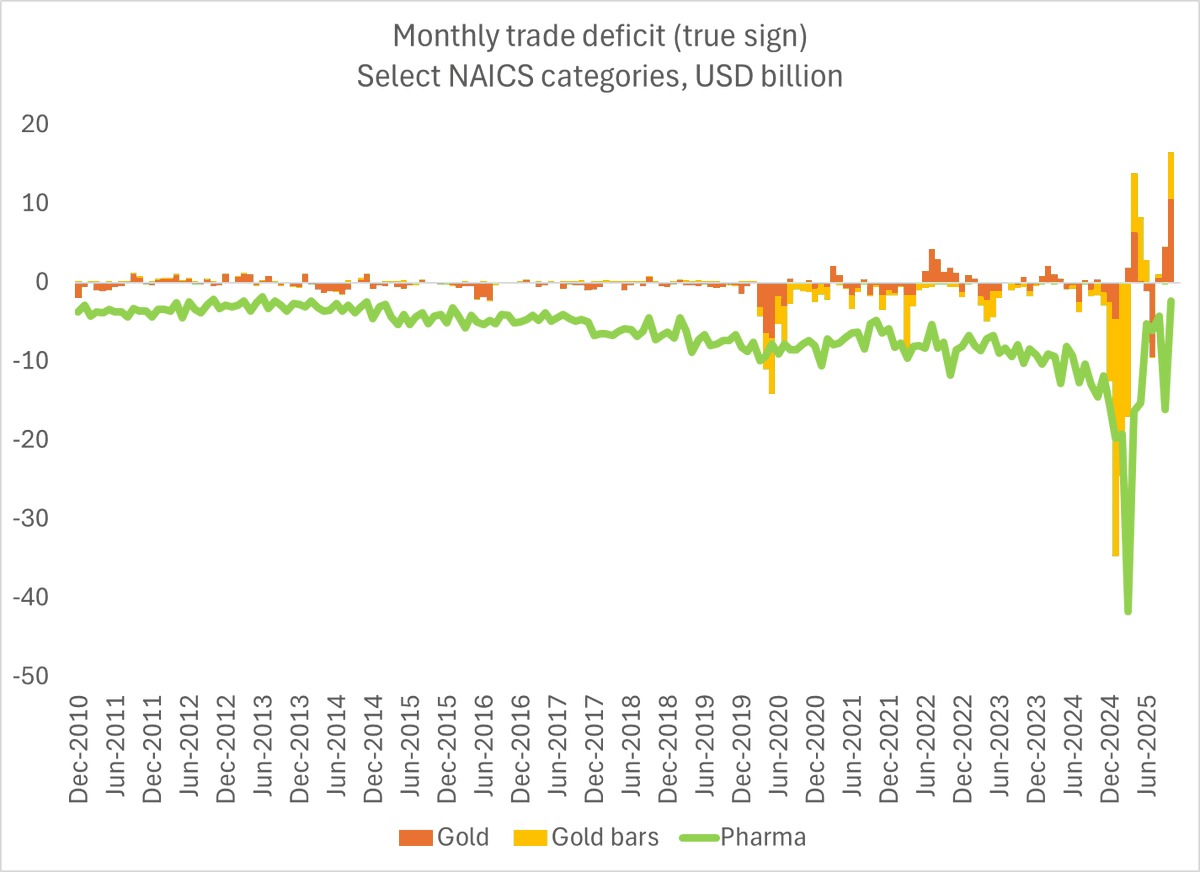
Net all the pharma noise out and imports remain flattish (up a bit in October v September) at a high level and exports are more or less flat too -- maybe there is a tiny upward trend since May but it is tiny
2/
The no pharma or gold trade deficit is down a bit v 2025 (there was a bit of front running in other categories too -- see Jan v March) but actually up a bit v September
3/
If the administration wanted to make a serious case that adjustment has started, they can show a down trend ex pharma and gold (pharma will still be up for the year tho, impacting the overall number) -- 2025 will likely be close to 2024 (peak in q1)
4/
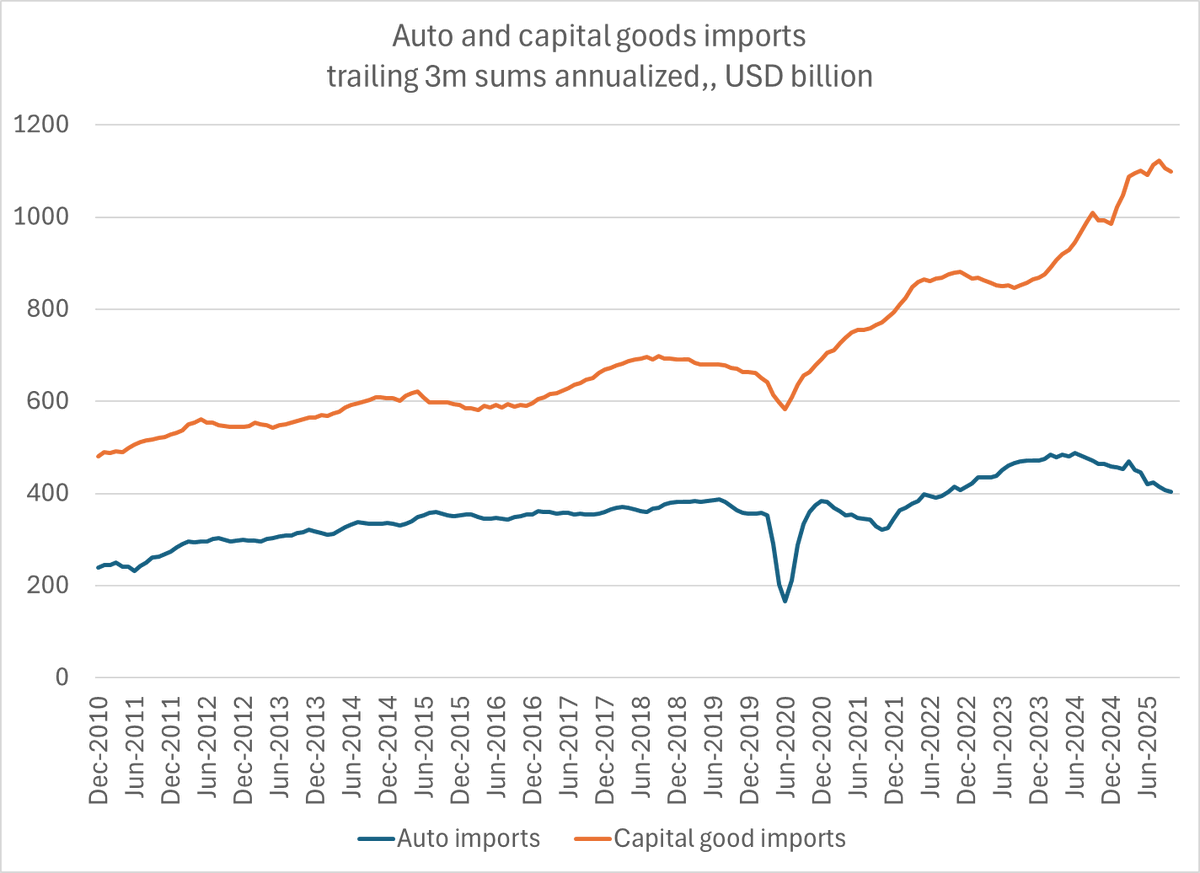
Auto imports remain weak (alas so it auto demand, there isn't a domestic auto boom) b/c of the tariffs (adjustment) --
I was expecting capital goods imports to rise in October on the AI investment boom/ more chip imports but it wasn't in the data. Expect it in November 5/
Bottom line -- analysis of the US trade data right now requires a pharma and a gold (and probably an "all precious metals") adjustment
6/6
• • •
Missing some Tweet in this thread? You can try to
force a refresh

$15b in December works out to $175b a year annualized
the surplus in 2024 was already large -- yet it was "only" around $50b
AI bubble or not, that is a ton cash
1/
for the year, Taiwan's surplus will more than double -- from ~ $50b to over $100b. and the q4 surplus annualized is WAY higher, at around $175b. That is a crazy number for a country that already had a bit external surplus and has a lot of investment income
2/
In a sane world, the massive increase in Taiwan's trade surplus would lead to a stronger Taiwan dollar
But that isn't what is happening. The lifers, with $700b in foreign assets, are hedging less & that generates a flow that pushes the TWD down
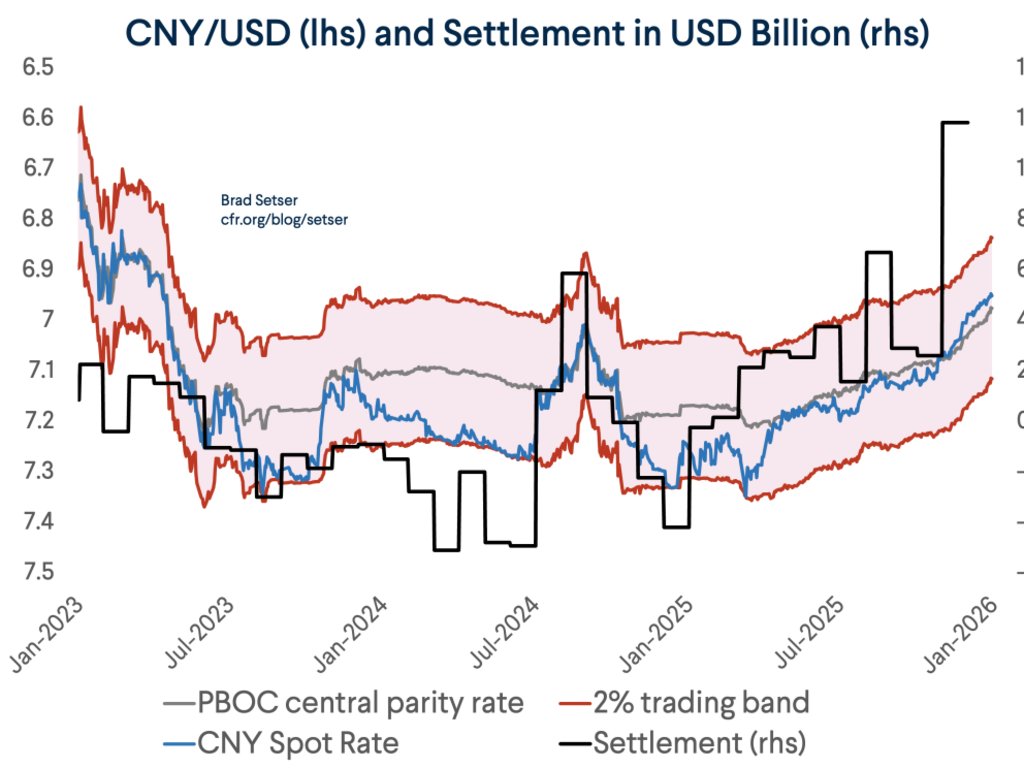
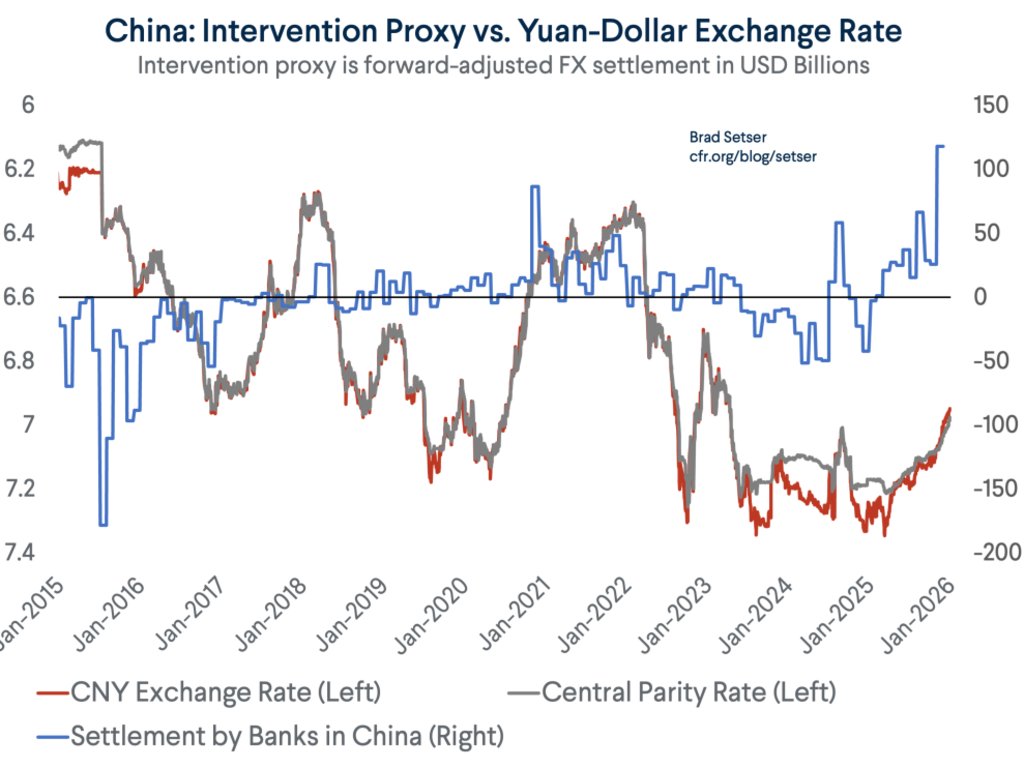
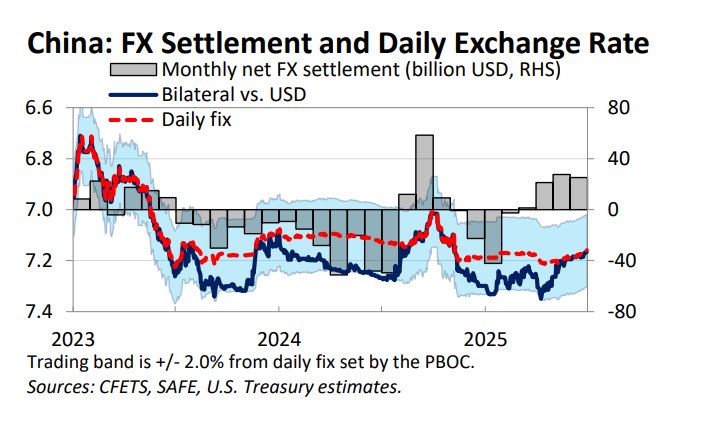
The appreciation of the yuan (against the dollar) in the second half of 2025 -- and particularly in December -- has attracted a bit of attention.
(h/t to @Mike_Weilandt for the chart)
1/ many
It isn't like the yuan's appreciation against the dollar has been particularly fast. But it has been steady. And a predictable no volatility appreciation that exceeds the loss from the rate differential is bound to get attention
2/
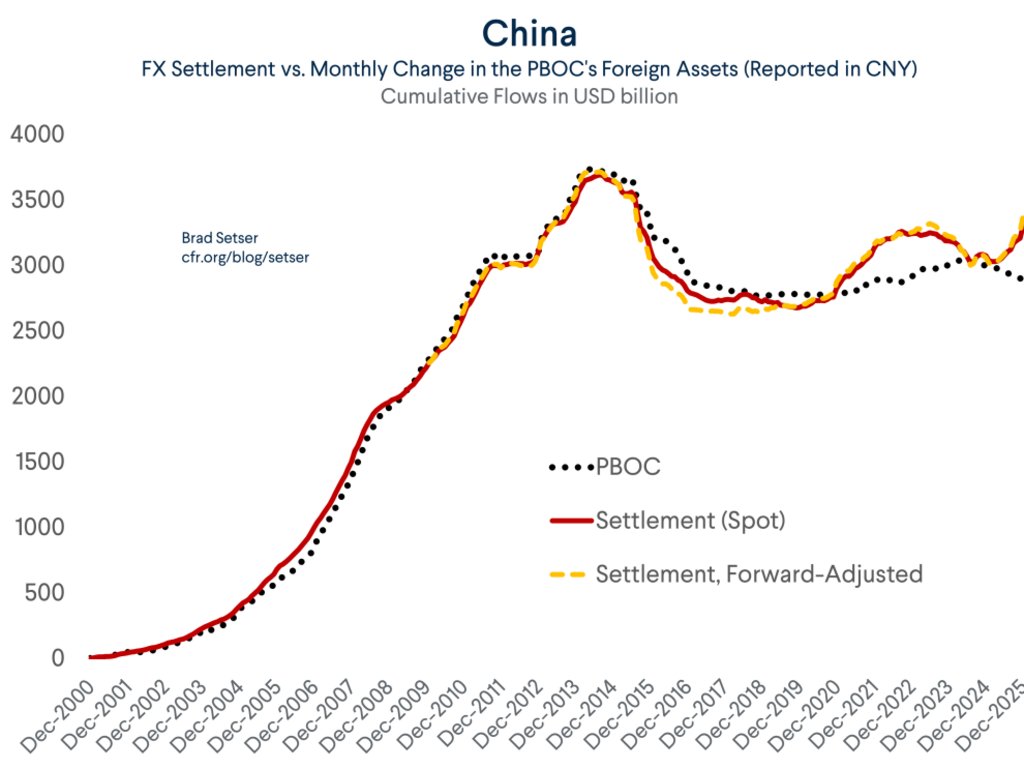
It will be interesting to see the numbers for fx settlement in December. The number of reports of activity in the market (dollar buying to limit appreciation) by state banks in say Bloomberg's fx coverage picked up in December.
Saudi Arabia's q3 current account numbers are out, and they -- unsurprisingly -- showed an ongoing deficit.
My rough estimate for Saudi Arabia's current account break even (the oil price that results in external balance) continues to be over $90 a barrel
1/x
A reminder -- the external break even is calculating using reported oil export revenues, the non-oil current account, and net exports (my numbers there are dependent on getting regular updates from @Rory_Johnston )
2/
@Rory_Johnston i.e. Saudi Arabia needs $250 billion a year in export receipts from oil to balance its current account -- and that is much more than it gets with oil at ~ $60 a barrel
There is a lot of talk -- not the least from the US Administration -- about the windfall from Venezuela's oil. It is worth doing a bit of (boring) quantification.
Bottom line: it isn't going to pay for everything ...
1/
Venezuela's oil is heavy and sour, so it trades at a discount to sweet light.
2024 production was 0.9 mbd. Domestic consumption isn't zero. To generous, assume 0.75 mbd at day at $50 a barrel -- that generates $14 billion a year in exports.
2/
Industry experts (@Big_Orrin ) think the upper bound on how much additional production could be generated if the international oil service giants came in to revitalize the fields is ~ 1 mbd, or a ~$18b
3/
Interesting comments from South Korea's Rhee (central bank governor). Seems like there is a level of the won that is too weak even for Korea ...
1/ many
Rhee also emphasized the foreign exchange implications of Korea's investment pledge (part of its "deal" with Lutnick and Trump). Rhee "vowed to oppose any US investment decisions that could threaten the stability of the foreign-exchange market"
2/
I share Governor Rhee's misgivings -- explicitly relying on Korea (and Japan and perhaps Taiwan) to finance investment in the US -- if it actually happens (incentives aren't well aligned) likely implies accepting continued trade imbalances ...
Second Peter's comment. Xi is not for turning. The question is how China's trading partners -- not just the US -- react. Suspect France and Germany will set the direction of policy in 2026 ...
China's top leadership seems convinced that there is a "fortress" in one country global equilibrium -- where China exports (and controls key supply chains) but doesn't import (at least not much beyond oil and iron)
2/
But I am a bit skeptical that a China that doesn't import yet continues to export is a sustainable equilibrium, politically or economically.
Note that a constant 1 to 1.5 pp net export contribution implies an ever widening trade surplus