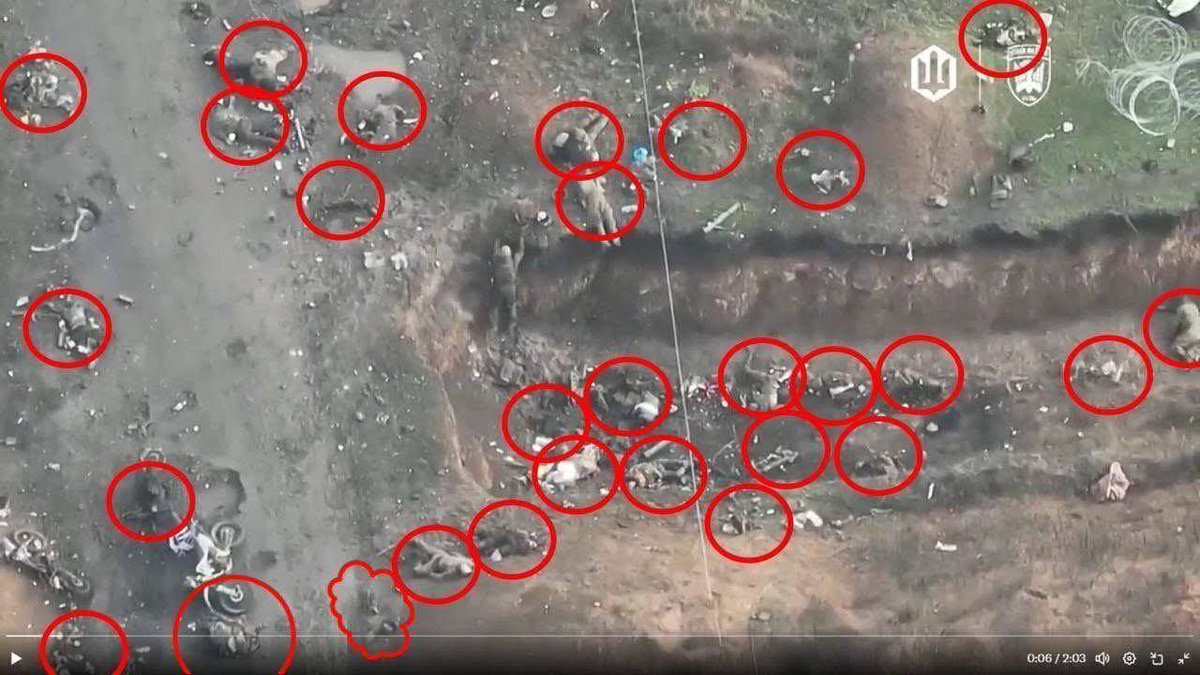
“…almost everywhere, and their task is to make our offensive as difficult, bloody, and resource-intensive as possible. And this is not just about the ‘drone line’ anymore.
2/
“For example, we are now seeing tactical techniques like this: their artillery is positioned deep in their battle lines, beyond the reach of our main drones, and they keep their own forward positions and key objects on it well-fortified with well-positioned fire.
3/
“Accordingly, as soon as our forces start moving, they knock out an enemy stronghold with drones and go to capture it. The enemy then waits for our forces to enter and eliminates them along with the incoming troops.
4/
“Their drone operators, in turn, not only habitually scavenge on supply and reinforcement routes, but also catch our forces engaged in any activity near ‘formerly ours’ objects.
5/
“Add to this constant mining, including remote detonation, and the active use of ‘ambushers’ on the few (and well-monitored) logistical lines.
6/
“If our forces try to quickly deploy a second echelon - for example, drone operators - the enemy immediately launches a local tactical ‘offensive’ and, even at the cost of losing equipment and personnel, achieves its goal: …
7/
“…preserving the ‘kill zone’ between our forward positions and the nearest rear areas. In Kupiansk, for example, they successfully applied this tactic several times - which led to the current situation there.
8/
“Since this situation repeats itself not once or twice, our forces, at all levels, are increasingly less willing to advance at all, and they can be easily understood - it's an inevitable trade-off of kilometers covered for lives, and very valuable lives of soldiers: …
9/
“…those who actually know and are able to act in this very kill zone (the untrained ones will simply die without any result). Therefore, the problem of ‘map coloring’ is not just about headquarters' lies.
10/
“It's also about the difficult moral choice that commanders make: if I really go all out in an unprepared offensive now, I'll lose many people, but if I just send a few teams forward to plant flags and report on the drone footage about the physical presence at the necessary…
11/
“…positions - I'll save lives and equipment.
However, as a result, this leads to situations where it's impossible to request strikes on already ‘colored’ (i.e., ‘our own’ on the headquarters' maps) positions - …
12/
“…neither by artillery, nor by the Aerospace Forces, nor even by drones. Everything there is already ours! And as a result, we still have to pay with lives.”
13/13
Russian politician and blogger Dmitry Rogozin continues his examination of “Madyar's” adoption of corporate practices and metrics instead of traditional military bureaucracy to achieve battlefield truth.
“In parallel, a large-scale management reform is being carried out. 1/
“Project management is being introduced, personal responsibility is being strengthened, transparent calculation of needs is being automated, redundant positions are being cut, and the role of analytics is being enhanced.
2/
“In essence, the Ukrainian leadership is striving to replace the traditional military bureaucracy with a corporate management model.
3/
FPV drones have risen from an obscure hobby of racing drones to the mass production of millions and dominance of the Ukrainian battlefield.
However, cheap but lethal FPVs are rapidly being assimilated by terrorist and separatist organizations, cartels, and criminal gangs. 1/
In the Sahel, al-Qaeda-linked Jama’at Nusrat al-Islam wal-Muslimin (JNIM) has used FPV drones armed with explosive warheads against fortified positions.
This marks a significant shift from indirect IED warfare to long-range precision-guided strikes. 2/
Other regional jihadist actors, including elements tied to Al-Qaeda in the Islamic Maghreb (AQIM), Islamic State West Africa Province (ISWAP), and Boko Haram, have adopted similar FPV systems.
Commercial quadcopters have been adapted into guided kamikaze attack platforms. 3/
Russian blogger Dmitry Rogozin compares Ukraine's Unmanned Systems Forces Commander “Madyar’s” use of statistics-based management, transparency of data, and confirmed results of operations with the Russian inheritance from the Soviets of the “operational lie”: 1/
“In early 2026, one of the key commanders of the Ukrainian drone units, … Brody-Madyar, published a programmatic text in which he detailed his vision of the development of the war against Russia for the next year.
2/
“This material is noteworthy not for its grandiose slogans or emotional rhetoric, but for its pronounced pragmatism - today, for the readers of my Telegram channel, we will analyze it together with the head of the Unmanned Systems Service at the ‘Bars-Sarmat’..
3/
Russian millogger Alexei Zhivoff has nostalgia for the good old days of early 2023 before the small drone revolution completely changed the landscape of the War in Ukraine.
“Drones That Changed Everything,
Nostalgia
Spring 2023, the left bank of the Kherson River. 1/
“The enemy is no more than five kilometers away as the crow flies. We maintain night camouflage and head to the rear positions of the airborne troops. Driving at night without headlights is a special ‘pleasure.’
2/
“I already understand: before drones, arriving at the front lines was literally ‘war in luxury style.’
The next day, we reach the road along the Dnieper. The enemy is no more than two kilometers away from this road—technically, driving is allowed.
3/
Ukraine’s Minister of Defense Mykhailo Fedorov reports that SpaceX and Elon Musk have quickly agreed to resolve the Russian UAV use of Starlink satellites.
“The Ministry of Defense, together with SpaceX, is already addressing the issue of using Starlink on Russian UAVs. 1/
“A few hours after the appearance of Russian drones with Starlink connectivity over Ukrainian cities, the Ministry of Defense team promptly contacted SpaceX and proposed solutions to this problem.
2/
“I am grateful to SpaceX President Gwynne Shotwell and Elon Musk personally for their quick response and the start of work on resolving the situation. 2/
Fresnel zones significantly affect control and video communications with FPV drones.
Fresnel zones are volumes of space between a transmitter and receiver in which any obstacles interfere with a signal even if radio line-of-sight (LOS) is clear. 1/
Trees, buildings, terrain, and even vehicles within this zone can interfere because radio waves propagate as expanding wavefronts.
Waves therefore arrive at the receiver via slightly different paths, but they interfere constructively if the zone is clear. 2/
Obstacles within the zone cause diffraction (bending or scattering of waves around edges), so some waves arrive out of phase.
They also cause reflections, in which secondary signals bounce off the obstacle and interfere destructively with the direct signal. 3/