
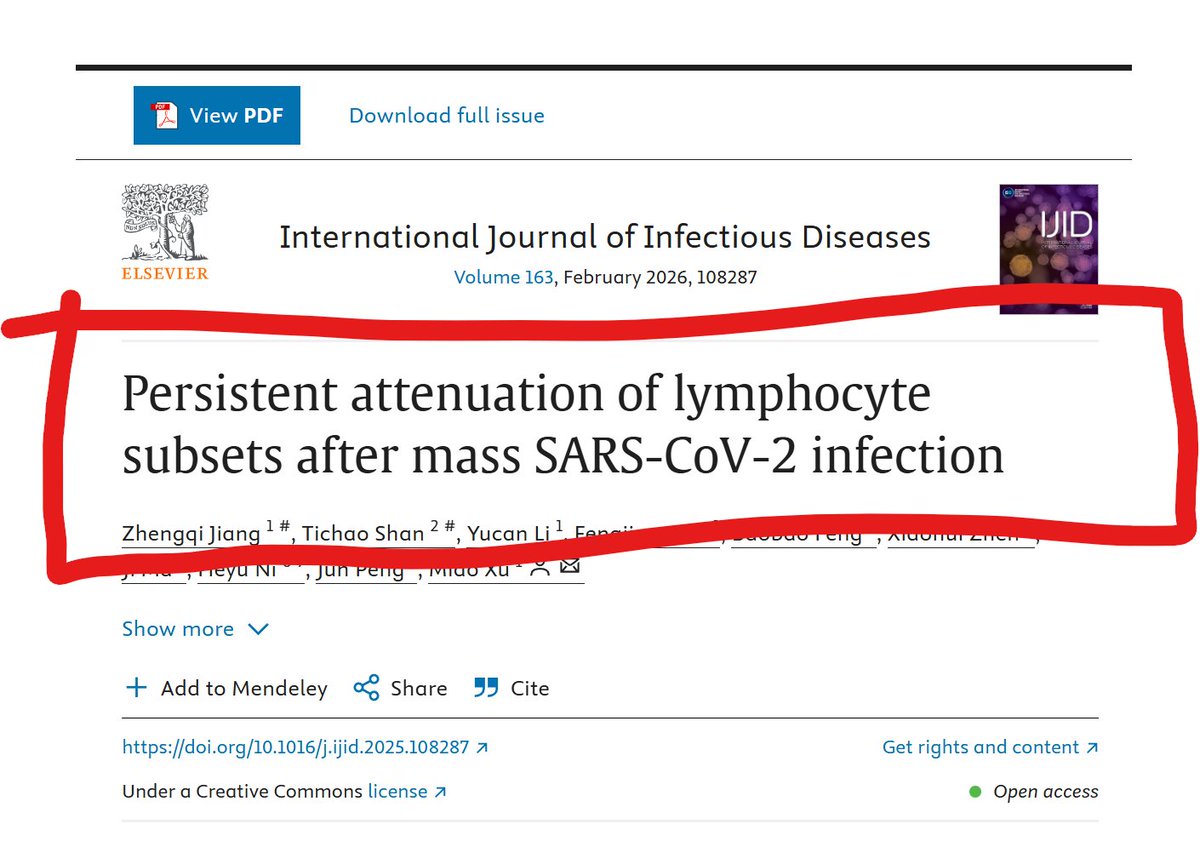
A couple of very important studies out just in the last 24 hours confirming what we've been saying for years and years now: Covid infections affect your immune system *badly*.
Here's a few things you may have missed in them.
Here's a few things you may have missed in them.
This is almost entirely post vaccination data
This is not an unprotected population.
Baseline immune measurements come from a period when vaccination coverage was already high, and the immune damage appears *after mass infection*.
This is not an unprotected population.
Baseline immune measurements come from a period when vaccination coverage was already high, and the immune damage appears *after mass infection*.
So two things there:
The effect didn't appear until after infection.
Vaccination didn't stop it.
The effect didn't appear until after infection.
Vaccination didn't stop it.
So whatever mechanism is driving the long-term lymphocyte loss (and my assumption is that it's direct infection of those cells by covid, and subsequent dysregulation), it is happening despite vaccination, not because people were naive.
Percentages recover while absolute counts don't
One of the more confusing things in this study is that some immune percentages appear to recover.
One of the more confusing things in this study is that some immune percentages appear to recover.
Immune panels usually report two different things:
>Percentages
These tell you how the immune cells are *divided up*.
For example: what proportion of your lymphocytes are B cells, T cells, or NK cells.
These tell you how the immune cells are *divided up*.
For example: what proportion of your lymphocytes are B cells, T cells, or NK cells.
Percentages are *relative*. They always add up to 100, no matter how many cells you actually have.
>Absolute counts
These tell you how many cells are actually there, usually as cells per microlitre of blood.
This is the immune system's capacity and reserve.
These tell you how many cells are actually there, usually as cells per microlitre of blood.
This is the immune system's capacity and reserve.
Percentages can all stay the same, while you suffer a massive loss of capacity.
And your overall capacity might stay the same, while percentages change wildly.
This study says that B cells rise as a proportion of all cells after infection.
But that at the same time *absolute counts of B cells* fall below the original baseline.
Those two facts together are crucial.
They mean that:
> the total number of lymphocytes has dropped
> T cells have dropped more sharply than B cells
> so B cells make up a larger share of a smaller pool
They mean that:
> the total number of lymphocytes has dropped
> T cells have dropped more sharply than B cells
> so B cells make up a larger share of a smaller pool
It's not that B cells have recovered or expanded.
It's that everything else has shrunk faster.
It's that everything else has shrunk faster.
A clinician or reader glancing at percentages might see:
"B cells look normal or high"
"ratios look OK"
"nothing obviously out of balance"
"B cells look normal or high"
"ratios look OK"
"nothing obviously out of balance"
But that's because percentages only describe proportions, not volume.
The immune system can look neatly rebalanced on paper while actually being smaller, thinner, and less resilient.
The immune system can look neatly rebalanced on paper while actually being smaller, thinner, and less resilient.
So *don't* look at the percentages.
You'll see B-cell percentages go up even as absolute counts fall.
Absolute counts matter more.
You'll see B-cell percentages go up even as absolute counts fall.
Absolute counts matter more.
But also *do* look at the percentages - because your immune system needs to be in balance.
Dysregulation can lead to deficiency - too little - or autoimmunity - too much.
Next, CD8 T cells are hit hardest and stay down longest
Even *20 months after infection*, CD8 counts in the population remain suppressed. CD8s are essential for keeping viral agents and latent infections in check. This points to a serious antiviral deficit.
Even *20 months after infection*, CD8 counts in the population remain suppressed. CD8s are essential for keeping viral agents and latent infections in check. This points to a serious antiviral deficit.
If you don't know what's happening with secondary infections after Covid, watch this, then come back here.
https://x.com/1goodtern/status/1982758327689019668?s=20
Viruses, bacteria, they're taking advantage of this weakness in your immune system.
This is so flipping serious.
And there's no reason to think that this mechanism does not cause the same problems after reinfections.
This is so flipping serious.
And there's no reason to think that this mechanism does not cause the same problems after reinfections.
In fact, the evidence that we're seeing all around is that the effect is cumulative.
Repeat infections are making your immune system weaker.
Repeat infections are making your immune system weaker.
Next... you spotted the cardiovascular disease bit?
Cardiovascular patients show a *delayed* immune collapse.
Cardiovascular patients show a *delayed* immune collapse.
Cardiovascular disease patients *appear* to recover in early 2023, then around mid tolate 2023 their T cells crash to roughly one third of baseline and stay there for *a year*.
Seriously that is the opposite of good.
That pattern does not fit simple post-viral recovery.
It looks like immune exhaustion or a second cumulative hit.
It looks like immune exhaustion or a second cumulative hit.
Next...
I thought it was really interesting that baseline variation matters more than averages.
I thought it was really interesting that baseline variation matters more than averages.
There have been lots of reasons thrown around about why Covid infection affects different people so differently...
... but why age groups seem to be affected similarly...
Well, here's one of the reasons here in this study.
People's baseline immune system percentages and counts are different according to your age group.
People's baseline immune system percentages and counts are different according to your age group.
Yes, I've been saying this for a long time now, but it's stark seeing it there in a study in black and white.
The study carefully shows baseline immune differences by age and sex before mass infection. Older adults and men start with lower reserves.
The same absolute loss pushes some people over a functional threshold while others remain 'within range'.
Population averages hide a long tail of harm.
Population averages hide a long tail of harm.
Next...
This came from a short, sharp exposure window.
Because of China's containment policies, almost everyone was infected in a very tight time period, with little prior exposure.
This came from a short, sharp exposure window.
Because of China's containment policies, almost everyone was infected in a very tight time period, with little prior exposure.
One mass infection wave was enough to produce immune disruption lasting nearly two years.
You do not need years of uncontrolled spread to get long-term immune damage.
You do not need years of uncontrolled spread to get long-term immune damage.
But here in the UK some people were already on infection 5 by the time China opened up.
The cumulative damage is *far higher* here.
The cumulative damage is *far higher* here.
Next...
Reinfection is not measured, but it kinda haunts the paper
They explicitly say they cannot track reinfections, but they note later surges and ongoing exposure.
Reinfection is not measured, but it kinda haunts the paper
They explicitly say they cannot track reinfections, but they note later surges and ongoing exposure.
The delayed crashes and persistent deficits make far more sense if immune injury is cumulative, not one off.
And you may have missed that this study was not about ICU grade illness.
ICU patients were *excluded*.
ICU patients were *excluded*.
These are ordinary hospital populations, which means long lasting immune change does not require severe acute disease.
This study plainly shows that long term immune damage can occur in vaccinated populations, after mild infection, shaped by baseline immune differences, and persist for years, and probably gets worse with reinfection.
That study is here:
sciencedirect.com/science/articl…
sciencedirect.com/science/articl…
And then there's this one...

This one is saying that Long Covid immune dysregulation shows up in *antibody patterns*.
After most infections, antibody responses fade.
In long Covid, they don't behave normally.
In long Covid, they don't behave normally.
Oo... speaking of which, wait a second, something important I missed from the first one is that it wasn't looking at 'people with Long Covid'.
It was looking at 'people who had caught Covid'.
And the damage was everywhere.
It was looking at 'people who had caught Covid'.
And the damage was everywhere.
I've thought for a long time that covid infection means lasting effects for everyone.
Sorry.
Sorry.
Back to the second study...
After most infections, antibody responses fade... not so much after Covid.
After most infections, antibody responses fade... not so much after Covid.
In a typical viral infection, the immune system follows a fairly predictable pattern.
Antibodies rise during and shortly after infection, then gradually fall away once the virus is cleared - what's left behind is 'immune memory', not *constant activation*.
That fading is an important part of the immune system standing down.
If it's on red alert the whole time, it's dangerous.
If it's on red alert the whole time, it's dangerous.
And that's what the researchers saw in people who had Long Covid.
Antibodies against parts of the virus like the 'nucleocapsid' and 'envelope' remain persistently elevated, while responses to 'spike' look weaker or atypical compared with people who seem to have recovered more cleanly.
That pattern suggests the immune system is still being reminded of the virus, not just remembering it.
That may not make sense unless you read it a couple of times.
There's a difference between thinking of pink elephants because your brain remembered it, and thinking of pink elephants because you've just read this tweet about pink elephants.
There's a difference between thinking of pink elephants because your brain remembered it, and thinking of pink elephants because you've just read this tweet about pink elephants.
It looks less like *tidy immune memory* and more like *ongoing antigen exposure* or *repeated stimulation*.
Why?
Could be persistent infection in a hidden reservoir in the body.
Could be persistent infection in a hidden reservoir in the body.
Could be dysregulation of the immune system itself.
Under normal circumstances, once antibodies fade and memory is established, the immune system reduces its level of coordination.
Helper cells step back.
Helper cells step back.
In long COVID, certain T cell populations remain elevated:
Counts of 'circulating T follicular helper (cTFH) cells', which actively push B cells to keep making and refining antibodies, stay higher.
MAIT cells, which respond to persistent inflammatory and mucosal signals and sit at the interface of innate and adaptive immunity, also stay elevated.
The study shows that these cells track closely with the abnormal antibody patterns.
In other words, the immune system is still acting as if the job isn't finished.
In other words, the immune system is still acting as if the job isn't finished.
This should be the convalescence period.
The stage when you steadily get better.
But it's not.
The stage when you steadily get better.
But it's not.
Cytokines are the immune system's broadcast message system.
In long Covid, some remain elevated months after infection, meaning the system is still signalling activation.
In long Covid, some remain elevated months after infection, meaning the system is still signalling activation.
At the same time, autoantibodies are more common.
These usually appear when immune regulation has gone wonky, either because activation has gone on too long or because resolution mechanisms have failed.
These usually appear when immune regulation has gone wonky, either because activation has gone on too long or because resolution mechanisms have failed.
Put the two studies together and it's more hard evidence (on top of all the previous hard evidence) that after covid infection, the immune response *does not resolve in the usual way*.
Taken together, they're describing the same immune problem from different angles.
One looks at
*what is missing after covid infection*
the other looks at
*what won't switch off after covid infection*.
*what is missing after covid infection*
the other looks at
*what won't switch off after covid infection*.
The lymphocyte study shows that, long after infection, many people are left with:
fewer T cells overall
persistently reduced CD8 T cells
uneven recovery shaped by age, sex, and comorbidity
immune 'rebalancing' that hides real loss when you only look at percentages
persistently reduced CD8 T cells
uneven recovery shaped by age, sex, and comorbidity
immune 'rebalancing' that hides real loss when you only look at percentages
The immune profiling study shows that, in parallel, people with long COVID have:
antibody responses that do not fade normally
continued activity of helper and innate-like T cells
persistent cytokine signalling
evidence of immune regulation slipping (autoantibodies)
continued activity of helper and innate-like T cells
persistent cytokine signalling
evidence of immune regulation slipping (autoantibodies)
Put together, this shows yet again that covid infection does not just cause passing immune activation followed by recovery.
It leaves behind an immune system that is both depleted and persistently stimulated.
It leaves behind an immune system that is both depleted and persistently stimulated.
Some arms of immunity are *worn down* (T-cell loss, reduced reserve), while others are *kept active when they shouldn't be* (antibody production, helper signalling, inflammation).
This is *exactly* the kind of combination which leads to a third huge study released in the last twenty four hours.
"Study of 97 million people found COVID infection led to a 49% increased risk of new-onset autoimmune-related diseases, esp vascular & connective tissue issues."
https://x.com/ahandvanish/status/2011962706157355193?s=20
Vaccination mitigates acute severity, but these studies and the data they contain show it does not fully prevent post infectious immune dysregulation at population scale.
The common thread in all three is *failed resolution*.
After most infections, the immune system:
clears the pathogen
builds memory
and quietens down
clears the pathogen
builds memory
and quietens down
Covid leaves the immune system part activated, part exhausted, and poorly reset.
Long Covid is not a mystery syndrome in search of a mechanism.
With every passing year, it's increasingly clear it's a specific, measurable immune state that emerges when recovery does not complete.
With every passing year, it's increasingly clear it's a specific, measurable immune state that emerges when recovery does not complete.
But also the damage of covid infection stretches far beyond the symptoms that are most commonly called Long Covid.
And far more people have that damage than everyone admits.
• • •
Missing some Tweet in this thread? You can try to
force a refresh




