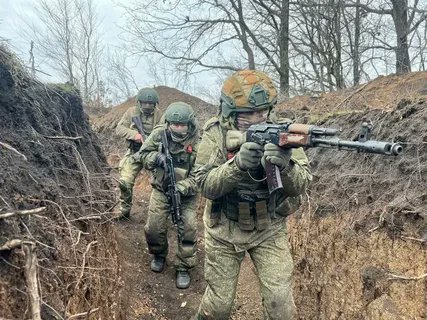
1/ The Russian army has adopted infiltration tactics to slip past Ukrainian defences, dividing platoons into a handful of men who advance as far as they can, entrench, and await reinforcements. A Russian warblogger comments on this tactic's limitations. ⬇️
2/ This change of approach since 2024 has enabled Russia to advance slowly, though still generating heavy losses along the way. 'Archangel Spetsnaz' writes:
"Indeed, assault tactics have changed dramatically."
3/ "The wide range of detection and engagement systems and means has, figuratively speaking, "brought to its knees the old tactics," whereby company/battalion-sized offensives were carried out at the frontier.
4/ "Infiltration" tactics are currently proving more effective with fewer personnel losses, but at the same time, they are not without a number of problems that must be considered when planning a combat operation.
5/ "▪️When sending three or four stormtroopers, it is necessary to understand:
▪️Such a group becomes ineffective when 300s (wounded) appear, since the removal of one wounded, as a rule, requires at least four people for the variable evacuation of the wounded and his equipment.
6/ "▪️Evacuation for small groups is unlikely to be organized. It's difficult to imagine a situation where an evacuation team would advance into an area under enemy fire to evacuate one or two wounded. Losses in this case could be even greater.
7/ "▪️Supplies of ammunition, food, water, and other necessary equipment for completing the mission are very limited. It's important to remember that the last group dispatched must reach the troop deployment point before the first group runs out of food and water.
8/ "Otherwise, the assault group suffers non-combat losses, reducing the unit's overall combat readiness.
9/ "▪️Armoured support is also limited at the start of an assault. Classic tactics recommend a simultaneous infantry and vehicle attack, after first engaging enemy firing positions with artillery and precision weapons.
10/ "Now, however, stormtroopers are forced to mass and launch attacks in conjunction with strikes on enemy firing positions, while the armoured group's maneuverability is severely limited, as it becomes a priority target for enemy drones.
11/ "▪️Mission completion deadlines are stretched out because it's simply impossible to accurately predict the outcome due to numerous factors.
12/ "Setting unrealistic goals immediately without taking the situation into account can have serious consequences for the next step of the operation.
13/ "Ultimately, it's equally difficult, both mentally and physically, to complete a mission while outnumbered on the battlefield, which also impacts the outcome of the battle." /end
1/ Huge numbers of Russian soldiers are dying unnecessarily in Ukraine because commanders at every level are falsifying claims of success, according to Russian warbloggers. "To back up their words, they're sending people to their deaths," says one front-line soldier. ⬇️
2/ The image above is an extract from an official Russian Ministry of Defence map showing a completely fictional front line around Kupyansk in Ukraine's Kharkiv region. Commanders falsely reported having taken settlements around the city before it was regained by Ukraine.
3/ Russian commentators call this practice "taking on credit" (as in amassing credit card debt). Commanders have both financial and career motivations for making false reports of success, which are relayed all the way up to Vladimir Putin himself.
1/ A poetry reading by Russian ultra-nationalists in Krasnodar has been violently suppressed by Russian security forces, much to the dismay of their online supporters. The incident highlights how much Putin's regime fears being outflanked from the nationalist right. ⬇️
2/ Members and supporters of the National Bolshevik movement, founded by the late poet and Soviet-era dissident Eduard Limonov, were holding a regularly scheduled reading of Limonov's works in Krasnodar on 17 January when they were interrupted by a law enforcement raid.
3/ According to the 'Carefree Carpenter Z' Telegram channel, "Everything was proceeding as usual when operatives from the regional "Centre E" and the FSB, armed with automatic rifles, burst into the loft space specially rented for the event."
1/ Russia's logistical capability to threaten Greenland, 1500 miles away, is fundamentally dependent on its ability to project naval power over long distances, potentially in contested waters. However, Russian warbloggers admit that this is severely limited even in peacetime. ⬇️
2/ 'Military Informant' writes that the Russian logistics vessel MYS ZHELANIYA has "delivered important cargo to the Afrika Korps, calling at the Libyan port of Tobruk. The SPARTA IV, escorted by the large anti-submarine ship Severomorsk, continued on to the coast of Syria."
3/ However, the channel acknowledges, this operation highlights the limits of "the real capabilities of the Russian Navy to escort its merchant ships at great distances from the country's coast."
1/ Donald Trump's aggressive tactics over Greenland are causing consternation among his far-right allies in Europe. With European publics overwhelmingly against surrendering Greenland, leading European far-rightists have come out in opposition to Trump's plans. ⬇️
2/ Bloomberg reports that Trump's designs have forced his ostensible allies to reconsider their support for him. Some may fear voters turning on them for their past support of Trump, much as Pierre Poilievre suffered in Canada in 2024.
3/ 🇩🇪 Alternative for Germany co-leader Alice Weidel says that Trump has acted no differently to Vladimir Putin in his actions in Venezuela and threats against Greenland. "Trump has violated a fundamental campaign promise — namely not to interfere in other countries," she says.
1/ 30 years ago, Russian law enforcement agents started wearing masks to carry out their duties. It soon became a standard tactic to intimidate and extort those seen as opponents of the regime, and became known in Russian as a 'mask show'. ⬇️
2/ During the Soviet era, there was no need for law enforcement officers to hide their faces. They were the agents of an all-powerful state, which although corrupt had huge resources to repress crime and political dissidence.
3/ This changed in the 1990s, when the chaotic collapse of the Communist economy led to the rise of widespread and deadly gangsterism. The police came under direct threat from well-armed criminals. To deal with this, some officers began wearing masks to conceal their identities.
1/ Cuts to public funding due to money being redirected to Russia's war effort are having increasingly severe effects on its already struggling health service. In one region, a collapsing maternity care system has produced horrifying stories of mistreatment and abuse. ⬇️
2/ An increasing number of Russian regions are facing financial crises due to the federal government making severe cuts to regional budgets. This is having a host of negative effects, ranging from collapsing healthcare to cities being flooded with sewage.
3/ The West Siberian region of Kemerovo is one of many to be affected, and faces a healthcare crisis that locals say is already costing lives. A recent scandal has centred on the Maternity Hospital No. 1 in the city of Novokuznetsk, where a number of newborns have died.