/thread/
There is an ongoing debate about the current size of the Russian AFV fleet, losses it has taken, new production level storage+reactivation, etc.
Here is my take on the topic
There is an ongoing debate about the current size of the Russian AFV fleet, losses it has taken, new production level storage+reactivation, etc.
Here is my take on the topic
notes:
this is just my take on the "middle case " - so I am going for what is IMO the most plausible interpretation of the data, not hyper-optimistic/pessimistic interpretation of the data that some folks use.
I rounded the numbers slightly to make it easier to read
this is just my take on the "middle case " - so I am going for what is IMO the most plausible interpretation of the data, not hyper-optimistic/pessimistic interpretation of the data that some folks use.
I rounded the numbers slightly to make it easier to read
At the start of the 2022 invasion of Ukraine, Russia had approximately (incl. marines + VDV + LDPR forces):
3000 tanks + 7200 in storage
3500 BMP-1/2s + 7100 in storage
650 BMP-3s
2500 BTR-80/82s +3600 older BTRs in storage
1000 BMDs + 600 in storage
3500 MT-LBs +4200 in storage
3000 tanks + 7200 in storage
3500 BMP-1/2s + 7100 in storage
650 BMP-3s
2500 BTR-80/82s +3600 older BTRs in storage
1000 BMDs + 600 in storage
3500 MT-LBs +4200 in storage
and thousands more of obsolete lightly armored obsolete vehicles like BRDM-2, MT-LBu, etc.
Out of those, T-90M, BMP-3, and BTR-82s are in a large scale production, the rest are either not being produced, or in only small numbers.
Out of those, T-90M, BMP-3, and BTR-82s are in a large scale production, the rest are either not being produced, or in only small numbers.
Oryx lists losses as "destroyed", "damaged" (we exclude light damage), "abandoned" (unknown fate - many are later changed to the destroyed status based on additional evidence, but some are later either removed (if recovered)) and "captured".
For the purposes of this thread, I would count 50% of abandoned as permanently lost (destroyed or captured), so the "permanent losses" mentioned later will include all "destroyed", all "captured", and 50% of "abandoned".
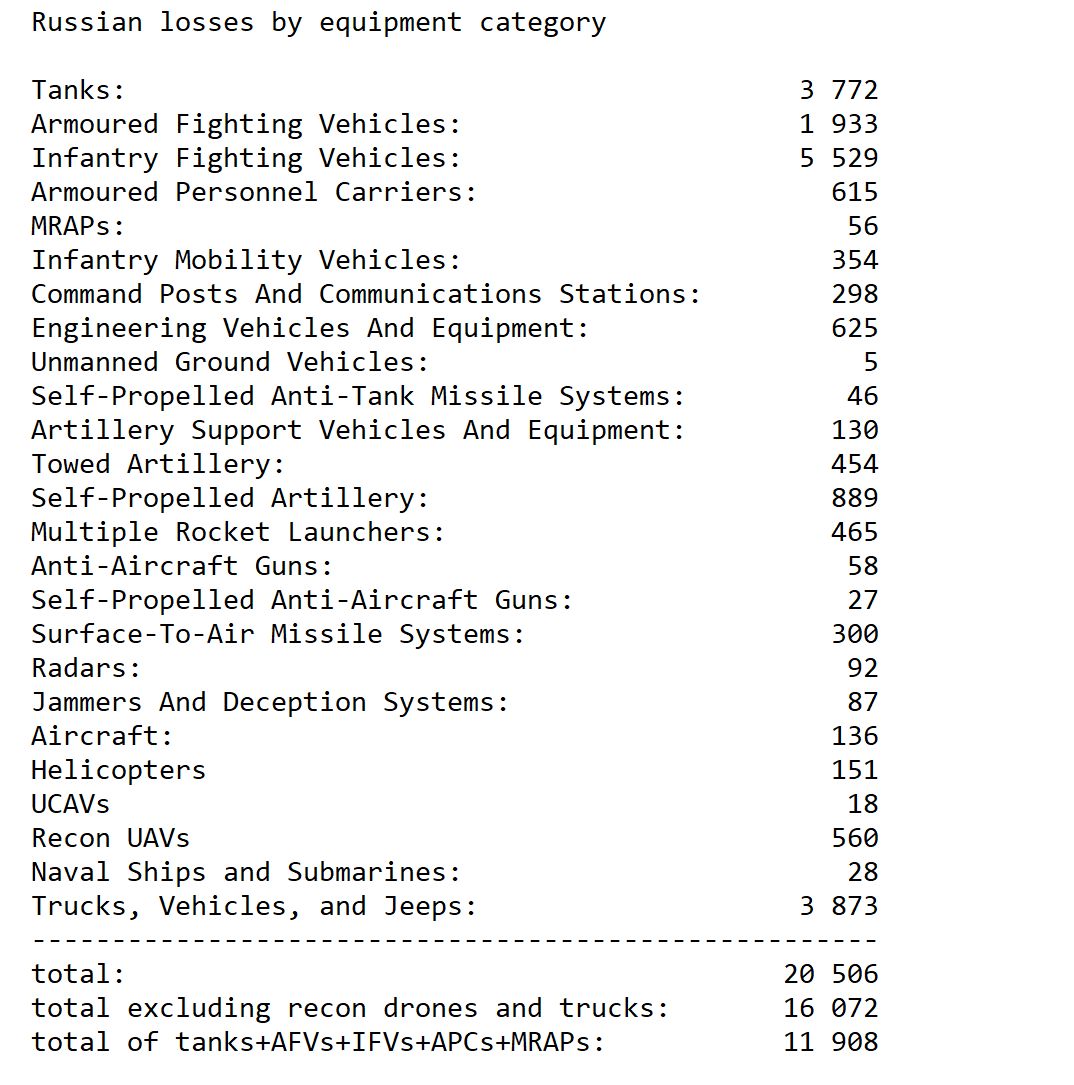
As of early 2026, Oryx has documented following losses:
4300 tanks (~3960 permanent losses)
3650 BMP-1/2 (~3000 permanent losses)
800 BMP-3 (~740 permanent losses)
1680 BTR-80/82 (~1580 permanent losses)
590 BMD (~550 permanent losses)
1860 MT-LB (~1790 permanent losses)
4300 tanks (~3960 permanent losses)
3650 BMP-1/2 (~3000 permanent losses)
800 BMP-3 (~740 permanent losses)
1680 BTR-80/82 (~1580 permanent losses)
590 BMD (~550 permanent losses)
1860 MT-LB (~1790 permanent losses)
As these are all visually confirmed losses, it is abviously just a floor, with the actual losses being significantly higher. For equipment used on the frontline, like AFVs, I use 20% on top of the documented losses as the likely number on top that is missing from the data.
As these are all visually confirmed losses, it is abviously just a floor, with the actual losses being significantly higher. For equipment used on the frontline, like AFVs, I use 20% on top of the documented losses as the likely number on top that is missing from the data
That would translate into following numbers for permanent losses:
~4800 tanks
~3600 BMP-1/2
~890 BMP-3
~1900 BTR-80/82
~700 BMD
~2150 MT-LB
~4800 tanks
~3600 BMP-1/2
~890 BMP-3
~1900 BTR-80/82
~700 BMD
~2150 MT-LB
These losses are being compensated for by pulling the inherited Soviet-era equipment from storage. Here I rely on the excellent data from @CovertCabal , @Jonpy99 and @HighMarsed
What has been pulled from storage since the start of the war:
~5000 tanks
~4870 BMP-1/2
~1390 older BTRs
~470 BMD
~3600 MT-LB
~5000 tanks
~4870 BMP-1/2
~1390 older BTRs
~470 BMD
~3600 MT-LB
While many of those vehicles were likely reactivated from a reasonable state, there were also many in poor/terrible state that also dissapeared from storage and were likely used as sources of parts, before being scrapped
,so be aware that not everything that was pulled from storage became an operational vehicle.
I assume that at least 10% of tanks and 20% of lighter AFVs so far pulled from storage were stripped for parts and scrapped.
I assume that at least 10% of tanks and 20% of lighter AFVs so far pulled from storage were stripped for parts and scrapped.
What remains in storage are in many cases vehicles in a terrible state or undesirable due to the lack of spare parts production.
As a result, out of the remaining ~2210 tanks in storage, I discount 1180 tanks that are likely to end up scrapped.
As a result, out of the remaining ~2210 tanks in storage, I discount 1180 tanks that are likely to end up scrapped.
For other categories the numbers in storage are (and those likely to be scrapped):
~2280 BMP-1/2 (~1170 scap)
~2270 older BTRs (~270 scap)
~140 BMD (~20 scap)
~590 MT-LB (~60 scap)
~2280 BMP-1/2 (~1170 scap)
~2270 older BTRs (~270 scap)
~140 BMD (~20 scap)
~590 MT-LB (~60 scap)
And in storage there are also still thousands of lightly armored obsolete vehicles like BRDM-2, MT-LBu, etc. that appear to being pulled from storage in only small numbers - likely as sources of parts to maintain vehicles in active use.
Those appear to be undesirable even in the current conditions where assault troops use bikes, ATVs, civilian cars, etc. so I expect these vehicles to be useless and to be later scapped.
On top of all this, there is an active production.
On the large scale, only the following AFVs are AFAIK being produced (note: Russia likes to call refurbishment and upgrades "production", while I only treat newly made vehicles as produced):
T-90M
BMP-3
BTR-82
On the large scale, only the following AFVs are AFAIK being produced (note: Russia likes to call refurbishment and upgrades "production", while I only treat newly made vehicles as produced):
T-90M
BMP-3
BTR-82
There are large spread of estimates for the production, but here are what are IMO reasonable estimates (but note that there is a large margin of error) for the current annual production:
200x T-90M
400x BMP-3
500x BTR-82
And those were lower in previous years.
200x T-90M
400x BMP-3
500x BTR-82
And those were lower in previous years.
As a result, my estimates for the production (note that I am ignoring upgrades like turning a T-90A into T-90M and only consider newly made vehices) since the war has started are:
~350x T-90M
~1000x BMP-3
~1200x BTR-82
~350x T-90M
~1000x BMP-3
~1200x BTR-82
When you put all of that together, you get approximately:
Tanks:
3000 operational
+4500 from storage (after 10% deducted for those likely scrapped for parts)
+350 new production
-4800 permanent losses
----------------
3050 remaining operational
1030 remaining viable in storage
Tanks:
3000 operational
+4500 from storage (after 10% deducted for those likely scrapped for parts)
+350 new production
-4800 permanent losses
----------------
3050 remaining operational
1030 remaining viable in storage
BMP-1/2:
3500 operational
+3900 from storage (after 20% deducted for those likely scrapped for parts)
+0 new production
-3600 permanent losses
-------------------
3800 remaining operational
1110 remaining viable in storage
3500 operational
+3900 from storage (after 20% deducted for those likely scrapped for parts)
+0 new production
-3600 permanent losses
-------------------
3800 remaining operational
1110 remaining viable in storage
BMP-3:
650 operational
+ negligible numbers from storage
+1000 new production
-890 permanent losses
-------------------
760 remaining
0 remaining viable in storage
650 operational
+ negligible numbers from storage
+1000 new production
-890 permanent losses
-------------------
760 remaining
0 remaining viable in storage
BTR-82:
2500 operational
+1110 from storage (after 20% deducted for those likely scrapped for parts)
+1200 new production
-1900 permanent losses
-------------------
2910 remaining
2000 (older BTRs) remaining viable in storage
2500 operational
+1110 from storage (after 20% deducted for those likely scrapped for parts)
+1200 new production
-1900 permanent losses
-------------------
2910 remaining
2000 (older BTRs) remaining viable in storage
BMD:
1000 operational
+370 from storage (after 20% deducted for those likely scrapped for parts)
+ negligible new production
-700 permanent losses
-------------------
670 remaining
120 remaining viable in storage
1000 operational
+370 from storage (after 20% deducted for those likely scrapped for parts)
+ negligible new production
-700 permanent losses
-------------------
670 remaining
120 remaining viable in storage
MT-LB:
3500 operational
+2880 from storage (after 20% deducted for those likely scrapped for parts)
+ no new production
-2150 permanent losses
-------------------
4230 remaining
530 remaining viable in storage
3500 operational
+2880 from storage (after 20% deducted for those likely scrapped for parts)
+ no new production
-2150 permanent losses
-------------------
4230 remaining
530 remaining viable in storage
So, the Russian AFV fleet is now in most regards approximately comparable or slightly larger to what the Russian military had operational at the start of the 2022 invasion of Ukraine
This may appear to be a lot, but lets remember that in terms of manpower, the Russian military has grown by around 40% and a lot more that that in terms of combat troops.
And this has come at the cost of almost completely depleting the relevant equipment in storage, with a lot that remains in storage being either extremely obsolete or in a terrible state.
My conclusion is that the Russian military is still very dangerous, but at the same time it appears to currently be unable to effectively use the armored vehicles it now still has,
,as indicated by the mininal current AFV use in Ukraine and terrible losses when mechanized assaults happen. I also dont think Russia will ever be able to rebuild its resever stockpile
which means that replacements for future losses will need to mostly be covered by the newly produced vehicles and that turns into really bad prospects for Russia to wage offensive war(s) at this (let alone larger) scale in the future.
• • •
Missing some Tweet in this thread? You can try to
force a refresh