America has just released its 2026 National Defense Strategy (NDS). Not seeing much press activity from the Dept of Defense/War on this. While I need time to ponder the deeper implications of the document, a few things stand out on first reading. 1/11 🧵 
2/ First, the document is consistent with the 2025 National Security Strategy (NSS) released by the Trump Administration in November 2025. Key priorities in the NDS align with the NSS, as you would expect. However, while the NSS has priorities, the NDS has "Lines of Effort".
whitehouse.gov/wp-content/upl…
whitehouse.gov/wp-content/upl…
3/ There are four Lines of Effort in the new NDS:
1. Defend the U.S. Homeland.
2. Deter China in the Indo-Pacific Through Strength, Not Confrontation.
3. Increase Burden-Sharing with U.S. Allies and Partners.
4. Supercharge the U.S. Defense Industrial Base.
1. Defend the U.S. Homeland.
2. Deter China in the Indo-Pacific Through Strength, Not Confrontation.
3. Increase Burden-Sharing with U.S. Allies and Partners.
4. Supercharge the U.S. Defense Industrial Base.
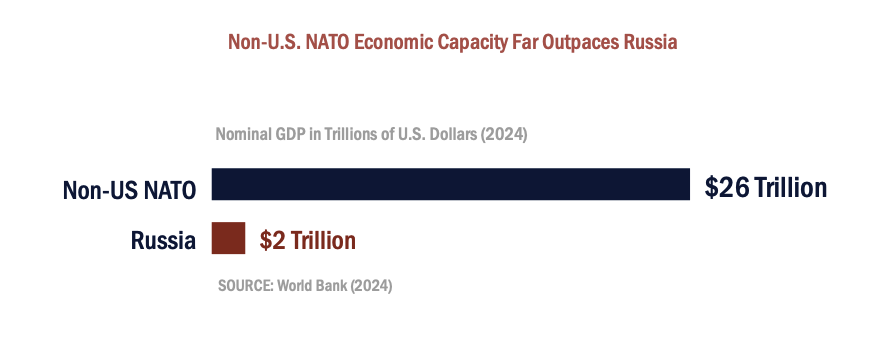
4/ In its examination of the security environment, the document is clear that America sees Russia as a mainly (but not solely) European problem, and that America's interest is to "defend against Russian threats to the U.S. Homeland." The graph below is included to helpfully point out that Europe has the resources to deal with Russia if it choses to.
5/ On China, the document notes that "although we are and will remain engaged in Europe, we must—and will—prioritize defending the U.S. Homeland and deterring China." It also states the following:
"The NSS directs DoW to maintain a favorable balance of military power in the Indo-Pacific. Not for purposes of dominating, humiliating, or strangling China. To the contrary, our goal is far more scoped and reasonable than that: It is simply to ensure that neither China nor
anyone else can dominate us or our allies."
"The NSS directs DoW to maintain a favorable balance of military power in the Indo-Pacific. Not for purposes of dominating, humiliating, or strangling China. To the contrary, our goal is far more scoped and reasonable than that: It is simply to ensure that neither China nor
anyone else can dominate us or our allies."
6/ It is hard to know exactly where the Trump administration is headed with China. The document states that America desires "a decent peace." Fair enough. It also states America does not want confrontation.
The problem is, China is already on a war footing with America, and has been executing large-scale cognitive warfare and massive industrial espionage against the Homeland for two decades. These are not mentioned at all in the document.
Trump's upcoming summit with Xi may give us more insights.
The problem is, China is already on a war footing with America, and has been executing large-scale cognitive warfare and massive industrial espionage against the Homeland for two decades. These are not mentioned at all in the document.
Trump's upcoming summit with Xi may give us more insights.
7/ There is a useful section on the challenges of concurrency for U.S. military forces. This is a reasonable and logical section - America cannot do everything. This is used to build the case for more burden sharing from allies, a consistent theme from this administration. Some of America's allies have stepped up to this challenge in Europe and Asia. But others have not.
8/ Interestingly, in the section that discusses increasing burden sharing with allies (Line of Effort 4), almost every region of the world is discussed except the Asia-Pacific region (Korean peninsula has its own section).
A couple of key takeaways from this:
1. America side-steps any discussion about the defence of Taiwan in the strategy. Indeed, Taiwan is not mentioned. It does however commit to erecting "a strong denial defense along the First Island Chain."
2. America has avoided getting into any dust ups with Asia-Pacific allies on their defence spending. This is a shame - too many of us continue to shirk our responsibilities.
A couple of key takeaways from this:
1. America side-steps any discussion about the defence of Taiwan in the strategy. Indeed, Taiwan is not mentioned. It does however commit to erecting "a strong denial defense along the First Island Chain."
2. America has avoided getting into any dust ups with Asia-Pacific allies on their defence spending. This is a shame - too many of us continue to shirk our responsibilities.
9/ In the strategic environment, there is no mention of the potential threats posed by new technologies. I will need to give this more thought but I thought it was an interesting topic missing from the document.
10/ Finally, the conclusion makes the following interesting assertion: "Taking our nation from the precipice of a world war just a year ago..."
Did I miss something last year? Or should that have read "a week ago"?
Did I miss something last year? Or should that have read "a week ago"?
11/ Overall, the 2026 U.S. National Defense Strategy does not introduce any surprises. It reinforces the NSS as well as statements by President Trump and other members of the administration over the past year. That said, I will need to read it a few more times. More analysis to follow, from me and many others, in the next day or so!
media.defense.gov/2026/Jan/23/20…
media.defense.gov/2026/Jan/23/20…
• • •
Missing some Tweet in this thread? You can try to
force a refresh