Been thinking about implications of AI disruption on investing. When incumbents fall and new upstarts emerge, stocks usually don’t go from 100 to 0 or vice versa overnight - they get there over time, forming strong trends.
Momentum investors who win on trends caused by real fundamentals take their profits to chase fake trends too. Dumb money that got lucky can’t tell the difference but now they have enough capital to really move things.
Investors eventually catch on and the inefficiency of gradual one-way moves start giving way to more sudden, sharper moves. Megacaps jumping 10-20% a day and entire sectors (e.g. semis, software) move with speed that shock investors who lived in an age of relative stability.
Quality/moat investing is often a bet on stability. The ideal environment for many of these companies is one where the world changes slowly so they easily stay on top and print money decade after decade. Moats won’t defend your castle anymore when someone invents bomber planes.
Many investors, myself included, feel like things are getting increasingly “weird” in the market. But if it’s due to AI (and indexing and options) and they keep growing, it’s dangerous to rely on backtests/experience based on a world of stability that doesn’t exist anymore.
• • •
Missing some Tweet in this thread? You can try to
force a refresh

Yet another Shannon's Demon musings thread. Imagine a stock that has a 50/50 chance to gain 100% or fall 60% every day. Long term buy and hold will almost guarantee a total loss. But buying for one day is an incredibly good trade: (100-60)/2 = 20% expected return. 1/
This is an asset with very positive arithmetic avg return but very negative geometric avg return. You can make money as a long (and lose money as a short) if you get close to the arithmetic return. And this is done by effectively making one-day trades, i.e. daily rebalancing. 2/
Continual rebalancing is the idea behind Shannon's Demon. For an asset w/ +arith and -geo returns, buy and hold loses bc it doesn't rebalance and as a result will often be overbetting or underbetting. Pos size is the only difference, demonstrating the value of active trading. 3/
Seems like a good time to revisit this old thread discussing different types of trends.
There are trends where price goes up because of price going up, but there are also trends where price goes up *despite skepticism* and trend-following is actually contrarian.
I think it's the same idea behind +/- gamma. Options are like strategies embedded in an instrument. Long calls = long stock and trading pro-trend, buying more as price goes up. Short put = long stock/trading counter-trend. If everyone's selling covered calls, calls will be cheap.
A blow-off top is when trend-faders (shorts and skeptics/sideline sitters) capitulate and flip to trend-chasers. At this point, positive feedback kicks in. The trend's days are numbered, as eventually it runs out of buyers, but as time becomes bounded, price becomes unbounded.
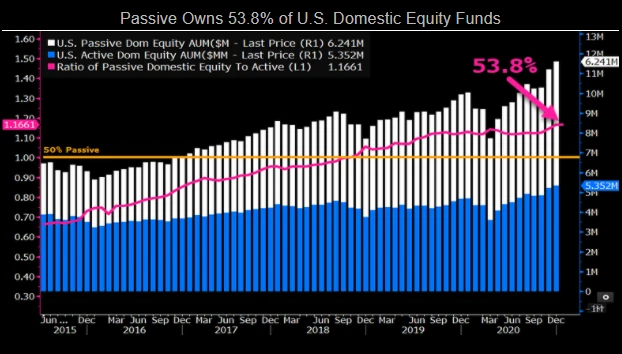
Domination of passive remains one of the most important trends. $ flowing out of active into passive means $ flowing from active overweights into underweights/shorts. And thus relying on reversion to efficiency is treacherous in this market. Short thread:
Market efficiency is created by active managers all trying to fairly value securities. Passive assumes the market is highly efficient and attempts to free-ride on it. But obviously this assumption will not hold if passive drives out the very agents enforcing it.
Each actively managed dollar is a vote in the market. But whenever an active manager must unwind a position due to redemptions, their trades must be reversed, and those votes flip sign from positive to negative, perversely pushing the market away from fair value.
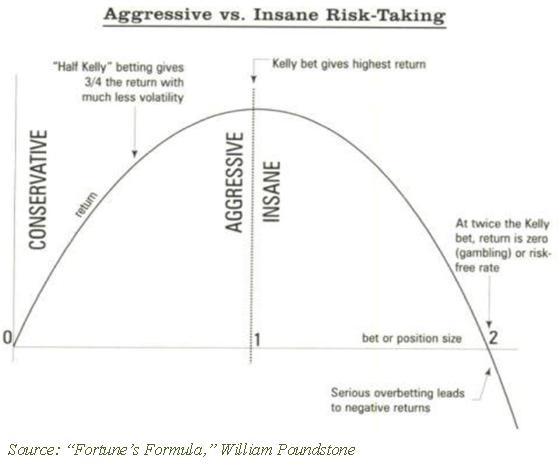
The counterintuitive idea behind the Kelly Criterion that's striking to me is that you can improve returns by taking less risk. Seems like many use Kelly to justify more risk, but I believe the opposite, especially after accounting for uncertainty and correlation. Thread:
Kelly tells you the mathematically optimal bet size given the risk/reward of a bet. When you bet too big, your returns fall. Not risk-adjusted returns, actual returns. Overbet enough and your returns go negative. But when you underbet, you still get most of the returns.
Given this asymmetry of severe punishment for overbetting but small penalty for underbetting, it seems wise to always underbet. If you're currently overbetting, it's a no-brainer to reduce size - returns go up, risk goes down, plus you'll sleep better and probably live longer.
A lesson for me over the last couple years is that flows drives price and fundamentals only matter to the extent they drive flows. I know it's become a meme at this point but that's saying something - I think the market as a whole came to understand this and changed. Thread:
Ex: severe recessions always coincided with bear markets. But recessions didn't cause bear markets directly, they caused market outflows by corps and households, which then caused bear markets. But this relationship breaks down if outflows are more than offset by govt actions.
And of course crypto, TSLA, GME and all the squeezes and other countless crazy things that I think are very difficult to explain from a fundamentals standpoint. I believe everyone seeing TSLA do what it did changed the entire market.
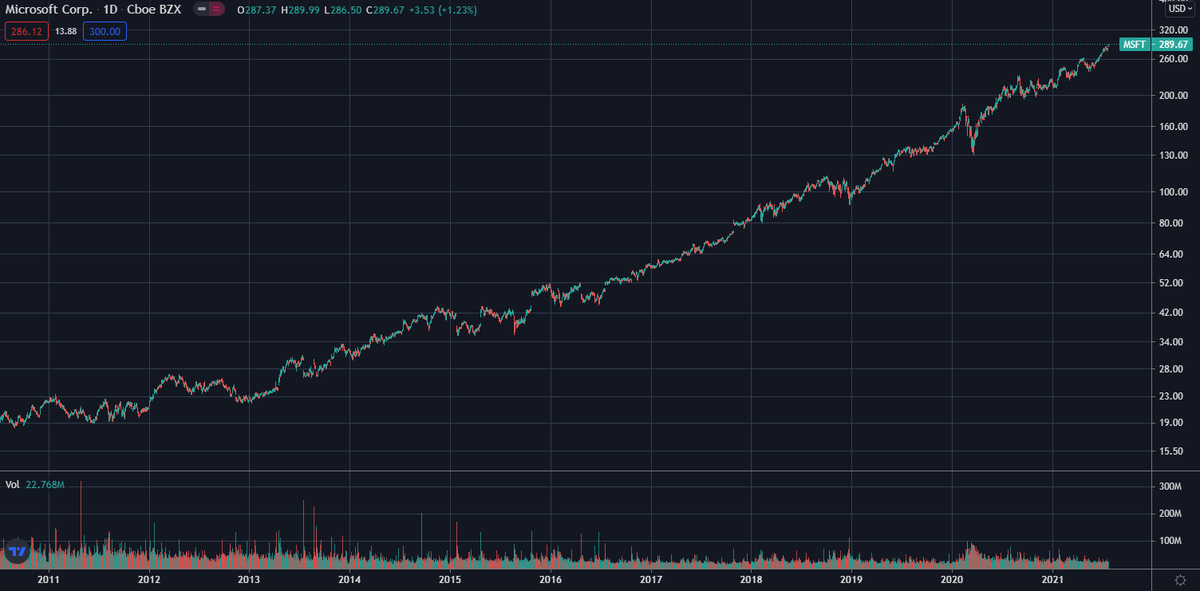
$MSFT is an interesting case study. Tech bubble, crash, wandered in the desert for years, got cheap and made it into the Magic Formula, mgmt change, pivot biz model and caught a secular trend, then quality/growth and momentum winner for years on end. Something for everyone. 1/n
The original tweet pointed out how long it took for MSFT to regain its tech bubble high. What I find more remarkable is its performance since it stopped going sideways. Almost a straight line up and to the right.
Enough fundamentals have proved out to know it was wildly undervalued at least most of that time. Interesting that in hindsight one of the cheapest stocks in the past decade was a universally known megacap, and a momentum stock constantly hitting new all time highs.