As we approach a point marking the beginning of the war’s 5th year, it is time to discuss how we assess the war’s overall dynamics, strictly from a military standpoint. One method many analysts use is the pace of territory capture. However, this methodology has a serious issue🧵:
2/ Generally, this is not a bad method of analyzing battlefield dynamics, as the history of wars shows far more cases of states advancing along frontlines or into enemy territory before a war ends in their favor than the opposite. The devil, however, lies in the details
3/ Putting aside other domains of war, such as economics and socio-politics, battlefield dynamics are often judged by metrics like casualty rates and square kilometers of controlled territory. This can produce a distorted picture, a problem I informally term the “Sahara Fallacy”
4/ So what is the “Sahara Fallacy”? Imagine a scenario where an attacking side must choose how to allocate military resources, either to seize 10 square kilometers controlling the strategically vital Suez Canal or 1,000 square kilometers of random, landlocked Sahara desert.
5/ Capturing the desert produces immediate territorial gains, but of little military value. Seizing the small Suez area, by contrast, provides immediate tactical, operational, and strategic advantages, yet on metrics like occupied territory it appears as only a minor gain.
6/ Thus, the principle can be formulated as follows: The battlefield value of territory lies in the tactical, operational, and strategic leverage it provides. Metric based assessments that reduce warfare to casualty figures and surface measures such as area gained can produce misleading interpretations of battlefield dynamics when detached from the territory’s operational and strategic value.
7/ So what does this mean in our case? Simply put, if Russian forces move into a sparsely populated and lightly defended town surrounded by open steppe in Zaporizhzhia Oblast, territorial metrics may suggest accelerating gains, but not necessary a battlefield dynamics change
8/ Thus, if the goal is to assess changes in battlefield dynamics, relying solely on kilometers as a metric risks falling into this fallacy. An important caveat is that territorial advances are not irrelevant, only that they cannot serve as a standalone indicator of dynamics
• • •
Missing some Tweet in this thread? You can try to
force a refresh

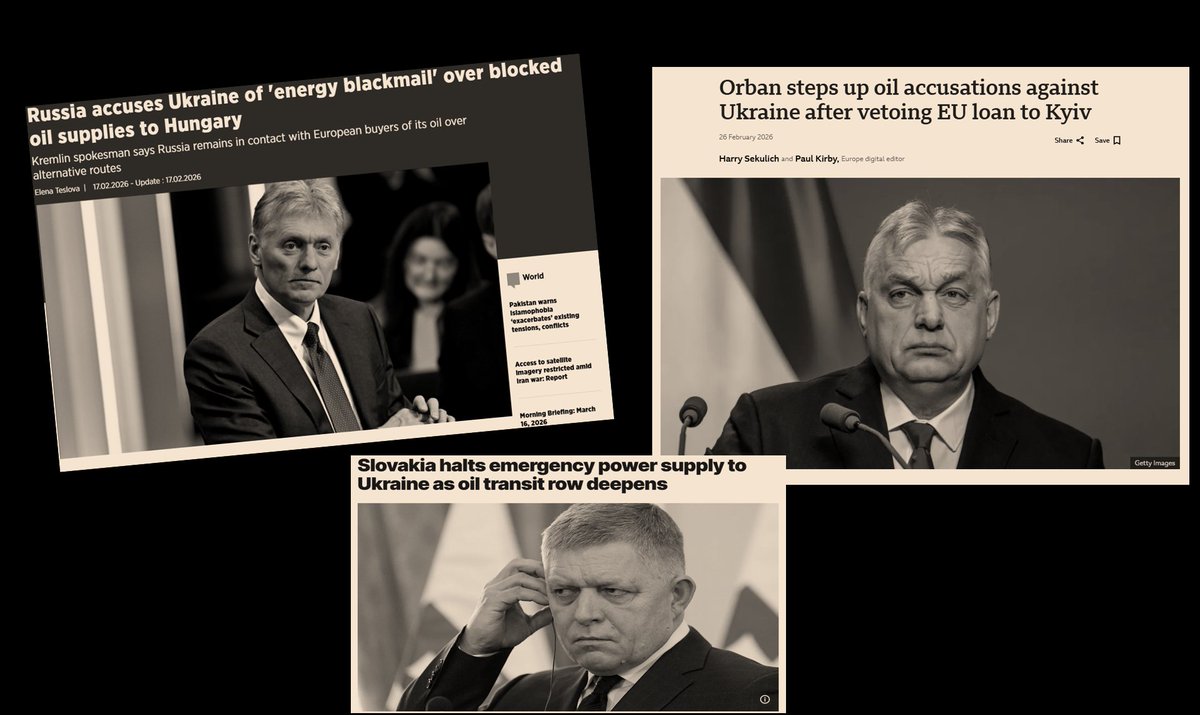
With an uncertain battlefield position, Russia has intensified hybrid operations to shape European public opinion. A key element is the spread of narratives portraying Ukraine as using “energy blackmail” against Europe, often echoed by politically sympathetic actors. 🧵Thread:
2/ Since the full-scale invasion began, Russian missile and drone strikes have targeted Ukraine’s energy system, damaging power plants, gas facilities, and transmission networks nationwide. Ukraine has lost about 11.5 GW of capacity, with damage reportedly exceeding $24.8 billion
3/ The war has also affected energy transport infrastructure. Ukrainian oil facilities have been attacked more than 400 times since the invasion began. On 27 January 2026, a strike damaged equipment working for the Druzhba pipeline near Brody in western Ukraine.
Leaked internal files from Moscow reveal that Russia’s ruling party, United Russia, keeps intelligence-style dossiers on its own politicians. They document corruption facts, criminal ties, and personal vulnerabilities, information used to manage Russia’s politics
Thread 🧵:
2/ United Russia is the political party that dominates Russia’s parliament and regional governments and serves as the main political vehicle of Putin.
Leaked documents from the party, published by @dallasparkua and @256CyberAssault, reveal details of an internal vetting process
3/ Meet Evgeniy Gnedov, who oversees the vetting of candidates for various lawmaking bodies - from local assemblies to the federal parliament.
A longtime security official, he spent decades inside the Federal Penitentiary Service of Russia, eventually rising to a senior role
Russia’s war in Ukraine has increasingly become a war of drones, but artillery still plays a key role on the battlefield. Newly obtained documents from 2014 to 2025 show that Russia continues to modernize its artillery production using industrial machinery from Europe. 🧵Thread:
2/ In a joint analysis, Frontelligence Insight and the @dallasparkua company reviewed hundreds of internal documents from Russian defense contractor Zenit-Investprom and found that Plant No. 9, a maker of artillery barrels and tank guns, went through major upgrades in 2025
3/ Six facilities within the Uralmash industrial zone were found to be undergoing modernization, including planned delivery of industrial machinery from several European countries. Several workshops were dedicated to work on the Armata project and the Koalitsiya SPG.
The catastrophic situation of Russian forces trapped in Kupyansk, who continue to lose ground, together with a second consecutive year of failure to fully seize Pokrovsk, represents one of the more optimistic scenarios for 2025.
Thread:
2/ As war fatigue increasingly affects Russia, the prospect of enforcing a rapid, unfavorable capitulation of Ukraine through Washington, DC now appears even more remote, not not entirely excluded
3/ While Russia has used the negotiation process primarily to delay new sanctions and slow support for Kyiv, its economic situation continues to deteriorate, and tactical gains have failed to translate into strategic breakthroughs.
Information about a new modification of Russia’s Geran-2 drone has been published by Ukraine’s Defense Intelligence, including a detailed technical breakdown. According to the analysis, the Geran drone has been fitted with an R-60 air-to-air missile mounted on its fuselage:
2/ The missile, fitted with an APU-60-1MD (P-62-1MD) aircraft launcher, is mounted on a special bracket located on the upper front section of the Geran’s fuselage.
3/ The most likely employment of rocket involves transmitting images from the drone’s cameras to an operator via the modem. If a Ukrainian aircraft or helicopter enters the engagement zone, the operator sends a launch command to the missile’s control unit.
Analysis: New Data Suggests Russia Is Sustaining Mi-8 Output Despite Wartime Losses
According to non-public Russian procurement documents obtained and analyzed by the Frontelligence Insight team, current Mi-8 production appears sufficient to offset wartime losses. 🧵Thread:
2/ Since the Soviet era, more than 12,000 Mi-8 helicopters of all types have been produced. It’s a versatile military transport platform that can move troops, cargo, serve as a flying hospital or EW asset, and conduct attack missions with unguided rockets and 100–500 kg bombs.
3/ Correspondence between Aviafarm and ZOMZ the Defense Ministry and ZOMZ show a request for 40 IS-264A thermometers: 20 for Kazan and 20 for Ulan-Ude, where Mi-8s are produced.