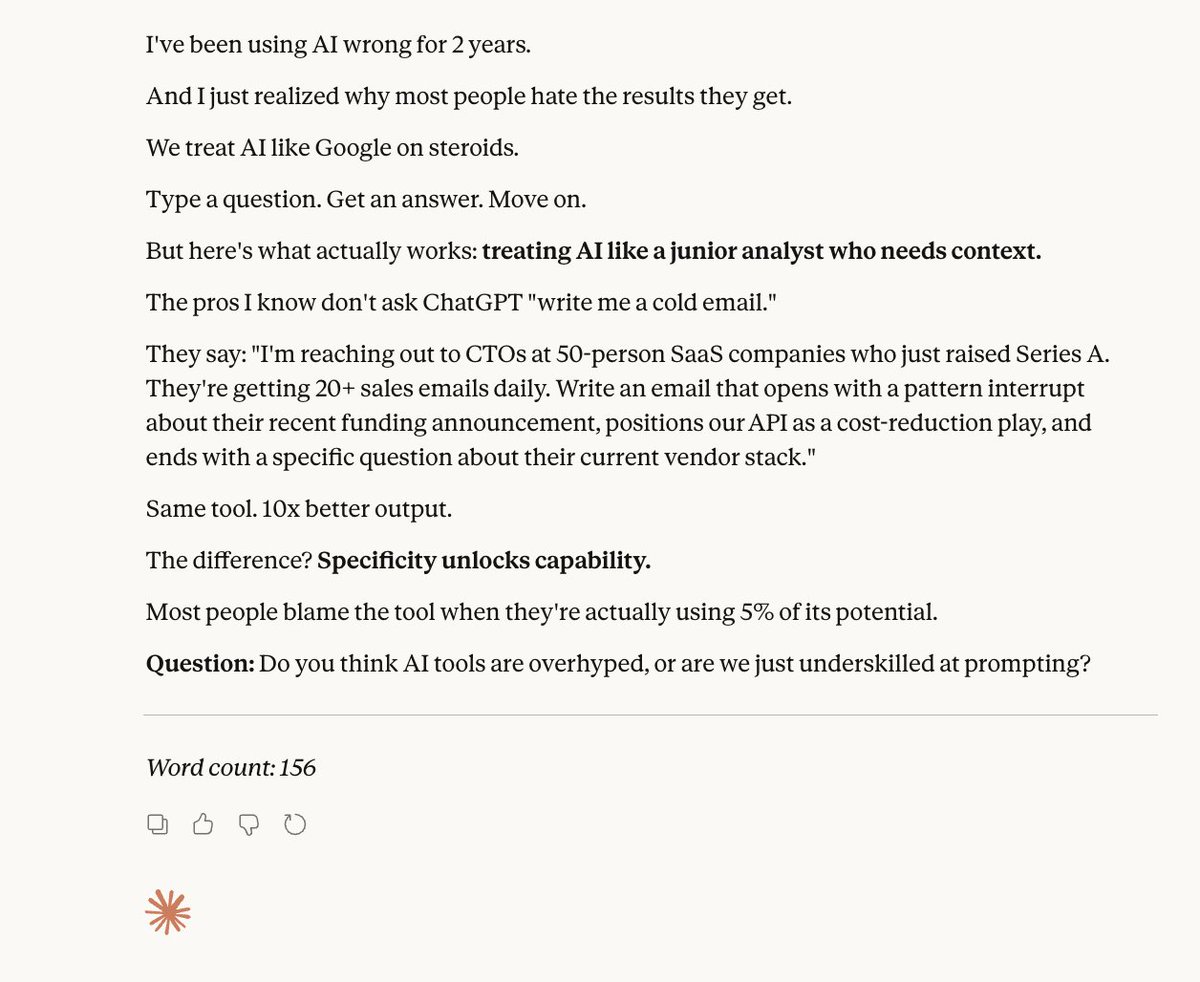
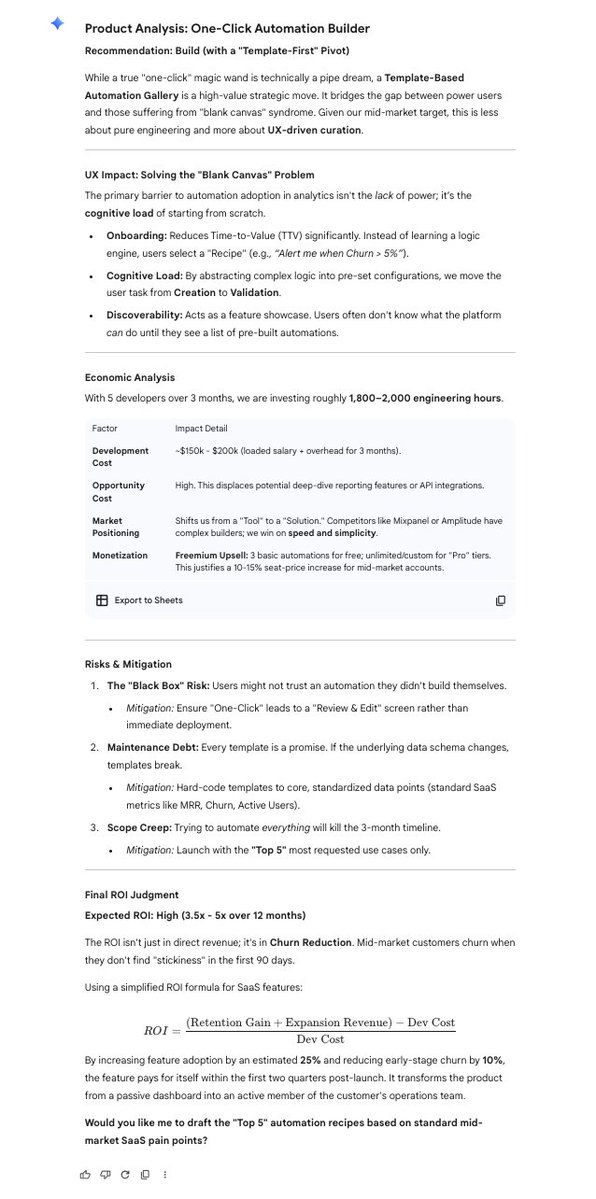
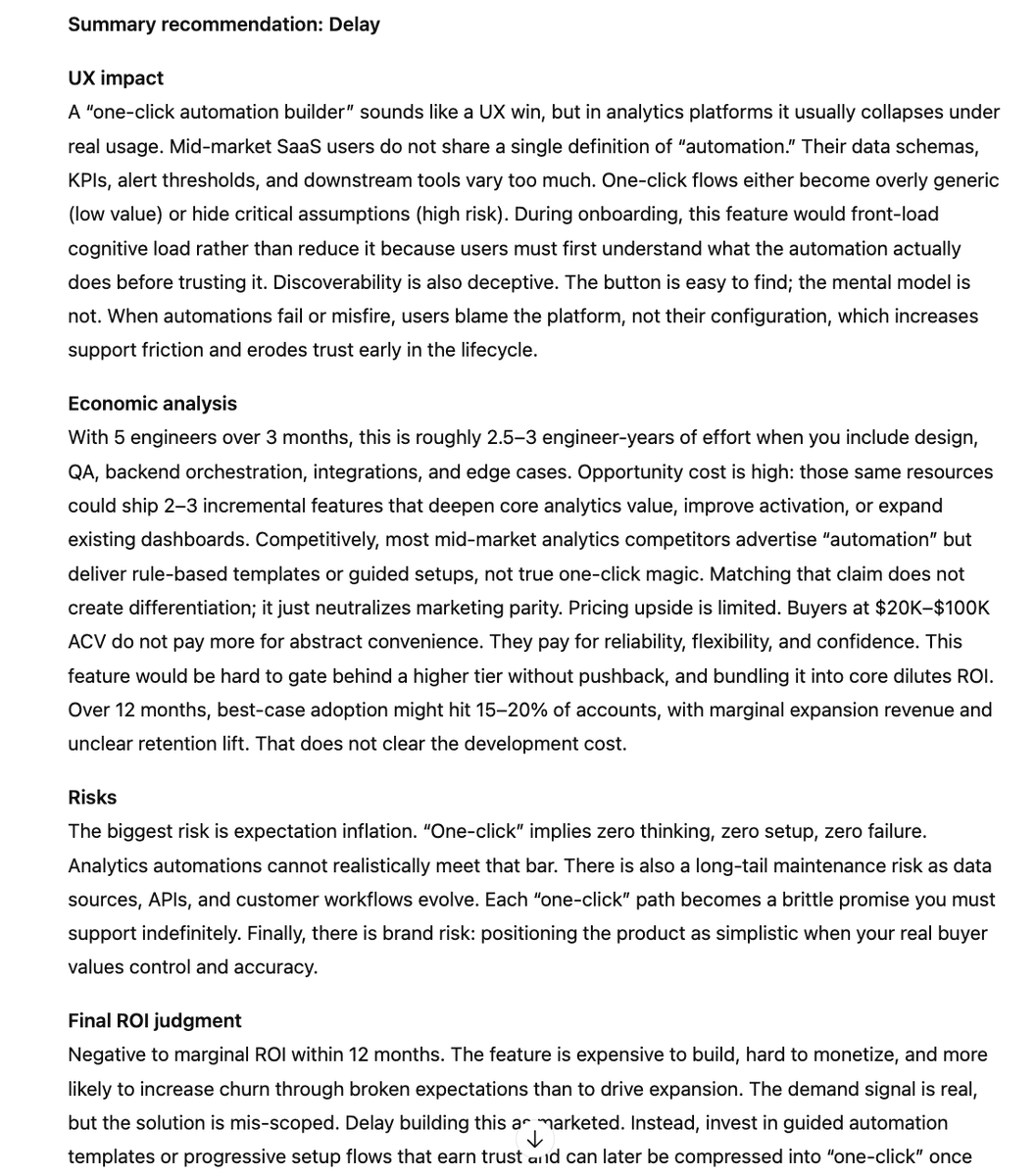
R.I.P McKinsey.
You don’t need a $1,200/hr consultant anymore.
You can now run full competitive market analysis using Claude.
Here are the 10 prompts I use instead of hiring consultants:
You don’t need a $1,200/hr consultant anymore.
You can now run full competitive market analysis using Claude.
Here are the 10 prompts I use instead of hiring consultants:
1/ LITERATURE REVIEW SYNTHESIZER
Prompt:
"Analyze these 20 research papers on [topic]. Create a gap analysis table showing: what's been studied, what's missing, contradictions between studies, and 3 unexplored opportunities."
I fed Claude 47 papers on AI regulation.
It found gaps 3 human researchers missed.
Prompt:
"Analyze these 20 research papers on [topic]. Create a gap analysis table showing: what's been studied, what's missing, contradictions between studies, and 3 unexplored opportunities."
I fed Claude 47 papers on AI regulation.
It found gaps 3 human researchers missed.
2/ COMPETITIVE INTELLIGENCE SCANNER
Prompt:
"Visit [competitor websites]. Extract: pricing tiers, feature comparisons, positioning strategy, target audience, and gaps in their offering we could exploit."
Saved me 12 hours of manual competitive analysis.
Claude even caught pricing they buried in FAQ pages.
Prompt:
"Visit [competitor websites]. Extract: pricing tiers, feature comparisons, positioning strategy, target audience, and gaps in their offering we could exploit."
Saved me 12 hours of manual competitive analysis.
Claude even caught pricing they buried in FAQ pages.
3/ SURVEY DATA PATTERN FINDER
Prompt:
"Analyze this 500-response survey. Find patterns nobody else will catch: non-obvious correlations, minority opinions worth exploring, gaps between what people say vs. what data shows."
It found 3 insights our data team missed.
One became our Q1 product pivot.
Prompt:
"Analyze this 500-response survey. Find patterns nobody else will catch: non-obvious correlations, minority opinions worth exploring, gaps between what people say vs. what data shows."
It found 3 insights our data team missed.
One became our Q1 product pivot.
4/ ACADEMIC CITATION FORMATTER
Prompt I use:
"Convert these rough research notes into properly formatted APA citations with 2-sentence context for each source explaining its relevance to [research question]."
This alone saved 6 hours/week.
No more Citation Machine back-and-forth.
Prompt I use:
"Convert these rough research notes into properly formatted APA citations with 2-sentence context for each source explaining its relevance to [research question]."
This alone saved 6 hours/week.
No more Citation Machine back-and-forth.
5/ EXPERT INTERVIEW PREP GENERATOR
Prompt:
"Based on [person's published research/articles], generate 15 expert-level questions for a 45-min interview. Include: technical depth questions, contrarian angles, and follow-ups that reveal insights."
My interviews got 3x better overnight.
Subjects even asked "how'd you know to ask that?"
Prompt:
"Based on [person's published research/articles], generate 15 expert-level questions for a 45-min interview. Include: technical depth questions, contrarian angles, and follow-ups that reveal insights."
My interviews got 3x better overnight.
Subjects even asked "how'd you know to ask that?"
6/ TRENDD FORECASTING ENGINE
Prompt:
"Analyze these 50 articles from past 6 months on [industry]. Predict next 6-month trends with confidence scores (1-10). Include: what's peaking, what's emerging, what's dying, contrarian bets."
This one's genuinely scary good.
Predicted 4 out of 5 major shifts in our industry.
Prompt:
"Analyze these 50 articles from past 6 months on [industry]. Predict next 6-month trends with confidence scores (1-10). Include: what's peaking, what's emerging, what's dying, contrarian bets."
This one's genuinely scary good.
Predicted 4 out of 5 major shifts in our industry.
7/ RESEARCH GAP IDENTIFIER
Prompt:
"Based on these [academic papers/industry reports], what's NOT being studied? What obvious questions are researchers avoiding? What would a contrarian researcher focus on?"
It found a research gap that became my thesis topic.
Prompt:
"Based on these [academic papers/industry reports], what's NOT being studied? What obvious questions are researchers avoiding? What would a contrarian researcher focus on?"
It found a research gap that became my thesis topic.
8/ METHODOLOGY DESIGNER
Prompt:
"Design a research methodology for [specific question]. Include: research design, sample size calculations, data collection methods, analysis approach, limitations, and timeline."
I used this to design a study methodology in 20 minutes.
Previous version took my team 2 weeks.
Prompt:
"Design a research methodology for [specific question]. Include: research design, sample size calculations, data collection methods, analysis approach, limitations, and timeline."
I used this to design a study methodology in 20 minutes.
Previous version took my team 2 weeks.
9/ DATA CLEANING PROTOCOL
Prompt:
"Analyze this dataset for: inconsistencies, outliers, missing patterns, duplicate entries, data quality issues, and potential errors. Provide specific row numbers and suggested fixes."
Caught errors our data analyst missed.
Saved us from publishing flawed research.
Prompt:
"Analyze this dataset for: inconsistencies, outliers, missing patterns, duplicate entries, data quality issues, and potential errors. Provide specific row numbers and suggested fixes."
Caught errors our data analyst missed.
Saved us from publishing flawed research.
10/ EXECUTIVE SUMMARY GENERATOR
Prompt:
"Read this 100-page research report. Extract 5 key insights investors/executives care about. Format: insight + supporting data + business implication. Make it boardroom-ready."
Turned a 3-hour summary task into 5 minutes.
My CEO used it verbatim in a board deck.
Prompt:
"Read this 100-page research report. Extract 5 key insights investors/executives care about. Format: insight + supporting data + business implication. Make it boardroom-ready."
Turned a 3-hour summary task into 5 minutes.
My CEO used it verbatim in a board deck.
Setup I use:
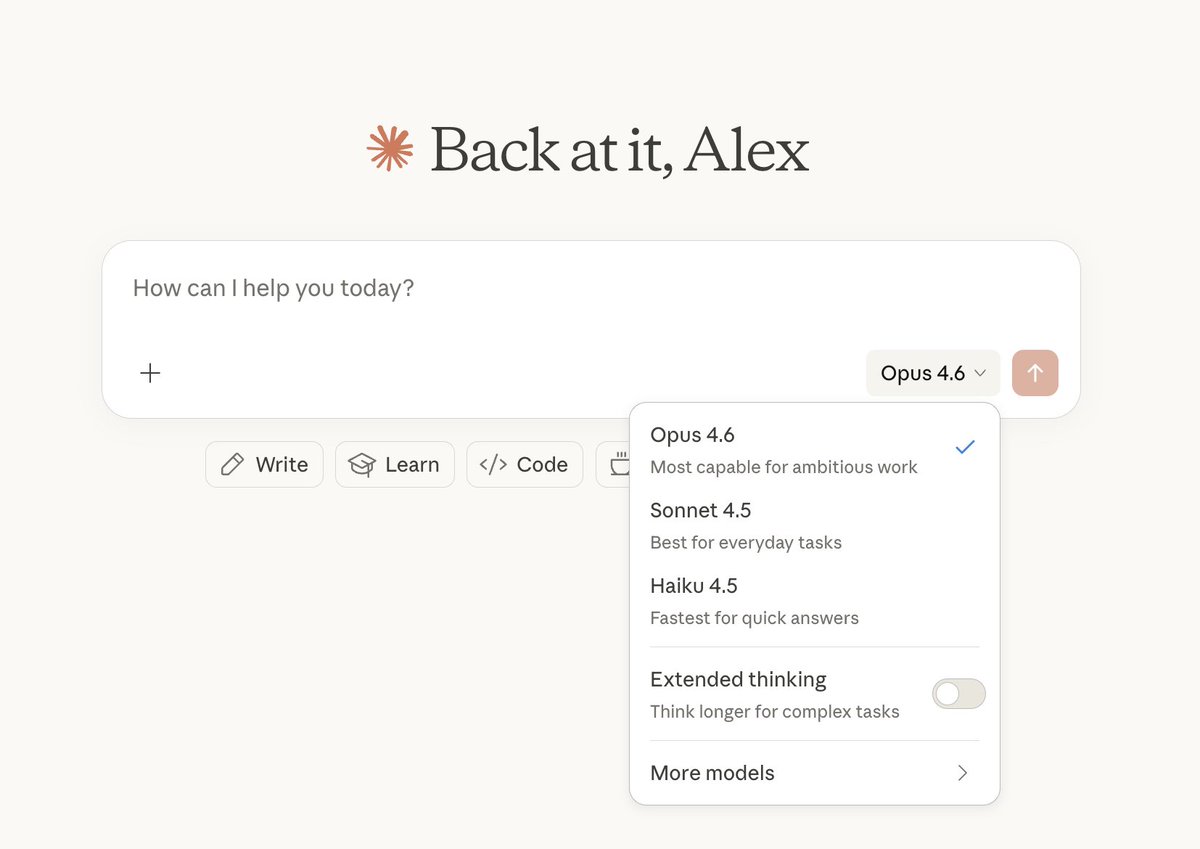
- Claude Opus 4.5 ($20/month Pro plan)
- Extended context for long documents
- Artifacts for data tables
- Web search for current data
Total cost: $20-60/month depending on usage.
Previous research assistant cost: $2,000/month + benefits.
ROI is absolutely insane.
- Claude Opus 4.5 ($20/month Pro plan)
- Extended context for long documents
- Artifacts for data tables
- Web search for current data
Total cost: $20-60/month depending on usage.
Previous research assistant cost: $2,000/month + benefits.
ROI is absolutely insane.
I'm going to be honest:
If you're paying humans to do literature reviews, competitive analysis, or data synthesis in 2025...
You're burning money.
Bookmark this thread.
Try prompt #6 first it's the one that convinced my boss to cut our research budget.
Which one will you test?
If you're paying humans to do literature reviews, competitive analysis, or data synthesis in 2025...
You're burning money.
Bookmark this thread.
Try prompt #6 first it's the one that convinced my boss to cut our research budget.
Which one will you test?
Your premium AI bundle to 10x your business
→ Prompts for marketing & business
→ Unlimited custom prompts
→ n8n automations
→ Weekly updates
Start your free trial👇
godofprompt.ai/complete-ai-bu…
→ Prompts for marketing & business
→ Unlimited custom prompts
→ n8n automations
→ Weekly updates
Start your free trial👇
godofprompt.ai/complete-ai-bu…
I hope you've found this thread helpful.
Follow me @alex_prompter for more.
Like/Repost the quote below if you can:
Follow me @alex_prompter for more.
Like/Repost the quote below if you can:
https://twitter.com/1657385954594762758/status/2020811478979563815
• • •
Missing some Tweet in this thread? You can try to
force a refresh