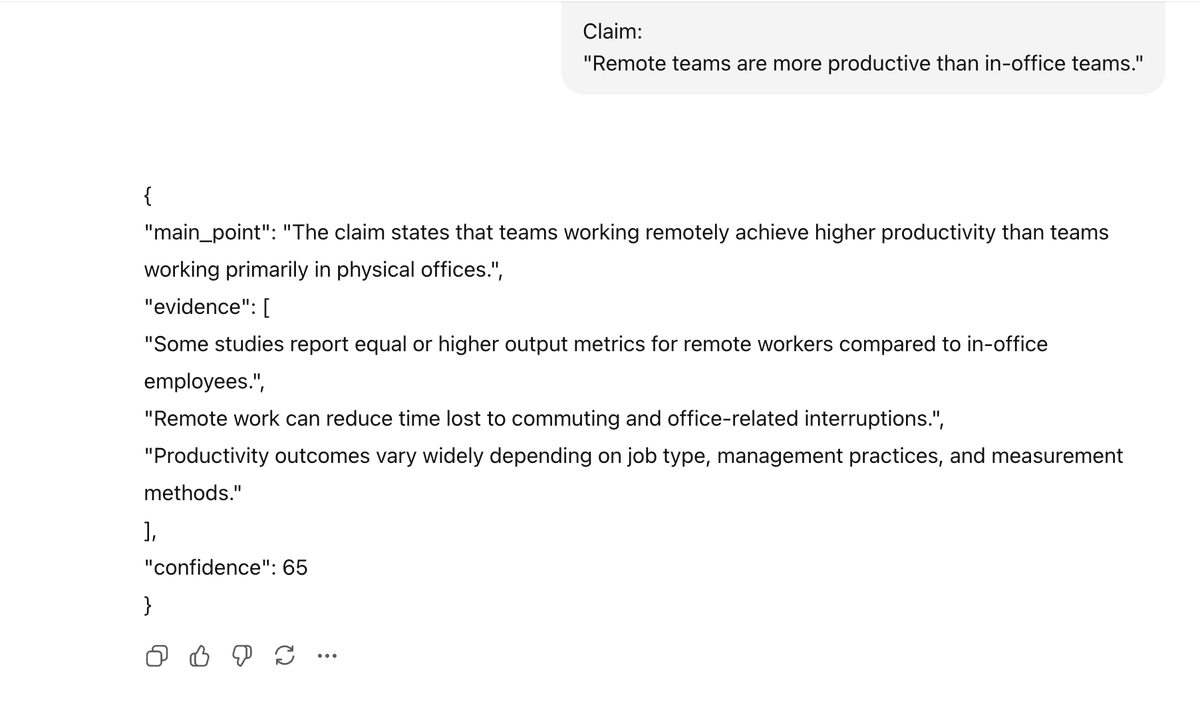
I've written 500 articles, 23 whitepapers, and 3 ebooks using Claude over 2 years, and these 10 prompts are the ONLY ones I actually use anymore because they handle 90% of professional writing better than any human editor I've worked with and cost me $0.02 per 1000 words: 👇 
1. The 5-Minute First Draft
Prompt:
"Turn these rough notes into an article:
[paste your brain dump]
Target length: [800/1500/3000] words
Audience: [describe reader]
Goal: [inform/persuade/teach]
Keep my ideas and examples. Fix structure and flow."
Prompt:
"Turn these rough notes into an article:
[paste your brain dump]
Target length: [800/1500/3000] words
Audience: [describe reader]
Goal: [inform/persuade/teach]
Keep my ideas and examples. Fix structure and flow."
2. Headline Machine (Steal This)
Prompt:
"Topic: [your topic]
Write 20 headlines using these formulas:
- How to [benefit] without [pain point]
- [Number] ways [audience] can [outcome]
- The [adjective] guide to [topic]
- Why [common belief] is wrong about [topic]
- [Do something] like [authority figure]
- I [did thing] and here's what happened
- What [success case] knows about [topic] that you don't
Rank top 3 by click-through potential."
Prompt:
"Topic: [your topic]
Write 20 headlines using these formulas:
- How to [benefit] without [pain point]
- [Number] ways [audience] can [outcome]
- The [adjective] guide to [topic]
- Why [common belief] is wrong about [topic]
- [Do something] like [authority figure]
- I [did thing] and here's what happened
- What [success case] knows about [topic] that you don't
Rank top 3 by click-through potential."
3. The Clarity Surgeon
Prompt:
"Rewrite this for maximum clarity:
[paste text]
Rules:
- Cut word count by 30% minimum
- Remove: jargon, passive voice, hedge words ("perhaps", "might", "could")
- Replace abstract nouns with concrete verbs
- Break sentences over 20 words
- Keep technical terms only if necessary
Show before/after word count."
Prompt:
"Rewrite this for maximum clarity:
[paste text]
Rules:
- Cut word count by 30% minimum
- Remove: jargon, passive voice, hedge words ("perhaps", "might", "could")
- Replace abstract nouns with concrete verbs
- Break sentences over 20 words
- Keep technical terms only if necessary
Show before/after word count."
4. Argument Builder (Long-Form)
Prompt:
"I want to argue that: [your thesis]
Build a persuasive essay using this structure:
1. HOOK - Start with surprising statistic, story, or question that makes thesis inevitable
2. PROBLEM - Establish what's broken and why it matters (include costs/consequences)
3. CURRENT SOLUTIONS - Explain why existing approaches fail (be fair but critical)
4. THESIS - Present your argument clearly in one sentence
5. EVIDENCE - Provide 3-5 supporting points with:
- Data/research citations
- Expert opinions
- Real-world examples
- Logical reasoning
6. COUNTERARGUMENTS - Address 2 strongest objections head-on
7. IMPLICATIONS - What changes if you're right?
8. CALL TO ACTION - What should reader do now?
Tone: [professional/conversational/academic]
Length: [target word count]
Use subheadings. Write like you're explaining to a smart skeptic."
Prompt:
"I want to argue that: [your thesis]
Build a persuasive essay using this structure:
1. HOOK - Start with surprising statistic, story, or question that makes thesis inevitable
2. PROBLEM - Establish what's broken and why it matters (include costs/consequences)
3. CURRENT SOLUTIONS - Explain why existing approaches fail (be fair but critical)
4. THESIS - Present your argument clearly in one sentence
5. EVIDENCE - Provide 3-5 supporting points with:
- Data/research citations
- Expert opinions
- Real-world examples
- Logical reasoning
6. COUNTERARGUMENTS - Address 2 strongest objections head-on
7. IMPLICATIONS - What changes if you're right?
8. CALL TO ACTION - What should reader do now?
Tone: [professional/conversational/academic]
Length: [target word count]
Use subheadings. Write like you're explaining to a smart skeptic."
5. Content Remix Engine
Prompt:
"Source content: [paste article/report/transcript]
Remix this into:
1. Twitter thread (8-10 tweets)
2. LinkedIn post (150 words)
3. Email newsletter section (250 words)
4. Slide deck outline (8 slides with bullet points)
5. Executive summary (3 paragraphs)
6. FAQ section (5 questions)
7. Pull quotes (5 tweetable quotes)
8. Podcast script intro (2 min read time)
9. Instagram caption (100 words + 10 hashtags)
10. Reddit post (conversational, 200 words)
Keep core message identical. Adapt tone to platform."
Prompt:
"Source content: [paste article/report/transcript]
Remix this into:
1. Twitter thread (8-10 tweets)
2. LinkedIn post (150 words)
3. Email newsletter section (250 words)
4. Slide deck outline (8 slides with bullet points)
5. Executive summary (3 paragraphs)
6. FAQ section (5 questions)
7. Pull quotes (5 tweetable quotes)
8. Podcast script intro (2 min read time)
9. Instagram caption (100 words + 10 hashtags)
10. Reddit post (conversational, 200 words)
Keep core message identical. Adapt tone to platform."
6. Research-to-Article Pipeline
Prompt:
"Sources: [paste URLs, excerpts, or PDFs]
Write an article on: [topic]
Process:
1. Extract key arguments from each source
2. Find narrative thread connecting them
3. Add original analysis (don't just summarize)
4. Structure as: Introduction → 3-5 main sections → Conclusion
5. Cite sources naturally in text [Source Name, Year]
6. Add transition sentences between sections
Requirements:
- 0% plagiarism (paraphrase everything)
- Attribute every factual claim
- Add your own "so what?" after each section
- Write for [target audience]
- [Word count] words
Include "Further Reading" section at end with source links."
Prompt:
"Sources: [paste URLs, excerpts, or PDFs]
Write an article on: [topic]
Process:
1. Extract key arguments from each source
2. Find narrative thread connecting them
3. Add original analysis (don't just summarize)
4. Structure as: Introduction → 3-5 main sections → Conclusion
5. Cite sources naturally in text [Source Name, Year]
6. Add transition sentences between sections
Requirements:
- 0% plagiarism (paraphrase everything)
- Attribute every factual claim
- Add your own "so what?" after each section
- Write for [target audience]
- [Word count] words
Include "Further Reading" section at end with source links."
7. The Empathy Rewriter
Prompt:
"Technical content: [paste]
Rewrite this for someone who:
- Doesn't know the jargon
- Needs to understand why they should care
- Wants to know "what do I do with this?"
For every technical term:
1. Define it in one sentence
2. Give a concrete example or analogy
3. Explain why it matters
Structure as:
- What is this? (plain English, no assumptions)
- Why should I care? (benefits, not features)
- How does it work? (simplified, with examples)
- What should I do next? (clear action step)
Test: A smart 16-year-old should understand this."
Prompt:
"Technical content: [paste]
Rewrite this for someone who:
- Doesn't know the jargon
- Needs to understand why they should care
- Wants to know "what do I do with this?"
For every technical term:
1. Define it in one sentence
2. Give a concrete example or analogy
3. Explain why it matters
Structure as:
- What is this? (plain English, no assumptions)
- Why should I care? (benefits, not features)
- How does it work? (simplified, with examples)
- What should I do next? (clear action step)
Test: A smart 16-year-old should understand this."
8. Story Structure Overlay
Prompt:
"Content to improve: [paste article/report]
This is informative but boring. Rewrite using story structure:
ACT 1 - SETUP (20%)
- Start with relatable moment or specific scenario
- Introduce protagonist (can be reader, case study, or "people who...")
- Establish stakes (what happens if problem isn't solved?)
ACT 2 - CONFLICT (60%)
- Show obstacles and failed attempts
- Build tension with "but then..." moments
- Include turning point or key insight
ACT 3 - RESOLUTION (20%)
- Reveal solution or transformation
- Show before/after contrast
- End with actionable takeaway
Keep all factual content. Add narrative connective tissue.
Current tone: [tone]
Maintain: [any technical requirements]"
Prompt:
"Content to improve: [paste article/report]
This is informative but boring. Rewrite using story structure:
ACT 1 - SETUP (20%)
- Start with relatable moment or specific scenario
- Introduce protagonist (can be reader, case study, or "people who...")
- Establish stakes (what happens if problem isn't solved?)
ACT 2 - CONFLICT (60%)
- Show obstacles and failed attempts
- Build tension with "but then..." moments
- Include turning point or key insight
ACT 3 - RESOLUTION (20%)
- Reveal solution or transformation
- Show before/after contrast
- End with actionable takeaway
Keep all factual content. Add narrative connective tissue.
Current tone: [tone]
Maintain: [any technical requirements]"
9. The Polish Pass (Final Edit)
Prompt:
"Edit this for publication:
[paste draft]
Checklist:
□ Fix grammar, spelling, punctuation
□ Improve weak verbs (is/was/have → action verbs)
□ Vary sentence length (mix short punchy sentences with longer ones)
□ Remove redundancies and filler phrases
□ Strengthen opening sentence and closing paragraph
□ Add transition words where flow is choppy
□ Check that every paragraph has one clear point
□ Ensure subheadings are descriptive and scannable
□ Replace clichés with fresh language
□ Fact-check any claims that sound suspicious
Mark changes with [EDIT: reason] so I can learn.
Output: Clean final version + list of major changes made."
Prompt:
"Edit this for publication:
[paste draft]
Checklist:
□ Fix grammar, spelling, punctuation
□ Improve weak verbs (is/was/have → action verbs)
□ Vary sentence length (mix short punchy sentences with longer ones)
□ Remove redundancies and filler phrases
□ Strengthen opening sentence and closing paragraph
□ Add transition words where flow is choppy
□ Check that every paragraph has one clear point
□ Ensure subheadings are descriptive and scannable
□ Replace clichés with fresh language
□ Fact-check any claims that sound suspicious
Mark changes with [EDIT: reason] so I can learn.
Output: Clean final version + list of major changes made."
10. The Voice Cloner (Advanced)
Prompt:
"TRAINING PHASE:
Here are 3 samples of my writing:
[Sample 1 - paste 300+ words]
[Sample 2 - paste 300+ words]
[Sample 3 - paste 300+ words]
Analyze my writing style:
VOICE FINGERPRINT:
- Sentence structure patterns (average length, variation, fragments?)
- Vocabulary level (simple/complex? technical/casual?)
- Tone markers (humor? formality? directness?)
- Rhythm (choppy? flowing? mixed?)
- Signature phrases or verbal tics
- How I use examples and analogies
- Paragraph length preferences
- Use of questions, lists, emphasis
WRITING PHASE:
Now write about [topic] in MY voice:
Topic: [describe what to write]
Length: [word count]
Purpose: [inform/persuade/entertain]
Requirements:
- Match my sentence rhythm and variety
- Use my typical vocabulary range
- Replicate my tone and personality
- Include the kinds of examples I'd use
- Mirror my formatting preferences
After writing, explain: "This matches your style because [3 specific elements].""
Prompt:
"TRAINING PHASE:
Here are 3 samples of my writing:
[Sample 1 - paste 300+ words]
[Sample 2 - paste 300+ words]
[Sample 3 - paste 300+ words]
Analyze my writing style:
VOICE FINGERPRINT:
- Sentence structure patterns (average length, variation, fragments?)
- Vocabulary level (simple/complex? technical/casual?)
- Tone markers (humor? formality? directness?)
- Rhythm (choppy? flowing? mixed?)
- Signature phrases or verbal tics
- How I use examples and analogies
- Paragraph length preferences
- Use of questions, lists, emphasis
WRITING PHASE:
Now write about [topic] in MY voice:
Topic: [describe what to write]
Length: [word count]
Purpose: [inform/persuade/entertain]
Requirements:
- Match my sentence rhythm and variety
- Use my typical vocabulary range
- Replicate my tone and personality
- Include the kinds of examples I'd use
- Mirror my formatting preferences
After writing, explain: "This matches your style because [3 specific elements].""
Your premium AI bundle to 10x your business
→ Prompts for marketing & business
→ Unlimited custom prompts
→ n8n automations
→ Weekly updates
Start your free trial👇
godofprompt.ai/complete-ai-bu…
→ Prompts for marketing & business
→ Unlimited custom prompts
→ n8n automations
→ Weekly updates
Start your free trial👇
godofprompt.ai/complete-ai-bu…
That's a wrap:
I hope you've found this thread helpful.
Follow me @godofprompt for more.
Like/Repost the quote below if you can:
I hope you've found this thread helpful.
Follow me @godofprompt for more.
Like/Repost the quote below if you can:
https://twitter.com/1643695629665722379/status/2021176130741600471
• • •
Missing some Tweet in this thread? You can try to
force a refresh