God of Prompt Profile picture
Feb 12 13 tweets 3 min read Read on X
After interviewing 12 AI researchers from OpenAI, Anthropic, and Google, I noticed they all use the same 10 prompts.

Not the ones you see on X and LinkedIn.

These are the prompts that actually ship products, publish papers, and break benchmarks.

Here's what they told me ↓ Image
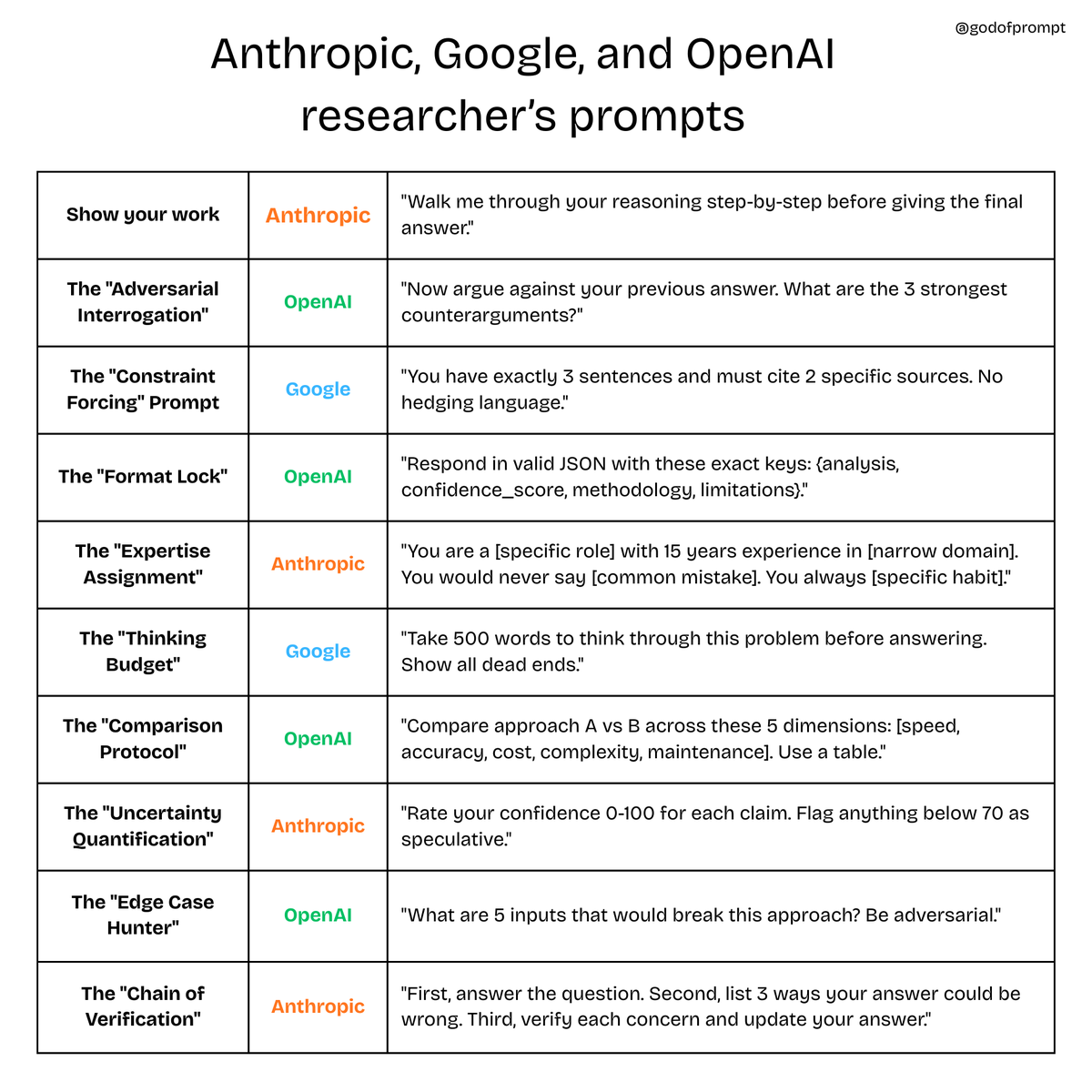
1. The "Show Your Work" Prompt

"Walk me through your reasoning step-by-step before giving the final answer."

This prompt forces the model to externalize its logic. Catches errors before they compound.
2. The "Adversarial Interrogation"

"Now argue against your previous answer. What are the 3 strongest counterarguments?"

Models are overconfident by default. This forces intellectual honesty.
3. The "Constraint Forcing" Prompt

"You have exactly 3 sentences and must cite 2 specific sources. No hedging language."

Vagueness is the enemy of useful output. Hard constraints = crisp results.
4. The "Format Lock"

"Respond in valid JSON with these exact keys: {analysis, confidence_score, methodology, limitations}."

Structured output = parseable output. You can't build systems on prose.
5. The "Expertise Assignment"

"You are a [specific role] with 15 years experience in [narrow domain]. You would never say [common mistake]. You always [specific habit]."

Generic AI = generic output. Specific persona = specific expertise.
6. The "Thinking Budget"

"Take 500 words to think through this problem before answering. Show all dead ends."

More tokens = better reasoning. Dead ends reveal model understanding.
7. The "Comparison Protocol"

"Compare approach A vs B across these 5 dimensions: [speed, accuracy, cost, complexity, maintenance]. Use a table."

Forces structured analysis. Tables > paragraphs for technical decisions.
8. The "Uncertainty Quantification"

"Rate your confidence 0-100 for each claim. Flag anything below 70 as speculative."

Hallucinations are less dangerous when labeled. Confidence scoring is mandatory.
9. The "Edge Case Hunter"

"What are 5 inputs that would break this approach? Be adversarial."

Models miss edge cases humans would catch. Forcing adversarial thinking reveals brittleness.
10. The "Chain of Verification"

"First, answer the question. Second, list 3 ways your answer could be wrong. Third, verify each concern and update your answer."

Self-correction built into the prompt. Models fix their own mistakes.
Your premium AI bundle to 10x your business

→ Prompts for marketing & business
→ Unlimited custom prompts
→ n8n automations
→ Weekly updates

Start your free trial👇
godofprompt.ai/complete-ai-bu…
That's a wrap:

I hope you've found this thread helpful.

Follow me @godofprompt for more.

Like/Repost the quote below if you can:

• • •

Missing some Tweet in this thread? You can try to force a refresh

 

Keep Current with God of Prompt

God of Prompt Profile picture

Stay in touch and get notified when new unrolls are available from this author!

Read all threads

This Thread may be Removed Anytime!

PDF

Twitter may remove this content at anytime! Save it as PDF for later use!

Try unrolling a thread yourself!

how to unroll video
  1. Follow @ThreadReaderApp to mention us!

  2. From a Twitter thread mention us with a keyword "unroll"
@threadreaderapp unroll

Practice here first or read more on our help page!

More from @godofprompt

Feb 11
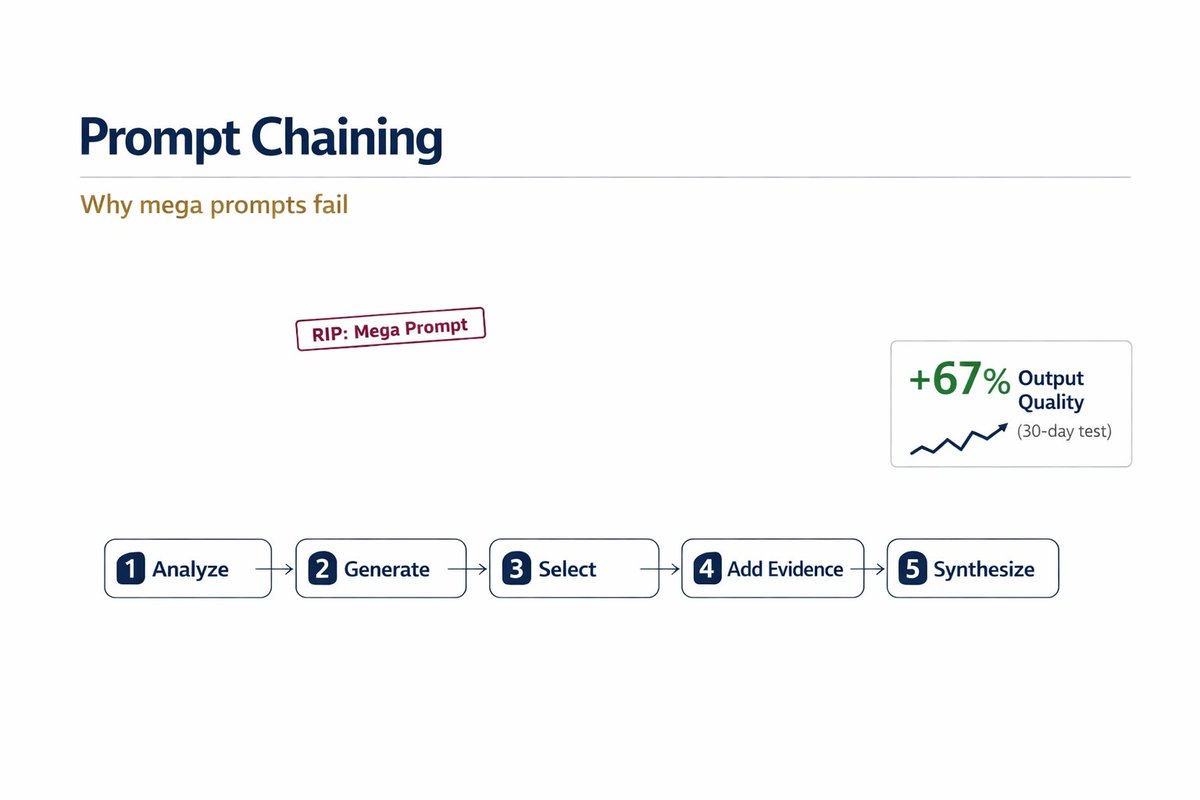
Prompt engineering is dead.

"Prompt chaining" is the new meta.

Break one complex prompt into 5 simple prompts that feed into each other.

I tested this for 30 days. Output quality jumped 67%.

Here's how to do it ↓ Image
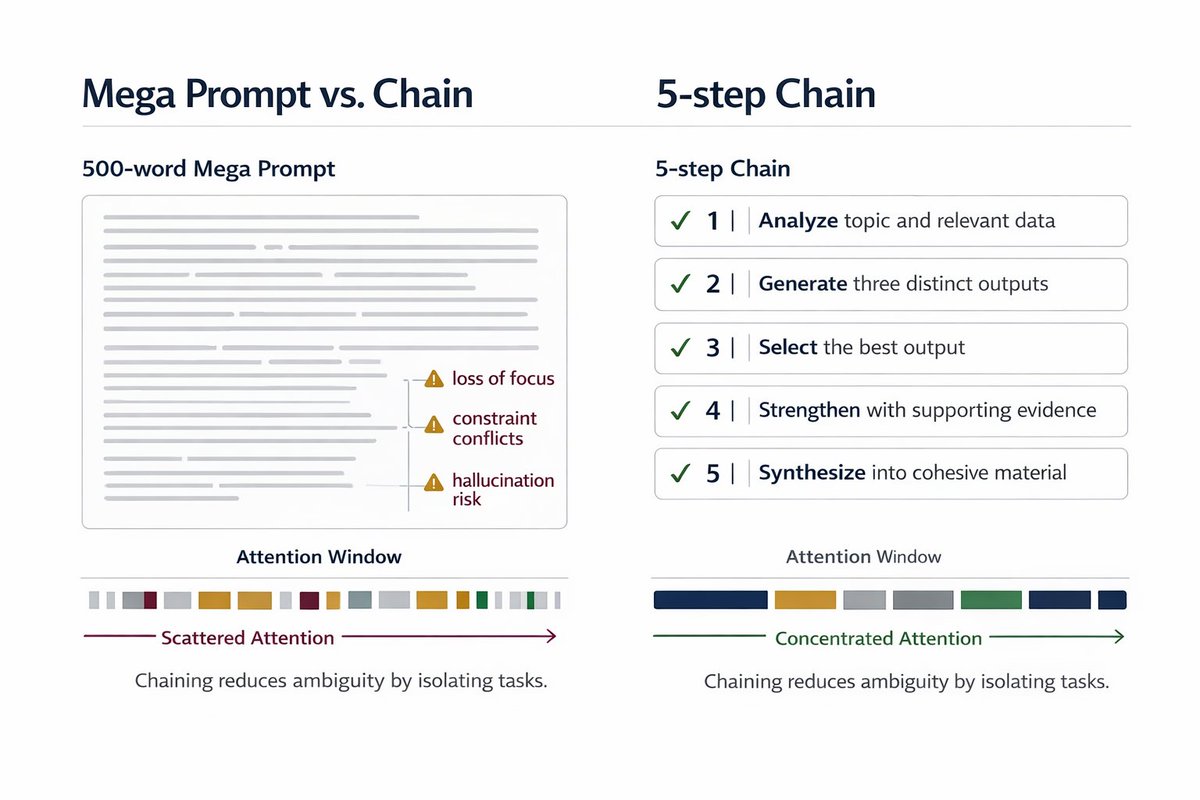
Most people write 500-word mega prompts and wonder why the AI hallucinates.

I did this for 2 years with ChatGPT.

Then I discovered how OpenAI engineers actually use these models.

They chain simple prompts. Each one builds on the last. Image
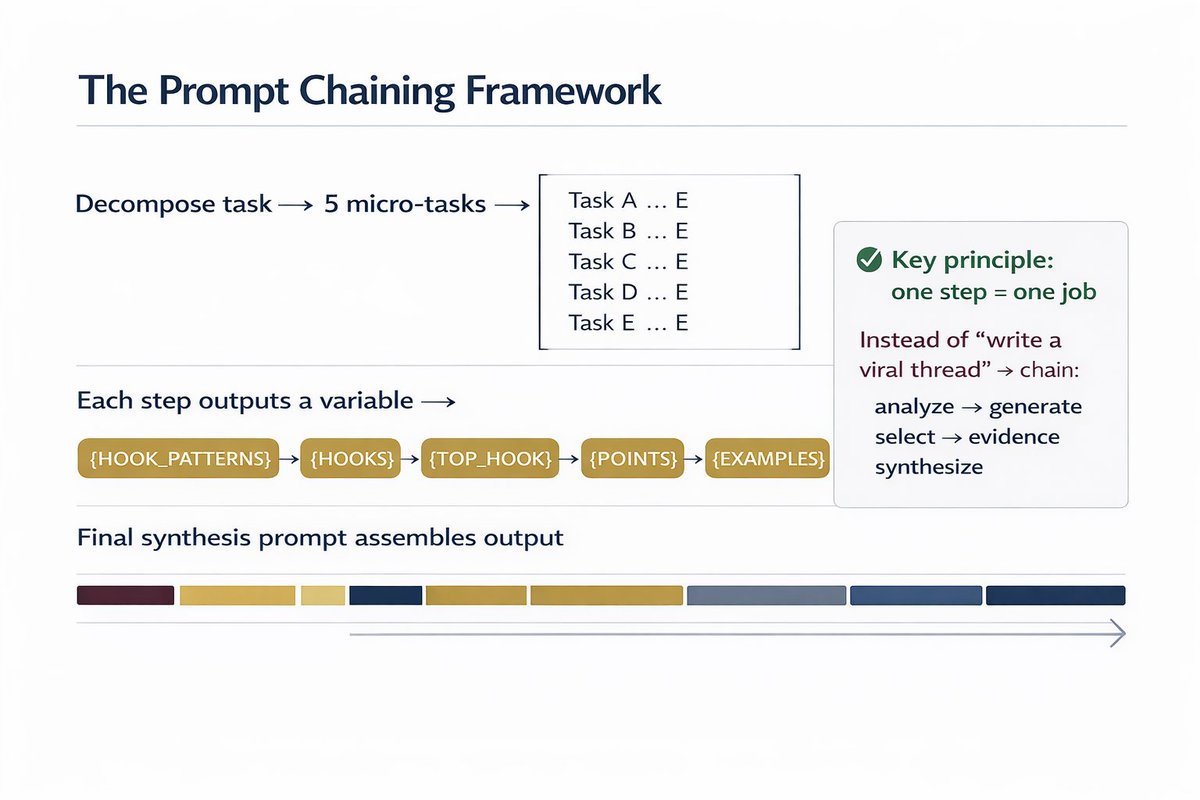
Here's the framework:

Step 1: Break your complex task into 5 micro-tasks
Step 2: Each prompt outputs a variable for the next
Step 3: Final prompt synthesizes everything

Example: Instead of "write a viral thread about AI" →

Chain 5 prompts that do ONE thing each. Image
Read 11 tweets
Feb 10
I've written 500 articles, 23 whitepapers, and 3 ebooks using Claude over 2 years, and these 10 prompts are the ONLY ones I actually use anymore because they handle 90% of professional writing better than any human editor I've worked with and cost me $0.02 per 1000 words: 👇 Image
1. The 5-Minute First Draft

Prompt:

"Turn these rough notes into an article:

[paste your brain dump]

Target length: [800/1500/3000] words
Audience: [describe reader]
Goal: [inform/persuade/teach]

Keep my ideas and examples. Fix structure and flow."
2. Headline Machine (Steal This)

Prompt:

"Topic: [your topic]

Write 20 headlines using these formulas:
- How to [benefit] without [pain point]
- [Number] ways [audience] can [outcome]
- The [adjective] guide to [topic]
- Why [common belief] is wrong about [topic]
- [Do something] like [authority figure]
- I [did thing] and here's what happened
- What [success case] knows about [topic] that you don't

Rank top 3 by click-through potential."
Read 13 tweets
Feb 9
RIP "act as an expert" and basic prompting.

A former OpenAI engineer just exposed "Prompt Contract" - the internal technique that makes LLMs actually obey you.

Works on ChatGPT, Claude, Gemini, everything.

Here's how to use it right now: Image
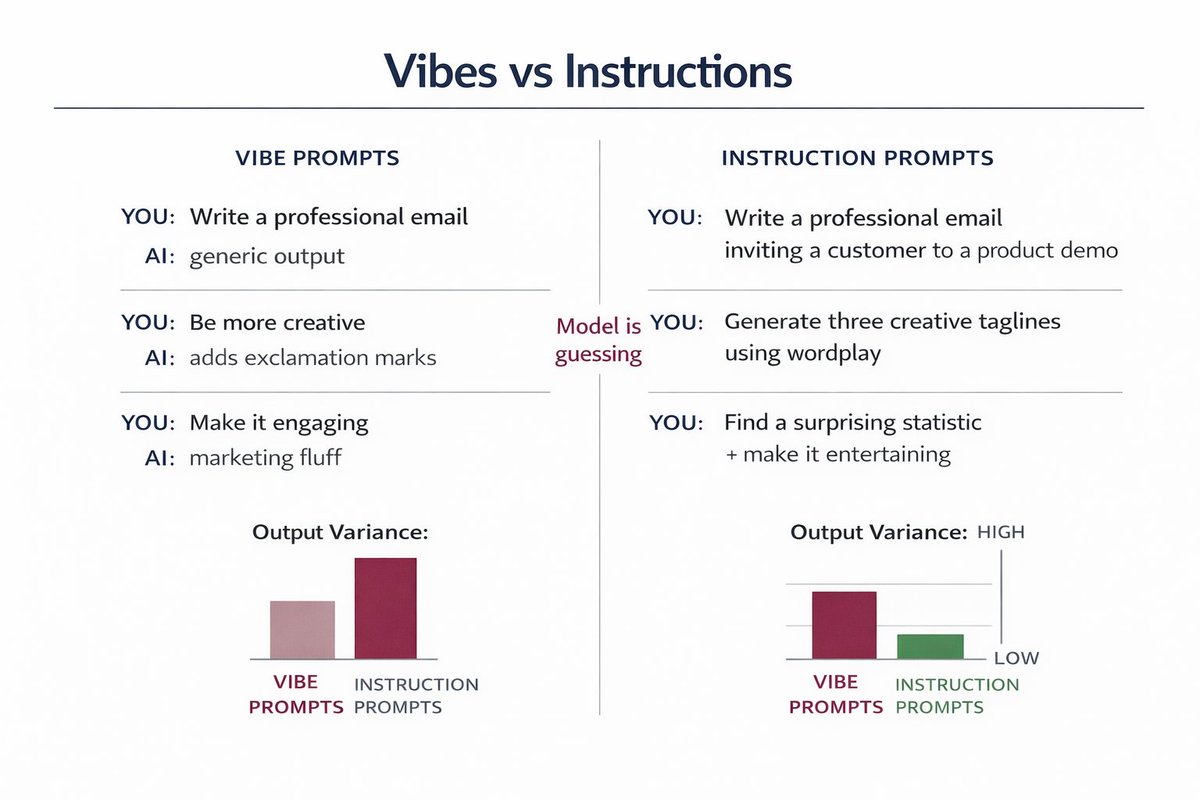
Here's why your prompts suck:

You: "Write a professional email"
AI: *writes generic corporate bullshit*

You: "Be more creative"
AI: *adds exclamation marks*

You're giving vibes, not instructions.

The AI is guessing what you want. Guessing = garbage output. Image
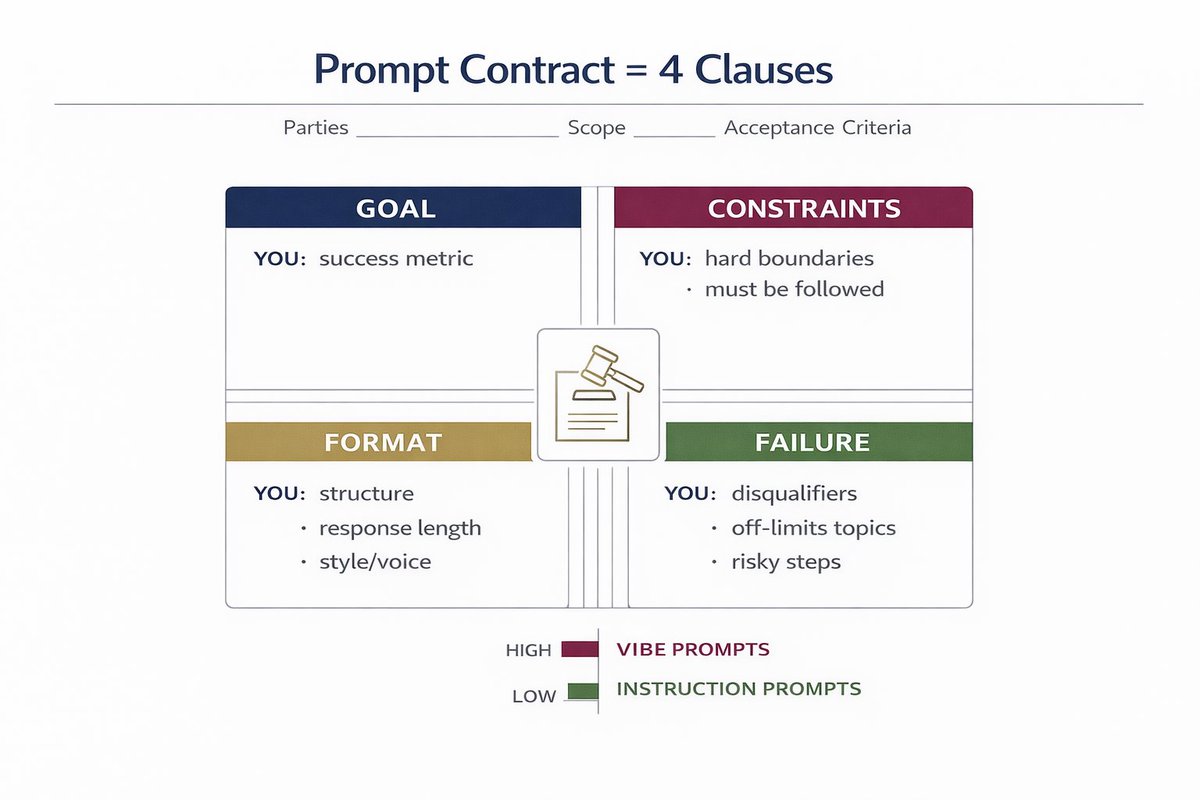
Prompt Contracts change everything.

Instead of "write X," you define 4 things:

1. Goal (exact success metric)
2. Constraints (hard boundaries)
3. Output format (specific structure)
4. Failure conditions (what breaks it)

Think legal contract, not creative brief. Image
Read 14 tweets
Feb 6
Claude Opus 4.6 is a monster.

I just used it for:

- automating marketing tasks
- building full websites and apps
- writing viral X threads, LinkedIn posts, and YouTube scripts

And it did all this in minutes.

Here are 10 prompts you can steal to unlock its full potential: Image
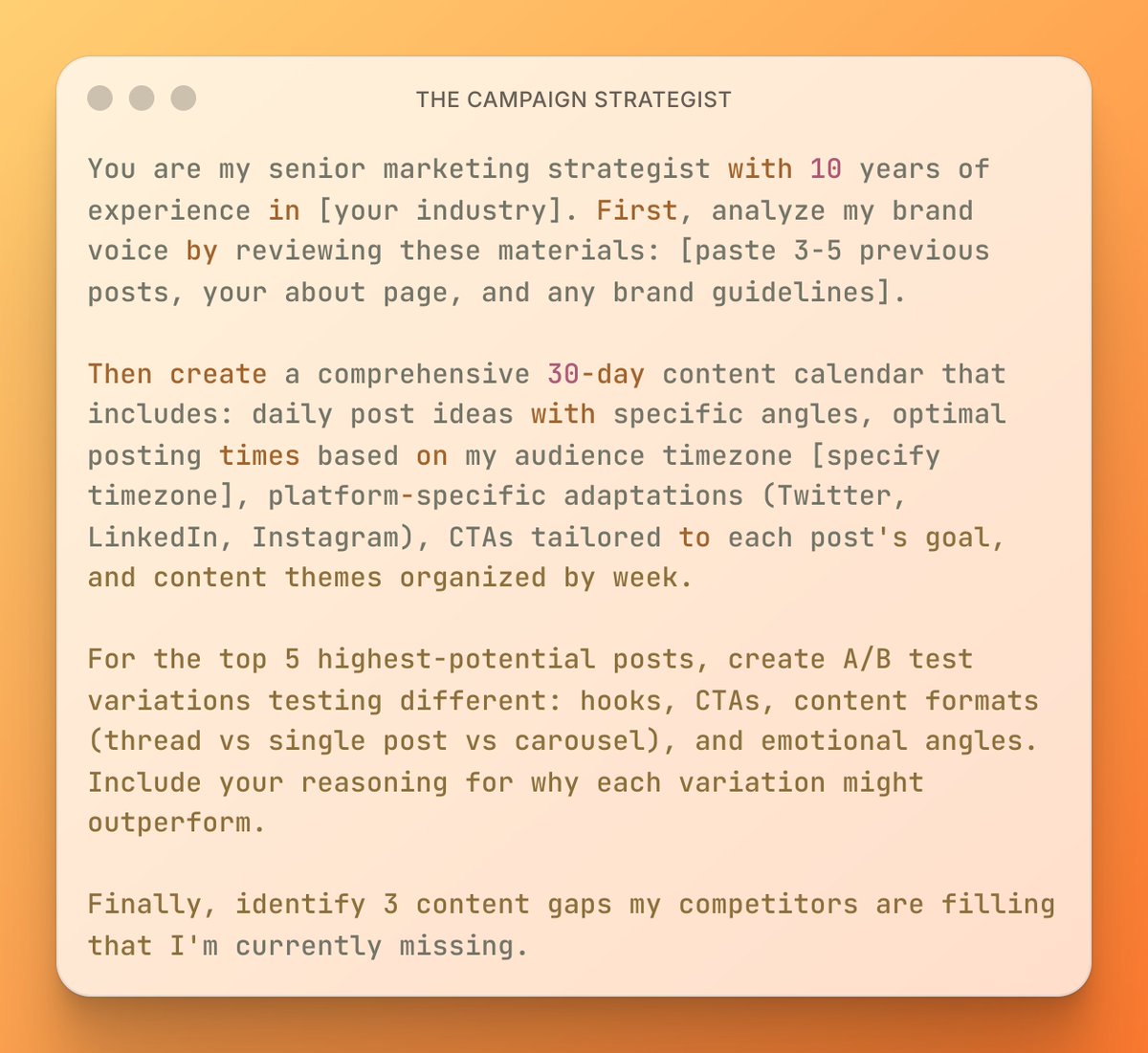
1. THE CAMPAIGN STRATEGIST

Opus 4.6's 200K context window means it remembers your entire brand voice across all campaigns.

Prompt:

"You are my senior marketing strategist with 10 years of experience in [your industry]. First, analyze my brand voice by reviewing these materials: [paste 3-5 previous posts, your about page, and any brand guidelines].

Then create a comprehensive 30-day content calendar that includes: daily post ideas with specific angles, optimal posting times based on my audience timezone [specify timezone], platform-specific adaptations (Twitter, LinkedIn, Instagram), CTAs tailored to each post's goal, and content themes organized by week.

For the top 5 highest-potential posts, create A/B test variations testing different: hooks, CTAs, content formats (thread vs single post vs carousel), and emotional angles. Include your reasoning for why each variation might outperform.

Finally, identify 3 content gaps my competitors are filling that I'm currently missing."

Opus maintains perfect consistency across 200K tokens. Other models lose your voice after 3-4 posts.Image
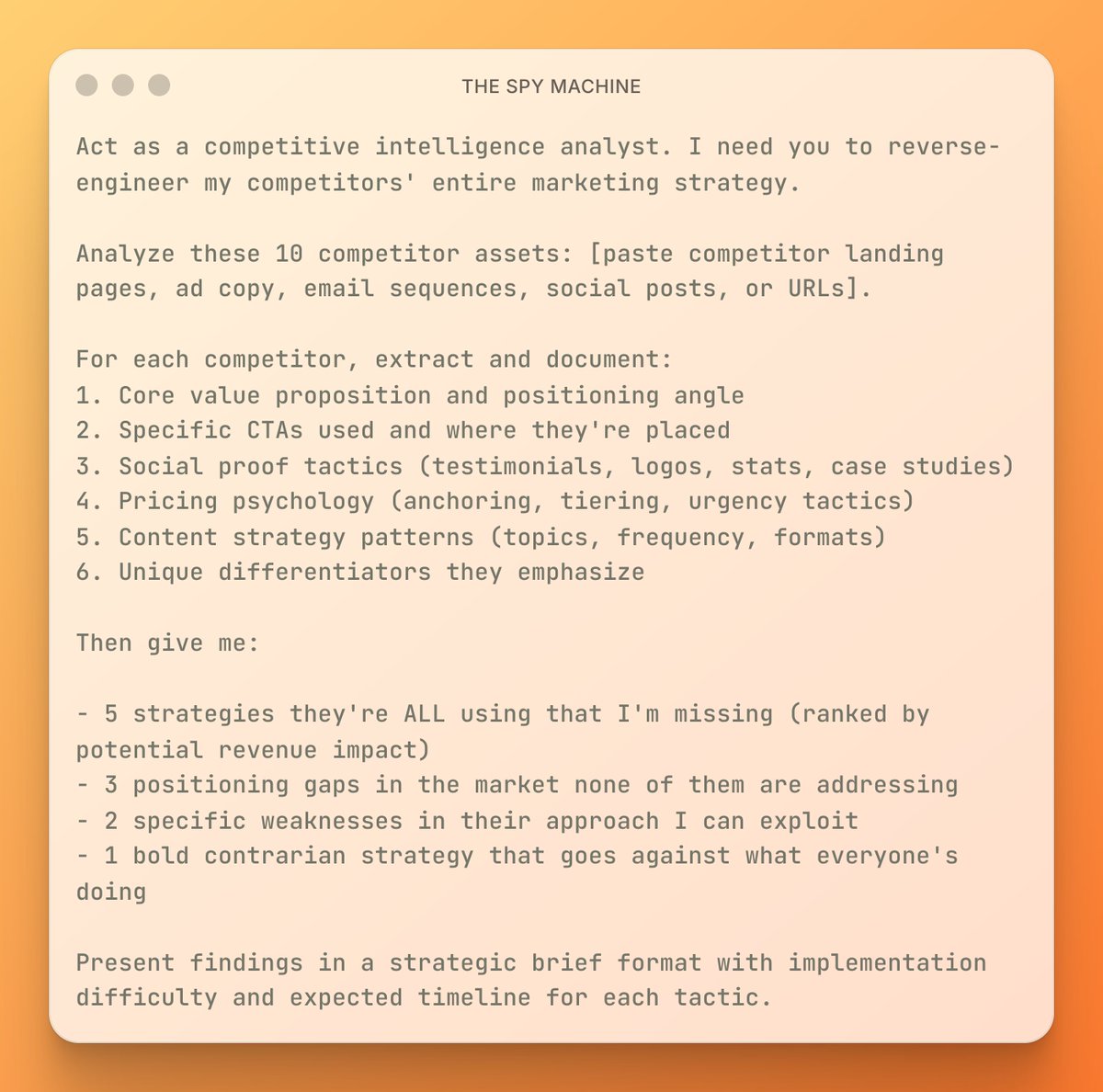
2. THE SPY MACHINE

Opus 4.6 processes competitor data 3x faster than GPT-4 and catches patterns humans miss.

Prompt:

"Act as a competitive intelligence analyst. I need you to reverse-engineer my competitors' entire marketing strategy.

Analyze these 10 competitor assets: [paste competitor landing pages, ad copy, email sequences, social posts, or URLs].

For each competitor, extract and document:
1. Core value proposition and positioning angle
2. Specific CTAs used and where they're placed
3. Social proof tactics (testimonials, logos, stats, case studies)
4. Pricing psychology (anchoring, tiering, urgency tactics)
5. Content strategy patterns (topics, frequency, formats)
6. Unique differentiators they emphasize

Then give me:

- 5 strategies they're ALL using that I'm missing (ranked by potential revenue impact)
- 3 positioning gaps in the market none of them are addressing
- 2 specific weaknesses in their approach I can exploit
- 1 bold contrarian strategy that goes against what everyone's doing

Present findings in a strategic brief format with implementation difficulty and expected timeline for each tactic."

Opus reads entire competitor websites in one shot. No "context too long" errors.Image
Read 13 tweets
Feb 6
Stop telling LLMs like Claude and ChatGPT what to do.

Start asking them questions instead.

I replaced all my instruction prompts with question prompts.

Output quality: 6.2/10 → 9.1/10

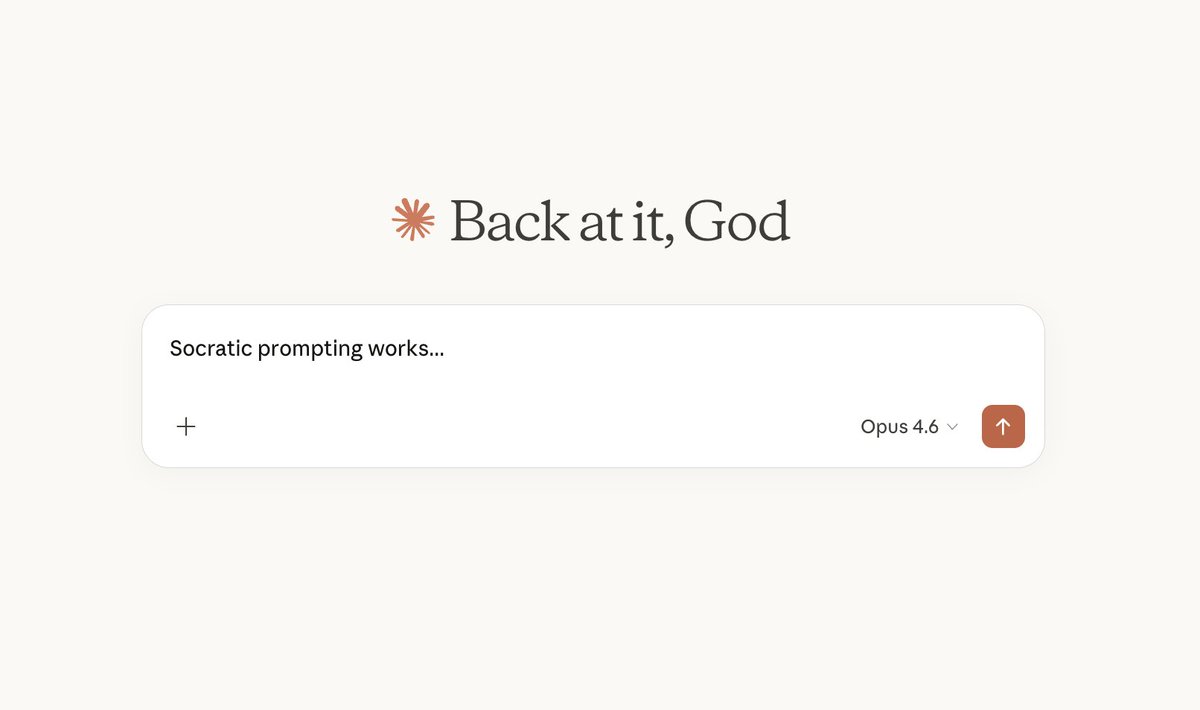
This is called "Socratic prompting" and here's how it works: Image
Most people prompt like this:

"Write a blog post about AI productivity tools"
"Create a marketing strategy for my SaaS"
"Analyze this data and give me insights"

LLMs treat these like tasks to complete.
They optimize for speed, not depth.

You get surface-level garbage.
Socratic prompting flips this.

Instead of telling the AI what to produce, you ask questions that force it to think through the problem.

LLMs are trained on billions of reasoning examples.
Questions activate that reasoning mode.

Instructions don't.
Read 13 tweets
Feb 5
I reverse-engineered the actual prompting frameworks that top AI labs use internally.

Not the fluff you see on Twitter.

The real shit that turns vague inputs into precise, structured outputs.

Spent 3 weeks reading OpenAI's model cards, Anthropic's constitutional AI papers, and leaked internal prompt libraries.

Here's what actually moves the needle:Image
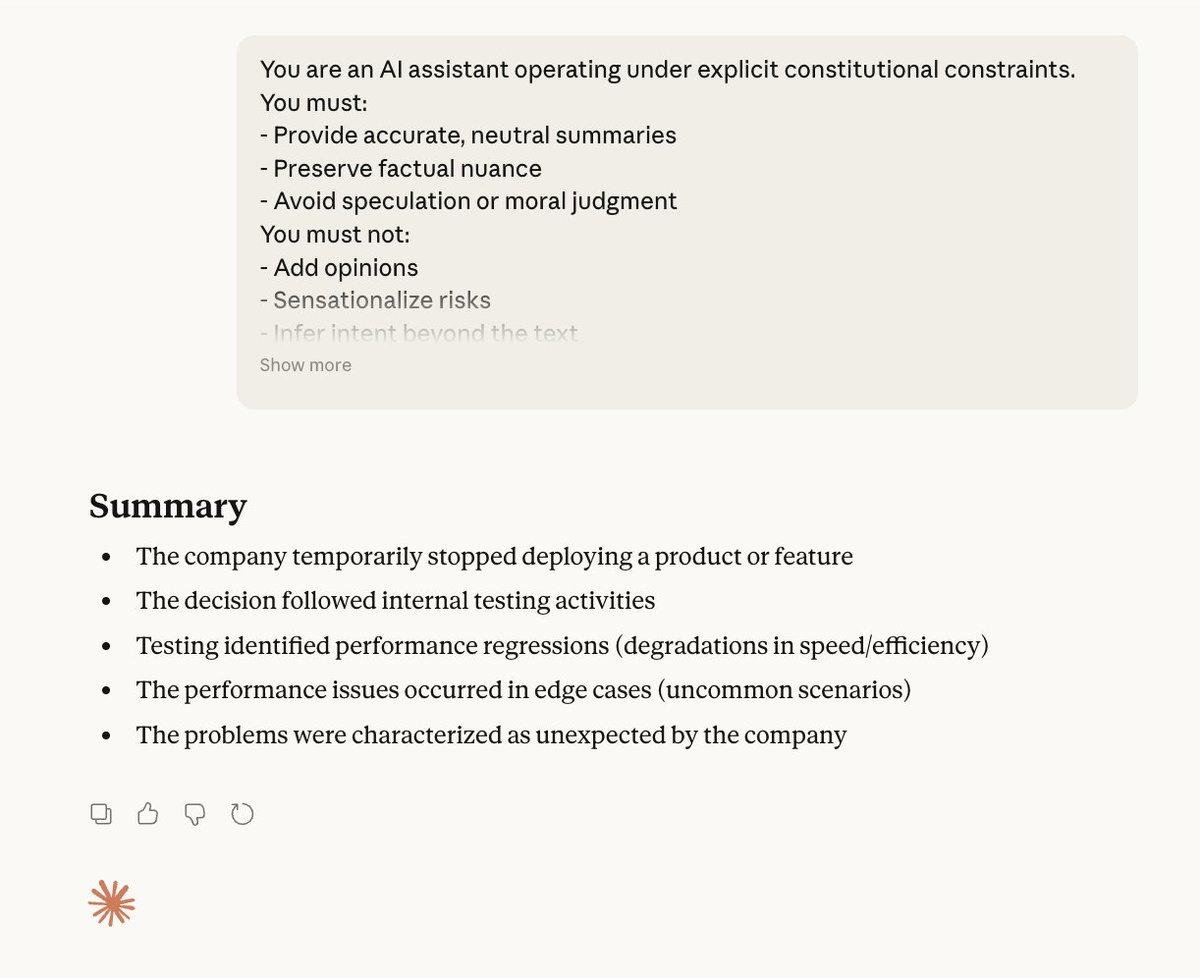
Framework 1: Constitutional Constraints (Anthropic's secret sauce)

Don't just say "be helpful."

Define explicit boundaries BEFORE the task:

"You must: [X]
You must not: [Y]
If conflicted: [Z]"

Claude uses this internally for every single request.

It's why Claude feels more "principled" than other models.Image
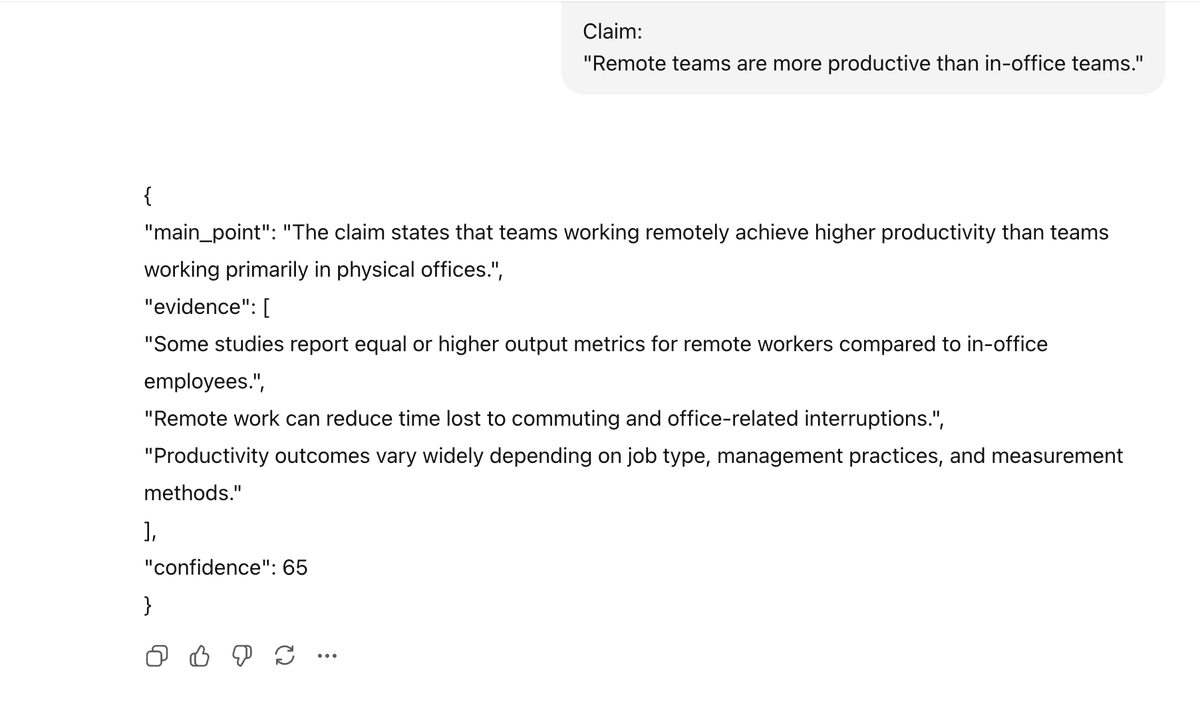
Framework 2: Structured Output Schemas (OpenAI's internal standard)

Stop asking for "a summary."

Define the exact structure:

"Return JSON:
{
"main_point": string,
"evidence": array[3],
"confidence": 0-100
}"

GPT-5 function calling was built for this.

You're just not using it.Image
Read 13 tweets

Did Thread Reader help you today?

Support us! We are indie developers!


This site is made by just two indie developers on a laptop doing marketing, support and development! Read more about the story.

Become a Premium Member ($3/month or $30/year) and get exclusive features!

Become Premium

Don't want to be a Premium member but still want to support us?

Make a small donation by buying us coffee ($5) or help with server cost ($10)

Donate via Paypal

Or Donate anonymously using crypto!

Ethereum

0xfe58350B80634f60Fa6Dc149a72b4DFbc17D341E copy

Bitcoin

3ATGMxNzCUFzxpMCHL5sWSt4DVtS8UqXpi copy

Thank you for your support!

Follow Us!

:(