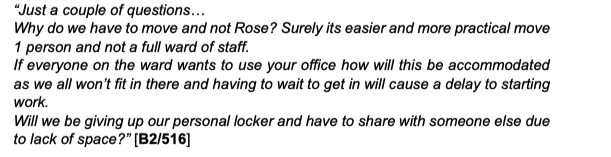
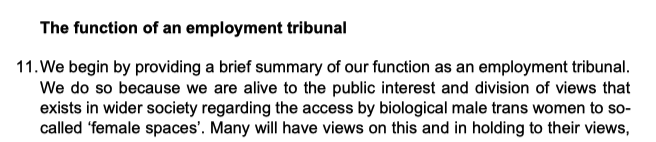
First impressions read-through of GLP v EHRC judgment coming up. 
A strong stat at ¶5 with the peanuts point: if it's got peanuts in it, it's not peanut-free.

The Court then sets out the guidance that the GLP wanted to challenge, which includes this:
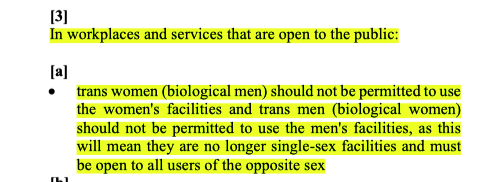
The Court rejects @EHRC's submission that the challenge was academic because the Interim Update had been withdrawn, because it was still having practical effects:
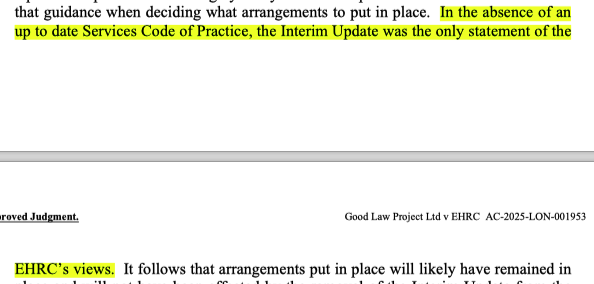
@EHRC "In the absence of an up to date Services Code of Practice" may be read as pointed: the reason there's no up to date CoP is that the Minister for Women and Equalities, Bridget Phillipson, who received it from EHRC on 4 September, still hasn't laid it before parliament.
@EHRC The Court accepts EHRC's submission that the Good Law Project does not have standing, for the same reasons as were given in R (GLP) v Prime Minister. But there are 3 individual claimants who do have standing.
@EHRC EHRC's statutory power to give advice or guidance on the law must be understood as a power to give advice or guidance that is accurate.
@EHRC The Court then notes that such obligations as exist to provide lavatories etc are drawn from a patchwork of different legislation.
@EHRC Local authorities have powers to provide public lavatories, and to require certain types of premises to provide lavatories (eg cafés).
@EHRC And the Building Regulations 2010 require buildings other than dwellings to make "reasonable provision" for single-sex toilets, or, where space prevents that, for universal toilets.
@EHRC This is an interesting detail:
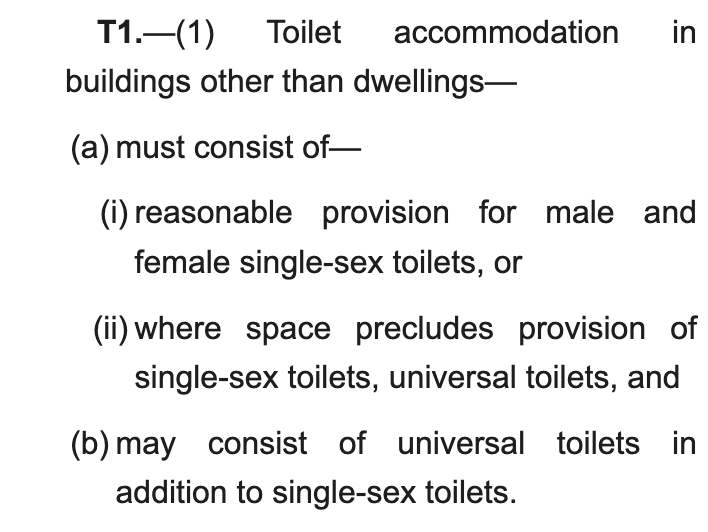
@EHRC So under the Building Regs, single-sex toilets are the default, and universal toilets are only permitted where space precludes single-sex provision.
@EHRC On the face of things, it would seem that businesses and services following the fashion for replacing existing adequate single-sex facilities with universal toilets are in breach of the requirement to provide single-sex toilets where space permits.
@EHRC This is mixed. The traditional lament about the "polarised" debate. Obviously any suggestion that not letting people self-identify into facilities provided for the opposite sex means they "must" use lavatories provided for their own sex was silly.
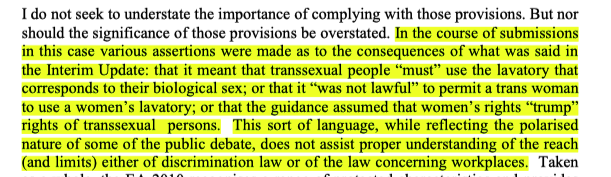
@EHRC But it's not clear (maybe all will be revealed later in the judgment) what's wrong with the suggestion that it's unlawful to let men use women's facilities — particularly given the acknowledgment at ¶5 of the peanuts point.
@EHRC A salutary reminder that the PC of gender reassignment has a definition, and can't simply be defined by self-ID:

@EHRC This would be nice. The problem is how widely common sense has been redefined as bigotry, and benevolence reserved for men who (for whatever reason) like to dress as women and withheld from women who might want or need privacy from men.

@EHRC The judgment then sets out a summary of the effect of the EqA 2010 and the 1992 Workplace Regs so far as they concern the matters dealt with in EHRC's Interim Update.
@EHRC Followed by a summary of the propositions that comprise the guidance in the Interim Update.
@EHRC The judge is unimpressed by the Claimants' submission that a requirement to provide single-sex facilities could be met by providing separate facilities, but making it clear that people could use whichever facilities they pleased:

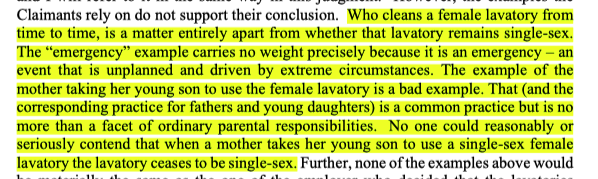
@EHRC He makes short work of the trans activists favoured "gotchas": the male cleaner, the man using a women's toilet in an emergency, the woman taking her young son into the women's toilet or changing room:
@EHRC He's having none of the wailing about "toilet police," either:
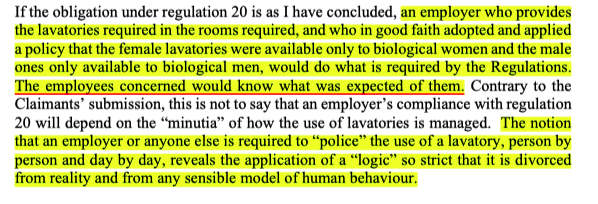
@EHRC "The employees concerned would know what was expected of them" is in particular a breath of fresh air. All that's required of employers is that they have clear rules. Employees can be expected to obey them. If they don't, disciplinary consequences can be expected to follow.
@EHRC The High Court was (perhaps predictably) not assisted by submissions after the hearing relying of the judgment of an employment tribunal in Kelly v Leonardo Ltd:

@EHRC Employers must not comply with their Workplace Regs obligations in such a way as to discriminate directly or indirectly against employees who have the PC of GR:
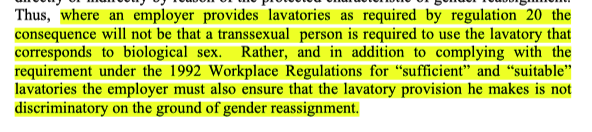
@EHRC In other words: where possible, there must be alternative provision for those who are unwilling to use the facilities provided for their biological sex. (Where that's not possible, the limited provision can for the purposes of a s.19 analysis can be taken to be justified.)
@EHRC The court then deals with the Claimants' submission that the Workplace Regs must be interpreted so that the category "woman" means "women, plus men with GRCs, minus women with GRCs". The judgment quotes ¶224 from the SC's judgment in FWS and concludes:

@EHRC The Claimants had relied on Croft, a pre-GRA case in which the CA had suggested that there would come a time in "transition" where a trans-identifying man would be entitled to the use of women's facilities...
@EHRC ... and that an opposite-sex comparator might be appropriate for a person undergoing "gender reassignment". That didn't find favour:

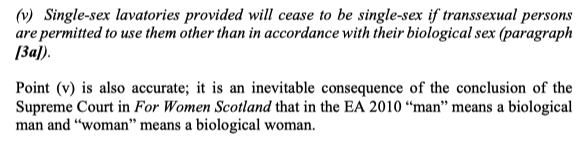
@EHRC Peanuts again:
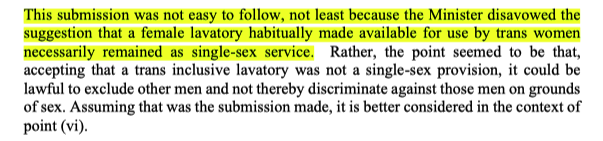
@EHRC Submissions for the Minister for Women and Equalities to the effect that a peanut-free meal might sometimes contain peanuts were not easy to follow.
@EHRC Next the court considers the proposition "If [trans-identifying men] are permitted to use a single-sex female lavatory all biological males must be permitted to use that lavatory."
@EHRC The judge is dubious about this, on the basis that separate but equivalent provision may not amount to less favourable treatment. He parks that point, and comes back to it later (but spoiler: it doesn't mean the guidance is unlawful).
@EHRC The judge notes that the claim that transsexuals may sometimes be permissibly excluded from facilities for their own sex directly reflects the reasoning of the SC in FWS.
@EHRC Considering the guidance's instruction "do not fail to make provision for transsexual persons", the judge notes that it has assumed that failure to do so would never be justifiable. By implication, that may be going too far.

@EHRC The judge is not impressed by the Claimants' arguments about being "singled out" and potentially the subject of speculation or gossip if they are refused the use of opposite-sex facilities and choose not to use the facilities for their own sex:
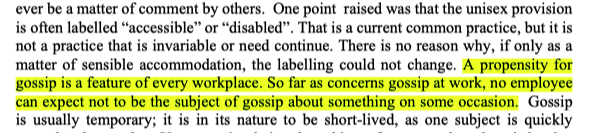
@EHRC This is a pleasing departure from the tendency that has been evident in many earlier judgments to treat it as an unarguable given that people with a trans identity are uniquely vulnerable.
@EHRC Drawing together his conclusions on the argument that the guidance was legally erroneous, the judge returns to the suggestion that if trans-identifying men were allowed to use the ladies', men who did not assert a trans identity would be suffering direct discrimination.
@EHRC As noted above, he's not as sure as the EHRC is that that that would be so, but he does not think the way the point is put in the update is necessarily wrong, and thinks a court should be slow to interfere.
@EHRC No, "case by case" analysis of the particular circumstances is not necessary.

@EHRC Trivial point, but we feel we should be awarded a special prize for catching a typo that has escaped the judge himself plus all 10 counsel. (Or at least 4, if the judgment was proof-read only by one member of each team.)

@EHRC The judge is critical at ¶92 of the manner in which subsequent changes to the Interim Update were handled. Given the comprehensive nature of its win on this challenge, EHRC may feel it can take this philosophically.
@EHRC The final few paragraphs of the judgment deal with the Claimants' arguments based on articles 8 and 14.
@EHRC The judge is prepared to assume that article 8 is engaged, but even that much he doubts:
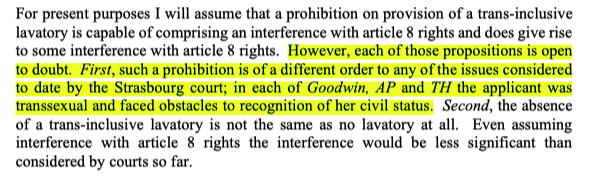
@EHRC It's important to understand what "for present purposes I will assume" means. It means that the judgment cannot be taken as authority for the proposition assumed: it is an express disavowal of any decision on the subject. It is assumed, not decided.
@EHRC And this paragraph makes it clear that the judge is pretty dubious about the proposition assumed.
@EHRC But even on that assumption, he concludes that because employers can lawfully provide in addition to single-sex facilities, "trans-inclusive" facilities, there's no interference with those (assumed) article 8 rights.
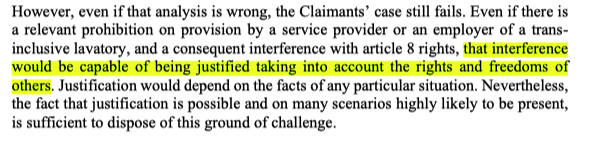
@EHRC And finally — for good measure — even if that is wrong, the challenge still fails because other people have rights:
@EHRC end/
• • •
Missing some Tweet in this thread? You can try to
force a refresh