Cern Basher Profile picture
Feb 18 1 tweets 1 min read Read on X

• • •

Missing some Tweet in this thread? You can try to force a refresh
 

Keep Current with Cern Basher

Cern Basher Profile picture

Stay in touch and get notified when new unrolls are available from this author!

Read all threads

This Thread may be Removed Anytime!

PDF

Twitter may remove this content at anytime! Save it as PDF for later use!

Try unrolling a thread yourself!

how to unroll video
  1. Follow @ThreadReaderApp to mention us!

  2. From a Twitter thread mention us with a keyword "unroll"
@threadreaderapp unroll

Practice here first or read more on our help page!

More from @CernBasher

Mar 8
Trump's Cyber Strategy for America vs SOFTWAR

There is significant conceptual overlap between these two documents.

@JasonPLowery published his in 2023 (and shortly after it was banned for a time).

Trump issued his in March, 2026.

continued below...Image
Image
Core Commonality: Power Projection Through Infrastructure

Lowery's central argument:

Power in the digital age is projected through physical enforcement of rules over cyberspace infrastructure.

Trump’s cyber strategy says almost the same thing in policy language: The U.S. will use all instruments of national power to shape cyberspace outcomes (not just defensive IT tools).

Common thread: cyberspace isn’t abstract - it’s a geopolitical battlespace tied to real-world force.

1. Deterrence Through Cost Imposition

Lowery (SOFTWAR):

Bitcoin = a “softwar” system that enforces property rights through energy-backed computation. Its deterrence comes from making attacks physically expensive.

Cyber Strategy:

Emphasizes raising adversaries’ costs through offensive operations and systemic disruption.

Both center on deterrence economics, not just defense mechanics.

2. Cyberspace as a Domain of Warfare

Lowery:

Frames cyberspace as analogous to land/sea/air/space - governed by force and logistics.

Cyber Strategy:

Explicitly treats cyberspace as an operational domain tied to military and economic competition.

Both reject the “internet-as-neutral-platform” framing.

3. Infrastructure Dominance as Strategy

Lowery:

Bitcoin mining = control over digital territory via energy expenditure.

Cyber Strategy:

Focuses on securing:
- Data centers
- AI stacks
- supply chains
- telecom + energy infrastructure

Same logic: control the substrate → control the system.

4. Machine-Speed Conflict

Lowery:

Predicts conflict migrating toward automated enforcement systems.

Cyber Strategy:

Calls for AI-enabled cyber tools and agentic AI for defense/offense.

Both envision machine-vs-machine geopolitics.
What’s Most Interesting

The overlap strongly supports the thesis I've been talking about - energy, compute, and capital allocation are converging into the same strategic layer.

Lowery frames Bitcoin as digital energy storage, time enforcement and a geopolitical stabilizer.

The cyber strategy frames AI + infrastructure as: economic engines, defense systems and sovereignty tools

They’re two views of the same macro shift.

Both frameworks argue that future geopolitical competition is about controlling the physical and economic enforcement layer of cyberspace, not just information flows.
Read 6 tweets
Jul 8, 2025
USA Inc. - Avoiding the Doom Loop

The USA is heading off a fiscal cliff - spending more than it takes in as revenue.

How can this be avoided?

The solutions are simple, but there are two difficult choices.

1) Cut spending and balance the budget.
2) Grow our way out of it.

Let's look at both scenarios, but first let's look at the problem.

THE PROBLEM

To make it easier (because trillions are hard to comprehend), let's look at the numbers as though it was a household (I took the actual figures for the government and dividend them by 50 million to make them more relatable).

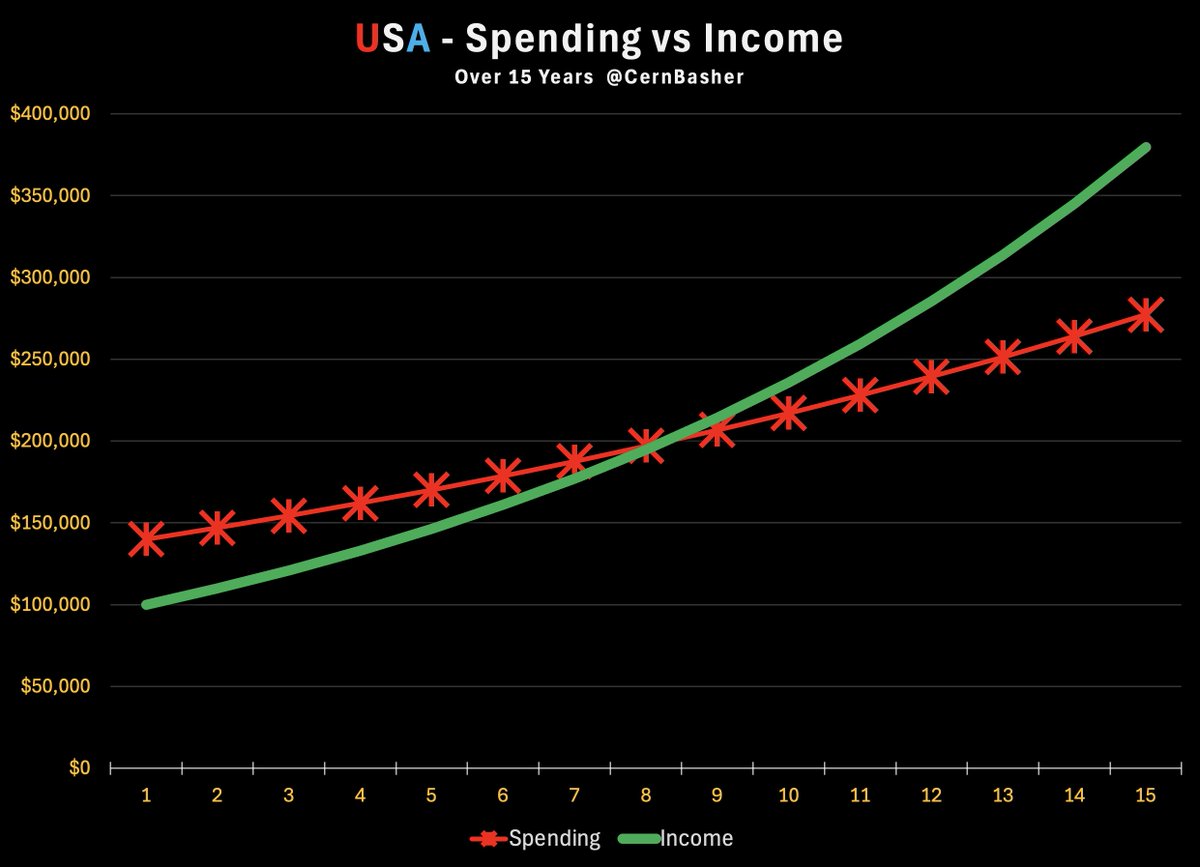
You have annual income of $100,000. But you're spending $140,000.
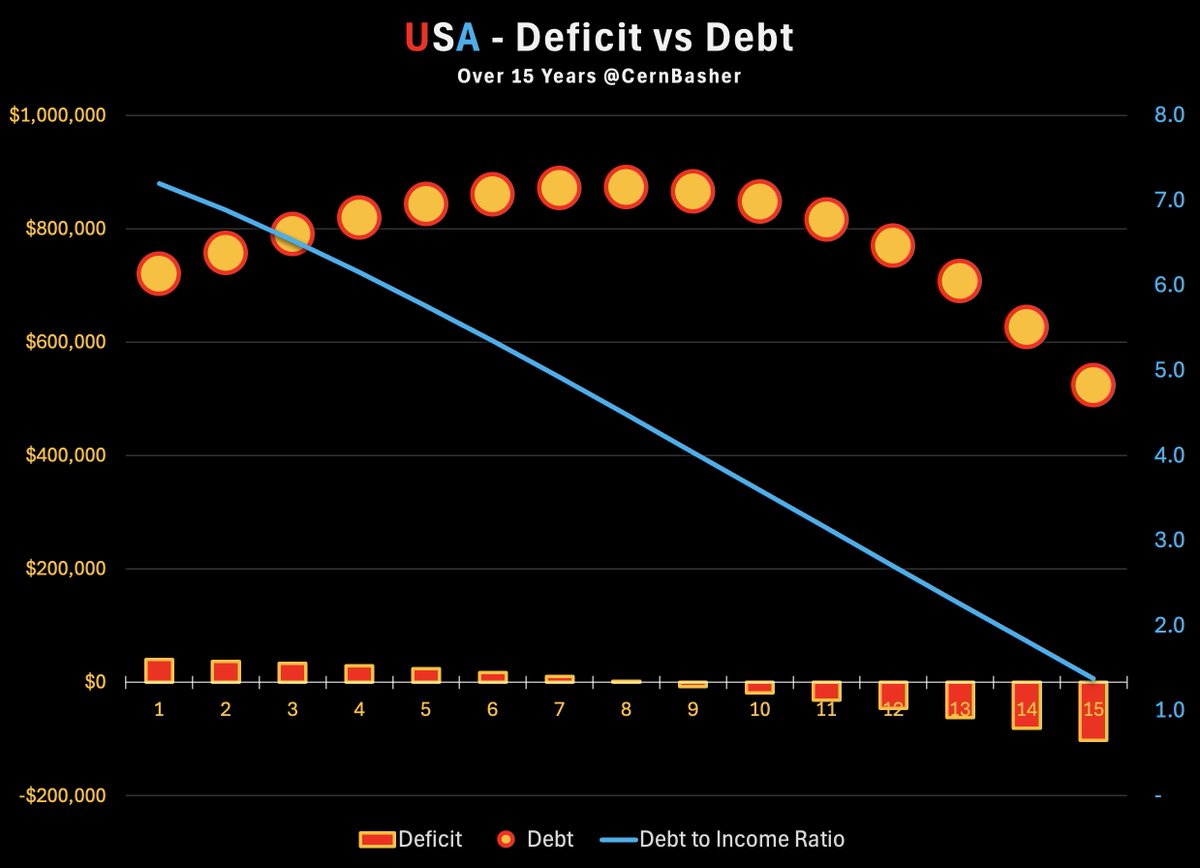
Let's say that the growth in your spending is 5% per year and the growth in your income is only 3% per year - then your annual shortfall (deficit) grows from $40,000 per year to more than $125,000 over 15 years (assuming you are able to continue to borrow the shortfall).

Your initial level of debt is $720,000 and your debt to income ratio is 7.2.
But over just 15 years your debt rises to 1.84 million and your debt to income ratio climbs to 12.2 (and your lender is really sweating).

Okay, so what's the problem?

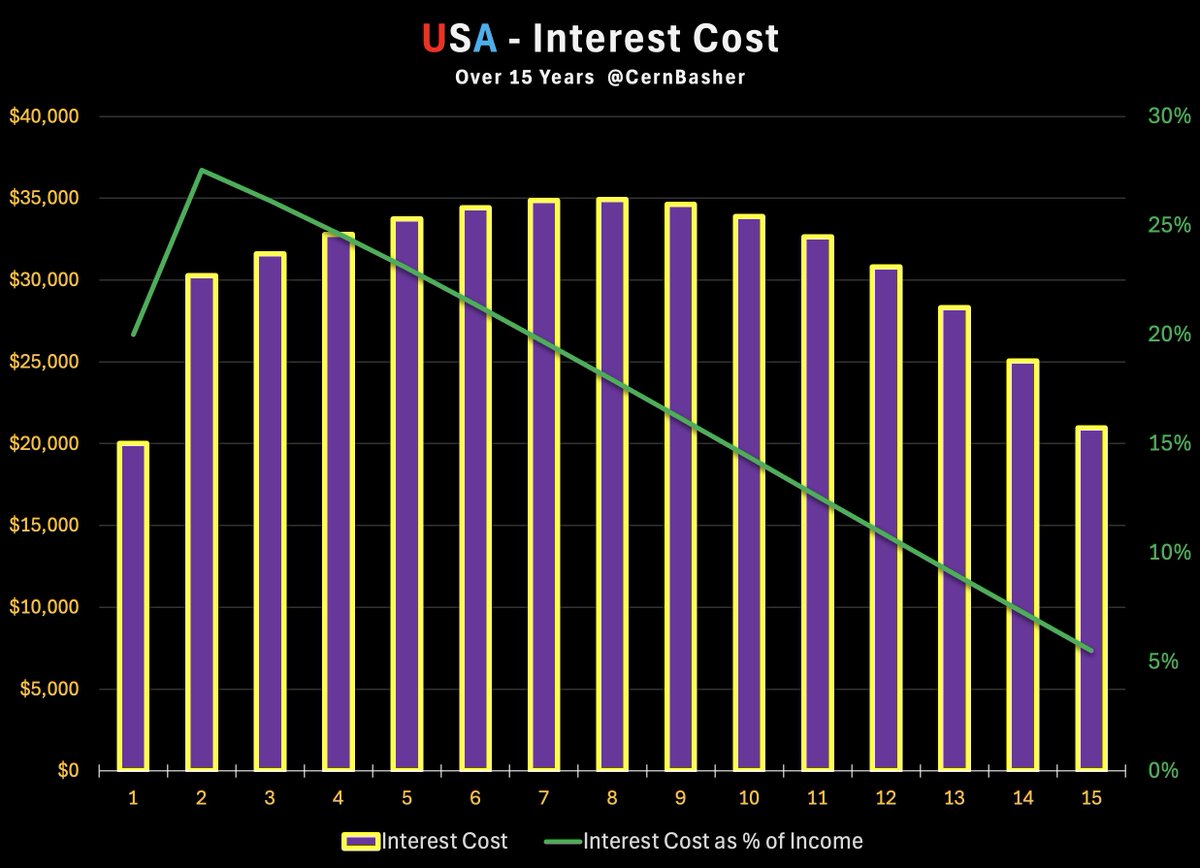
Well, initially your interest expense is only $20,000 per year - which is "just 20%" of your income.

But the interest rate on your debt is about to reset to higher levels (from 2.8% to 4%), so over the 15-year period your interest costs as a percentage of your income balloons to 49%.

This isn't sustainable. It crowds out other spending.

For a household it would leave little money for all the other necessary expenses like rent, food, clothing, transportation, education and vacations.

For a country, growing interest on debt leaves less and less for Social Security, healthcare, defense, transfers to States and other expenses.

So that's the problem.

Now, let's examine the two solutions...Image
Image
Image
Image
Solution #1: Cut Spending and Balance the Budget

Let's say that Congress finally sees the light and gets serious about balancing the budget.

And let's say that actually do it - I know, it's an unlikely dream/painful scenario.

So, spending is now in-line with income and the budget is balanced.
The debt stops growing and the debt to income ratio falls over time.
The interest cost is still higher than where it initially was, but over 15 years the interest cost as a percentage of income falls back the initial level of about 20%.
Clearly this is a "great" solution, but in practice we just don't have the political will to do it.

So, let's examine the second solution... can we grow our way out of the problem?Image
Image
Image
Solution #2: Grow Our Way Out of It

Another solution to the problem is simply finding ways to accelerate GDP growth.

Let's say we find ways to accelerate GDP growth (via AI and humanoid bots and with the full support of government) and this leads to a 10% increase in annual income, while spending only grows by 5%.
Initially the debt continues to grow, but the deficits begin to shrink and then become surpluses -- leading to a rapidly declining debt to income ratio.
Similarly, the interest cost initially continues to rise, but over 15 years the interest cost as a percentage of income falls back to a much more reasonable level of about 5% (crowding out a smaller amount of spending).
Some problems with this scenario include:

1) As additional income is flowing in it's tempting to spend it!

2) While AI and humanoid labor can accelerate GDP growth, they can also wreak havoc on the job market (with millions losing their jobs). This means that spending may need to increase by a large amount to retrain/support people during such an economic upheaval.

3) Higher growth + higher spending doesn't put us in any better spot --> we're still heading off a fiscal cliff.

So the best approach is probably a combination of the two --> cut spending, try to balance the budget AND grow our way out of it.

Hence Elon's continued involvement in politics.Image
Image
Image
Read 5 tweets
Jun 19, 2025
The Four Stages of Robotaxi Domination and Their Value

$: If you have a few robotaxis in a given market and your cost structure is the same as your competition, you are just one of many and you earn your share of the market.

$$: If you can rapidly scale up in a given market and your cost structure is the same as your competition, you can take market share.

$$$: If you can rapidly scale up in a given market and your cost structure is lower than your competition, you can drive down prices (while remaining very profitable) and eliminate your competition - it's winner-take all.

$$$$: Then if you can massively scale up in a given market - where your vehicles are passing any given point multiple times per minute - your "transportation service" becomes an autonomous platform - where all kinds of new services (from delivery services, in-car commerce and entertainment to sophisticated data collection and smart city integration) can be layered on top.

The value creation between stages $, $$ and $$$ is linear.

But the value creation between stages $$$ and $$$$ follows Metcalfe's Law, or more likely, Reed's Law.

Let's explore this idea...

Metcalfe's Law: This is one of the most cited models for understanding network effects. It states that the value of a network is proportional to the square of the number of connected users, or V = n². This applies to networks where each user can connect with every other user, such as a telephone network or a social media platform. The addition of each new user creates a quadratic increase in the number of potential connections, leading to exponential growth in the network's value.

Reed's Law: Taking Metcalfe's Law a step further, Reed's Law argues that the value of a network also includes the value of potential subgroups or communities that can form within it. The potential number of subgroups in a network of size 'n' is 2^n. Therefore, Reed's Law suggests that the value of a network can grow exponentially, or V = 2^n. This is particularly relevant for platforms that facilitate group collaboration and community building.

1/4 continued...
Robotaxi as a Utility Network (Metcalfe's Law)

Initially, the primary value of the robotaxi network is providing simple, point-to-point transportation. At this stage, the network functions more like a utility grid than a social network.

How Metcalfe's Law (Value = n²) applies (with a twist):

Metcalfe's Law traditionally describes networks where any user can connect with any other user (like a phone network). In a robotaxi network, riders don't primarily connect with other riders. Instead, the "nodes" are the riders on one side and the robotaxis on the other (a two-sided market).

However, a modified version of Metcalfe's Law is highly relevant here:

Value is in the density of potential trips. The value for any rider (n) is directly related to the density and availability of the cars (m). As the number of cars and the size of the service area grow, the number of possible efficient pickup-to-dropoff pairings increases exponentially.

Drastically Reduced Wait Times: With a massive-scale fleet, the wait time for a vehicle at any given point approaches zero. The value isn't just that you can get a ride, but that you can get one almost instantly. This near-instant availability for millions of potential trips is a squared-value proposition.

A massive network means no "out-of-service" areas within a metropolis. The value of the network for a user in one neighborhood is squared by the fact they can reliably get to any other neighborhood.

In this initial phase, the massive scale and low cost create a powerful, utility-like network effect.

The value grows quadratically not from social connections, but from the logistical perfection of coverage and availability.

2/4 continued...
Robotaxi as a Mobility Platform (The Rise of Reed's Law)

This is where your scenario gets truly transformative and where Reed's Law becomes dominant. Once the foundational grid of "a car is always available everywhere" is established, the company can layer on services that rely on group formation.

Reed's Law states that the value of a network scales exponentially (Value = 2ⁿ) because of the potential for users to form subgroups. This is where the robotaxi service transcends being a taxi company and becomes a true autonomous platform.

How Reed's Law would apply:

The platform could now facilitate an explosive number of group-forming activities, each creating its own value on top of the base network:

Dynamic, Hyper-Efficient Carpooling: This is the most obvious example. The platform could create ad-hoc groups of 2, 3, or 4 people traveling along a similar route, dramatically lowering the cost for each individual. The number of potential carpool groups (2ⁿ) is astronomically higher than the number of individual trips.

On-Demand Logistics and Delivery Networks: Businesses could form "groups" of delivery destinations. A local pizza chain could essentially create its own temporary, dynamic delivery network for a Friday night rush, with the platform optimizing routes for dozens of simultaneous orders.

Subscription Services: A company could create a "commuter group" for its employees, paying a flat fee for unlimited transport within a certain zone. Families could create "family plan" groups.

Dynamic Shuttle Services: For a concert or sporting event, the platform could create thousands of temporary "shuttle" groups, picking up people from designated hubs and routing them directly to the venue.

In this stage, the robotaxi is no longer just a car; it's a flexible asset that can be allocated to serve not just individuals, but an exponentially large number of potential groups. The value is no longer just in going from A to B, but in the platform's ability to coordinate complex, multi-person, multi-stop mobility and logistics challenges on the fly.

3/4 continued...
Read 4 tweets
Jun 16, 2025
Robotaxi - More "Juice" than Gene Thinks

Here are my thoughts on Gene Munster's post...

Gene seems to be stuck on the rideshare market as the market opportunity - when in reality it's far larger than that (especially when prices drop, the market size will greatly expand).

Again, his fleet ramps are based on the current rideshare market (Uber's own research in 2022 showed the potential for massive TAM expansion as prices drop - see post below).

And finally, his numbers for Tesla owners and Small business fleets are very conservative.
I don't quibble with his idea that Tesla owners will only put their vehicle in the Robotaxi network 3 days a week (on average), but there's no reason that Small businesses fleets would only operate five days per week for only 10 hours a day.Image
Image
Image
Image
Many people seem to think that Robotaxis can only make money during the daytime and just for a few peak hours, but this real life case study using non-peak hours proves otherwise.
It won't take too much to begin disrupting the Subprime auto market.
Read 5 tweets
Mar 21, 2025
Q1 2025 Tesla All-Hands Meeting

Highlights from Elon's comments:

- have produced over 7 million vehicles globally.
- will surpass 10 million next year.
- at times there are rocky times, a little bit of stormy weather.
- but the future is bright.
- Tesla remains the company of choice for people to work for.
- lots of opportunity for upward mobility.
- Tesla's work related injury rate has declined over time.
- where does AI and robots fit into the sustainability picture?
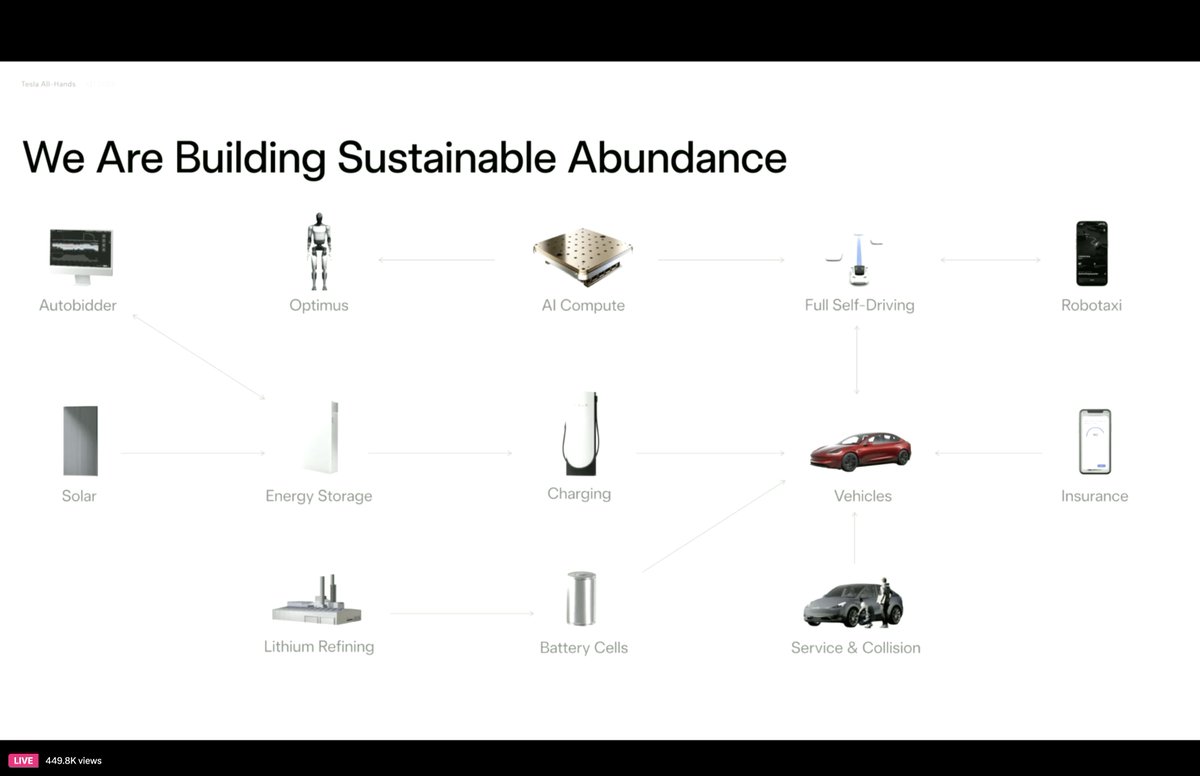
- it's about sustainable abundance for all.
- what does an amazing future look like?
- it sounds impossible.
- the future we are headed for is one where you can literally have anything you want.
- what is key to that is robotics and AI.
- enable the production of goods and services with no limit.
- combined with sustainable energy, can also maintain a great environment.
- what other future would you want? Also, Space travel - let's not forget that!
- Model Y became the best-selling vehicle on earth for two years in a row and will be again this year.
- Cybertruck became the best selling electric pick-up truck, instantly.
- Cybertruck achieved 5-star safety.
- if you read the news it feels like armagedon.
- if you don't like our product, you don't need to burn it down - that's psycho.
- on track to complete the Semi factory - will make millions of the Tesla Semi - will also have the ability to go autonomous down the road.
- the future is autonomous.
- five years from now, autonomous Teslas will be everywhere - regulatory globally.
- almost the entire fleet - which will surpass 10 million vehicles next year - is capable of autonomy.
- an autonomous car could have the usefulness that's 5x to 10x a regular car.
- with a software update, we could turn 10 million cars into the usefulness of 50 to 100 million overnight.
- "what I'm saying is hang on to your stock."
- shout out to Tesla service team - they sell the cars long-term.
- Superchargers: great for trips - "the car's battery will last longer than your bladder."
- The Megapack and Powerwall team is knocking it out of the park.
- Megapack can more than double the total power output of a given grid and excellent for stablizing the grid.
- Long-term more than 90% of all power on earth will be solar + batteries.
- Cell manufacturing - we're making the most efficient cell in the world - lowest cost per kWh.
- built the first Optimus on the production line in Fremont.
- Cortex 1 - used for AI training. Over 50,000 active GPUs - soon to be 100,000 GPUs - making it top five in the world.
- Have Dojo 1 active now - handling 5% to 10% of the training load. Dojo 2 - will be 10x better than Dojo 1. Optimistic about Dojo - "have a real shot at a breakthrough."
- have the cars doing useful work for the first time with no one in them - driving from end of line and park themselves in Frement and now in Austin.
- Tesla self-driving will be 10x better than human drivers.
- Optimus is going into production this year - the new 22 DOF hand is now in production.
- "most sophisticated humanoid robot on earth"
- "our robot has a real brain"
- "Tesla is the leader in real-world AI - what we learned from the cars we transferred to the bot."
- Tesla is the only company that can make intelligent humanoid robots at scale.
- "Optimus will be the biggest product of all time by far - nothing will be even close - I think it will be 10x bigger than any other product ever made."
- the Cybercab production line looks like a high speed consumer electronics line - moving so fast that people can't get close to it - cars coming off the line in 5 seconds.
- we need even bigger casting machines - 50,000 tons - "how big can a casting machine be - what are the limits of physics? - let's find out!"
- hope make about 5,000 Optimus (parts for 10k to 12k) this year.
- 50,000 Optimus in 2026.
- available outside of Tesla in second half of 2026.
- offering Optimus first to Tesla employees.
- our goal is to make great products/services that people love, and then service those products.
- profit is the difference in value between the output versus the input.
- we're by far the most innovative company in the car industry.
- the stock market is a very strange thing - Tesla stock goes up and goes down - based on peoples' perception of the future - very emotional.
- the future of Tesla is incredibly bright.
- An employee asked: is a robot going to steal my job? Elon: people will manage a flock of robots. Same will be true for self-driving cars - people will manage a fleet of cars.
- interesting opportunity to make an electric VTOL jet - "maybe at some point we'll do that."
- Hyperloop - vacuum tunnels - high speed autonomous pods from city center to city center.
- ideas are the easy part - execution is the hard part.
- future new mission statement: "it's all about sustainable abundance."
- Master Plan 3 + abundance for all = Master Plan 4
- Optimus production in Fremont + an even bigger production line in Austin. "We'll be making tens of millions of robots a year - serious volume - maybe one hundred million robots a year."
- "one thing is for sure - the future is going to be very interesting."Image
Image
Read 5 tweets
Mar 15, 2025
Tesla - Next Five Year Growth
On March 1st Elon said that a "1,000% gain (in profit) for Tesla in 5 years is possible."
And on the Q4 2024 earnings call he said that 2026 would be "epic" and 2027 & 2028 looks "ridiculous."
So I set out to put numbers "to paper" and find out what epic and ridiculous might mean for Tesla's financials.

Let's see if we can answer these questions...
continued...Image
Image
Image
Image
First, let's take a look at Nvidia - which is the first example of an "AI compounder."

Five years ago it was a Gaming company, but now it's an AI infrastructure company, with Data Center revenue 37x'ing over the last five years. Total revenue 12.7x'd.
Operating income 24.3x'd.
The market cap 19.3x'd - all in just five years!
And the astounding thing: you could have purchased Nvidia stock five years ago for about 2x Q4 2024 annualized earnings!
Of course, it's only with the benefit of hindsight, that we can see how incredibly cheap Nvidia was five years ago.

What if Tesla, which is also on a path to becoming an AI compounder with real-world AI services like Robotaxi and Optimus, is similarly cheap now?

Instead of hindsight, can we have foresight?

continued...Image
Image
Image
Image
Jensen has talked about how Physical AI (self-driving cars and general robotics) is the future of AI --> this is exactly where Tesla is focused.
If Nvidia could produce the kind of results that they did, what can Tesla do riding the same wave?

continued...Image
Read 14 tweets

Did Thread Reader help you today?

Support us! We are indie developers!


This site is made by just two indie developers on a laptop doing marketing, support and development! Read more about the story.

Become a Premium Member ($3/month or $30/year) and get exclusive features!

Become Premium

Don't want to be a Premium member but still want to support us?

Make a small donation by buying us coffee ($5) or help with server cost ($10)

Donate via Paypal

Or Donate anonymously using crypto!

Ethereum

0xfe58350B80634f60Fa6Dc149a72b4DFbc17D341E copy

Bitcoin

3ATGMxNzCUFzxpMCHL5sWSt4DVtS8UqXpi copy

Thank you for your support!

Follow Us!

:(