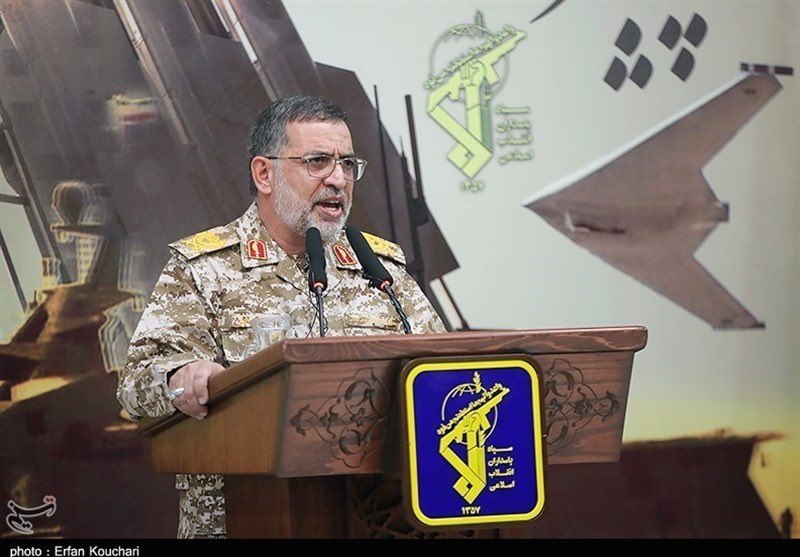
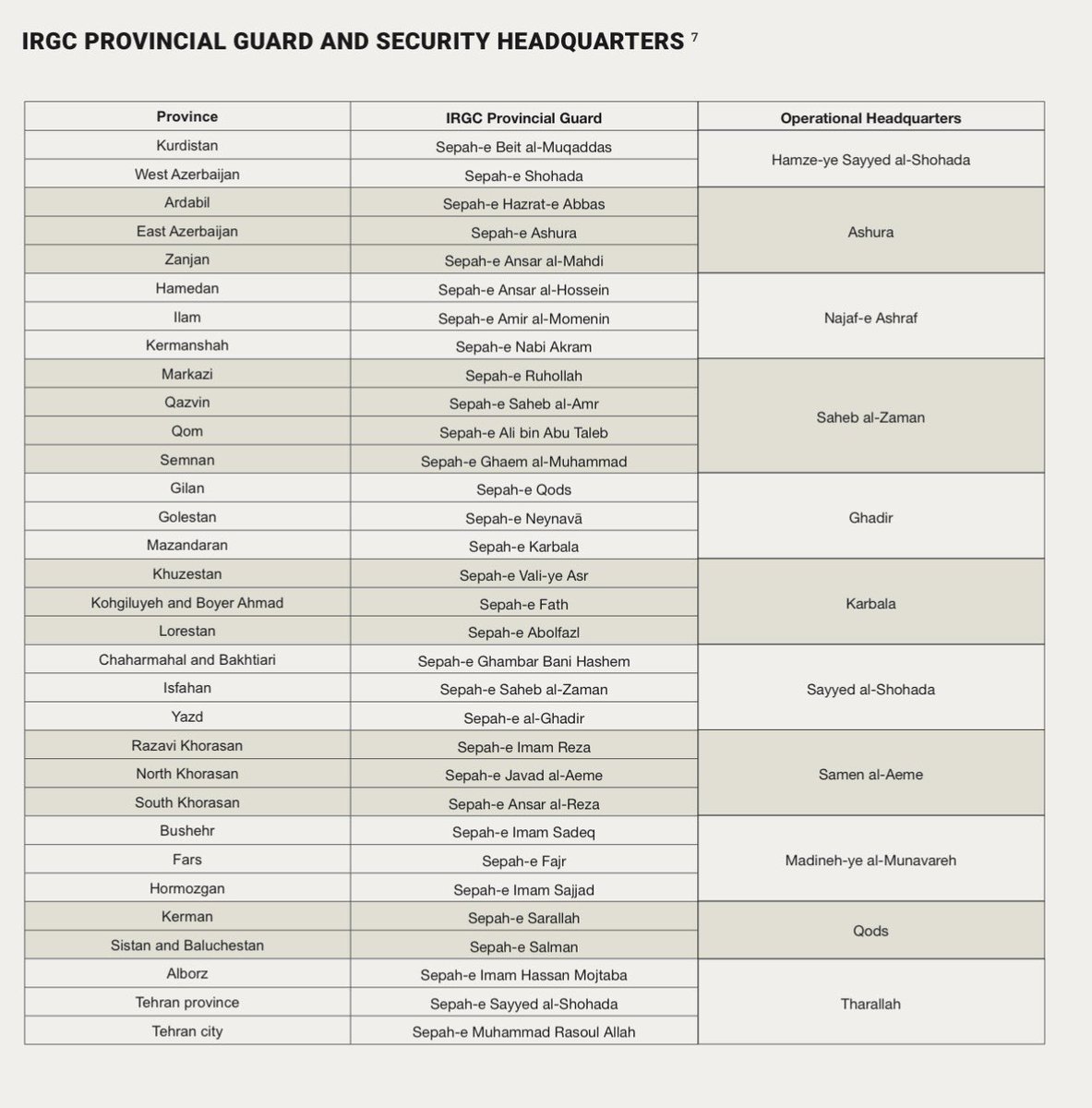
There’s growing talk about possible U.S. strikes on the IRGC’s suppressive apparatus—but what would this look like?
Beyond the intel services, there’s almost no detailed public info on the IRGC’s domestic repressive infrastructure
Our research exposes it—for the first time 👇🧵
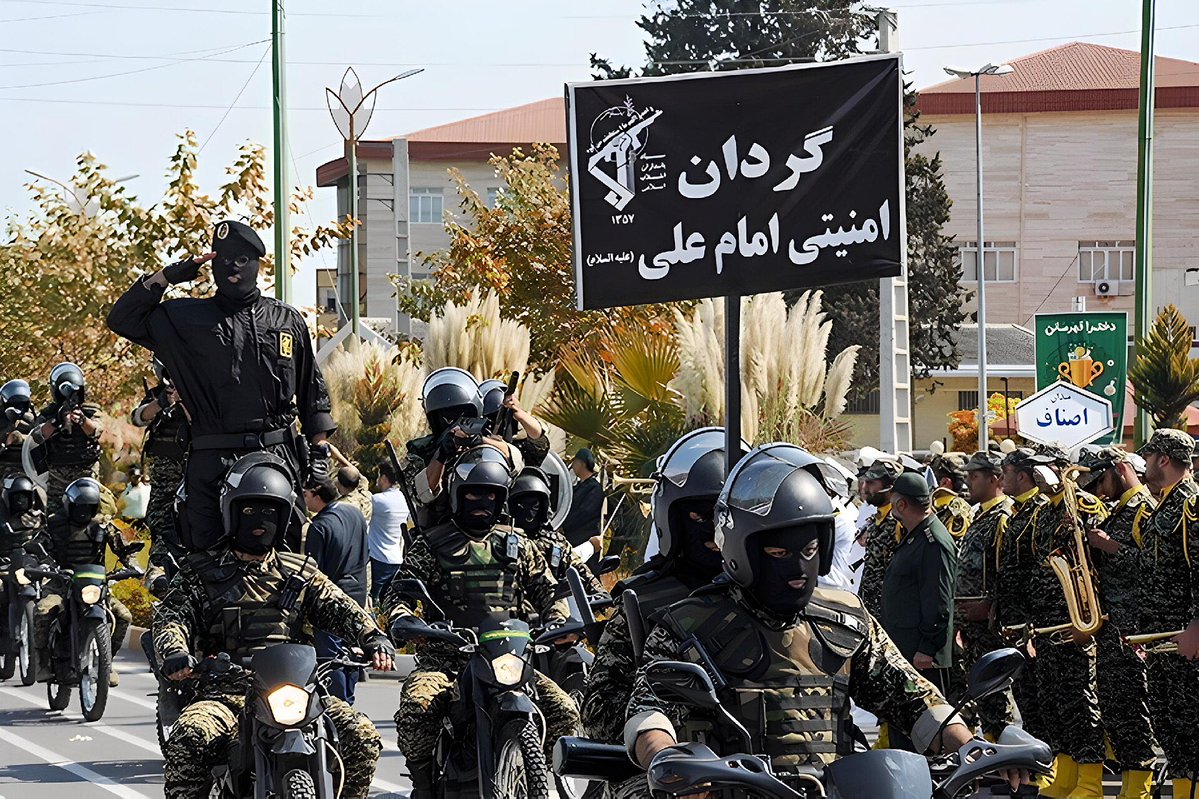
There are 11 IRGC security-military HQs across Iran’s 31 provinces. They control the IRGC’s provincial guard in the respective provinces they oversee (3 provinces on average). If a “red situation” is declared, these HQs gain full authority over the provinces they control 2/
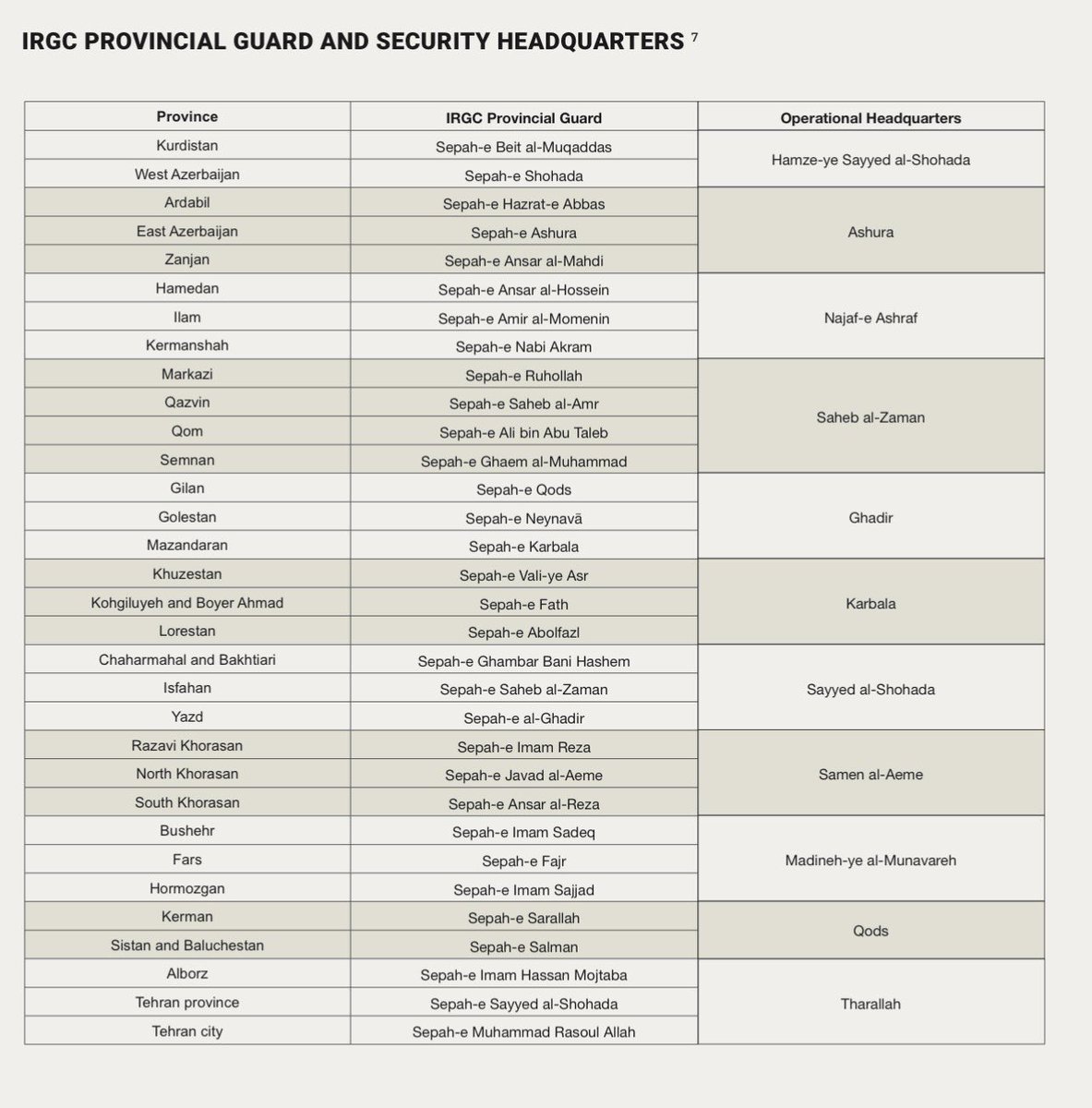
Since 2007, the IRGC has decentralized its structure via the establishment of its Provincial Guards (PG), which operate under the control of the 11 IRGC security-military HQs. The Tharallah HQ operates as the nerve center of the regime’s repression in Tehran and across Iran. 3/
These PGs serve as military commanders for their respective provinces, overseeing all IRGC & Basij bases within their areas. Tharallah HQ oversees 3 PGs for Tehran & Alborz Province. The IRGC’s Mohammad Rasulullah Corps in Tehran is the most critical & Tehran’s main IRGC force 4/
The Mohammad Rasulullah Corps operates a main staff base on Niayesh Highway in the north of Tehran. Our report identifies 23 IRGC-Basij Regional Bases, each located in one of Tehran’s 22 municipality regions, operating under its command. 5/
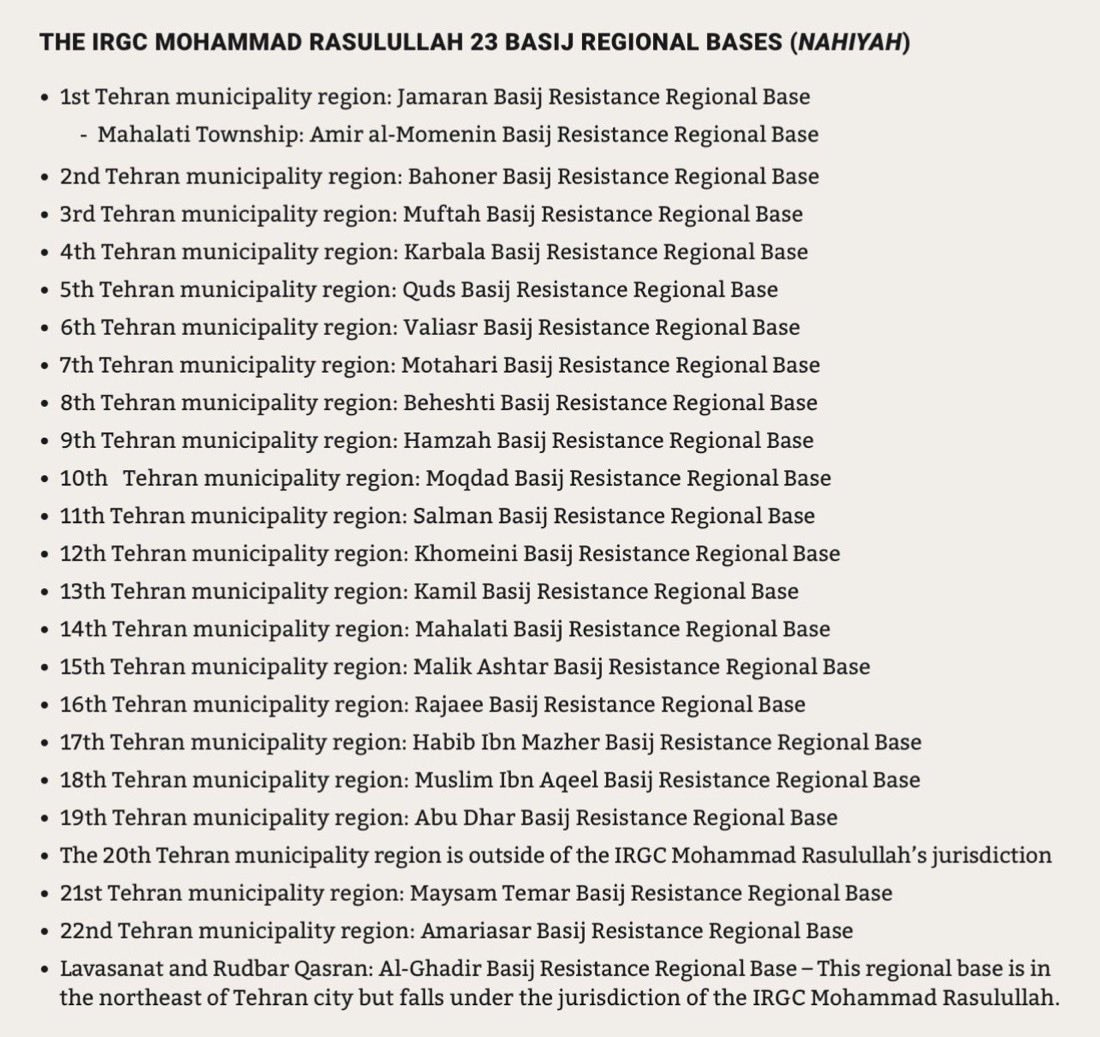
These 23 IRGC-Basij Regional Bases—the locations of which are in our report—have been at the forefront of the brutal massacre on the Iranian streets. Think of them as the nerve centres for repression at the operational level. 6/
In the vertical structure, beneath the IRGC-Basij Regional Bases lies the Basij District Bases (howzeh in Farsi). We identify 300 Basij District Bases spread across Tehran city’s 123 municipality districts. 7/
The final layer in the IRGC Mohammad Rasullullah’s vertical structure are the Basij Neighborhood Bases (mahalaat). In total, we identify 3000 Basij neighbourhood bases across Tehran’s 375 neighbourhoods. Many of these neighbourhood bases are mosques. 8/
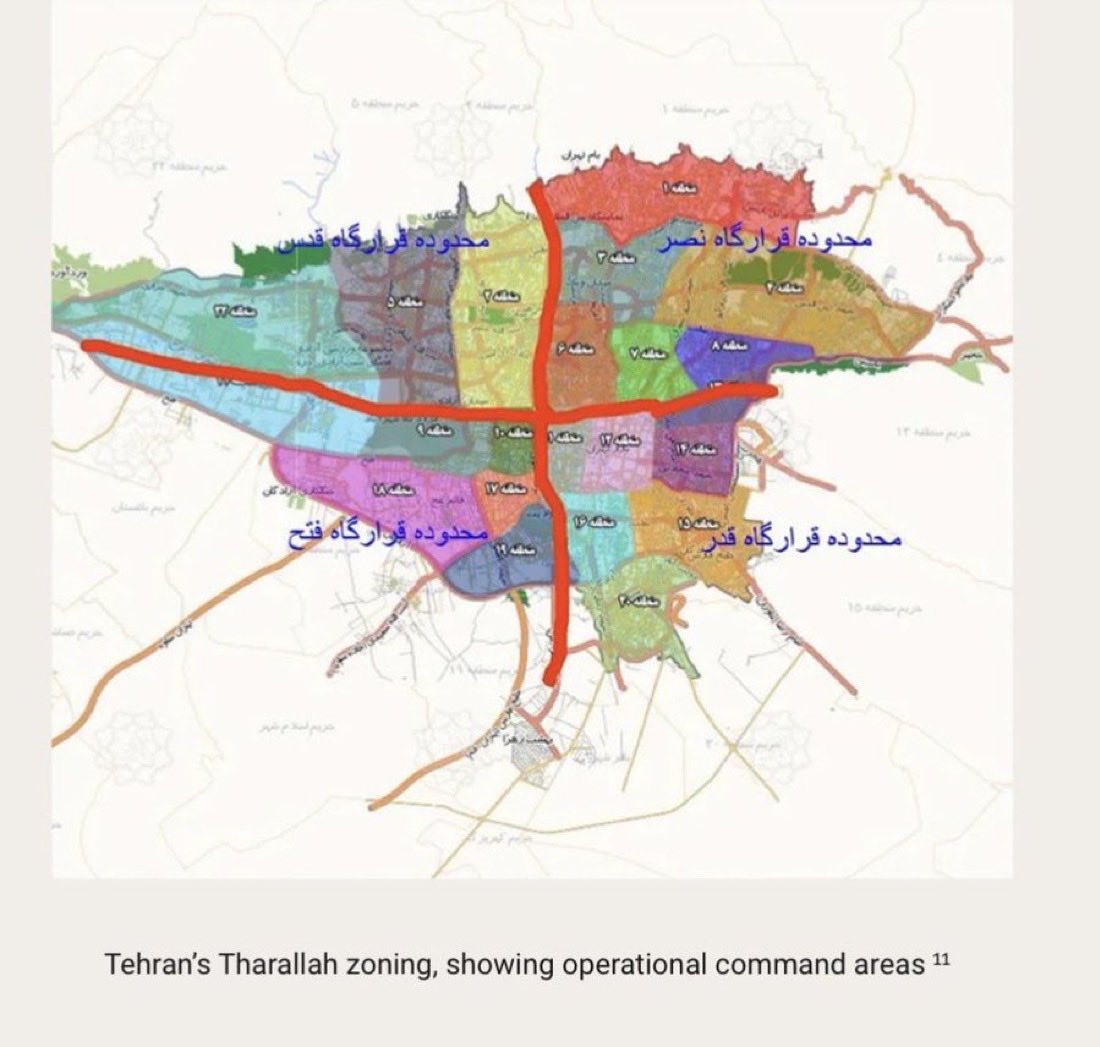
In addition to all these layers, to control Tehran & manage its security forces, the Tharallah HQ has established 4 operational sub-HQs, dividing Tehran into 4: Quds (northwest Tehran), Nasr (northeast Tehran), Fath (southwest Tehran), & Ghadr (southeast & central Tehran). 9/
For full research co-authored by me and Dr. Saeid Golkar please see link below. Our research is based of primary IRGC material acquired from within the Tharallah HQ and its sub-headquarters in Iran. 👇unitedagainstnucleariran.com/tharallah-head…
• • •
Missing some Tweet in this thread? You can try to
force a refresh

Western policy circles have concluded a new strongman has emerged in Tehran. And while the egotistical Ghalibaf has played to the limelight, a far more powerful figure is silently pulling the strings: Ahmad Vahidi – the new IRGC commander-in-chief who is a Khamenei absolutist. 2/
Vahidi has unmatched experience and influence across the regime’s military, intelligence, and bureaucracy—the three key pillars upholding the Islamic Republic. This includes Deputy for IRGC’s Intel; Quds Force Commander; Defense Minister; Interior Minister. 3/
“I think the West has underestimated the ideological commitment of the regime’s hard base. That’s not to say that the military operation can’t succeed in toppling the regime. But to do so will require a comprehensive operation.”
Known in Farsi as the hasteh-yeh sakht or “hard base”, this loyalist constituency is estimated to make up about 10 per cent of the population, or roughly nine million people.
2/
The Basij Mobilisation Forces, which has bases in every neighbourhood across the country, is primarily responsible for marshalling the hard base and mobilising it when needed, along with a shadowy department within the IRGC, known as the Baqiyatallah headquarters.
3/
The elimination of Ali Mohammad Naini is a huge blow to the IRGC + Office of Supreme Leader.
Naini wasn’t just the IRGC’s spokesman—he was the founding father of its psychological warfare & propaganda doctrine. These 2 components have been critical to the regime’s warfare 👇1/
Naini was one of the most senior figures in the regime’s “soft war” apparatus, with over 40 years of experience in psychological, cognitive, and propaganda operations within the IRGC.
2/
His credentials led to his appointment as IRGC spokesman following the killing of Ismail Haniyeh in Iran in July 2024—at a moment of heightened pressure on the regime, not least due to IRGC incompetence and clear counterintelligence weakness.
3/
How the IRGC suppresses unrest—& blocks regime change in Iran
My new research with @SaeidGolkar uses original material from inside IRGC HQs to expose its real-time suppressive playbook—hidden infrastructure, battalions & operational methods before, during, & after unrest 🧵
Since 2007, the IRGC has decentralized its structure via the establishment of its Provincial Guards (PG), which operate under the control of the 11 IRGC security-military HQs. The Tharallah HQ operates as the nerve center of the regime’s repression in Tehran and across Iran. 2/
These PGs serve as military commanders for their respective provinces, overseeing all IRGC & Basij bases within their areas. Tharallah HQ oversees 3 PGs for Tehran & Alborz Province. The IRGC’s Mohammad Rasulullah Corps in Tehran is the most critical & Tehran’s main IRGC force 3/
Israel must strike Iran’s regime in the next year while Bibi remains in power.
This is the conclusion from the recent conversations I have been having with sources inside Iran including those in the IRGC, the Ayatollah’s ideological army.
The Ayatollah and the IRGC fear Bibi more than any other world leader—even more so than Pres Trump. There’s a deep-rooted and inescapable paranoia that exists in the regime’s psyche when it comes to Bibi, something even the Israelis have yet to fully appreciate.
2/
“The kind of attack we witnessed wouldn’t have taken place without Netenyahu,” a source within the IRGC tells me. Rightly or wrongly, there’s a firm belief that the spectacular scale of Israel’s strikes in June simply would not have occurred had Bibi not been in office.
3/
Why didn’t Iranians rise up during Israel’s war with the regime?🇮🇷🇮🇱
It wasn’t lack of dissent. It was control — a suppressive apparatus embedded in every layer of society.
@SaeidGolkar & I expose the regime’s vast security web silencing Iranians.
What the world missed🧵👇1/
As Israel began to control Iran’s skies, many believed this was a golden moment for an anti-regime uprising. But as the war ended, policymakers & dissidents questioned why Iranians didn’t rise up. The regime’s spun the silence as popular support—but that’s far from the truth. 2/
The real reason lies in the regime’s hidden security measures, activated as soon as Israel’s operations began. Since 2007, the regime has built a vast suppressive network across all levels of Iranian society—largely ignored by foreign powers and the opposition. 3/