Financial markets feel increasingly fraught to me, with the elements for a meaningful selloff coming into place. This threat is highest for stocks and corporate bonds, but even crypto, gold, and silver remain at risk despite recent pullbacks. Valuations are high. There are good fundamental reasons for this, but markets appear increasingly tainted by speculation. That is, investors are simply investing on the faith that prices will rise quickly in the future because they have in the recent past.
On the fundamentals, the economy’s performance is mixed. Real GDP is the strongest indicator, and it is growing just over 2%, below the economy’s potential, estimated to be near 2.5%. Employment has flat-lined, and unemployment continues to creep higher. Inflation, as measured by the Fed’s preferred consumer expenditure deflator, remains stubbornly and uncomfortably high at 3%. And there is no economic upside to the renewed chaos over tariffs and a looming military conflict with Iran.
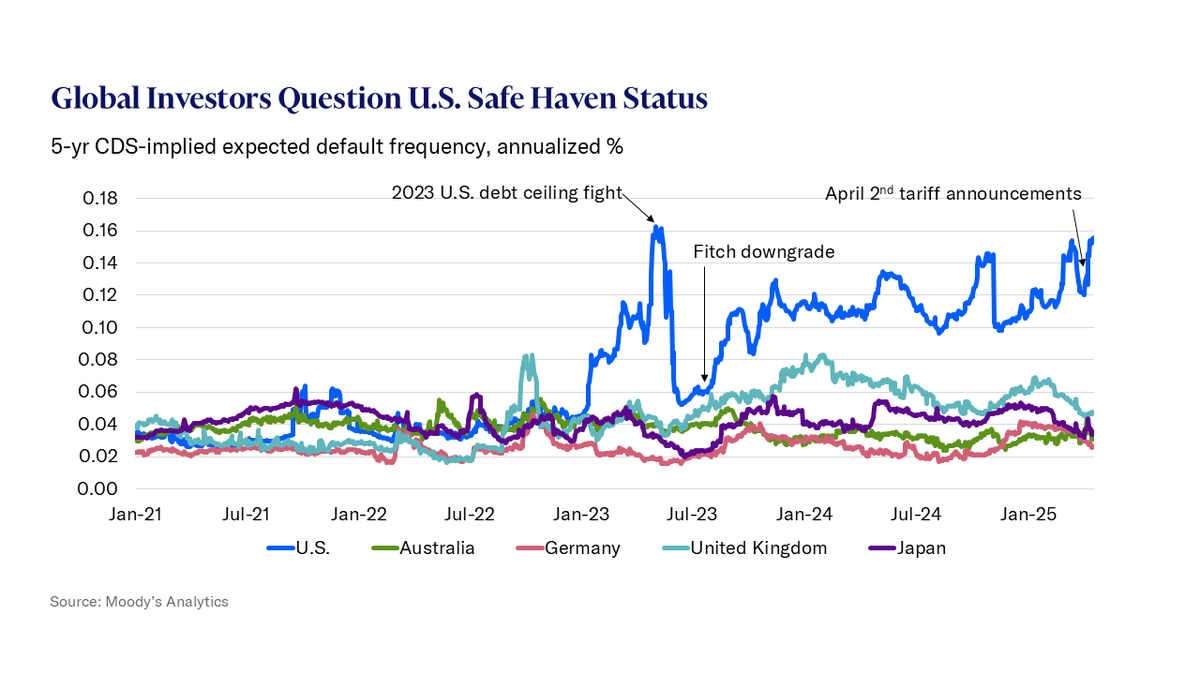
Then there is the fragile Treasury market. As the price-insensitive Federal Reserve and global investors have stepped away from the market, uber price-sensitive hedge funds playing a leveraged basis trade have stepped in. It’s not hard to imagine them running for the proverbial door all at once, and interest rates spike. The catalyst could be the nation’s massive budget deficits and funding needs, and global investors’ legitimate concerns about the safe-haven status of Treasuries in a fast de-globalizing economy.
I rarely weigh in on financial markets, as they generally reflect and are broadly consistent with economic conditions. But there are times when I feel markets are overdone and increasingly disconnected from the economy. Markets risk moving in a big way, causality is reversed, and falling asset prices threaten an already vulnerable economy. This is one of those times.
• • •
Missing some Tweet in this thread? You can try to
force a refresh

My previous post argued that the economy is on the precipice of recession. How will we know if we are in one? Historically, it's not clear-cut until well after the fact. The pandemic was one time that it was. Even then, there were deniers claiming that the recession calls were politically motivated.
A group of academics at the NBER is the arbiter of when recessions begin and end. While they look at a plethora of data to make this determination, most importantly, far and away, is payroll employment. If employment declines for more than a month consecutively, we are in a downturn.
Payroll employment hasn’t declined yet this time around, but it has barely grown since May. And given that the recent revisions to the jobs numbers have been consistently lower, much lower, it wouldn’t be surprising if we learn with the coming revisions that employment is already declining.
Global investors anticipate two rate cuts from the Fed this year and more next year. This is a reasonable forecast and consistent with my baseline, but I don’t hold it with any confidence. It is increasingly likely the Fed will sit on its hands and not change monetary policy in 2025.
Given the mounting tariffs, inflation, which is already meaningfully above the Fed’s 2% target, will significantly accelerate. The core consumer expenditure deflator is up 2.8% over the year through June, and given the tariffs will be closer to 4% by next spring.
While inflation expectations remain tame (at least the bond market measures of expectations), they will likely increase as actual inflation picks up, making it difficult for the Fed to conclude that the tariff-induced price increases are a one-off and won’t persist.
A ton of economic data comes out this week, and the storyline will be that growth has slowed sharply so far this year. GDP will grow 2.8% in the 2nd quarter, but this is a tariff-induced bounce from the 0.5% decline in the 1st. First-half growth will be less than half of last year’s nearly 3% gain.
Cautious consumers are largely behind the slowdown. Real consumer spending has gone nowhere since the end of last year, and with the release of the June data this week, we will see that consumers are still on the sidelines. And this is before the tariff-related price increases kick into full swing.
We’ll also get a read on inflation with the release of the June PCE deflator, the inflation measure the Fed uses to set its 2% target. We anticipate a 0.3% increase in core inflation, putting year-over-year growth at 2.7%. That’s above target, and given the tariffs, the direction of travel is clear.
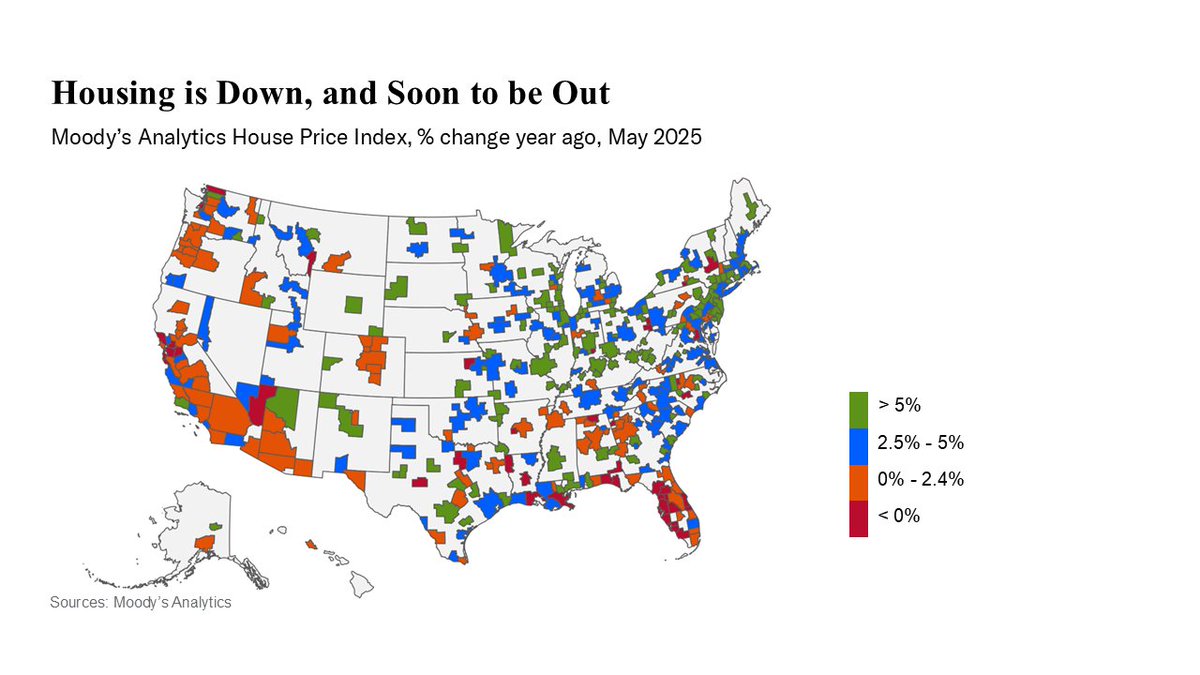
I sent off a yellow flare on the housing market in a post a couple of weeks ago, but I now think a red flare is more appropriate. Home sales, homebuilding, and even house prices are set to slump unless mortgage rates decline materially from their current near 7% soon. That, however, seems unlikely.
Home sales are already uber depressed, but homebuilders providing rate buydowns had been propping sales up. They are giving up. It’s simply too expensive. A big tell is that many builders are delaying their land purchases from the land banks. New home sales, starts, and completions will soon fall.
House price growth had held up well. But this, too, is changing, as prices have gone sideways and are set to fall. 7% is hammering demand, and there are more listings. Given their demographic and job situations, locked-in homeowners must move. They can only work around these needs for so long.
Fannie Mae & Freddie Mac’s fate is back under debate, 15 years after entering conservatorship. Their stock prices are up, but what’s next for the GSEs? Here’s a breakdown of the most likely scenarios over the next few years, their probabilities, and their impact on mortgage rates:
Scenario 1 - Status Quo (50%): GSEs remain in conservatorship. Mortgage rates won’t change. The system works well as-is, with risks already shifted to private investors via credit risk transfers. No legislation is needed, and there’s little incentive to disrupt what’s already functioning smoothly.
Scenario 2 - Release w/ Implicit Guarantee (35%): GSEs would operate like they did pre-2008, but with better capital buffers. Mortgage rates would rise +20–40 bps as investors worry about long-term stability. While it’s more likely than other reforms, memories of the financial crisis make this politically sensitive.
The Trump administration’s policies are set to severely diminish the economy, not only for the next few months but for years. The administration’s trade war is undermining the global safe-haven status of the U.S., which has provided incalculable benefits, including our economy’s exceptionalism.
Safe-haven status means that global investors know that if they invest in the U.S., in a Treasury bond or anything else, their investments’ value won’t be upended by a capricious government; laws and regulations are transparent, and while they may change, only after deliberation and due process.
The Trump administration’s tariffs and resulting global trade war with foes and allies alike have blown our nation’s safe-haven status to smithereens. The tariffs are not deliberate but based on a Mickey Mouse formula. And there is no process other than the whims of one man.