At the end of the 4th year of the full-scale war in Ukraine, many are asking: who is winning and who is losing? The answer is obviously complicated, but for comparing narrative vs. numbers, consider the following questions:
2/ Who has achieved more of its core objectives? When he ordered a massive invasion of Ukraine on February 24, 2022, Putin intended to erase Ukraine from the map. Most Western intelligence agencies gave him better than even odds of succeeding. Remarkably, Zelensky and his colleagues remained determined to fight for the survival of their country. Despite huge physical losses, Ukraine is a stronger nation today than it was before it was invaded.
3/ Who has seized more territory? Over the past four years, Russia has captured 29,191 square miles of Ukrainian land (13% of the country, or roughly equivalent to half the U.S. state of Illinois). Ukraine’s brief adventure into the Russian oblast of Kursk was stymied and completely reversed.
4/ Who has more citizens displaced? Nearly 1/4 of all Ukrainians have been displaced following the outbreak of the war, with 6.9 million migrating within the country while the other 3.7 million have gone abroad. While up to a million Russians initially left the country in 2022, somewhere between 15% and 45% of them have since returned.
5/ Whose economy has suffered more? Despite announcements about Western sanctions strangling Russia’s economy, in the first three years of the war, Russia’s economy grew by 8%. Since the start of the war, Ukraine’s economy has shrunk by more than 20%.
6/ Who suffered more casualties? Western sources estimate that Russian casualties (dead and wounded) are about twice those of Ukraine: 1.2 million vs. 600,000. But the Russian population is more than three times the size of Ukraine’s. Moreover, as Napoleon, Hitler and others would testify: no one has ever won a war of attrition against Russia.
7/ For a more refined and detailed assessment of the Russia-Ukraine War, I recommend
@RussiaMatters’ weekly Ukraine War Report Card. russiamatters.org/news/russia-uk…
• • •
Missing some Tweet in this thread? You can try to
force a refresh

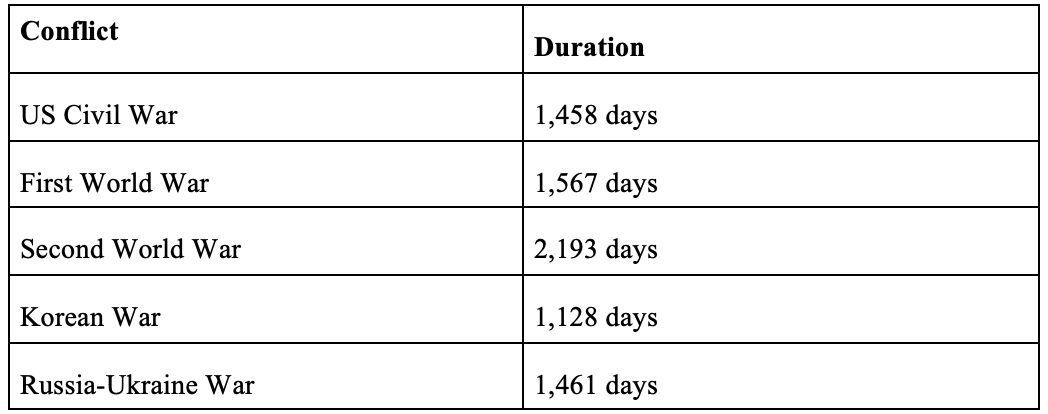
1/ How long will this war go on? As we mark the fourth anniversary of Russia’s invasion of Ukraine, the most deadly war in Europe since World War II enters its 1,461st day.
2/ For comparison, see the chart below.
3/ As I wrote on the first anniversary of the war: “While the average interstate war lasts less than two years, major Russian and US wars since WWII have lasted over a decade, suggesting that the Russia-Ukraine War could last for many more years.” belfercenter.org/publication/ru…
1/ Deglobalization Delusions: The successive waves of press noise about US-China decoupling, derisking, or now "divorce" deserve one more big D: delusional.
2/ While Trump’s tariffs have caused a 25% decline in total trade between the US and China, China remains the US’s third-largest trading partner, right after Mexico and Canada, and the US remains China’s largest trading partner.
3/ Even more misguided are claims about Trump’s tariffs leading to economic “deglobalization.”
2/ Whose robots are kicking whose ass in the rivalry between US and Chinese technology companies? According to America’s leading promoter of humanoid robots, Elon Musk: “China is an ass-kicker, next level. We don’t see any significant humanoid robot competitors outside of China.”
3/ More inconvenient for Musk: his robot, Optimus, relies on Chinese suppliers for essential parts, such as the roller screws and motors behind the robot’s lifelike movements, according to a recent WSJ article in which Musk is quoted.
1/ In the Trump administration’s effort to negotiate a sustainable peace/ceasefire in Ukraine, the dispute about territory has proved to be one of two final sticking points. Putin has continued to demand that Ukraine leave the last chunk of Donbas his troops have yet to seize. Zelenskyy has continued to insist that Ukraine would not give up at the negotiating table what its troops have successfully denied Russia on the battlefield.
2/ So: after nearly four years of war in which Ukraine has lost 12 percent of its territory, more than a fifth of its economy, and two thirds of its electrical infrastructure; suffered hundreds of thousands of casualties; and seen about a quarter of its citizens displaced, why the fuss about a piece of land the size of the state of Delaware?
3/ Major news outlets have continued to misreport the issue. For example, again last week the New York Times reported that Ukraine still controls “14 percent or so of the Donbas.” Similarly, Axios repeated the same mistake, referencing “the roughly 14% of the Donbas region which [Ukraine] controls.”
1/ If you are having trouble sleeping at night, see attached three podcasts from the past month in which I offer my current best answers to a range of questions on US-China relations, Trump’s second term, and the international security order.
2/ The hosts of Bloomberg’s Odd Lots podcast asked a number of uncomfortable questions:
- Whether the current discombobulation between the US and China comes down to the Thucydidean dynamics of a rapidly rising power seriously challenging a major ruling power? (My central proposition: Yes, much of the tension does arise from Thucydidean dynamics. Thus, if history is our best guide, war is likely—but not inevitable).
- What have I learned in 2025? (My answer: that the world is even more uncertain than I recognized this time last year. But in relations between the US and China, if we’re stretching for silver linings, mine include that Trump is decidedly not a China hawk and that he is serious about being remembered as a great peacemaker, including with China and Xi Jinping).
3/ With The Straits Times's (@straits_times) Asian Insider podcast, I responded to a similar set of questions, including:
- What do Trump and Xi want from each other? (A clue: A mutually beneficial economic relationship, which is what Trump’s advisors proposed in his National Security Strategy.
- Will China be the world’s sole superpower? (My bottom line: No. But I expect it to keep rising and thus that as Lee Kuan Yew advised, the US and China will have to find ways to coexist and share the Pacific in the 21st century).
2/ This week, @ericschmidt returned to the @Kennedy_School @JFKJrForum for the third year in a row to help us remember our colleague, mentor, and friend Henry Kissinger and check where we stand in the AI race.
3/ First, Eric described the enduring wisdom of Henry’s insights into the “epochal change” that AI presents. “We are today grappling with the question that he foresaw 20 years ago when we first started working on this—What does it mean to be human in the age of AI?” Eric urged today’s graduate and undergraduate students and the rest of us to continue searching for better answers.