The latest Ukrainian counterattack has drawn significant attention. The Ukrainians have claimed to liberate over 400 km².
There’s some sensationalism in the information space, as there seems to be some misunderstanding of what a liberated square kilometer here actually means. 1/
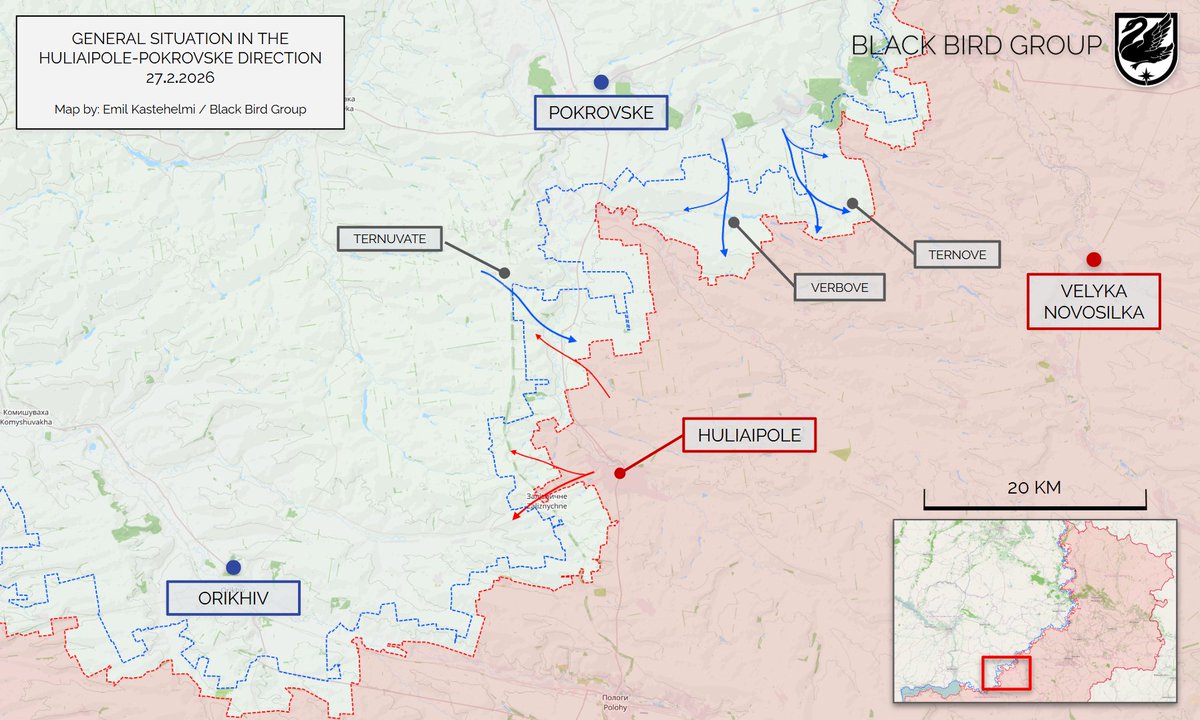
In Jan-Feb 2026, Ukraine conducted counterattacks in eastern Zaporizhzhia & Dnipropetrovsk oblasts. It’s the same area where Russia made a significant amount of their gains in late 2025. The area mostly consists of fields and small villages, without significant cities nearby. 2/
The Ukrainians are executing a localized operation to enhance their tactical positioning, rather than a broad counteroffensive with operational objectives. Politically and in the information space, these successes are vital, given the scarcity of positive news. 3/
The ongoing Ukrainian counterattack appears relatively successful, depending on the point of view. For comparison, Russia advanced roughly 400–500 km² monthly from May 2025 to January 2026. This has usually been called a slow monthly advance. 4/
The recent attacks have likely aimed to take back the Haichur River line. After liberating Ternuvate, Ukraine cleared the nearby villages and pushed toward the river, re-establishing positions on the western bank. The attacks continued east with limited success. 5/
Another axis of attack lies southwest of Pokrovske, where combat has moved from the Vovcha River to the Verbove-Ternove area, creating a vast gray zone. Ukraine holds the initiative, though it's uncertain whether they can consolidate control over the liberated territories. 6/
How much has Ukraine advanced? How much has Russia lost? It isn't straightforward – in this war, assessing control has grown increasingly challenging. What was once a clear frontline is now often a blurred, contested zone, with some villages not securely held by either side. 7/
Frontline troop density is typically low, allowing small groups from both sides to advance relatively deep without actually enabling further operations. Troops can be intermingled in villages or around fields. This is why the value of singular geolocations has decreased. 8/
Media coverage has especially fixated on one metric: the square kilometers Ukraine has reportedly liberated. Tracking km² offers some insight into battlefield shifts and trends, particularly over medium- and long-term periods, but it has limitations and weaknesses too. 9/
Square kilometers don't always reveal an operation's importance. For instance, in the Zaporizhzhia–Dnipropetrovsk area, hundreds of km² can shift without altering the general situation much. Elsewhere, the same change could be far more impactful. 10/
For instance, in the Lyman-Sloviansk direction, it might signal an imminent encirclement threat to Lyman, potentially leading to a loss of the city. This would strengthen Russian control in northern Donbas, which would align with their strategic aims. 11/
A final note: This operation isn't comparable to the 2023 counteroffensive. They differed in scope, environment, force composition, and ambitions. 12/
2025 can reasonably be seen as an operational and strategic failure for Russia, but all scenarios remain on the table. Any optimism is premature, as Ukraine also faces serious challenges.
In this thread: An assessment of the past year and its broader implications. 1/
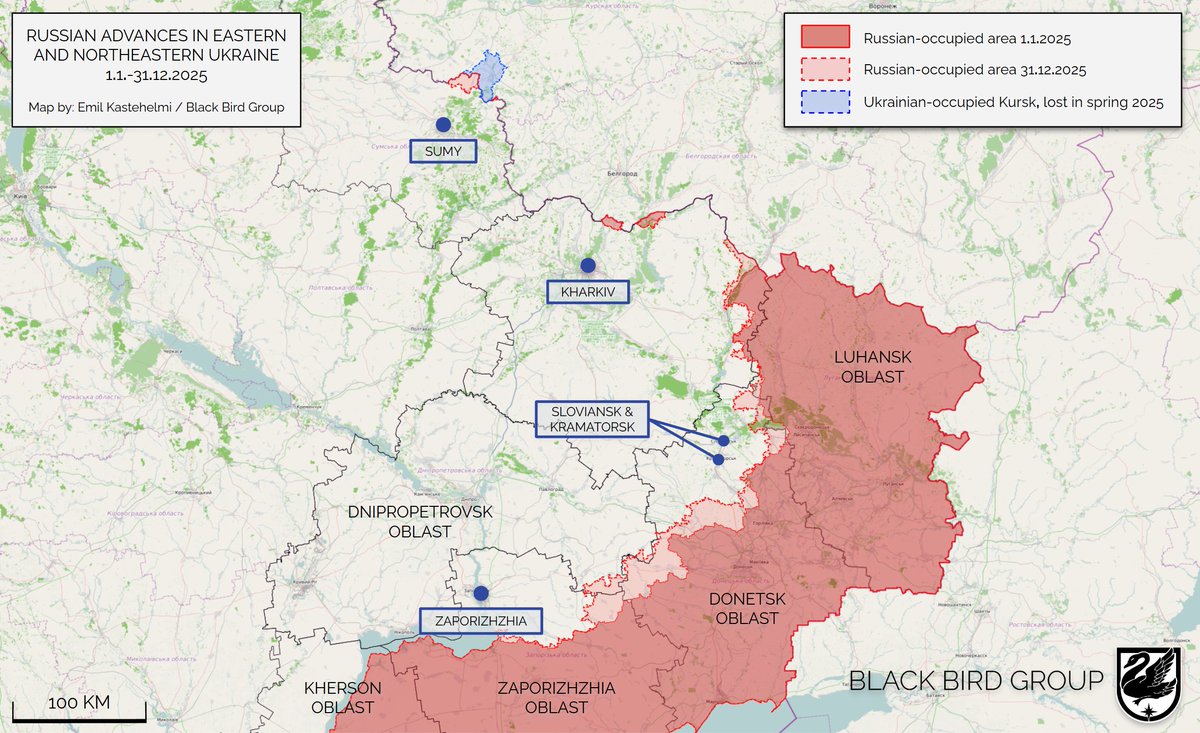
First, some numbers. Russia took under 4,600 km² of Ukrainian territory in 2025, compared to roughly 3,500 km² in 2024.
Despite the increase, focusing only on square kilometers provides poor tools for analyzing current dynamics and the war’s future. 2/
Russia failed to achieve operational goals. The front advanced relatively evenly despite local salients. Most captured territory consisted of fields, villages and small towns.
Even when brief momentum appeared, Russian forces were unable to turn it into a larger breakthrough. 3/
Ukraine may be repeating a costly mistake in Pokrovsk.
It’s a recurring pattern, seen for example in Vuhledar and Kursk – a reluctance to conduct a controlled, militarily justified withdrawal from a threatened salient when the situation no longer favors the defender. 1/
The situation in Pokrovsk is difficult for the Ukrainians. Russians have consolidated positions in the southern parts of the city, and are advancing further north. Most of the city is a gray zone, where infantry groups fight without a clear frontline. 2/
The latest Ukrainian counterattacks have not turned the situation decisively in Ukraine's favor. They managed to recapture various positions in Rodynske and in the Dobropillia direction, but the threat of encirclement in Pokrovsk and Myrnohrad has not been removed. 3/
According to Ukrainian 1st Corps (Azov), the situation east of Dobropillia has been stabilized and the Russians have been pushed out of six villages. They also reported that the combined Russian losses in the area are 385 men, 37 vehicles, 2 AFVs and 1 tank.
A few thoughts: 1/🧵
It is evident that this operation was not merely a few infiltration groups slipping past Ukrainian lines only to be destroyed. While it may have begun as a lighter operation, Russian forces were prepared to exploit breakthroughs, successfully advancing into the Ukrainian rear. 2/
If the reported losses are accurate, it implies multiple Russian battalions were engaged in the battle, with many still fighting, as Russia has not lost all gained territory. The Russians are now likely trying to consolidate and defend the southern part of the corridor. 3/
Russians have recently advanced deep in the area east of Dobropillia. The situation has concerning elements which can escalate it into a serious crisis, but at this stage we’re still not witnessing a disaster – and by definition, not even a breakthrough. I’ll explain. 1/
The situation had been deteriorating for some time. The Russians had been attempting to advance in the Dobropillia direction earlier this month. A gray zone had formed in the area, as the Ukrainians struggled to maintain a firm defence against the infiltrating enemy. 2/
Russia has an advantage in expendable manpower – once it finds a weak spot, it can aggressively try to exploit it by pushing more infantry into the area. Small infiltration groups will try to advance as far as possible, which is enabled by the porous Ukrainian defences. 3/
According to our data, the Russians did not accelerate their advance during June. The pace isn't slow, but most of the Russian gains last month were in less crucial areas.
It can be argued that Russia mostly wasted June without achieving significant success. 1/
The situation isn't great for Ukraine, but it could be worse.
The salient between Pokrovsk and Kostiantynivka is still an issue, but it didn't rapidly expand in June. The front in Sumy was also stabilized. The worst-case scenarios didn't materialize, at least not yet. 2/
A large part of the Russian gains were south of Pokrovsk, where they are pushing towards the administrative borders of Donetsk oblast. Entering Dnipropetrovsk oblast doesn't change the general situation much, even though there's a lot of Russian propaganda about it. 3/
On June 1, Ukraine conducted a successful operation targeting Russian strategic bombers and other aircraft.
Our battle damage assessment can confirm the following losses: 12 destroyed and 3 damaged aircraft, of which 14 are strategic bombers and 1 is a transport aircraft. 1/
From videos and satellite images, 23 distinct aircraft were identified in total as potentially targeted. The condition of 4 aircraft seen in videos remains unclear. Available evidence doesn’t allow for assessing potential damage or whether nearby drones even detonated. 2/
The highest possible number for total losses is 19, if all aircraft in unknown condition are actually damaged. However, this can’t be confirmed at the moment.
In 4 cases, it appears the drones likely missed, did not explode or cause visible damage for other reasons. 3/