"I’m asking you to hold the line. Not because the President is infallible... he’s not, nobody is... but because the logic is sound. You cannot build a fortress of peace on a foundation of unresolved threats. You have to clear the ground first. That’s what’s happening."
The question you have to ask... the honest question, not the Tucker question, not the Marjorie question, the real question... is this... Could Donald Trump have achieved a permanent, lasting America First posture... the real doctrine, the thing we all voted for... without first clearing the board of the existential threats that previous administrations allowed to metastasize for decades?
The answer is no. And everybody who is being honest with themselves knows it’s no
Let me take you through it, because the details matter. They always matter with this President. He doesn’t do anything by accident. People think he’s impulsive... the media loves that narrative, “Trump is impulsive, Trump is chaotic”... but look at the timeline. Look at how this actually played out.
Venezuela: The Western Hemisphere First
Trump didn’t wake up one morning and decide to grab Maduro. This was months in the making. Years, actually, if you go back to his first term, when the Justice Department indicted Maduro on narco-terrorism charges in March 2020. Nobody did anything about it then. The indictment just sat there. Biden recognized the opposition candidate Edmundo González as the legitimate president after the stolen 2024 election, and then did absolutely nothing about it. Nothing. Just a statement.
Trump came back and started squeezing. Designated Tren de Aragua as a Foreign Terrorist Organization on Day One. Designated the Cartel of the Suns... which Maduro basically ran... as an FTO in July. Started a maritime blockade of sanctioned oil tankers in December 2025. And the whole time, by the way, he was offering Maduro off-ramps. Multiple off-ramps. Rubio was negotiating. There were back channels through Qatar. The Rodríguez siblings... Delcy and Jorge... were apparently trying to work out a deal where Maduro would go into exile. But Maduro wouldn’t go. He thought he could wait it out. He was wrong.
January 2, 2026... the operation launched. Special forces went in under cover of night. Army Warrant Officer 5 Eric Slover flew the lead Chinook into Maduro’s military fortress. Eighty-three people died, including thirty-two Cuban soldiers who were stationed there... and by the way, what were Cuban soldiers doing in Venezuela? Think about that. Cuban soldiers protecting a Venezuelan dictator. That tells you everything about the network that had to be broken.
Maduro is now in federal custody in New York. Delcy Rodríguez is the interim president, cooperating with our government. We’re marketing Venezuelan oil on global markets. The largest proven oil reserves on the planet... three hundred billion barrels, bigger than Saudi Arabia... are no longer being used to fund narco-terrorism and Cuban communism. They’re being used to benefit the American people and the Venezuelan people.
Now. Was that regime change? Technically? Yes. But here’s the critical difference... and this is what separates what Trump did from what Bush did in Iraq, what Obama did in Libya, what the whole rotten establishment has done for twenty-five years. Trump did not invade Venezuela. He did not send a hundred and fifty thousand troops. He did not dissolve the Venezuelan state. He did not fire every government employee and disband the security forces like Paul Bremer did in Iraq, which was the single stupidest decision in the history of American foreign policy, by the way. Single stupidest decision. Created ISIS. Created the entire insurgency. Because they took a million armed, trained men, humiliated them, and set them loose with nothing to do but fight.
Trump did the opposite. He took the head. Left the body. Made a deal with the body. That’s not nation-building. That’s not a forever war. That’s a surgical correction of a threat that had been allowed to fester for over two decades. Get in, remove the problem, arrange the pieces, get out. The Venezuelan state is still functioning. The military is still intact. The oil is flowing. And America is no longer dealing with a hostile narco-state in its own backyard.
We’re not building schools in Caracas. We’re not training a Venezuelan national police force. We’re not spending a trillion dollars over ten years trying to turn Venezuela into Vermont. We’re leaving. That is the doctrine. But you can’t leave a problem you haven’t solved.
Iran: The Nuclear Sword of Damocles
Iran is the harder case, and I’ll be straight with you... it’s the one that bothers people the most, and I understand why. Because Iran looks like exactly what we said we wouldn’t do. It looks like Iraq 2003. It looks like the neocons got what they always wanted. John Bolton is happy. Bill Kristol is happy. When John Bolton and Bill Kristol are happy about something you did, you should be nervous. I get it.
But Iran is not Iraq, and here is why.
Iraq in 2003 was a contained threat. Saddam didn’t have weapons of mass destruction. The intelligence was either wrong or fabricated. The threat was manufactured to justify a war that certain people in Washington wanted for ideological reasons that had nothing to do with American security. The entire premise was a lie.
Iran in 2025-2026 was an uncontained, accelerating, existential threat. This is not debatable. After Biden let the JCPOA collapse without replacing it with anything... because Biden couldn’t negotiate his way out of a parking garage... Iran was enriching uranium to near-weapons-grade levels. The IAEA confirmed it. Four hundred kilograms of uranium enriched to sixty percent. They were, by every credible estimate, within weeks of breakout capability. The regime was simultaneously funding Hamas... which carried out October 7, the worst massacre of Jewish people since the Holocaust... funding Hezbollah, funding the Houthis who were attacking global shipping in the Red Sea, and funding proxy wars across the entire Middle East.
Trump tried diplomacy first. And this is the part that everyone who’s screaming “betrayal” conveniently forgets. He wrote a letter to Khamenei in March 2025 offering negotiations. He sent Steve Witkoff to Oman for multiple rounds of talks. Five rounds of talks. Five. Khamenei wouldn’t take the deal. They were offered sanctions relief, normalization, the whole package... in exchange for dismantling the nuclear program. They said no. They kept enriching.
So in June 2025, during the Twelve-Day War with Israel, Trump sent B-2 bombers... seven of them, flying eighteen hours straight from Missouri... and dropped bunker-buster bombs on Fordow, Natanz, and Isfahan. The three main enrichment sites. Obliterated. Set the program back years. And then he said... “NOW IS THE TIME FOR PEACE.”
And what did Iran do? They tried to rebuild. They kicked out the IAEA inspectors. They refused to let anyone verify what happened to their uranium stockpiles. They kept developing missiles. The regime... Khamenei specifically... made the calculation that he could outlast Trump, rebuild the program, and eventually get the bomb anyway.
That calculation ended on February 28, 2026, when a precision strike killed Khamenei at his own residence during a meeting of senior officials. Gone. The defense minister, the IRGC commander, the secretary of the Security Council... all gone. Forty-eight senior leaders taken out, according to the President. And in the streets of Tehran... this is the part the media doesn’t want to show you... people were celebrating. Dancing. Cheering. Because the Iranian people have been hostages of this regime since 1979, and they know exactly what it is.
The cost of war is horrific and anyone who pretends there’s a way to do this without innocent people dying is lying to you. This President didn’t lie about it. He said, in his own address, “The lives of courageous American heroes may be lost, and we may have casualties... that often happens in war.” He’s telling you the truth. The question isn’t whether people will die. People were already dying... under the regime, in the protests the regime crushed by killing over seven thousand people in January alone. The question is whether the outcome justifies the cost. And the outcome... the permanent elimination of the Iranian nuclear threat, the destruction of the world’s number one state sponsor of terror, the liberation of eighty-eight million people from a medieval theocracy... is worth it. It has to be. Because the alternative was a nuclear-armed Iran, and a nuclear-armed Iran means the end of everything we’re trying to build.
Cuba: Gravity Does the Work
Cuba is the proof that the doctrine works even when you don’t fire a shot. Nobody invaded Cuba. Nobody bombed Havana. Trump simply cut the lifeline. When Maduro fell, the Venezuelan oil that kept Cuba alive disappeared. When Trump signed the executive order on January 29 threatening tariffs on any country that sells oil to Cuba, Mexico... which supplied forty-four percent of Cuba’s oil... suspended shipments. Russia called the situation “truly critical” but hasn’t sent a tanker. China made sympathetic noises but hasn’t delivered fuel.
And now Cuba is collapsing under its own weight. Eighty-nine percent of families in extreme poverty. Schools suspended. Hospitals losing power. Airlines canceling flights because there’s no jet fuel. The regime can’t even run garbage trucks. This is what sixty-seven years of communism looks like when nobody’s willing to subsidize it anymore.
Trump’s approach? “Make a deal before it’s too late.” He’s talking to people inside the Cuban system... including, reportedly, Raúl Castro’s grandson. Rubio, who understands Cuba better than anyone in government, is leading the effort. The terms haven’t been made public, but the logic is obvious... open the economy, release political prisoners, hold elections, or watch the lights go out for good. No Marines. No occupation. Just leverage, applied from a position of absolute economic dominance, and the patience to let gravity do what gravity does.
So here is where it all comes together. Here is the part where you have to step back and look at the board... the whole board, not just the square you’re standing on.
Before January 2025, the Western Hemisphere contained a hostile narco-state with the world’s largest oil reserves, a communist holdout that served as a forward base for Russian and Chinese influence ninety miles from Florida, and a Middle Eastern theocracy with an active nuclear weapons program that was funding terror organizations across three continents. Those were not theoretical threats. They were active, operational, escalating threats that any future president... of either party... would have had to deal with eventually.
The question was never whether to deal with them. The question was how. And the twenty-five-year answer from the foreign policy establishment... sanctions that didn’t work, diplomacy that got played, nation-building that wasted trillions, forever wars that killed thousands... had been tried and had failed catastrophically. Iraq proved it. Afghanistan proved it. Libya proved it.
What Trump has done in sixty days... Maduro captured, Khamenei killed, Cuba strangled into negotiation... is not a betrayal of the America First doctrine. It is the precondition for the doctrine. It’s the thing that has to happen once so that it never has to happen again.
Think of it this way. If you inherit a house with a flooded basement, a collapsing roof, and a gas leak, you don’t get to say “I’m a low-maintenance homeowner” and sit on the porch. You have to fix the emergencies first. Rip out the pipes. Replace the roof. Seal the gas line. It’s expensive. It’s messy. People are going to say “I thought you said this would be a quiet house.” And you say... “It will be. After I fix the things that are about to kill us.”
That’s what the second term has been. Emergency triage on a world that was handed to this President in a state of active decay. Not by accident, not by fate, but by the deliberate incompetence of everyone who came before.
The Trump Doctrine... the real, permanent version... is still coming. And it will look exactly like what you voted for. No permanent troop deployments in Caracas. No American military governor in Tehran. No nation-building, no democracy-exporting, no trillion-dollar reconstruction funds. Get in. Fix the emergency. Arrange cooperative locals to run things in a direction that doesn’t threaten America. Get out.
Venezuela is already on that track. The oil deal was signed within days of Maduro’s capture. Delcy Rodríguez is cooperating. American companies are investing. The troops are not staying.
Iran is going to be harder and take longer... there’s active combat right now, this weekend, as you’re reading this. Three Americans are dead. More will follow, the President himself said so. But the objective is not to occupy Iran. The objective is to break the regime’s capacity to threaten the United States and its allies, support whatever transition the Iranian people choose... and they’re already in the streets, they’ve been in the streets since December... and then leave. This is not Afghanistan. There will not be twenty years of patrols in Isfahan. There will not be a democratic transition monitored by USAID consultants who’ve never been outside the Green Zone. There will be a broken regime, a liberated population, and an American exit.
Cuba will fold without a single American boot on the ground. It’s already happening.
And when it’s done... when the threats that took decades to build have been eliminated in months... the doctrine takes hold. Not as a slogan on a hat. Not as a campaign promise that sounds good in a rally and dissolves on contact with reality. As an actual, operational, strategic posture that future presidents will inherit and maintain, because the conditions that required intervention will no longer exist.
No Iranian nuclear program to contain. No Venezuelan narco-pipeline to interdict. No Cuban forward base to monitor. No justification for the next generation of neocons to drag us into the next Iraq.
That’s the vision. That’s what the second term is building toward. And I know it’s painful right now. I know three families are grieving tonight. I know more will grieve before this is over. And I know it looks, from the outside, like everything we were promised has been broken.
But I’m asking you to hold the line. Not because the President is infallible... he’s not, nobody is... but because the logic is sound. You cannot build a fortress of peace on a foundation of unresolved threats. You have to clear the ground first. That’s what’s happening. It’s ugly and it’s costly and it was never going to look the way anyone wanted it to look.
But the house will be clean. And then we maintain it. And then... finally, for the first time in a generation... we stop sending our kids to die in countries that hate us.
That’s the Trump Doctrine. Not the opening act. The final destination. And we’re almost there.
🔗Before the Trump Doctrine: Why the President Who Promised No More Wars Had to Fight Three of Them
E. Jean Carroll and the Judge in this case need to be sitting in a prison cell.
When Carroll first went public in 2019, she described laughing on the phone to Birnbach immediately after the encounter, recounting it as cheeky banter in a dressing room. Birnbach is the one who stopped her and said, “I think he raped you.” Carroll refused to go to the police.
Fast-forward to the lawsuit, and suddenly it’s a three-minute violent rape, Trump lunging, slamming her against the wall, pinning her, ripping down her tights. She fights him off and escapes.
The same woman who was giggling on the sidewalk about the “playful” meeting with the “real estate tycoon” now describes a brutal assault she barely survived.
E. Jean Carroll’s own account of when the alleged attack happened is a comedy of shifting dates that should have ended the case on day one:
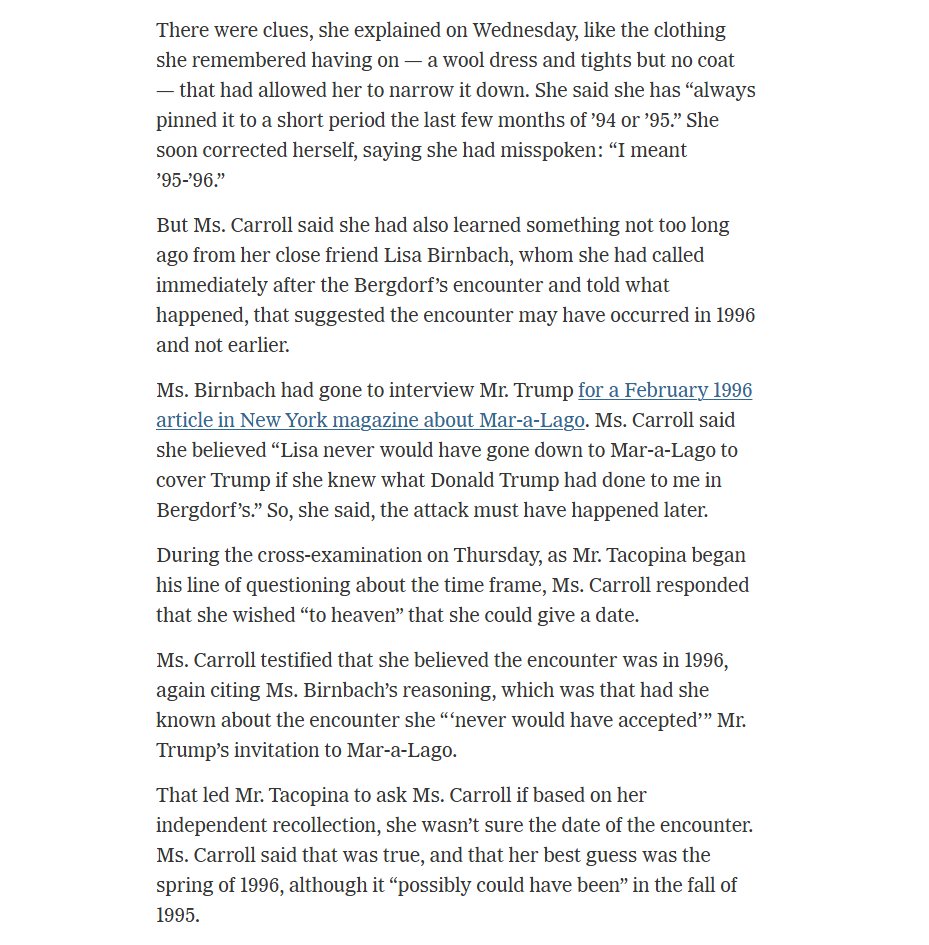
- She first pinned it to the last few months of 1994 or 1995 (based on the wool dress and tights, no coat).
Then she corrected herself: “I mean ‘95–’96.”
- At some point it was brought up that Birnbach, her main witness and the person she called within minutes of the attack, traveled to Mar-a-lago Feb. 1996 and wrote a glowing review on Trump.
- Then, citing her friend Lisa Birnbach, she insisted it must have been after February 1996, because Birnbach interviewed Trump at Mar-a-Lago for a glowing New York magazine piece in February 1996.
Carroll’s logic: “Lisa never would have gone down there if she knew what Trump had done to me.”
- Then, when pressed on cross-examination to pick a date, she immediately walked it back: “I’m not sure… my best guess is spring of 1996… although it possibly could have been in the fall of 1995.”
So the attack was before February 1996, after February 1996, maybe 1994, definitely 1995-96, she wishes she could give a date but can’t, and heaven help her if she could. Got it.
The absurdity is off the charts. If this is what passes for credible evidence in America, we don’t have a justice system anymore.
The jury awarded her $5,000,000.....
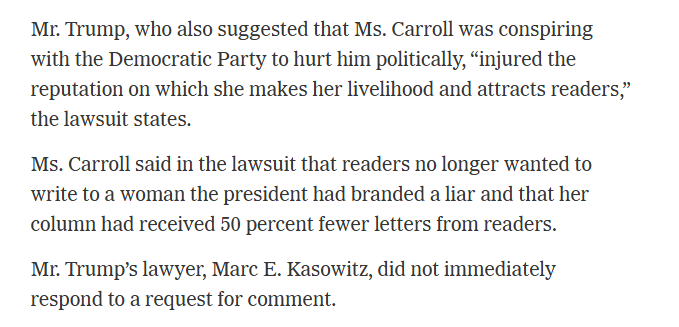
When Trump responded to the allegation and rightfully called Carroll a liar, she sued him for defamation. She claimed that readers no longer wanted to write to a woman the president had branded a liar and that her column had received 50 percent fewer letters from readers.
She had been posting anti-trump content on Facebook for 4 years leading up to this false claim... It is highly unlikely she had any Trump supporters "writing to her" to begin with.
Here is Trump... March of 1996 at the Academy Awards.
Somehow not one person on the street or in the store saw a billionaire celebrity walk in, get to the 6th floor, and attack Carroll. They didn’t see Carroll run out. Not one person saw Trump leave the store.
I mean this is absurd. I demand E. Jean Carroll get prosecuted to the fullest extent of the law.
Are we being scammed by the Somali government also???? Phone number comes back to VIRTUE HOME HEALTH CARE LLC in MN and UNITY HOME HEALTH LLC...
VIRTUE HOME HEALTH CARE LLC is registered to Yusuf A Mohamed
Yusuf Mohamed Adan is Minister of Labour and Social Affairs, Federal Government of Somalia and Member of Federal parliament.
The google street view of Yusuf's address is blurred out..
The address to VIRTUE HOME HEALTH CARE LLC shows a different healthcare company
There are 22 healthcare companies at this address on the MEDICAID AUTHORITY "Exclusion" list...
Every single person linked is Somali.. Every name I searched has multiple healthcare companies or link to each other.... All receiving 6 figures every single year.
The fraud is so much deeper than people think it is...
33. Human beings have a need (probably based in biology) for something that we will call the power process. This is closely related to the need for power (which is widely recognized) but is not quite the same thing. The power process has four elements. The three most clear-cut of these we call goal, effort and attainment of goal. (Everyone needs to have goals whose attainment requires effort, and needs to succeed in attaining at least some of his goals.) The fourth element is more difficult to define and may not be necessary for everyone. We call it autonomy and will discuss it later (paragraphs 42-44).
34. Consider the hypothetical case of a man who can have anything he wants just by wishing for it. Such a man has power, but he will develop serious psychological problems. At first he will have a lot of fun, but by and by he will become acutely bored and demoralized. Eventually he may become clinically depressed. History shows that leisured aristocracies tend to become decadent. This is not true of fighting aristocracies that have to struggle to maintain their power. But leisured, secure aristocracies that have no need to exert themselves usually become bored, hedonistic and demoralized, even though they have power. This shows that power is not enough. One must have goals toward which to exercise one’s power.
35. Everyone has goals; if nothing else, to obtain the physical necessities of life: food, water and whatever clothing and shelter are made necessary by the climate. But the leisured aristocrat obtains these things without effort. Hence his boredom and demoralization.
36. Nonattainment of important goals results in death if the goals are physical necessities, and in frustration if non-attainment of the goals is compatible with survival. Consistent failure to attain goals throughout life results in defeatism, low self-esteem or depression.
37. Thus, in order to avoid serious psychological problems, a human being needs goals whose attainment requires effort, and he must have a reasonable rate of success in attaining his goals.
THE DANGER OF LEFTISM
213. Because of their need for rebellion and for membership in a movement, leftists or persons of similar psychological type often are unattracted to a rebellious or activist movement whose goals and membership are not initially leftist. The resulting influx of leftish types can easily turn a non-leftist movement into a leftist one, so that leftist goals replace or distort the original goals of the movement.
214. To avoid this, a movement that exalts nature and opposes technology must take a resolutely anti-leftist stance and must avoid all collaboration with leftists. Leftism is in the long run inconsistent with wild nature, with human freedom and with the elimination of modern technology. Leftism is collectivist; it seeks to bind together the entire world (both nature and the human race) into a unified whole. But this implies management of nature and of human life by organized society, and it requires advanced technology. You can’t have a united world without rapid transportation and communication, you can’t make all people love one another without sophisticated psychological techniques, you can’t have a “planned society” without the necessary technological base. Above all, leftism is driven by the need for power, and the leftist seeks power on a collective basis, through identification with a mass movement or an organization. Leftism is unlikely ever to give up technology, because technology is too valuable a source of collective power.
215. The anarchist too seeks power, but he seeks it on an individual or small-group basis; he wants individuals and small groups to be able to control the circumstances of their own lives. He opposes technology because it makes small groups dependent on large organizations.
216. Some leftists may seem to oppose technology, but they will oppose it only so long as they are outsiders and the technological system is controlled by non-leftists. If leftism ever becomes dominant in society, so that the technological system becomes a tool in the hands of leftists, they will enthusiastically use it and promote its growth. In doing this they will be repeating a pattern that leftism has shown again and again in the past. When the Bolsheviks in Russia were outsiders, they vigorously opposed censorship and the secret police, they advocated self-determination for ethnic minorities, and so forth; but as soon as they came into power themselves, they imposed a tighter censorship and created a more ruthless secret police than any that had existed under the tsars, and they oppressed ethnic minorities at least as much as the tsars had done. In the United States, a couple of decades ago when leftists were a minority in our universities, leftist professors were vigorous proponents of academic freedom, but today, in those of our universities where leftists have become dominant, they have shown themselves ready to take away from everyone else’s academic freedom. (This is “political correctness.”) The same will happen with leftists and technology: They will use it to oppress everyone else if they ever get it under their own control.
217. In earlier revolutions, leftists of the most power-hungry type, repeatedly, have first cooperated with non-leftist revolutionaries, as well as with leftists of a more libertarian inclination, and later have double-crossed them to seize power for themselves. Robespierre did this in the French Revolution, the Bolsheviks did it in the Russian Revolution, the communists did it in Spain in 1938 and Castro and his followers did it in Cuba. Given the past history of leftism, it would be utterly foolish for non-leftist revolutionaries today to collaborate with leftists.
218. Various thinkers have pointed out that leftism is a kind of religion. Leftism is not a religion in the strict sense because leftist doctrine does not postulate the existence of any supernatural being. But, for the leftist, leftism plays a psychological role much like that which religion plays for some people. The leftist needs to believe in leftism; it plays a vital role in his psychological economy. His beliefs are not easily modified by logic or facts. He has a deep conviction that leftism is morally Right with a capital R, and that he has not only a right but a duty to impose leftist morality on everyone. (However, many of the people we are referring to as “leftists” do not think of themselves as leftists and would not describe their system of beliefs as leftism. We use the term “leftism” because we don’t know of any better words to designate the spectrum of related creeds that includes the feminist, gay rights, political correctness, etc., movements, and because these movements have a strong affinity with the old left. See paragraphs 227-230.)
219. Leftism is a totalitarian force. Wherever leftism is in a position of power it tends to invade every private corner and force every thought into a leftist mold. In part this is because of the quasi-religious character of leftism: everything contrary to leftist beliefs represents Sin. More importantly, leftism is a totalitarian force because of the leftists’ drive for power. The leftist seeks to satisfy his need for power through identification with a social movement and he tries to go through the power process by helping to pursue and attain the goals of the movement (see paragraph 83). But no matter how far the movement has gone in attaining its goals the leftist is never satisfied, because his activism is a surrogate activity (see paragraph 41). That is, the leftist’s real motive is not to attain the ostensible goals of leftism; in reality he is motivated by the sense of power he gets from struggling for and then reaching a social goal. Consequently the leftist is never satisfied with the goals he has already attained; his need for the power process leads him always to pursue some new goal. The leftist wants equal opportunities for minorities. When that is attained he insists on statistical equality of achievement by minorities. And as long as anyone harbors in some corner of his mind a negative attitude toward some minority, the leftist has to re-educated him. And ethnic minorities are not enough; no one can be allowed to have a negative attitude toward homosexuals, disabled people, fat people, old people, ugly people, and on and on and on. It’s not enough that the public should be informed about the hazards of smoking; a warning has to be stamped on every package of cigarettes. Then cigarette advertising has to be restricted if not banned. The activists will never be satisfied until tobacco is outlawed, and after that it will be alcohol, then junk food, etc. Activists have fought gross child abuse, which is reasonable. But now they want to stop all spanking. When they have done that they will want to ban something else they consider unwholesome, then another thing and then another. They will never be satisfied until they have complete control over all child rearing practices. And then they will move on to another cause.
220. Suppose you asked leftists to make a list of all the things that were wrong with society, and then suppose you instituted every social change that they demanded. It is safe to say that within a couple of years the majority of leftists would find something new to complain about, some new social “evil” to correct; because, once again, the leftist is motivated less by distress at society’s ills than by the need to satisfy his drive for power by imposing his solutions on society.
221. Because of the restrictions placed on their thoughts and behavior by their high level of socialization, many leftists of the over-socialized type cannot pursue power in the ways that other people do. For them the drive for power has only one morally acceptable outlet, and that is in the struggle to impose their morality on everyone.
222. Leftists, especially those of the oversocialized type, are True Believers in the sense of Eric Hoffer’s book, *The True Believer*. But not all True Believers are of the same psychological type as leftists. Presumably a true-believing nazi, for instance, is very different psychologically from a true-believing leftist. Because of their capacity for single-minded devotion to a cause, True Believers are a useful, perhaps a necessary, ingredient of any revolutionary movement. This presents a problem with which we must admit we don’t know how to deal. We aren’t sure how to harness the energies of the True Believer to a revolution against technology. At present all we can say is that no True Believer will make a safe recruit to the revolution unless his commitment is exclusively to the destruction of technology. If he is committed also to another ideal, he may want to use technology as a tool for pursuing that other ideal (see paragraphs 200, 201).
223. Some readers may say, “This stuff about leftism is a lot of crap. I know John and Jane who are leftish types and they don’t have all these totalitarian tendencies.” It’s quite true that many leftists, possibly even a numerical majority, are decent people who sincerely believe in tolerating others’ values (up to a point) and wouldn’t want to use high-handed methods to reach their social goals. Our remarks about leftism are not meant to apply to every individual leftist but to describe the general character of leftism as a movement. And the general character of a movement is not necessarily determined by the numerical proportions of the various kinds of people involved in the movement.
224. The people who rise to positions of power in leftist movements tend to be leftists of the most power-hungry type, because power-hungry people are those who strive hardest to get into positions of power. Once the power-hungry types have captured control of the movement, there are many leftists of a gentler breed who inwardly disapprove of many of the actions of the leaders, but cannot bring themselves to oppose them. They need their faith in the movement, and because they cannot give up this faith they go along with the leaders. True, some leftists do have the guts to oppose the totalitarian tendencies that emerge, but they generally lose, because the power-hungry types are better organized, are more ruthless and Machiavellian and have taken care to build themselves a strong power base.
225. These phenomena appeared clearly in Russia and other countries that were taken over by leftists. Similarly, before the breakdown of communism in the, USSR, leftish types in the West would seldom criticize that country. If prodded they would admit that the USSR did many wrong things, but then they would try to find excuses for the communists and begin talking about the faults of the West. They always opposed Western military resistance to communist aggression. Leftish types all over the world vigorously protested the U.S. military action in Vietnam, but when the USSR invaded Afghanistan they did nothing. Not that they approved of the Soviet actions; but because of their leftist faith, they just couldn’t bear to put themselves in opposition to communism. Today, in those of our universities where “political correctness” has become dominant, there are probably many leftish types who privately disapprove of the suppression of academic freedom, but they go along with it anyway.
226. Thus the fact that many individual leftists are personally mild and fairly tolerant people by no means prevents leftism as a whole form having a totalitarian tendency.
227. Our discussion of leftism has a serious weakness. It is still far from clear what we mean by the word “leftist.” There doesn’t seem to be much we can do about this. Today leftism is fragmented into a whole spectrum of activist movements. Yet not all activist movements are leftist, and some activist movements (e.g., radical environmentalism) seem to include both personalities of the leftist type and personalities of thoroughly un-leftist types who ought to know better than to collaborate with leftists. Varieties of leftists fade out gradually into varieties of non-leftists and we ourselves would often be hard-pressed to decide whether a given individual is or is not a leftist. To the extent that it is defined at all, our conception of leftism is defined by the discussion of it that we have given in this article, and we can only advise the reader to use his own judgment in deciding who is a leftist.
228. But it will be helpful to list some criteria for diagnosing leftism. These criteria cannot be applied in a cut and dried manner. Some individuals may meet some of the criteria without being leftists, some leftists may not meet any of the criteria. Again, you just have to use your judgment.
229. The leftist is oriented toward large-scale collectivism. He emphasizes the duty of the individual to serve society and the duty of society to take care of the individual. He has a negative attitude toward individualism. He often takes a moralistic tone. He tends to be for gun control, for sex education and other psychologically “enlightened” educational methods, for social planning, for affirmative action, for multiculturalism. He tends to identify with victims. He tends to be against competition and against violence, but he often finds excuses for those leftists who do commit violence. He is fond of using the common catch-phrases of the left, like “racism,” “sexism,” “homophobia,” “capitalism,” “imperialism,” “neocolonialism,” “genocide,” “social change,” “social justice,” “social responsibility.” Maybe the best diagnostic trait of the leftist is his tendency to sympathize with the following movements: feminism, gay rights, ethnic rights, disability rights, animal rights, political correctness. Anyone who strongly sympathizes with all of these movements is almost certainly a leftist.
230. The more dangerous leftists, that is, those who are most power-hungry, are often characterized by arrogance or by a dogmatic approach to ideology. However, the most dangerous leftists of all may be certain oversocialized types who avoid irritating displays of aggressiveness and refrain from advertising their leftism, but work quietly and unobtrusively to promote collectivist values, “enlightened” psychological techniques for socializing children, dependence of the individual on the system, and so forth. These crypto-leftists (as we may call them) approximate certain bourgeois types as far as practical action is concerned, but differ from them in psychology, ideology and motivation. The ordinary bourgeois tries to bring people under control of the system in order to protect his way of life, or he does so simply because his attitudes are conventional. The crypto-leftist tries to bring people under control of the system because he is a True Believer in a collectivistic ideology. The crypto-leftist is differentiated from the average leftist of the oversocialized type by the fact that his rebellious impulse is weaker and he is more securely socialized. He is differentiated from the ordinary well-socialized bourgeois by the fact that there is some deep lack within him that makes it necessary for him to devote himself to a cause and immerse himself in a collectivity. And maybe his (well-sublimated) drive for power is stronger than that of the average bourgeois.
CONTROL OF HUMAN BEHAVIOR
143. Since the beginning of civilization, organized societies have had to put pressures on human beings for the sake of the functioning of the social organism. The kinds of pressures vary greatly from one society to another. Some of the pressures are physical (poor diet, excessive labor, environmental pollution), some are psychological (noise, crowding, forcing human behavior into the mold that society requires). In the past, human nature has been approximately constant, or at any rate has varied only within certain bounds. Consequently, societies have been able to push people only up to certain limits. When the limit of human endurance has been passed, things start going wrong: rebellion, or crime, or corruption, or evasion of work, or depression and other mental problems, or an elevated death rate, or a declining birth rate or something else, so that either the society breaks down, or its functioning becomes too inefficient and it is (quickly or gradually, through conquest, attrition or evolution) replaced by some more efficient form of society.
144. Thus human nature has in the past put certain limits on the development of societies. People could be pushed only so far and no farther. But today this may be changing, because modern technology is developing ways of modifying human beings.
145. Imagine a society that subjects people to conditions that make them terribly unhappy, then gives them drugs to take away their unhappiness. Science fiction? It is already happening to some extent in our own society. It is well known that the rate of clinical depression has been greatly increasing in recent decades. We believe that this is due to disruption of the power process, as explained in paragraphs 59-76. But even if we are wrong, the increasing rate of depression is certainly the result of some conditions that exist in today’s society. Instead of removing the conditions that make people depressed, modern society gives them antidepressant drugs. In effect, antidepressants are a means of modifying an individual’s internal state in such a way as to enable him to tolerate social conditions that he would otherwise find intolerable. (Yes, we know that depression is often of purely genetic origin. We are referring here to those cases in which environment plays the predominant role.) 146. Drugs that affect the mind are only one example of the new methods of controlling human behavior that modern society is developing. Let us look at some of the other methods.
147. To start with, there are the techniques of surveillance. Hidden video cameras are now used in most stores and in many other places, computers are used to collect and process vast amounts of information about individuals. Information so obtained greatly increases the effectiveness of physical coercion (i.e., law enforcement).26 Then there are the methods of propaganda, for which the mass communication media provide effective vehicles. Efficient techniques have been developed for winning elections, selling products, influencing public opinion. The entertainment industry serves as an important psychological tool of the system, possibly even when it is dishing out large amounts of sex and violence. Entertainment provides modern man with an essential means of escape. While absorbed in television, videos, etc., he can forget stress, anxiety, frustration, dissatisfaction. Many primitive peoples, when they don’t have work to do, are quite content to sit for hours at a time doing nothing at all, because they are at peace with themselves and their world. But most modern people must be constantly occupied or entertained, otherwise they get “bored,” i.e., they get fidgety, uneasy, irritable.
148. Other techniques strike deeper than the foregoing. Education is no longer a simple affair of paddling a kid’s behind when he doesn’t know his lessons and patting him on the head when he does know them. It is becoming a scientific technique for controlling the child’s development. Sylvan Learning Centers, for example, have had great success in motivating children to study, and psychological techniques are also used with more or less success in many conventional schools. “Parenting” techniques that are taught to parents are designed to make children accept fundamental values of the system and behave in ways that the system finds desirable. “Mental health” programs, “intervention” techniques, psychotherapy and so forth are ostensibly designed to benefit individuals, but in practice they usually serve as methods for inducing individuals to think and behave as the system requires. (There is no contradiction here; an individual whose attitudes or behavior bring him into conflict with the system is up against a force that is too powerful for him to conquer or escape from, hence he is likely to suffer from stress, frustration, defeat. His path will be much easier if he thinks and behaves as the system requires. In that sense the system is acting for the benefit of the individual when it brainwashes him into conformity.) Child abuse in its gross and obvious forms is disapproved in most if not all cultures. Tormenting a child for a trivial reason or no reason at all is something that appalls almost everyone. But many psychologists interpret the concept of abuse much more broadly. Is spanking, when used as part of a rational and consistent system of discipline, a form of abuse? The question will ultimately be decided by whether or not spanking tends to produce behavior that makes a person fit in well with the existing system of society. In practice, the word “abuse” tends to be interpreted to include any method of child-rearing that produces behavior inconvenient for the system. Thus, when they go beyond the prevention of obvious, senseless cruelty, programs for preventing “child abuse” are directed toward the control of human behavior on behalf of the system.
149. Presumably, research will continue to increase the effectiveness of psychological techniques for controlling human behavior. But we think it is unlikely that psychological techniques alone will be sufficient to adjust human beings to the kind of society that technology is creating. Biological methods probably will have to be used. We have already mentioned the use of drugs in this connection. Neurology may provide other avenues for modifying the human mind. Genetic engineering of human beings is already beginning to occur in the form of “gene therapy,” and there is no reason to assume that such methods will not eventually be used to modify those aspects of the body that affect mental functioning.
150. As we mentioned in paragraph 134, industrial society seems likely to be entering a period of severe stress, due in part to problems of human behavior and in part to economic and environmental problems. And a considerable proportion of the system’s economic and environmental problems result from the way human beings behave. Alienation, low self-esteem, depression, hostility, rebellion; children who won’t study, youth gangs, illegal drug use, rape, child abuse, other crimes, unsafe sex, teen pregnancy, population growth, political corruption, race hatred, ethnic rivalry, bitter ideological conflict (e.g., pro-choice vs. pro-life), political extremism, terrorism, sabotage, anti-government groups, hate groups. All these threaten the very survival of the system. The system will therefore be forced to use every practical means of controlling human behavior.
151. The social disruption that we see today is certainly not the result of mere chance. It can only be a result of the conditions of life that the system imposes on people. (We have argued that the most important of these conditions is disruption of the power process.) If the systems succeeds in imposing sufficient control over human behavior to assure its own survival, a new watershed in human history will have been passed. Whereas formerly the limits of human endurance have imposed limits on the development of societies (as we explained in Paragraphs 143, 144), industrial-technological society will be able to pass those limits by modifying human beings, whether by psychological methods or biological methods or both. In the future, social systems will not be adjusted to suit the needs of human beings. Instead, human being will be adjusted to suit the needs of the system.
152. Generally speaking, technological control over human behavior will probably not be introduced with a totalitarian intention or even through a conscious desire to restrict human freedom.28 Each new step in the assertion of control over the human mind will be taken as a rational response to a problem that faces society, such as curing alcoholism, reducing the crime rate or inducing young people to study science and engineering. In many cases there will be a humanitarian justification. For example, when a psychiatrist prescribes an anti-depressant for a depressed patient, he is clearly doing that individual a favor. It would be inhumane to withhold the drug from someone who needs it. When Parents send their children to Sylvan Learning Centers to have them manipulated into becoming enthusiastic about their studies, they do so from concern for their children’s welfare. It may be that some of these parents wish that one didn’t have to have specialized training to get a job and that their kid didn’t have to be brainwashed into becoming a computer nerd. But what can they do? They can’t change society, and their child may be unemployable if he doesn’t have certain skills. So they send him to Sylvan.
153. Thus control over human behavior will be introduced not by a calculated decision of the authorities but through a process of social evolution (rapid evolution, however). The process will be impossible to resist, because each advance, considered by itself, will appear to be beneficial, or at least the evil involved in making the advance will appear to be beneficial, or at least the evil involved in making the advance will seem to be less than that which would result from not making it (see paragraph 127). Propaganda for example is used for many good purposes, such as discouraging child abuse or race hatred. [14] Sex education is obviously useful, yet the effect of sex education (to the extent that it is successful) is to take the shaping of sexual attitudes away from the family and put it into the hands of the state as represented by the public school system.
154. Suppose a biological trait is discovered that increases the likelihood that a child will grow up to be a criminal, and suppose some sort of gene therapy can remove this trait.29 Of course most parents whose children possess the trait will have them undergo the therapy. It would be inhumane to do otherwise, since the child would probably have a miserable life if he grew up to be a criminal. But many or most primitive societies have a low crime rate in comparison with that of our society, even though they have neither high-tech methods of child-rearing nor harsh systems of punishment. Since there is no reason to suppose that more modern men than primitive men have innate predatory tendencies, the high crime rate of our society must be due to the pressures that modern conditions put on people, to which many cannot or will not adjust. Thus a treatment designed to remove potential criminal tendencies is at least in part a way of re-engineering people so that they suit the requirements of the system.
155. Our society tends to regard as a “sickness” any mode of thought or behavior that is inconvenient for the system, and this is plausible because when an individual doesn’t fit into the system it causes pain to the individual as well as problems for the system. Thus the manipulation of an individual to adjust him to the system is seen as a “cure” for a “sickness” and therefore as good.
156. In paragraph 127 we pointed out that if the use of a new item of technology is initially optional, it does not necessarily remain optional, because the new technology tends to change society in such a way that it becomes difficult or impossible for an individual to function without using that technology. This applies also to the technology of human behavior. In a world in which most children are put through a program to make them enthusiastic about studying, a parent will almost be forced to put his kid through such a program, because if he does not, then the kid will grow up to be, comparatively speaking, an ignoramus and therefore unemployable. Or suppose a biological treatment is discovered that, without undesirable side-effects, will greatly reduce the psychological stress from which so many people suffer in our society. If large numbers of people choose to undergo the treatment, then the general level of stress in society will be reduced, so that it will be possible for the system to increase the stress-producing pressures. This will lead more people to undergo the treatment; and so forth, so that eventually the pressures may become so heavy that few people will be able to survive without undergoing the stress-reducing treatment. In fact, something like this seems to have happened already with one of our society’s most important psychological tools for enabling people to reduce (or at least temporarily escape from) stress, namely, mass entertainment (see paragraph 147). Our use of mass entertainment is “optional”: No law requires us to watch television, listen to the radio, read magazines. Yet mass entertainment is a means of escape and stress-reduction on which most of us have become dependent. Everyone complains about the trashiness of television, but almost everyone watches it. A few have kicked the TV habit, but it would be a rare person who could get along today without using any form of mass entertainment. (Yet until quite recently in human history most people got along very nicely with no other entertainment than that which each local community created for itself.) Without the entertainment industry the system probably would not have been able to get away with putting as much stress-producing pressure on us as it does.
157. Assuming that industrial society survives, it is likely that technology will eventually acquire something approaching complete control over human behavior. It has been established beyond any rational doubt that human thought and behavior have a largely biological basis. As experimenters have demonstrated, feelings such as hunger, pleasure, anger and fear can be turned on and off by electrical stimulation of appropriate parts of the brain. Memories can be destroyed by damaging parts of the brain or they can be brought to the surface by electrical stimulation. Hallucinations can be induced or moods changed by drugs. There may or may not be an immaterial human soul, but if there is one it clearly is less powerful that the biological mechanisms of human behavior. For if that were not the case then researchers would not be able so easily to manipulate human feelings and behavior with drugs and electrical currents.
158. It presumably would be impractical for all people to have electrodes inserted in their heads so that they could be controlled by the authorities. But the fact that human thoughts and feelings are so open to biological intervention shows that the problem of controlling human behavior is mainly a technical problem; a problem of neurons, hormones and complex molecules; the kind of problem that is accessible to scientific attack. Given the outstanding record of our society in solving technical problems, it is overwhelmingly probable that great advances will be made in the control of human behavior.
159. Will public resistance prevent the introduction of technological control of human behavior? It certainly would if an attempt were made to introduce such control all at once. But since technological control will be introduced through a long sequence of small advances, there will be no rational and effective public resistance. (See paragraphs 127, 132, 153.)
160. To those who think that all this sounds like science fiction, we point out that yesterday’s science fiction is today’s fact. The Industrial Revolution has radically altered man’s environment and way of life, and it is only to be expected that as technology is increasingly applied to the human body and mind, man himself will be altered as radically as his environment and way of life have been.
The recent Gaza ceasefire and hostage release agreement was achieved through an unconventional, executive-led diplomatic approach.
The negotiation utilized a specific "playbook" that focused on pragmatic realism and leveraged personal relationships to overcome deep-seated mistrust.
Here are the main points regarding the negotiation process and the resulting agreements:
I. The Philosophy of Pragmatic Realism and Unconventional Diplomacy
A central theme is the deliberate rejection of traditional diplomatic protocol in favor of an executive-led, relationship-based model. This approach, honed during President Trump's first term, represented a challenge to orthodox foreign policy theories.
1. Interests Over Values
The core philosophy is termed Pragmatic Realism. This approach consciously prioritized shared national interests, such as regional stability and economic prosperity, over publicly admonishing or "lecturing the world" on values. Differences on values were intended to be discussed privately.
2. The Simplicity of Issues, The Complexity of People
A counter-intuitive maxim guiding the negotiators was that "Issues are Simple, People are Complicated". They argued that the foundational needs of all people are universal and straightforward: security, freedom, economic opportunity, and a better future for their children. The real complexity stems from decades of historical conflict, miscommunication, and profound mistrust among the actors. Steve Witkoff described their role as being the "secretary of miscommunication," focused on correcting these layers of distrust.
3. "Conflict of Interest is Experience"
The negotiators reframed criticism regarding their deep, pre-existing business relationships in the region. They viewed these connections as their primary strategic asset, providing trusted relationships and experience that traditional diplomacy lacked. This direct access allowed them to bypass bureaucratic intermediaries and speak directly with ultimate decision-makers, such as the Emir of Qatar, PM Netanyahu ("BB"), and MBS, which was deemed "very very critical" to success.
4. Delegated Authority and Risk-Taking
A crucial theme was the "freewheeling" delegation of authority granted by President Trump. This empowerment allowed Kushner and Witkoff to make rapid decisions, dynamically adapt strategy, and take calculated risks without needing constant clearance from Washington. This authority was essential for the eventual unprecedented decision to meet directly with Hamas leaders, a move previously "shut down and ridiculed" by career diplomats.
II. The Negotiation Trajectory: Crises and Catalysts
They emphasized that the successful deal was achieved not despite crises, but by leveraging crises as opportunities for strategic pivots.
1. The Catastrophe of the Doha Bombing
The initial promising negotiations were abruptly halted when an Israeli missile strike targeted the Hamas negotiator compound in Doha, killing the son of the lead negotiator. The American negotiators felt personally "betrayed" by the Israeli action, which instantly demolished the foundation of trust they had built. The fallout was catastrophic: the indispensable Qatari intermediaries lost confidence, and Hamas representatives went underground, severing the communication channel.
2. The Strategic Pivot and Arab Alignment
In the wake of this collapse, Kushner and Witkoff saw an opportunity born from chaos. They merged the separate temporary ceasefire and permanent end-of-war proposals into a single, comprehensive document. Their new strategy was to first forge a unified Arab front in support of the plan and then use that collective diplomatic weight to bring Israel into alignment.
3. The Lynchpin: Netanyahu's Apology
The process was unlocked by an apology from Israeli Prime Minister Benjamin Netanyahu to the Qataris. President Trump was instrumental in persuading Netanyahu that this gesture was necessary "to make peace". This action restored trust and formally established an essential trilateral mechanism between Israel, Qatar, and the United States.
4. The 20-Point Plan and Isolation of Hamas
Leveraging the new regional dynamic, President Trump publicly announced a comprehensive 20-Point Plan, which Israel formally endorsed. This maneuver inverted the global political landscape: whereas Israel had been globally isolated, the unified Arab world and Israel's alignment behind the U.S. plan meant that Hamas became globally isolated. This effectively reframed the hostages, previously seen as Hamas's primary asset, into a liability, compelling Hamas to accept the framework for negotiation. The negotiators trusted their private intelligence from regional leaders over public statements or U.S. intelligence predicting rejection.
5. The Sharm el-Sheikh Summit and Human Connection
The final negotiations were defined by the unconventional decision to meet directly with Hamas. A key moment of de-escalation occurred when Steve Witkoff offered personal condolences to the lead Hamas negotiator (who lost his son in Doha), sharing his own grief over the loss of his son. This exchange of shared human vulnerability fundamentally altered the atmosphere, proving that a genuine human connection could cut through deep ideology and mistrust. The agreement ultimately led to representatives from Israel, Qatar, Turkey, and Egypt hugging each other in the room
Democrats designed the Obamacare subsidies to expire at the end of 2025 when they renewed them with the Inflation Reduction Act... This was not an accident.
Wendell Primus, Nancy Pelosi's longtime health aide, admitted the strategy on the record: "We wanted it to be part of the tax reform debate."
Read that again. They deliberately timed healthcare subsidies, coverage for 20 million Americans, to expire alongside the 2017 tax provisions. Not to help people. To create leverage.
The subsidies passed in 2021. Temporary. They extended them in 2022. Still temporary. Democrats had two opportunities to make them permanent. They chose not to. They chose a 2025 expiration. They chose to weaponize healthcare.
Now follow the money.
Who benefits when Democrats demand renewal? The patients facing a "healthcare cliff"?
No. The healthcare industry.
Doctors, hospitals, insurance companies, and disease advocacy groups formed a coalition to lobby Congress for extension. The NYT article states it plainly: "To health professionals and insurance companies, the expiration of the subsidies will mean less revenue."
Less revenue. That's the stakes for them. Not patient care. Revenue.
The subsidies cost $335 billion over a decade. Democrats funneled that money to insurance companies, the same companies the Trump campaign said "benefit more than American patients" from this poorly designed program. Then Democrats set a timer on it. Then they positioned themselves as the saviors when the timer runs out.
The timeline proves intent:
2021: Pass temporary subsidies
2022: Extend temporary subsidies (could have made permanent, they didn't)
2025: Subsidies expire, conveniently aligned with tax negotiations they thought they would have.
2025: Democrats demand Republicans cave on taxes or "millions lose healthcare"
This was the plan. Primus confirmed it.
The question Democrats won't answer...
If these subsidies are a "moral imperative", if losing them creates a crisis so severe that millions of people will lose insurance, why make them temporary at all?
If this is about protecting vulnerable Americans, why set an expiration date?
If this is about healthcare, why time it to tax reform?
The answers are in the record. In their own words. In the lobbying coalitions. In the $335 billion flowing to insurance companies while Democrats position themselves as champions of the uninsured.
They built the cliff. They chose the date. They partnered with the industry that profits.
And now they'll campaign on saving you from the disaster they designed.
"Democrats deliberately timed the funding to expire at the end of 2025, to coincide with the expiration of the 2017 tax provisions. Renewing the tax bill will be a major Republican goal, increasing the chances of a deal involving both parties’ priorities. “We wanted it to be part of the tax reform debate,” said Wendell Primus, a longtime health aide to Nancy Pelosi who is now a visiting fellow at the Brookings Institution."
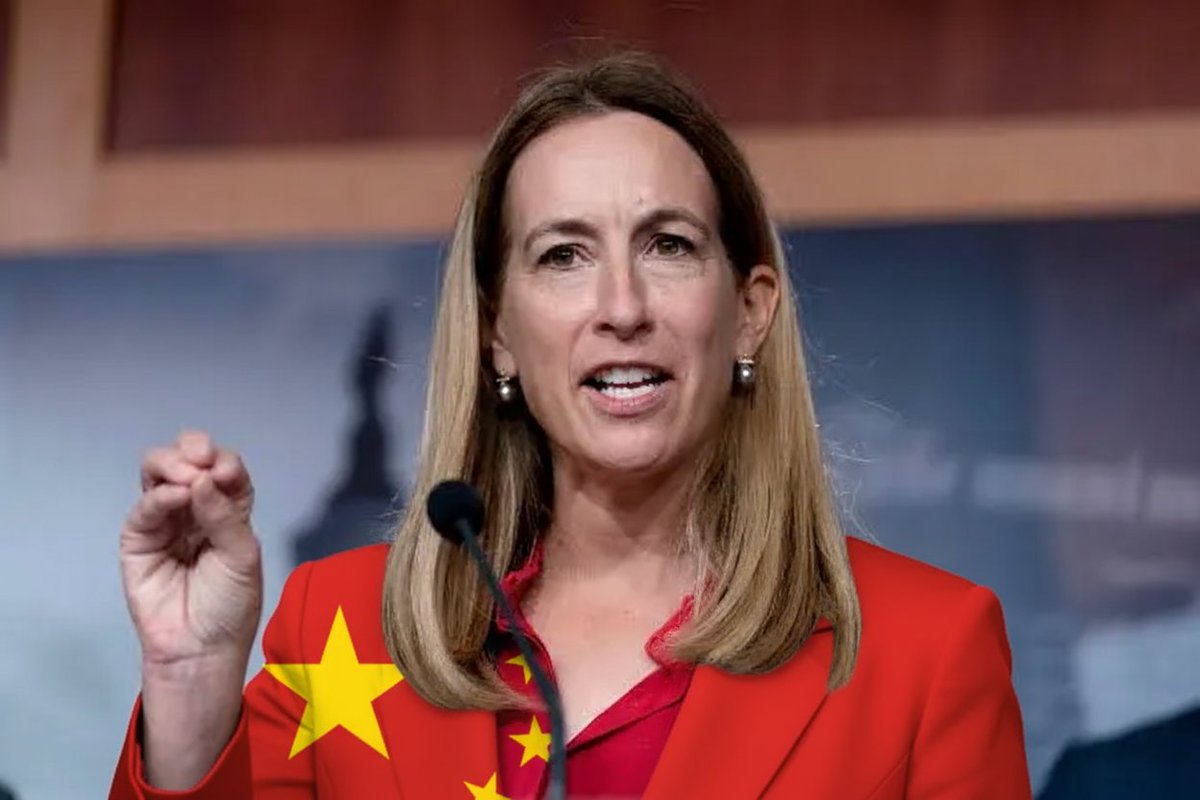
The ultimate sellout: While Rep. Mikie Sherrill talks tough on China, her family's $10M+ fortune depends on Beijing's favor. Whose side is she on?
Rep. Sherrill Prosecuted UBS for Financial Crimes. Now, Her Family Profits From Its CCP-Backed Monopoly
On Capitol Hill, Representative Mikie Sherrill has built a formidable reputation as a national security hawk, using her powerful committee assignments to warn of the existential threat posed by the Chinese Communist Party. The former Navy pilot and federal prosecutor is a leading voice on confronting Beijing’s economic and military ambitions.
But an investigation into her finances reveals a staggering conflict that is deeply compromised by a stunning reversal of roles. Rep. Sherrill’s family fortune, which has soared to over $10 million since she took office, is inextricably linked to the success of UBS… the very bank she once prosecuted for financial crimes. Today, that bank’s profitability hinges on a privileged, monopolistic position granted by the same Chinese government Sherrill is tasked with overseeing.
The core of the scandal lies with her husband, Jason Hedberg, a high-level executive at UBS. A significant portion of the family’s wealth, including a seven-figure unvested stock award, is tied directly to the performance of his division. That performance is supercharged by UBS’s unique status in China. The bank holds an exclusive, state-sanctioned license from Beijing to trade complex derivatives… a golden ticket unavailable to its global competitors. This exclusive channel depends entirely on the CCP’s continued goodwill.
What elevates this conflict into a stunning portrait of hypocrisy is Rep. Sherrill’s own professional history. Before entering politics, Sherrill served as an Assistant U.S. Attorney. In that role, she was part of the team that prosecuted UBS for a massive criminal tax evasion scheme, resulting in a $780 million settlement to avoid indictment. The fact that her family’s fortune is now derived from the very bank she once pursued on behalf of the U.S. government represents a profound ethical revolving door.
The timeline is damning. As UBS expanded its footprint and secured 100% ownership of its China venture… a move requiring explicit CCP approval… the Sherrill-Hedberg family’s net worth exploded from an estimated $4.3 million in 2019 to over $11.3 million by 2024. This financial dependency is woven into the fabric of their lives; the family’s multi-million dollar New Jersey home is financed with a mortgage from UBS.
This structural conflict appears to be reflected in a voting record that has been notably friendly to the financial services industry… a stark departure from her past as a prosecutor of bank crimes.
As a member of the House Armed Services and the elite China Select Committees, Rep. Sherrill sits in classified briefings where policies that could devastate UBS’s China operations… sanctions, capital controls, and military posturing… are decided. Any authentically “tough” policy on China directly threatens the business model that underwrites her family’s wealth.
This arrangement creates a textbook case of elite capture. The Chinese government doesn’t need to send a lobbyist to her office… it has created a system where her family’s prosperity is directly aligned with the CCP’s interest in maintaining the financial status quo. Any policy that truly “gets tough” on China risks disrupting the very business model that underwrites her family’s finances.
This pattern of conflict is matched by a pattern of obfuscation. Rep. Sherrill has been fined for violating the STOCK Act for failing to promptly disclose her husband’s UBS stock sales. More pointedly, her campaign’s recent insistence that she “does not own or trade individual stocks” is directly contradicted by her own 2017 candidate disclosure, which detailed extensive joint holdings in dozens of individual companies, including major defense contractors like Raytheon that fall under her committee’s jurisdiction.
The web is complete… a history of prosecuting a bank, a subsequent family fortune built by that same bank, a financial dependency on the goodwill of the Chinese Communist Party, and a record of misleading public statements about her finances.
This arrangement may not be illegal. It is, however, an unforgivable conflict. It is a betrayal of her past as a prosecutor and her duty as a public servant. For voters, the question is no longer about policy. It is about allegiance. Will Mikie Sherrill work for New Jersey, or will she work for the bank that depends on Beijing?
TLDR:
Rep. Mikie Sherrill, a "China hawk" on the Armed Services Committee, has a staggering conflict of interest. Her husband, Jason Hedberg, is UBS's Head of Americas Equity Derivatives Flow. His multi-million dollar compensation is directly fueled by UBS holding an exclusive, CCP-granted monopoly as the ONLY foreign bank licensed to trade certain derivatives in China.
This means while Sherrill makes policies that could punish Beijing, her family's $10M+ fortune is structurally dependent on the Chinese government's continued favor to her husband's bank... the same bank she once prosecuted for financial crimes.
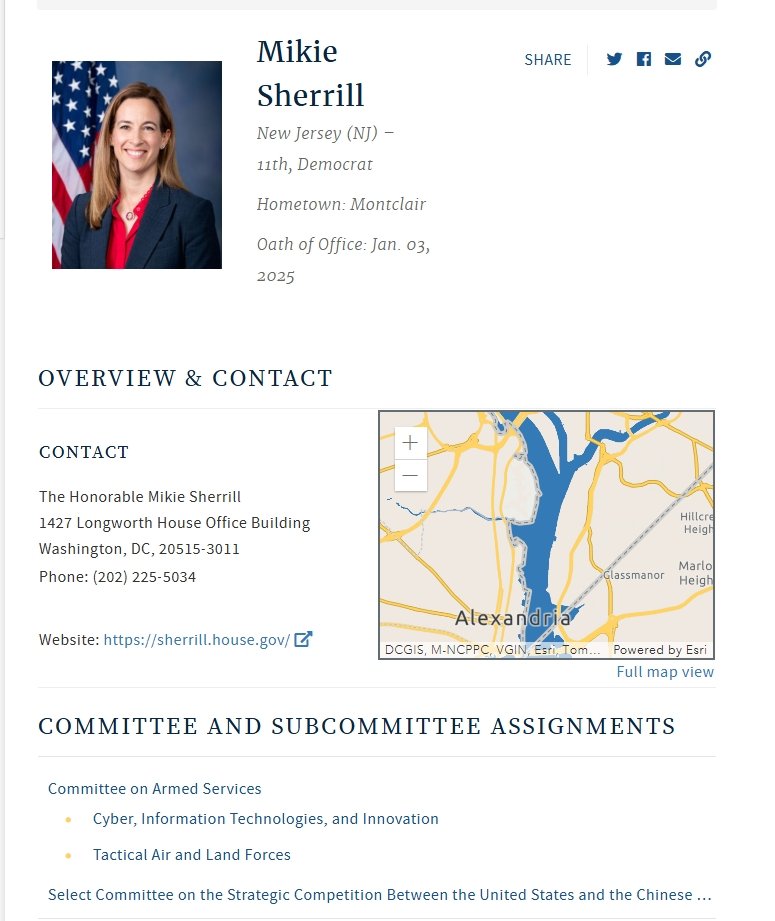
Mikie Sherrill
New Jersey (NJ) – 11th, Democrat
Oath of Office: Jan. 03, 2025
Committee and Subcommittee Assignments
Select Committee on the Strategic Competition Between the United States and the Chinese Communist Party
Committee on Armed Services
- Cyber, Information Technologies, and Innovation
- Tactical Air and Land Forces