🚨 Stanford just quietly dropped a bombshell on the AI industry.
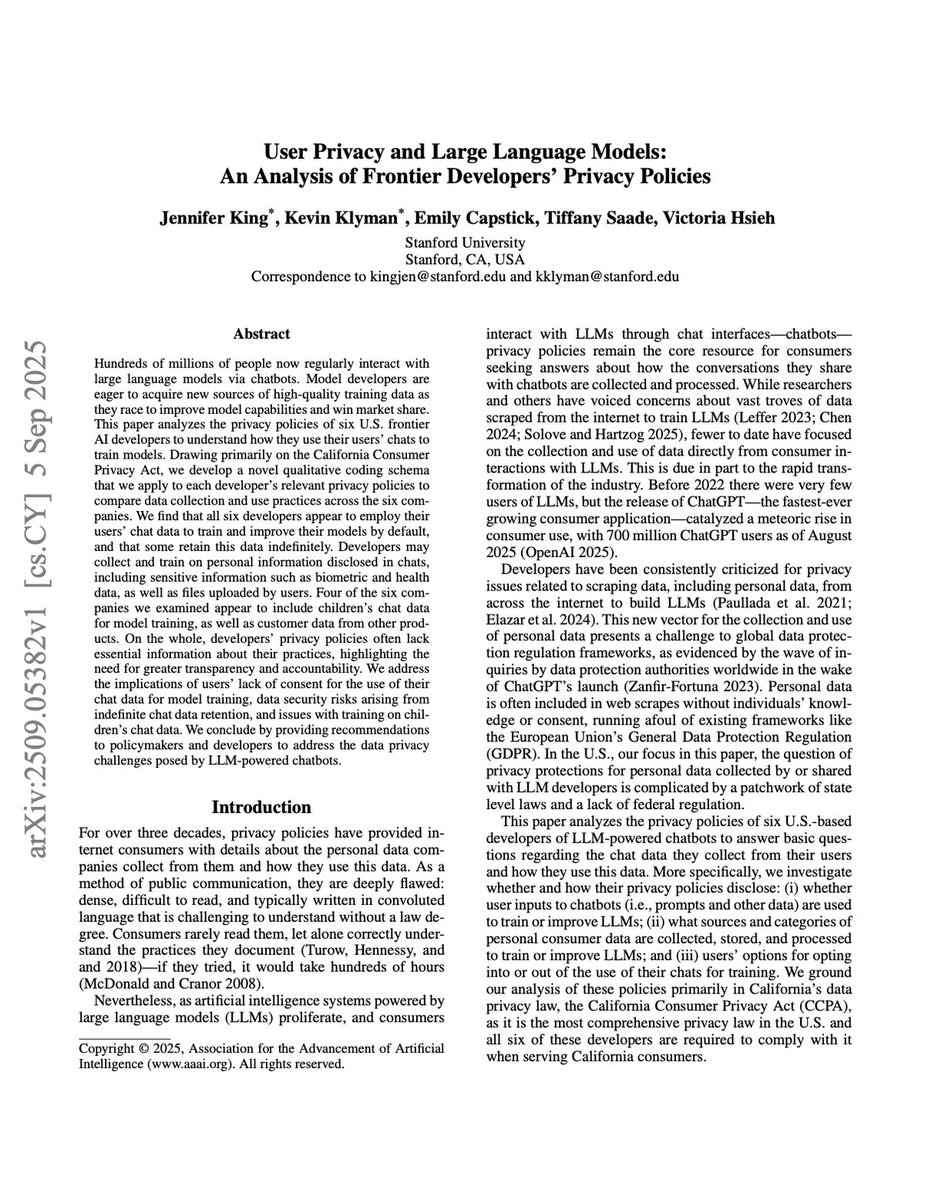
They combed through 28 privacy policy documents across OpenAI, Google, Meta, Anthropic, Microsoft, and Amazon. What they found should change how you use these tools forever.
Here's what they found:👇
They combed through 28 privacy policy documents across OpenAI, Google, Meta, Anthropic, Microsoft, and Amazon. What they found should change how you use these tools forever.
Here's what they found:👇
1/ Your conversations are training data by default
Every prompt, file, and personal detail you share feeds model training the moment you hit send. No extra confirmation. No clear warning.
Every prompt, file, and personal detail you share feeds model training the moment you hit send. No extra confirmation. No clear warning.
2/ Some companies keep your data forever
Amazon, Meta, and OpenAI have no confirmed deletion timeline for certain chat data. Your most private conversations could sit on their servers indefinitely.
Amazon, Meta, and OpenAI have no confirmed deletion timeline for certain chat data. Your most private conversations could sit on their servers indefinitely.
🎁 Bonus Alert!
Stay ahead in the AI game with my newsletter, packed with the best:
• AI news and updates
• Tips, tutorials, and resources
Subscribe now and unlock:
‣ 50+ AI courses
‣ 1200+ powerful prompts
‣ ChatGPT cheatsheets & more
100% FREE! 👉 brainbuzz.tech/subscribe
Stay ahead in the AI game with my newsletter, packed with the best:
• AI news and updates
• Tips, tutorials, and resources
Subscribe now and unlock:
‣ 50+ AI courses
‣ 1200+ powerful prompts
‣ ChatGPT cheatsheets & more
100% FREE! 👉 brainbuzz.tech/subscribe
3/ Children get almost no extra protection
4 of 6 companies allow users aged 13-18. Most apply zero special handling to minors' data. Kids who can't legally consent are likely training the models they're talking to.
4 of 6 companies allow users aged 13-18. Most apply zero special handling to minors' data. Kids who can't legally consent are likely training the models they're talking to.
4/ Enterprise users are protected. You aren't.
Companies paying thousands are opted OUT of training automatically. You, paying $20/month, are opted IN by default. Two-tier privacy. You're on the wrong side.
Companies paying thousands are opted OUT of training automatically. You, paying $20/month, are opted IN by default. Two-tier privacy. You're on the wrong side.
5/ The opt-out is designed to make you feel guilty
OpenAI's toggle reads: "Improve the model for everyone." Stanford researchers flagged this as a textbook dark pattern.
OpenAI's toggle reads: "Improve the model for everyone." Stanford researchers flagged this as a textbook dark pattern.
6/ Real people have been identified from chat data
Meta's contractors routinely see identifiable personal information. Journalists positively identified a real person from shared transcripts.
Meta's contractors routinely see identifiable personal information. Journalists positively identified a real person from shared transcripts.
7/ The policies are intentionally hard to find
Stanford had to dig through 6 separate documents for OpenAI alone. Researchers said piecing it together was challenging for them. For regular users? "Practically impossible."
Stanford had to dig through 6 separate documents for OpenAI alone. Researchers said piecing it together was challenging for them. For regular users? "Practically impossible."
8/ Only one company tries to anonymize your data
Microsoft explicitly stated they attempt to remove names, phone numbers, and addresses before training. The other five? Vague or completely silent.
Microsoft explicitly stated they attempt to remove names, phone numbers, and addresses before training. The other five? Vague or completely silent.
I hope you've found this thread helpful.
Follow me @saidul_dev for more.
Like/Repost the quote below if you can:
Follow me @saidul_dev for more.
Like/Repost the quote below if you can:
https://twitter.com/1662704373049483264/status/2028393632848613549
• • •
Missing some Tweet in this thread? You can try to
force a refresh